Passage Study
The Lord’s Table and the Many Members of His One Body
1 Corinthians 11:1–12:31
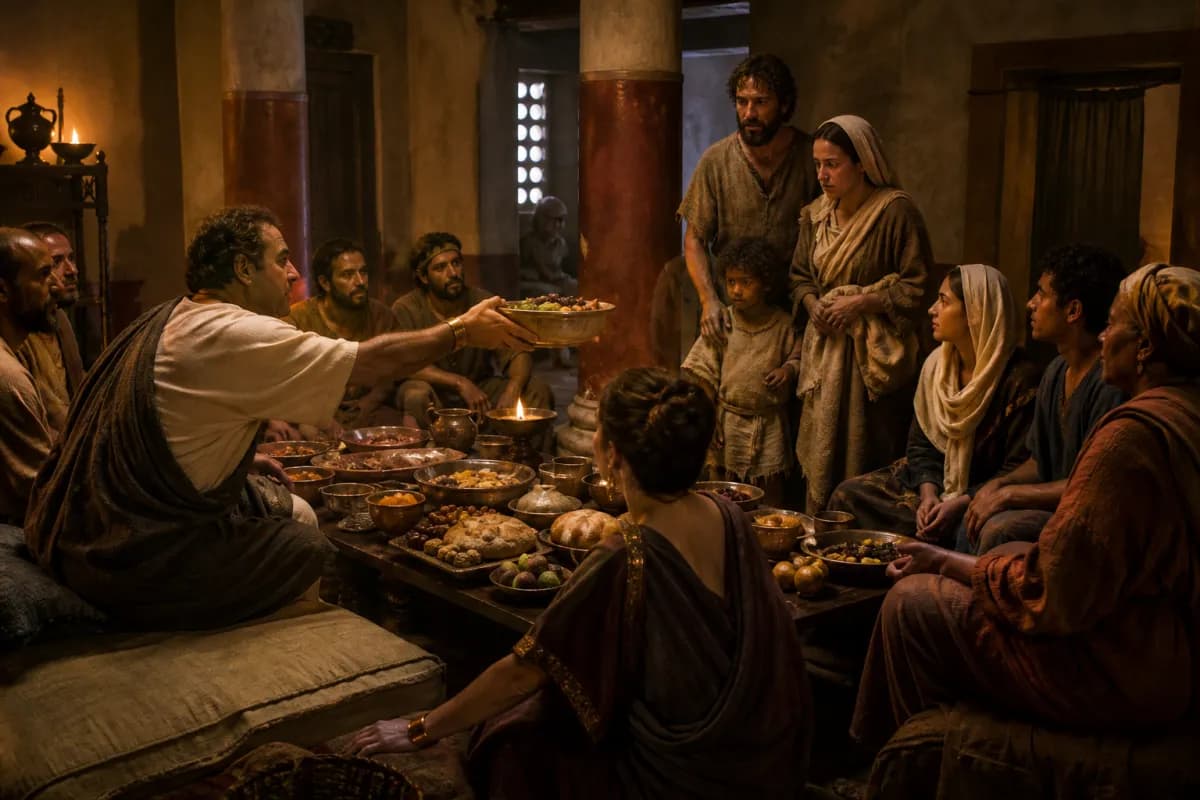
In 1 Corinthians 11–12, Paul corrects disorder in gathered worship. The church’s treatment of women and men, its humiliating Lord’s Supper, and its competition over gifts all contradict the Lord they confess. Christ gave His body and blood for them, and by one Spirit He has formed their diverse members into one body for mutual care.
- In this study
- 65 verses · 5 movements
1 Corinthians 11
11:1Be imitators of me, even as I also am of Christ.
11:2Now I praise you, brothers, that you remember me in all things, and hold firm the traditions, even as I delivered them to you.
11:3But I would have you know that the head of every man is Christ, and the head of the woman is man, and the head of Christ is God.
11:4Every man praying or prophesying, having his head covered, dishonors his head.
11:5But every woman praying or prophesying with her head uncovered dishonors her head. For it is one and the same thing as if she were shaved.
11:6For if a woman is not covered, let her hair also be cut off. But if it is shameful for a woman to have her hair cut off or be shaved, let her be covered.
11:7For a man indeed ought not to have his head covered, because he is the image and glory of God, but the woman is the glory of the man.
11:8For man is not from woman, but woman from man;
11:9for man wasn’t created for the woman, but woman for the man.
11:10For this cause the woman ought to have authority over her own head, because of the angels.
11:11Nevertheless, neither is the woman independent of the man, nor the man independent of the woman, in the Lord.
11:12For as woman came from man, so a man also comes through a woman; but all things are from God.
11:13Judge for yourselves. Is it appropriate that a woman pray to God unveiled?
11:14Doesn’t even nature itself teach you that if a man has long hair, it is a dishonor to him?
11:15But if a woman has long hair, it is a glory to her, for her hair is given to her for a covering.
11:16But if any man seems to be contentious, we have no such custom, neither do God’s assemblies.
11:17But in giving you this command I don’t praise you, because you come together not for the better but for the worse.
11:18For first of all, when you come together in the assembly, I hear that divisions exist among you, and I partly believe it.
11:19For there also must be factions among you, that those who are approved may be revealed among you.
11:20When therefore you assemble yourselves together, it is not the Lord’s supper that you eat.
11:21For in your eating each one takes his own supper first. One is hungry, and another is drunken.
11:22What, don’t you have houses to eat and to drink in? Or do you despise God’s assembly and put them to shame who don’t have enough? What shall I tell you? Shall I praise you? In this I don’t praise you.
11:23For I received from the Lord that which also I delivered to you, that the Lord Jesus on the night in which he was betrayed took bread.
11:24When he had given thanks, he broke it and said, “Take, eat. This is my body, which is broken for you. Do this in memory of me.”
11:25In the same way he also took the cup after supper, saying, “This cup is the new covenant in my blood. Do this, as often as you drink, in memory of me.”
11:26For as often as you eat this bread and drink this cup, you proclaim the Lord’s death until he comes.
11:27Therefore whoever eats this bread or drinks the Lord’s cup in a way unworthy of the Lord will be guilty of the body and the blood of the Lord.
11:28But let a man examine himself, and so let him eat of the bread and drink of the cup.
11:29For he who eats and drinks in an unworthy way eats and drinks judgment to himself if he doesn’t discern the Lord’s body.
11:30For this cause many among you are weak and sickly, and not a few sleep.
11:31For if we discerned ourselves, we wouldn’t be judged.
11:32But when we are judged, we are disciplined by the Lord, that we may not be condemned with the world.
11:33Therefore, my brothers, when you come together to eat, wait for one another.
11:34But if anyone is hungry, let him eat at home, lest your coming together be for judgment. The rest I will set in order whenever I come.
1 Corinthians 12
12:1Now concerning spiritual things, brothers, I don’t want you to be ignorant.
12:2You know that when you were heathen, you were led away to those mute idols, however you might be led.
12:3Therefore I make known to you that no man speaking by God’s Spirit says, “Jesus is accursed.” No one can say, “Jesus is Lord,” but by the Holy Spirit.
12:4Now there are various kinds of gifts, but the same Spirit.
12:5There are various kinds of service, and the same Lord.
12:6There are various kinds of workings, but the same God who works all things in all.
12:7But to each one is given the manifestation of the Spirit for the profit of all.
12:8For to one is given through the Spirit the word of wisdom, and to another the word of knowledge according to the same Spirit,
12:9to another faith by the same Spirit, and to another gifts of healings by the same Spirit,
12:10and to another workings of miracles, and to another prophecy, and to another discerning of spirits, to another different kinds of languages, and to another the interpretation of languages.
12:11But the one and the same Spirit produces all of these, distributing to each one separately as he desires.
12:12For as the body is one and has many members, and all the members of the body, being many, are one body; so also is Christ.
12:13For in one Spirit we were all baptized into one body, whether Jews or Greeks, whether bond or free; and were all given to drink into one Spirit.
12:14For the body is not one member, but many.
12:15If the foot would say, “Because I’m not the hand, I’m not part of the body,” it is not therefore not part of the body.
12:16If the ear would say, “Because I’m not the eye, I’m not part of the body,” it’s not therefore not part of the body.
12:17If the whole body were an eye, where would the hearing be? If the whole were hearing, where would the smelling be?
12:18But now God has set the members, each one of them, in the body, just as he desired.
12:19If they were all one member, where would the body be?
12:20But now they are many members, but one body.
12:21The eye can’t tell the hand, “I have no need for you,” or again the head to the feet, “I have no need for you.”
12:22No, much rather, those members of the body which seem to be weaker are necessary.
12:23Those parts of the body which we think to be less honorable, on those we bestow more abundant honor; and our unpresentable parts have more abundant modesty,
12:24while our presentable parts have no such need. But God composed the body together, giving more abundant honor to the inferior part,
12:25that there should be no division in the body, but that the members should have the same care for one another.
12:26When one member suffers, all the members suffer with it. When one member is honored, all the members rejoice with it.
12:27Now you are the body of Christ, and members individually.
12:28God has set some in the assembly: first apostles, second prophets, third teachers, then miracle workers, then gifts of healings, helps, governments, and various kinds of languages.
12:29Are all apostles? Are all prophets? Are all teachers? Are all miracle workers?
12:30Do all have gifts of healings? Do all speak with various languages? Do all interpret?
12:31But earnestly desire the best gifts. Moreover, I show a most excellent way to you.
CONTEXTUAL OVERVIEW
Paul begins with conduct when the church prays and prophesies, then reaches the sharper crisis: their meal is no longer truly the Lord’s Supper because the wealthy eat and drink while others go hungry. The gathered church is announcing Jesus’ death with bread and cup while denying the social reality created by that death. Their divisions at the table make their worship a contradiction.
Chapter 12 answers a related competition over spiritual gifts. The Spirit’s gifts are not evidence that one member has outgrown the others. The same Spirit distributes varieties of gifts, and the body needs every member. Paul’s image refuses both superiority—“I have no need of you”—and despair—“I do not belong to the body.”
HISTORICAL AND LITERARY CONTEXT
The opening instructions about head coverings are among the more debated parts of the letter. Paul’s central concerns are clear in the text: prayer and prophecy in the gathered community must honor God, neither sex is independent of the other in the Lord, and creation and propriety are brought into his reasoning. Details of the cultural practice are discussed, so the passage should not be used to pretend more certainty than it gives.
The Lord’s Supper likely took place in a larger meal setting, where differences of wealth and arrival time could become visible. Paul does not rebuke shared food itself; he condemns some eating ahead of others and humiliating those who have nothing. His remedy includes waiting for one another and discernment of the body, making the meal a public proclamation of Christ’s death rather than a private act of consumption.
SECTION-BY-SECTION ANALYSIS
- This is not really to eat the Lord’s supper · 1 Corinthians 11:20A meal that humiliates fellow believers denies the meaning of the Lord’s self-giving table.
- You proclaim the Lord’s death until he comes · 1 Corinthians 11:26Bread and cup locate the church between Christ’s saving death and His promised return.
- You are the body of Christ · 1 Corinthians 12:27Different gifts are not ranks; they are necessary services within the one body Christ has formed.
CHRIST IN THIS PASSAGE
Jesus’ words over the meal are the passage’s center: His body is given, His blood establishes the new covenant, His death is proclaimed, and He will come. The Supper does not repeat His sacrifice, but it publicly remembers the once-given Lord and calls the congregation to live as people reconciled through the same blood.
The church is Christ’s body because the Spirit joins diverse people to Him. That union makes contempt for a poorer member, an overlooked gift, or a suffering believer a Christological matter, not merely a social failure. The saving mission of Jesus creates a covenant people who wait for one another because His self-giving love has made them belong to one another.
REFLECTION
Before receiving the Lord’s Supper, examine not only private sins but the relationships your habits may be damaging. Is someone in Christ’s body routinely unheard, excluded, or made to feel like a burden because of wealth, education, race, age, disability, or gifting? Confession should lead to concrete repair, not a momentary inward feeling.
Consider the gift or role you either envy or dismiss. Paul does not ask the ear to become an eye; he asks every member to receive God’s arrangement and serve the body. Thank Jesus for one gift you see in another believer, and use one ability of your own this week to strengthen a specific person rather than draw attention to yourself.
Original Greek Word Study
1 Corinthians 12:12
σῶμα
soma · G4983
Usually translated: body
Soma means body. The church is Christ’s one body, so worship and spiritual gifts are meant to honor the mutual belonging and necessary contribution of every member.
Follow the Scripture trail
The Lord’s Table and the Many Members of His One Body in the larger story
The connection: At the table the church announces the death of the Lord who gave His body and established the new covenant in His blood. By His Spirit, that same Lord makes diverse believers His body, so worship must embody the reconciliation His saving death accomplished.
Respond to the passage
Ask Christ to show you one person in your congregation whose good you have not considered when you worship, plan, eat, or serve. Take a practical step toward them, and receive the Lord’s Supper with repentance, gratitude, and confidence in His promised return.
- Why does Paul say the Corinthians’ gathering can fail to be the Lord’s Supper?
- How does the phrase “until he comes” shape the meal’s meaning?
- What do the body’s weaker members teach about honor in the church?
Prayer
Lord Jesus, thank You for giving Your body and blood for us. Forgive the ways I have treated Your people as less necessary, and make me a faithful member of the body You have redeemed. Amen.