Passage Study
Love Is the Necessary Way for a Gifted Church
1 Corinthians 13:1–14:40
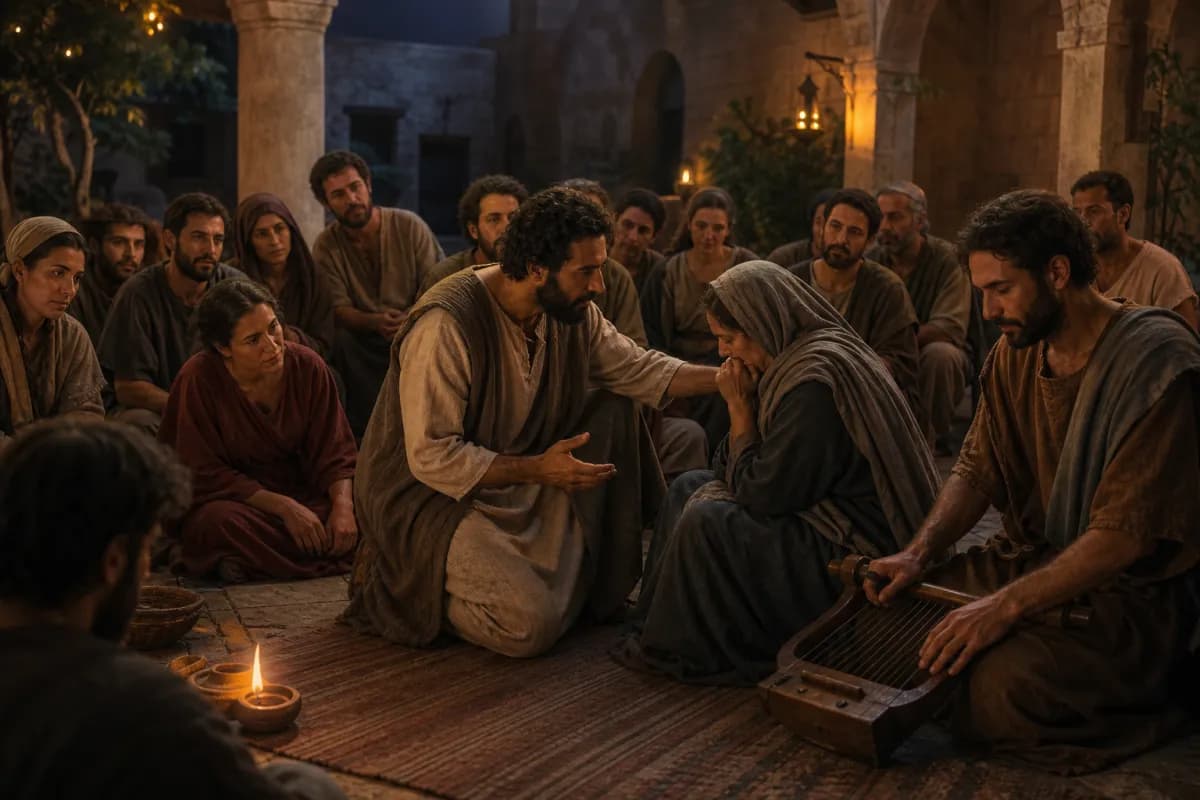
In 1 Corinthians 13–14, Paul places love at the center of spiritual life and gathered worship. Spectacular speech, prophecy, knowledge, faith, generosity, and even suffering amount to nothing without love. Love endures because it reflects God’s coming future, and it directs the church’s gifts toward intelligible speech that builds, consoles, and strengthens others.
- In this study
- 53 verses · 5 movements
1 Corinthians 13
13:1If I speak with the languages of men and of angels, but don’t have love, I have become sounding brass or a clanging cymbal.
13:2If I have the gift of prophecy, and know all mysteries and all knowledge, and if I have all faith, so as to remove mountains, but don’t have love, I am nothing.
13:3If I give away all my goods to feed the poor, and if I give my body to be burned, but don’t have love, it profits me nothing.
13:4Love is patient and is kind. Love doesn’t envy. Love doesn’t brag, is not proud,
13:5doesn’t behave itself inappropriately, doesn’t seek its own way, is not provoked, takes no account of evil;
13:6doesn’t rejoice in unrighteousness, but rejoices with the truth;
13:7bears all things, believes all things, hopes all things, and endures all things.
13:8Love never fails. But where there are prophecies, they will be done away with. Where there are various languages, they will cease. Where there is knowledge, it will be done away with.
13:9For we know in part and we prophesy in part;
13:10but when that which is complete has come, then that which is partial will be done away with.
13:11When I was a child, I spoke as a child, I felt as a child, I thought as a child. Now that I have become a man, I have put away childish things.
13:12For now we see in a mirror, dimly, but then face to face. Now I know in part, but then I will know fully, even as I was also fully known.
13:13But now faith, hope, and love remain—these three. The greatest of these is love.
1 Corinthians 14
14:1Follow after love and earnestly desire spiritual gifts, but especially that you may prophesy.
14:2For he who speaks in another language speaks not to men, but to God, for no one understands, but in the Spirit he speaks mysteries.
14:3But he who prophesies speaks to men for their edification, exhortation, and consolation.
14:4He who speaks in another language edifies himself, but he who prophesies edifies the assembly.
14:5Now I desire to have you all speak with other languages, but even more that you would prophesy. For he is greater who prophesies than he who speaks with other languages, unless he interprets, that the assembly may be built up.
14:6But now, brothers, if I come to you speaking with other languages, what would I profit you unless I speak to you either by way of revelation, or of knowledge, or of prophesying, or of teaching?
14:7Even lifeless things that make a sound, whether pipe or harp, if they didn’t give a distinction in the sounds, how would it be known what is piped or harped?
14:8For if the trumpet gave an uncertain sound, who would prepare himself for war?
14:9So also you, unless you uttered by the tongue words easy to understand, how would it be known what is spoken? For you would be speaking into the air.
14:10There are, it may be, so many kinds of languages in the world, and none of them is without meaning.
14:11If then I don’t know the meaning of the language, I would be to him who speaks a foreigner, and he who speaks would be a foreigner to me.
14:12So also you, since you are zealous for spiritual gifts, seek that you may abound to the building up of the assembly.
14:13Therefore let him who speaks in another language pray that he may interpret.
14:14For if I pray in another language, my spirit prays, but my understanding is unfruitful.
14:15What should I do? I will pray with the spirit, and I will pray with the understanding also. I will sing with the spirit, and I will sing with the understanding also.
14:16Otherwise, if you bless with the spirit, how will he who fills the place of the unlearned say the “Amen” at your giving of thanks, seeing he doesn’t know what you say?
14:17For you most certainly give thanks well, but the other person is not built up.
14:18I thank my God, I speak with other languages more than you all.
14:19However, in the assembly I would rather speak five words with my understanding, that I might instruct others also, than ten thousand words in another language.
14:20Brothers, don’t be children in thoughts, yet in malice be babies, but in thoughts be mature.
14:21In the law it is written, “By men of strange languages and by the lips of strangers I will speak to this people. They won’t even listen to me that way, says the Lord.”
14:22Therefore other languages are for a sign, not to those who believe, but to the unbelieving; but prophesying is for a sign, not to the unbelieving, but to those who believe.
14:23If therefore the whole assembly is assembled together and all speak with other languages, and unlearned or unbelieving people come in, won’t they say that you are crazy?
14:24But if all prophesy, and someone unbelieving or unlearned comes in, he is reproved by all, and he is judged by all.
14:25And thus the secrets of his heart are revealed. So he will fall down on his face and worship God, declaring that God is among you indeed.
14:26What is it then, brothers? When you come together, each one of you has a psalm, has a teaching, has a revelation, has another language, or has an interpretation. Let all things be done to build each other up.
14:27If any man speaks in another language, let there be two, or at the most three, and in turn; and let one interpret.
14:28But if there is no interpreter, let him keep silent in the assembly, and let him speak to himself and to God.
14:29Let two or three of the prophets speak, and let the others discern.
14:30But if a revelation is made to another sitting by, let the first keep silent.
14:31For you all can prophesy one by one, that all may learn and all may be exhorted.
14:32The spirits of the prophets are subject to the prophets,
14:33for God is not a God of confusion but of peace, as in all the assemblies of the saints.
14:34Let the wives be quiet in the assemblies, for it has not been permitted for them to be talking except in submission, as the law also says,
14:35if they desire to learn anything. “Let them ask their own husbands at home, for it is shameful for a wife to be talking in the assembly.”
14:36What!? Was it from you that the word of God went out? Or did it come to you alone?
14:37If any man thinks himself to be a prophet or spiritual, let him recognize the things which I write to you, that they are the commandment of the Lord.
14:38But if anyone is ignorant, let him be ignorant.
14:39Therefore, brothers, desire earnestly to prophesy, and don’t forbid speaking with other languages.
14:40Let all things be done decently and in order.
CONTEXTUAL OVERVIEW
Love is not a pause from Paul’s discussion of gifts; it is the “more excellent way” by which gifts must be used. The Corinthians appear drawn to displays that mark spiritual importance. Paul names tongues of humans and angels, prophecy, knowledge, mountain-moving faith, radical giving, and even bodily surrender, then says each can be empty without love.
Chapter 14 shows why this matters in an actual gathering. A tongue not interpreted may be genuine speech to God, but it does not build hearers who cannot understand it. Prophecy, by contrast, speaks to people for upbuilding, encouragement, and consolation. Paul’s concern is not to eliminate gifts but to order them under love so that an outsider can understand, be convicted, and worship God.
HISTORICAL AND LITERARY CONTEXT
The chapter follows Paul’s body image and its call to “strive for the greater gifts.” His praise of love cannot be reduced to a generic wedding sentiment because it is written to resolve disorder in a public worshiping body. The descriptions of envy, boasting, irritability, record-keeping, and rejoicing in wrongdoing meet the exact sins that have appeared throughout the letter.
Paul speaks of a present time in which believers know and prophesy only in part, and a future time when they will know fully as they have been fully known. He is not dismissing teaching or prophecy as useless in the present. He is locating every partial gift beneath the final future of God, where love remains because it belongs to the character of the life God is bringing to completion.
SECTION-BY-SECTION ANALYSIS
- If I have not love, I am nothing · 1 Corinthians 13:2Spiritual capacity and personal sacrifice cannot substitute for the self-giving character that seeks another’s good.
- Love rejoices in the truth · 1 Corinthians 13:6Love is not indulgence; it refuses wrongdoing and delights in what is true before God.
- Let all things be done for building up · 1 Corinthians 14:26Paul gives the congregation a practical standard for ordering its speech and gifts.
CHRIST IN THIS PASSAGE
Paul does not name Jesus in every sentence of this hymn, but its place in the letter gives its Christ-centered force. The church is Christ’s body, the Lord gave Himself for it, and the Spirit’s gifts are given to confess Jesus as Lord. Love is therefore not an abstract virtue added to spiritual power; it is the pattern of the crucified Lord who sought the good of those who could not repay Him.
The future face-to-face hope belongs to the risen Christ’s promised completion of His people. His saving mission does not merely forgive isolated individuals; it is bringing a body into mature, truthful love. Because He has first loved sinners in His death, believers can lay down the rivalry, scorekeeping, and self-display that make gifts destructive.
REFLECTION
Read Paul’s verbs as an examination of actual relationships. Whose failure are you tempted to enjoy? What injury are you still recording? Where has a desire to be heard made another person’s good secondary? Bring the specific name and situation to Christ; love begins in truthful repentance, not in vague warmth.
In gathered worship, ask not only “Was I moved?” but “Was the body built up?” Encourage an intelligible word, a faithful prayer, a needed act of service, or a quiet restraint that helps another person meet God. Pursue gifts with eagerness, but pursue them in the way of the Savior’s love.
Original Greek Word Study
1 Corinthians 13:13
ἀγάπη
agape · G26
Usually translated: love marked by self-giving care
Agape names self-giving love. Paul places love above impressive gifts because it reflects God’s character and builds the church in a way that gift displays without love never can.
Follow the Scripture trail
Love Is the Necessary Way for a Gifted Church in the larger story
The connection: The love Paul describes is made visible in the Lord who gave Himself for His people and will bring them into full communion with Him. Christ’s saving love frees a gifted church from rivalry so that its words and service become signs of His coming kingdom.
Respond to the passage
Choose one relationship where resentment, envy, or self-display has distorted your love. Confess it to Jesus and take a concrete act of truthful care—an apology, encouragement, patient listening, or refusal to repeat a damaging story.
- Why does Paul call gifts without love “nothing” rather than merely incomplete?
- How does love rejoice in truth without becoming harsh?
- Why does Paul move from love’s permanence to instructions about intelligible worship?
Prayer
Lord Jesus, whose love gave itself for sinners, expose my envy and scorekeeping. Form Your patient and truthful love in me, and use my words and gifts to build Your people. Amen.