Passage Study
The Risen Christ Is the First Fruits of Our Resurrection
1 Corinthians 15:1–15:58
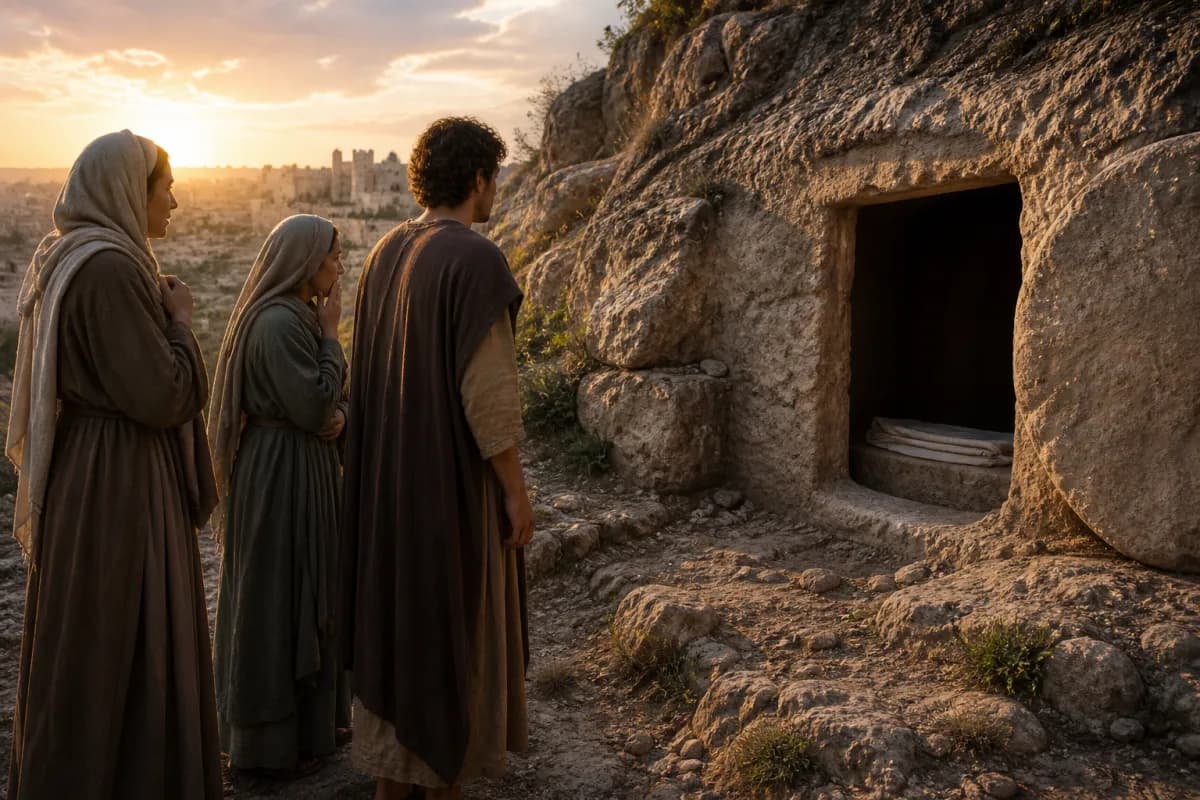
In 1 Corinthians 15, Paul defends the bodily resurrection by returning to the gospel the Corinthians received: Christ died for sins, was buried, was raised on the third day, and appeared to many witnesses. If Christ has not been raised, faith is empty; but Christ has been raised as first fruits, guaranteeing the defeat of death and the resurrection of those who belong to Him.
- In this study
- 58 verses · 5 movements
1 Corinthians 15
15:1Now I declare to you, brothers, the Good News which I preached to you, which also you received, in which you also stand,
15:2by which also you are saved, if you hold firmly the word which I preached to you—unless you believed in vain.
15:3For I delivered to you first of all that which I also received: that Christ died for our sins according to the Scriptures,
15:4that he was buried, that he was raised on the third day according to the Scriptures,
15:5and that he appeared to Cephas, then to the twelve.
15:6Then he appeared to over five hundred brothers at once, most of whom remain until now, but some have also fallen asleep.
15:7Then he appeared to James, then to all the apostles,
15:8and last of all, as to the child born at the wrong time, he appeared to me also.
15:9For I am the least of the apostles, who is not worthy to be called an apostle, because I persecuted the assembly of God.
15:10But by the grace of God I am what I am. His grace which was given to me was not futile, but I worked more than all of them; yet not I, but the grace of God which was with me.
15:11Whether then it is I or they, so we preach, and so you believed.
15:12Now if Christ is preached, that he has been raised from the dead, how do some among you say that there is no resurrection of the dead?
15:13But if there is no resurrection of the dead, neither has Christ been raised.
15:14If Christ has not been raised, then our preaching is in vain and your faith also is in vain.
15:15Yes, we are also found false witnesses of God, because we testified about God that he raised up Christ, whom he didn’t raise up if it is true that the dead are not raised.
15:16For if the dead aren’t raised, neither has Christ been raised.
15:17If Christ has not been raised, your faith is vain; you are still in your sins.
15:18Then they also who are fallen asleep in Christ have perished.
15:19If we have only hoped in Christ in this life, we are of all men most pitiable.
15:20But now Christ has been raised from the dead. He became the first fruit of those who are asleep.
15:21For since death came by man, the resurrection of the dead also came by man.
15:22For as in Adam all die, so also in Christ all will be made alive.
15:23But each in his own order: Christ the first fruits, then those who are Christ’s at his coming.
15:24Then the end comes, when he will deliver up the Kingdom to God the Father, when he will have abolished all rule and all authority and power.
15:25For he must reign until he has put all his enemies under his feet.
15:26The last enemy that will be abolished is death.
15:27For, “He put all things in subjection under his feet.” But when he says, “All things are put in subjection”, it is evident that he is excepted who subjected all things to him.
15:28When all things have been subjected to him, then the Son will also himself be subjected to him who subjected all things to him, that God may be all in all.
15:29Or else what will they do who are baptized for the dead? If the dead aren’t raised at all, why then are they baptized for the dead?
15:30Why do we also stand in jeopardy every hour?
15:31I affirm, by the boasting in you which I have in Christ Jesus our Lord, I die daily.
15:32If I fought with animals at Ephesus for human purposes, what does it profit me? If the dead are not raised, then “let’s eat and drink, for tomorrow we die.”
15:33Don’t be deceived! “Evil companionships corrupt good morals.”
15:34Wake up righteously and don’t sin, for some have no knowledge of God. I say this to your shame.
15:35But someone will say, “How are the dead raised?” and, “With what kind of body do they come?”
15:36You foolish one, that which you yourself sow is not made alive unless it dies.
15:37That which you sow, you don’t sow the body that will be, but a bare grain, maybe of wheat, or of some other kind.
15:38But God gives it a body even as it pleased him, and to each seed a body of its own.
15:39All flesh is not the same flesh, but there is one flesh of men, another flesh of animals, another of fish, and another of birds.
15:40There are also celestial bodies and terrestrial bodies; but the glory of the celestial differs from that of the terrestrial.
15:41There is one glory of the sun, another glory of the moon, and another glory of the stars; for one star differs from another star in glory.
15:42So also is the resurrection of the dead. The body is sown perishable; it is raised imperishable.
15:43It is sown in dishonor; it is raised in glory. It is sown in weakness; it is raised in power.
15:44It is sown a natural body; it is raised a spiritual body. There is a natural body and there is also a spiritual body.
15:45So also it is written, “The first man Adam became a living soul.” The last Adam became a life-giving spirit.
15:46However, that which is spiritual isn’t first, but that which is natural, then that which is spiritual.
15:47The first man is of the earth, made of dust. The second man is the Lord from heaven.
15:48As is the one made of dust, such are those who are also made of dust; and as is the heavenly, such are they also that are heavenly.
15:49As we have borne the image of those made of dust, let’s also bear the image of the heavenly.
15:50Now I say this, brothers, that flesh and blood can’t inherit God’s Kingdom; neither does the perishable inherit imperishable.
15:51Behold, I tell you a mystery. We will not all sleep, but we will all be changed,
15:52in a moment, in the twinkling of an eye, at the last trumpet. For the trumpet will sound and the dead will be raised incorruptible, and we will be changed.
15:53For this perishable body must become imperishable, and this mortal must put on immortality.
15:54But when this perishable body will have become imperishable, and this mortal will have put on immortality, then what is written will happen: “Death is swallowed up in victory.”
15:55“Death, where is your sting? Hades, where is your victory?”
15:56The sting of death is sin, and the power of sin is the law.
15:57But thanks be to God, who gives us the victory through our Lord Jesus Christ.
15:58Therefore, my beloved brothers, be steadfast, immovable, always abounding in the Lord’s work, because you know that your labor is not in vain in the Lord.
CONTEXTUAL OVERVIEW
Paul begins with what he “received” and “handed on”: Christ died for our sins in accordance with the Scriptures, was buried, was raised on the third day, and appeared to Cephas, the Twelve, more than five hundred, James, all the apostles, and finally Paul. The chapter is not a reflection on survival after death; it is an argument rooted in a proclaimed, witnessed event.
Some in Corinth say there is no resurrection of the dead. Paul shows that this cannot be held alongside Christian confession. If there is no resurrection, Christ has not been raised; if Christ has not been raised, the apostles misrepresent God, faith is futile, sins remain unforgiven, and believers who died in Christ have perished. The stakes are total because the gospel concerns a risen Messiah.
HISTORICAL AND LITERARY CONTEXT
Resurrection was not simply another name for the immortality of the soul. Paul argues for God’s future raising and transformation of the dead, drawing on Israel’s hope that death will not have the final word. His language of “first fruits” comes from the first portion of a harvest, an image that makes Christ’s resurrection the beginning and guarantee of the harvest that follows.
The chapter also addresses practical Corinthian confusion. Paul cites their practice concerning baptism for the dead without constructing a full doctrine from an unexplained practice, and he asks why he and others face danger if the dead are not raised. His main pastoral goal is clear: resurrection hope gives reason for steadfast labor and removes the fatalistic conclusion, “Let us eat and drink, for tomorrow we die.”
SECTION-BY-SECTION ANALYSIS
- Christ died for our sins and was raised · 1 Corinthians 15:3Paul defines the gospel by Jesus’ atoning death, burial, resurrection, and appearances according to Scripture.
- Christ the first fruits · 1 Corinthians 15:23His resurrection is the beginning of the harvest, guaranteeing resurrection for those who belong to Him.
- Death has been swallowed up in victory · 1 Corinthians 15:54The final enemy will be defeated through the risen Lord, making present labor meaningful.
CHRIST IN THIS PASSAGE
Christ’s saving mission is stated with exceptional clarity: He died for sins and was raised. His resurrection is not merely confirmation that He survives; it is the Father’s victory over the death sin brought into the world. Because He is raised, believers are not still in their sins, and because He is first fruits, those who belong to Him will share His resurrection.
Paul joins Jesus to Adam in a way that explains the scope of salvation. Death came through a human being; resurrection of the dead comes through a human being. The last Adam is the life-giving one from heaven, and His reign will end every hostile power, including death. This is explicit gospel hope: the crucified and risen Christ saves whole people, not disembodied fragments, and will complete what His resurrection began.
REFLECTION
Bring grief honestly to this chapter. Paul does not call death natural or insignificant; he calls it an enemy. Yet he refuses to let an enemy have the final word over the bodies and names of those who belong to Christ. At a grave, in chronic illness, or when fear of dying becomes sharp, rest your hope on the risen Jesus rather than on a vague confidence that things will somehow continue.
Resurrection also changes ordinary faithfulness. Work in the Lord is not wasted even when it produces no immediate recognition: caregiving, prayer, quiet witness, costly service, and perseverance all stand within the future Christ has secured. Be steadfast today because the Lord who rose will finish His victory.
Original Greek Word Study
1 Corinthians 15:12
ἀνάστασις
anastasis · G386
Usually translated: resurrection or rising again
Anastasis means resurrection. Christ’s resurrection is the foundation of the gospel and the guarantee that those who belong to Him will be raised, so labor in the Lord is never empty.
Follow the Scripture trail
The Risen Christ Is the First Fruits of Our Resurrection in the larger story
The connection: The gospel reaches its future horizon in the risen Christ: His death deals with sin, His resurrection begins the new creation, and His reign will destroy death itself. Every believer’s bodily hope rests on the first fruits already raised from the grave.
Respond to the passage
Name one fear or grief connected to death and bring it plainly to the risen Jesus. Then choose one act of “labor in the Lord” you have considered too small to matter, and do it this week as service that His resurrection declares is not in vain.
- Why does Paul treat denial of bodily resurrection as a denial of the gospel itself?
- What does “first fruits” say about Christ’s resurrection and ours?
- How does the promise of resurrection make present labor meaningful?
Prayer
Risen Lord Jesus, thank You that You died for my sins and rose as the first fruits of new creation. Hold me in grief, steady me in hope, and make my labor faithful because Your victory over death is sure. Amen.