Passage Study
Freedom That Refuses to Harm Those for Whom Christ Died
1 Corinthians 8:1–10:33
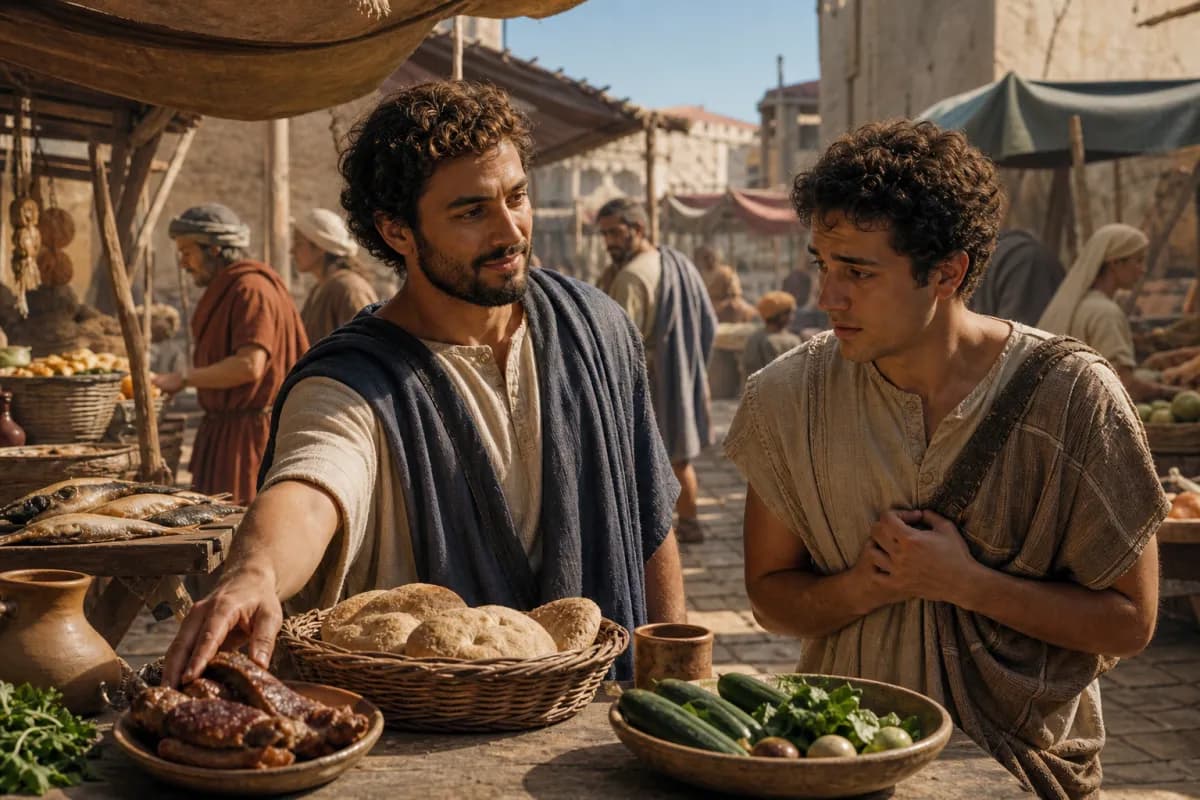
In 1 Corinthians 8–10, Paul addresses food associated with idols and turns a disputed right into a test of love. Knowledge that idols are nothing can inflate the strong, but love builds up the weak. Paul surrenders legitimate apostolic rights, warns Israel’s wilderness generation, and directs the church to seek the neighbor’s good and do everything for God’s glory.
- In this study
- 73 verses · 5 movements
1 Corinthians 8
8:1Now concerning things sacrificed to idols: We know that we all have knowledge. Knowledge puffs up, but love builds up.
8:2But if anyone thinks that he knows anything, he doesn’t yet know as he ought to know.
8:3But anyone who loves God is known by him.
8:4Therefore concerning the eating of things sacrificed to idols, we know that no idol is anything in the world, and that there is no other God but one.
8:5For though there are things that are called “gods”, whether in the heavens or on earth—as there are many “gods” and many “lords”—
8:6yet to us there is one God, the Father, of whom are all things, and we for him; and one Lord, Jesus Christ, through whom are all things, and we live through him.
8:7However, that knowledge isn’t in all men. But some, with consciousness of an idol until now, eat as of a thing sacrificed to an idol, and their conscience, being weak, is defiled.
8:8But food will not commend us to God. For neither, if we don’t eat are we the worse, nor if we eat are we the better.
8:9But be careful that by no means does this liberty of yours become a stumbling block to the weak.
8:10For if a man sees you who have knowledge sitting in an idol’s temple, won’t his conscience, if he is weak, be emboldened to eat things sacrificed to idols?
8:11And through your knowledge, he who is weak perishes, the brother for whose sake Christ died.
8:12Thus, sinning against the brothers, and wounding their conscience when it is weak, you sin against Christ.
8:13Therefore, if food causes my brother to stumble, I will eat no meat forever more, that I don’t cause my brother to stumble.
1 Corinthians 9
9:1Am I not free? Am I not an apostle? Haven’t I seen Jesus Christ, our Lord? Aren’t you my work in the Lord?
9:2If to others I am not an apostle, yet at least I am to you; for you are the seal of my apostleship in the Lord.
9:3My defense to those who examine me is this:
9:4Have we no right to eat and to drink?
9:5Have we no right to take along a wife who is a believer, even as the rest of the apostles, and the brothers of the Lord, and Cephas?
9:6Or have only Barnabas and I no right to not work?
9:7What soldier ever serves at his own expense? Who plants a vineyard, and doesn’t eat of its fruit? Or who feeds a flock, and doesn’t drink from the flock’s milk?
9:8Do I speak these things according to the ways of men? Or doesn’t the law also say the same thing?
9:9For it is written in the law of Moses, “You shall not muzzle an ox while it treads out the grain.” Is it for the oxen that God cares,
9:10or does he say it assuredly for our sake? Yes, it was written for our sake, because he who plows ought to plow in hope, and he who threshes in hope should partake of his hope.
9:11If we sowed to you spiritual things, is it a great thing if we reap your fleshly things?
9:12If others partake of this right over you, don’t we yet more? Nevertheless we didn’t use this right, but we bear all things, that we may cause no hindrance to the Good News of Christ.
9:13Don’t you know that those who serve around sacred things eat from the things of the temple, and those who wait on the altar have their portion with the altar?
9:14Even so the Lord ordained that those who proclaim the Good News should live from the Good News.
9:15But I have used none of these things, and I don’t write these things that it may be done so in my case; for I would rather die, than that anyone should make my boasting void.
9:16For if I preach the Good News, I have nothing to boast about, for necessity is laid on me; but woe is to me if I don’t preach the Good News.
9:17For if I do this of my own will, I have a reward. But if not of my own will, I have a stewardship entrusted to me.
9:18What then is my reward? That when I preach the Good News, I may present the Good News of Christ without charge, so as not to abuse my authority in the Good News.
9:19For though I was free from all, I brought myself under bondage to all, that I might gain the more.
9:20To the Jews I became as a Jew, that I might gain Jews; to those who are under the law, as under the law, that I might gain those who are under the law;
9:21to those who are without law, as without law (not being without law toward God, but under law toward Christ), that I might win those who are without law.
9:22To the weak I became as weak, that I might gain the weak. I have become all things to all men, that I may by all means save some.
9:23Now I do this for the sake of the Good News, that I may be a joint partaker of it.
9:24Don’t you know that those who run in a race all run, but one receives the prize? Run like that, so that you may win.
9:25Every man who strives in the games exercises self-control in all things. Now they do it to receive a corruptible crown, but we an incorruptible.
9:26I therefore run like that, not aimlessly. I fight like that, not beating the air,
9:27but I beat my body and bring it into submission, lest by any means, after I have preached to others, I myself should be disqualified.
1 Corinthians 10
10:1Now I would not have you ignorant, brothers, that our fathers were all under the cloud, and all passed through the sea;
10:2and were all baptized into Moses in the cloud and in the sea;
10:3and all ate the same spiritual food;
10:4and all drank the same spiritual drink. For they drank of a spiritual rock that followed them, and the rock was Christ.
10:5However with most of them, God was not well pleased, for they were overthrown in the wilderness.
10:6Now these things were our examples, to the intent we should not lust after evil things as they also lusted.
10:7Don’t be idolaters, as some of them were. As it is written, “The people sat down to eat and drink, and rose up to play.”
10:8Let’s not commit sexual immorality, as some of them committed, and in one day twenty-three thousand fell.
10:9Let’s not test Christ, as some of them tested, and perished by the serpents.
10:10Don’t grumble, as some of them also grumbled, and perished by the destroyer.
10:11Now all these things happened to them by way of example, and they were written for our admonition, on whom the ends of the ages have come.
10:12Therefore let him who thinks he stands be careful that he doesn’t fall.
10:13No temptation has taken you except what is common to man. God is faithful, who will not allow you to be tempted above what you are able, but will with the temptation also make the way of escape, that you may be able to endure it.
10:14Therefore, my beloved, flee from idolatry.
10:15I speak as to wise men. Judge what I say.
10:16The cup of blessing which we bless, isn’t it a sharing of the blood of Christ? The bread which we break, isn’t it a sharing of the body of Christ?
10:17Because there is one loaf of bread, we, who are many, are one body; for we all partake of the one loaf of bread.
10:18Consider Israel according to the flesh. Don’t those who eat the sacrifices participate in the altar?
10:19What am I saying then? That a thing sacrificed to idols is anything, or that an idol is anything?
10:20But I say that the things which the Gentiles sacrifice, they sacrifice to demons and not to God, and I don’t desire that you would have fellowship with demons.
10:21You can’t both drink the cup of the Lord and the cup of demons. You can’t both partake of the table of the Lord and of the table of demons.
10:22Or do we provoke the Lord to jealousy? Are we stronger than he?
10:23“All things are lawful for me,” but not all things are profitable. “All things are lawful for me,” but not all things build up.
10:24Let no one seek his own, but each one his neighbor’s good.
10:25Whatever is sold in the butcher shop, eat, asking no question for the sake of conscience,
10:26for “the earth is the Lord’s, and its fullness.”
10:27But if one of those who don’t believe invites you to a meal, and you are inclined to go, eat whatever is set before you, asking no questions for the sake of conscience.
10:28But if anyone says to you, “This was offered to idols,” don’t eat it for the sake of the one who told you, and for the sake of conscience. For “the earth is the Lord’s, with all its fullness.”
10:29Conscience, I say, not your own, but the other’s conscience. For why is my liberty judged by another conscience?
10:30If I partake with thankfulness, why am I denounced for something I give thanks for?
10:31Whether therefore you eat or drink, or whatever you do, do all to the glory of God.
10:32Give no occasion for stumbling, whether to Jews, to Greeks, or to the assembly of God;
10:33even as I also please all men in all things, not seeking my own profit, but the profit of the many, that they may be saved.
CONTEXTUAL OVERVIEW
The Corinthians know that an idol has no real existence and that there is one God. Paul agrees with the truth while refusing to let it settle the question. Some believers still associate a temple meal with their former worship; when they see a confident Christian eating there, their conscience is wounded and they may return to practices from which Christ has rescued them.
Paul widens the discussion by presenting his own ministry. He has rights to support, marriage, and other ordinary provisions, yet he refuses to make those rights an obstacle to the gospel. Christian freedom is not measured by how many permissions someone can assert. It is measured by faithful love for people whom God is gathering through Christ.
HISTORICAL AND LITERARY CONTEXT
Meat from sacrifices could appear in temple meals, markets, and private homes. Paul distinguishes these settings carefully. He does not require endless anxiety over food bought in the market, because the earth belongs to the Lord. But he rejects participation in an idol feast as communion with what stands behind idolatry, and he tells the informed believer to abstain when a host identifies food as sacrificed so that another person’s conscience is not pressed.
Chapters 9 and 10 supply the theological weight that chapter 8 alone could be made to evade. Paul’s costly ministry and Israel’s history prevent the “strong” from turning sound doctrine into complacency. Israel had baptism-like passage through the sea and spiritual provision in the wilderness, yet many fell through idolatry, sexual immorality, testing God, and grumbling.
SECTION-BY-SECTION ANALYSIS
- Love builds up · 1 Corinthians 8:1Truth about idols must be used for the neighbor’s good, not as a weapon against a tender conscience.
- I have made myself a servant to all · 1 Corinthians 9:19Paul’s voluntary surrender of rights makes the gospel’s advance more important than his status.
- You cannot partake of the table of the Lord and the table of demons · 1 Corinthians 10:21The Lord’s Supper creates a real allegiance that excludes returning to idolatrous worship.
CHRIST IN THIS PASSAGE
The decisive sentence in the first chapter is that the weak believer is “a brother or sister for whom Christ died.” The neighbor is not an inconvenience to manage; Christ has given His life for that person. Paul’s call to limit freedom therefore arises from the cross, where the Lord sought our good at immeasurable cost rather than demanding His own advantage.
Jesus is also the one Lord through whom all things exist and the Lord whose table forms one people. His saving mission delivers people from idols into communion with God. That is why Paul can affirm creation’s goodness while refusing temple fellowship: Christ’s people cannot treat allegiance to the crucified and risen Lord as compatible with a rival act of worship.
REFLECTION
Ask whether you have used a true conviction to make another Christian feel small. The strong conscience may be correct about a matter, but Paul asks whether your conduct makes it harder for another person to walk away from old bondage. Love may mean explaining patiently, abstaining quietly, or delaying a liberty rather than proving that you have one.
The wilderness warnings also address the person who assumes past spiritual experiences guarantee present faithfulness. Name the temptation that recurs—idolatry of approval, sexual compromise, resentment, or spiritual presumption—and receive God’s promised help to endure it. Seek the good of the people at your table, workplace, or church because Christ has sought yours.
Original Greek Word Study
1 Corinthians 8:9
ἐξουσία
exousia · G1849
Usually translated: authority, right, or freedom to act
Exousia means authority or rightful freedom. Christian freedom must be governed by love, because a right exercised without care can wound a brother or sister for whom Christ died.
Follow the Scripture trail
Freedom That Refuses to Harm Those for Whom Christ Died in the larger story
The connection: The one Lord through whom believers exist gave Himself for brothers and sisters whose consciences may be fragile. His cross frees people from idols and turns Christian liberty outward: the redeemed do not return to rival worship or use grace to destroy those Christ came to save.
Respond to the passage
Identify one liberty, opinion, or preference you have been eager to defend. Ask whether exercising it in your actual setting builds another believer up or reopens an old wound, then choose the loving course and explain your hope in Christ without contempt.
- Why is correct knowledge not enough in the question of idol food?
- What does Paul’s refusal of apostolic support reveal about his ministry?
- How do the Lord’s table and the idol’s table make different claims on a believer?
Prayer
Lord Jesus, thank You for dying for people I am tempted to treat as obstacles. Free me from idols, keep me faithful at Your table, and teach me to use every freedom for Your glory and my neighbor’s good. Amen.