Passage Study
The Ascended Jesus Pours Out the Spirit for His Witnesses
Acts 1:1–2:47
Acts 1:1–2:47 begins after Jesus’ resurrection with His ascension, His promise of the Spirit, and His commission to witness from Jerusalem to the ends of the earth. At Pentecost the Spirit enables the gathered disciples to proclaim God’s mighty acts, Peter announces the crucified and risen Jesus as Lord and Messiah, and a baptized community forms around teaching, prayer, shared possessions, and table fellowship.
- In this study
- 73 verses · 5 movements
Acts 1
1:1The first book I wrote, Theophilus, concerned all that Jesus began both to do and to teach,
1:2until the day in which he was received up, after he had given commandment through the Holy Spirit to the apostles whom he had chosen.
1:3To these he also showed himself alive after he suffered, by many proofs, appearing to them over a period of forty days and speaking about God’s Kingdom.
1:4Being assembled together with them, he commanded them, “Don’t depart from Jerusalem, but wait for the promise of the Father, which you heard from me.
1:5For John indeed baptized in water, but you will be baptized in the Holy Spirit not many days from now.”
1:6Therefore, when they had come together, they asked him, “Lord, are you now restoring the kingdom to Israel?”
1:7He said to them, “It isn’t for you to know times or seasons which the Father has set within his own authority.
1:8But you will receive power when the Holy Spirit has come upon you. You will be witnesses to me in Jerusalem, in all Judea and Samaria, and to the uttermost parts of the earth.”
1:9When he had said these things, as they were looking, he was taken up, and a cloud received him out of their sight.
1:10While they were looking steadfastly into the sky as he went, behold, two men stood by them in white clothing,
1:11who also said, “You men of Galilee, why do you stand looking into the sky? This Jesus, who was received up from you into the sky, will come back in the same way as you saw him going into the sky.”
1:12Then they returned to Jerusalem from the mountain called Olivet, which is near Jerusalem, a Sabbath day’s journey away.
1:13When they had come in, they went up into the upper room where they were staying, that is Peter, John, James, Andrew, Philip, Thomas, Bartholomew, Matthew, James the son of Alphaeus, Simon the Zealot, and Judas the son of James.
1:14All these with one accord continued steadfastly in prayer and supplication, along with the women and Mary the mother of Jesus, and with his brothers.
1:15In these days, Peter stood up in the middle of the disciples (and the number of names was about one hundred twenty), and said,
1:16“Brothers, it was necessary that this Scripture should be fulfilled, which the Holy Spirit spoke before by the mouth of David concerning Judas, who was guide to those who took Jesus.
1:17For he was counted with us, and received his portion in this ministry.
1:18Now this man obtained a field with the reward for his wickedness; and falling headlong, his body burst open and all his intestines gushed out.
1:19It became known to everyone who lived in Jerusalem that in their language that field was called ‘Akeldama,’ that is, ‘The field of blood.’
1:20For it is written in the book of Psalms, ‘Let his habitation be made desolate. Let no one dwell in it;’ and, ‘Let another take his office.’
1:21“Of the men therefore who have accompanied us all the time that the Lord Jesus went in and out among us,
1:22beginning from the baptism of John to the day that he was received up from us, of these one must become a witness with us of his resurrection.”
1:23They put forward two: Joseph called Barsabbas, who was also called Justus, and Matthias.
1:24They prayed and said, “You, Lord, who know the hearts of all men, show which one of these two you have chosen
1:25to take part in this ministry and apostleship from which Judas fell away, that he might go to his own place.”
1:26They drew lots for them, and the lot fell on Matthias; and he was counted with the eleven apostles.
Acts 2
2:1Now when the day of Pentecost had come, they were all with one accord in one place.
2:2Suddenly there came from the sky a sound like the rushing of a mighty wind, and it filled all the house where they were sitting.
2:3Tongues like fire appeared and were distributed to them, and one sat on each of them.
2:4They were all filled with the Holy Spirit and began to speak with other languages, as the Spirit gave them the ability to speak.
2:5Now there were dwelling in Jerusalem Jews, devout men, from every nation under the sky.
2:6When this sound was heard, the multitude came together and were bewildered, because everyone heard them speaking in his own language.
2:7They were all amazed and marveled, saying to one another, “Behold, aren’t all these who speak Galileans?
2:8How do we hear, everyone in our own native language?
2:9Parthians, Medes, Elamites, and people from Mesopotamia, Judea, Cappadocia, Pontus, Asia,
2:10Phrygia, Pamphylia, Egypt, the parts of Libya around Cyrene, visitors from Rome, both Jews and proselytes,
2:11Cretans and Arabians—we hear them speaking in our languages the mighty works of God!”
2:12They were all amazed and were perplexed, saying to one another, “What does this mean?”
2:13Others, mocking, said, “They are filled with new wine.”
2:14But Peter, standing up with the eleven, lifted up his voice and spoke out to them, “You men of Judea and all you who dwell at Jerusalem, let this be known to you, and listen to my words.
2:15For these aren’t drunken, as you suppose, seeing it is only the third hour of the day.
2:16But this is what has been spoken through the prophet Joel:
2:17‘It will be in the last days, says God, that I will pour out my Spirit on all flesh. Your sons and your daughters will prophesy. Your young men will see visions. Your old men will dream dreams.
2:18Yes, and on my servants and on my handmaidens in those days, I will pour out my Spirit, and they will prophesy.
2:19I will show wonders in the sky above, and signs on the earth beneath: blood, and fire, and billows of smoke.
2:20The sun will be turned into darkness, and the moon into blood, before the great and glorious day of the Lord comes.
2:21It will be that whoever will call on the name of the Lord will be saved.’
2:22“Men of Israel, hear these words! Jesus of Nazareth, a man approved by God to you by mighty works and wonders and signs which God did by him among you, even as you yourselves know,
2:23him, being delivered up by the determined counsel and foreknowledge of God, you have taken by the hand of lawless men, crucified and killed;
2:24whom God raised up, having freed him from the agony of death, because it was not possible that he should be held by it.
2:25For David says concerning him, ‘I saw the Lord always before my face, for he is on my right hand, that I should not be moved.
2:26Therefore my heart was glad, and my tongue rejoiced. Moreover my flesh also will dwell in hope,
2:27because you will not leave my soul in Hades, neither will you allow your Holy One to see decay.
2:28You made known to me the ways of life. You will make me full of gladness with your presence.’
2:29“Brothers, I may tell you freely of the patriarch David, that he both died and was buried, and his tomb is with us to this day.
2:30Therefore, being a prophet, and knowing that God had sworn with an oath to him that of the fruit of his body, according to the flesh, he would raise up the Christ to sit on his throne,
2:31he foreseeing this, spoke about the resurrection of the Christ, that his soul wasn’t left in Hades, and his flesh didn’t see decay.
2:32This Jesus God raised up, to which we all are witnesses.
2:33Being therefore exalted by the right hand of God, and having received from the Father the promise of the Holy Spirit, he has poured out this which you now see and hear.
2:34For David didn’t ascend into the heavens, but he says himself, ‘The Lord said to my Lord, “Sit by my right hand
2:35until I make your enemies a footstool for your feet.”’
2:36“Let all the house of Israel therefore know certainly that God has made him both Lord and Christ, this Jesus whom you crucified.”
2:37Now when they heard this, they were cut to the heart, and said to Peter and the rest of the apostles, “Brothers, what shall we do?”
2:38Peter said to them, “Repent and be baptized, every one of you, in the name of Jesus Christ for the forgiveness of sins, and you will receive the gift of the Holy Spirit.
2:39For the promise is to you and to your children, and to all who are far off, even as many as the Lord our God will call to himself.”
2:40With many other words he testified and exhorted them, saying, “Save yourselves from this crooked generation!”
2:41Then those who gladly received his word were baptized. There were added that day about three thousand souls.
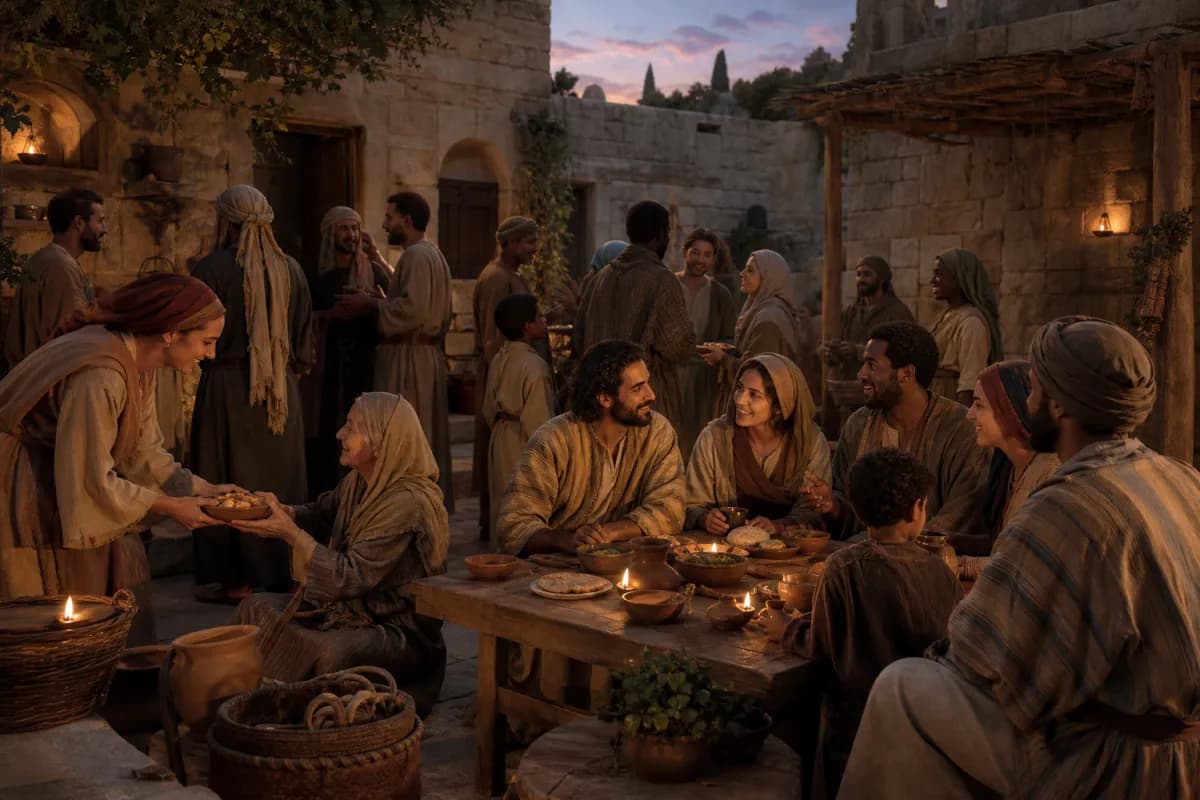
2:42They continued steadfastly in the apostles’ teaching and fellowship, in the breaking of bread, and prayer.
2:43Fear came on every soul, and many wonders and signs were done through the apostles.
2:44All who believed were together, and had all things in common.
2:45They sold their possessions and goods, and distributed them to all, according as anyone had need.
2:46Day by day, continuing steadfastly with one accord in the temple, and breaking bread at home, they took their food with gladness and singleness of heart,
2:47praising God and having favor with all the people. The Lord added to the assembly day by day those who were being saved.
CONTEXTUAL OVERVIEW
Acts opens where Luke’s Gospel ends: Jesus has risen, speaks about the kingdom of God, and is about to be taken up. The disciples ask whether He will now restore the kingdom to Israel. Jesus does not satisfy their curiosity about dates; He redirects them to the Father’s authority, the Spirit’s power, and a mission whose geography runs from Jerusalem through Judea and Samaria to the ends of the earth. The ascension is therefore not Jesus’ withdrawal from His work but His enthronement and the beginning of His witnesses’ Spirit-empowered work.
Pentecost supplies the event that makes this commission possible. The wind-like sound, divided tongues as of fire, and speech understood by diaspora Jews do not make a spectacle for its own sake. They signal that God has acted publicly and that the gospel of the risen Messiah will now be heard across languages. Peter’s sermon then centers the whole scene on Jesus: Israel handed Him over, God raised Him, David foresaw His resurrection, and God has made Him both Lord and Messiah.
HISTORICAL AND LITERARY CONTEXT
Pentecost was a Jewish pilgrimage festival, so Jerusalem contains worshipers from many regions when the Spirit comes. Luke names places from the eastern Mediterranean, North Africa, and Rome to emphasize that those hearing the apostles already represent a wider world. The disciples’ varied speech is not treated as confusion; the hearers recognize “God’s deeds of power” in their own languages.
Acts 1:8 supplies the book’s program, and 2:42–47 gives its first embodied result. The church’s common life does not replace proclamation with social concern: the same people who receive Peter’s word devote themselves to apostolic teaching, prayer, and the breaking of bread, while selling possessions to meet needs. Luke presents a community formed by the risen Lord’s message, not a voluntary association held together by enthusiasm alone.
SECTION-BY-SECTION ANALYSIS
- You will be my witnesses · Acts 1:8Jesus gives the apostles a concrete calling: to testify publicly to His resurrection as the message moves outward from Jerusalem.
- This is what was spoken through the prophet Joel · Acts 2:16Peter reads Pentecost as God’s promised Spirit-outpouring, not as an unexplained religious experience.
- God has made him both Lord and Messiah · Acts 2:36Peter’s climactic claim joins the crucified Jesus’ resurrection and exaltation to His present authority.
CHRIST IN THIS PASSAGE
Jesus is explicitly the risen Lord who commissions, ascends, and sends the Spirit. Peter does not present Pentecost as a substitute for Christ; he says the exalted Jesus has received from the Father the promised Holy Spirit and poured out what the crowd sees and hears. The Spirit’s gift therefore bears witness to the reign of the crucified one whom God raised from death.
Peter also speaks directly to Jesus’ saving mission. His hearers are called to repent and be baptized in His name because the Messiah they rejected has become the source of forgiveness and the Spirit’s gift. The new community’s shared life is a consequence of reconciliation to the risen King, not the basis on which they earn it. The mission to the nations begins with this announced Lordship and this offered forgiveness.
REFLECTION
Jesus’ answer to the apostles corrects a familiar temptation: to pursue secret timetables while neglecting the witness placed before us. He calls His people to receive the Spirit’s power and speak truthfully about Him where they actually live. Consider one person, neighborhood, or workplace where the next faithful act is not speculation but clear, patient testimony to what Christ has done.
Acts 2 also tests whether faith remains private. The first believers make room at their tables, bring needs into the open, pray together, and receive teaching together. Ask Christ to show you one concrete way to share time, food, money, or attention with His people, not to imitate an idealized past but because His risen life forms a real family.
Original Greek Word Study
Acts 1:8
μάρτυς
martys · G3144
Usually translated: witness
Martys means witness. The ascended Jesus sends His followers to bear public witness to Him from Jerusalem to the ends of the earth, and Pentecost supplies the Spirit’s power for that calling.
Follow the Scripture trail
The Ascended Jesus Pours Out the Spirit for His Witnesses in the larger story
The connection: Acts begins the church’s mission with the completed work of Jesus: He died, rose, ascended, and pours out the promised Spirit. Pentecost is the public beginning of the witness through which the crucified and risen Messiah brings forgiveness and gathers people from every people group.
Respond to the passage
Thank the ascended Jesus for a specific mercy in His death and resurrection, then name one person with whom you can speak honestly about that hope. Join the church’s shared life in one tangible way this week—prayer, a meal, giving, or attentive presence.
- How does Jesus redirect the disciples’ question about restoring the kingdom?
- Why does Peter make Jesus’ resurrection and exaltation the center of his explanation of Pentecost?
- Which practices in Acts 2:42–47 show what repentance and baptism began to produce among the believers?
Prayer
Risen Lord Jesus, thank You for forgiveness in Your name and for the Spirit You pour out. Make me a truthful witness, root me in Your church, and teach me to share Your mercy with the people You place near me. Amen.