Passage Study
The Spirit Sends the Gospel through Pisidia and Lycaonia
Acts 13:1–14:28
Acts 13:1–14:28 follows Barnabas and Saul from Antioch through Cyprus and southern Galatia on the first missionary journey. The Spirit sets them apart; Paul proclaims Jesus as David’s promised Savior and the risen One; Jewish and Gentile responses divide cities; a cripple walks in Lystra; Paul survives stoning; and the missionaries return to strengthen new disciples and report that God has opened a door of faith to the Gentiles.
- In this study
- 80 verses · 5 movements
Acts 13
13:1Now in the assembly that was at Antioch there were some prophets and teachers: Barnabas, Simeon who was called Niger, Lucius of Cyrene, Manaen the foster brother of Herod the tetrarch, and Saul.
13:2As they served the Lord and fasted, the Holy Spirit said, “Separate Barnabas and Saul for me, for the work to which I have called them.”
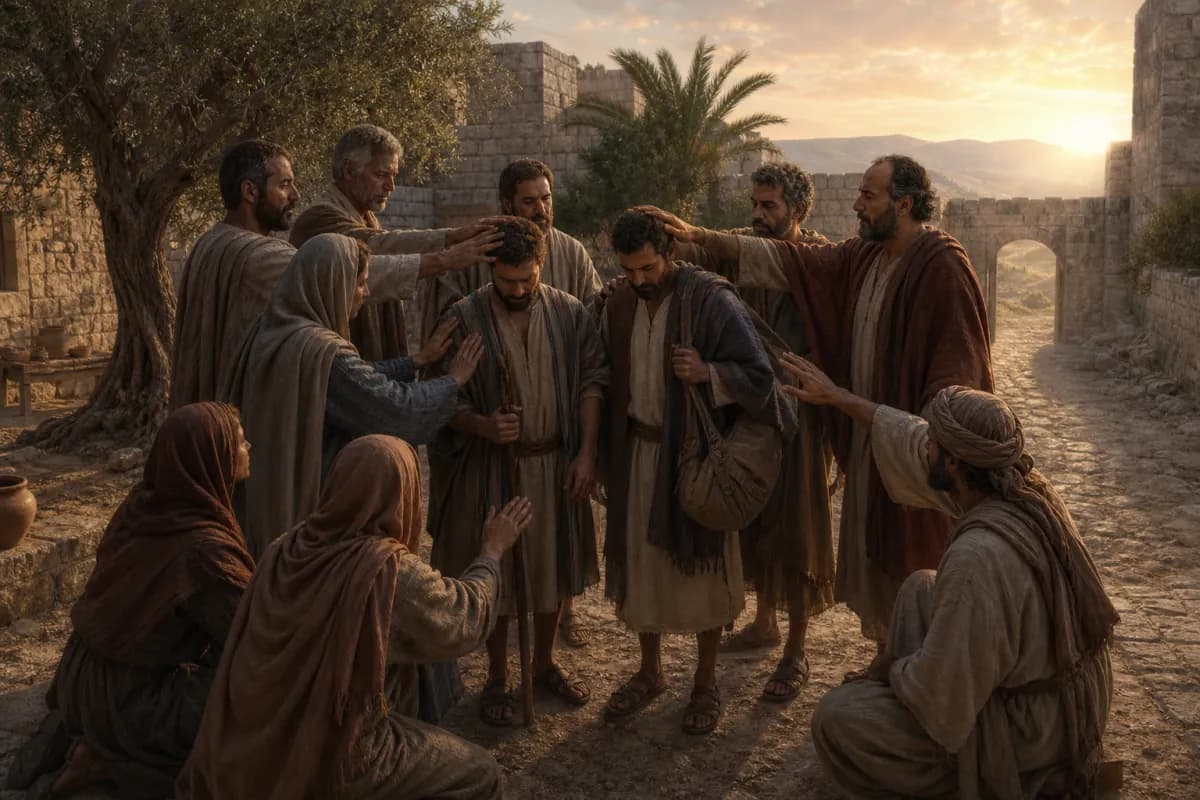
13:3Then, when they had fasted and prayed and laid their hands on them, they sent them away.
13:4So, being sent out by the Holy Spirit, they went down to Seleucia. From there they sailed to Cyprus.
13:5When they were at Salamis, they proclaimed God’s word in the Jewish synagogues. They also had John as their attendant.
13:6When they had gone through the island to Paphos, they found a certain sorcerer, a false prophet, a Jew whose name was Bar Jesus,
13:7who was with the proconsul, Sergius Paulus, a man of understanding. This man summoned Barnabas and Saul, and sought to hear the word of God.
13:8But Elymas the sorcerer (for so is his name by interpretation) withstood them, seeking to turn the proconsul away from the faith.
13:9But Saul, who is also called Paul, filled with the Holy Spirit, fastened his eyes on him
13:10and said, “You son of the devil, full of all deceit and all cunning, you enemy of all righteousness, will you not cease to pervert the right ways of the Lord?
13:11Now, behold, the hand of the Lord is on you, and you will be blind, not seeing the sun for a season!” Immediately a mist and darkness fell on him. He went around seeking someone to lead him by the hand.
13:12Then the proconsul, when he saw what was done, believed, being astonished at the teaching of the Lord.
13:13Now Paul and his company set sail from Paphos and came to Perga in Pamphylia. John departed from them and returned to Jerusalem.
13:14But they, passing on from Perga, came to Antioch of Pisidia. They went into the synagogue on the Sabbath day and sat down.
13:15After the reading of the law and the prophets, the rulers of the synagogue sent to them, saying, “Brothers, if you have any word of exhortation for the people, speak.”
13:16Paul stood up, and gesturing with his hand said, “Men of Israel, and you who fear God, listen.
13:17The God of this people chose our fathers, and exalted the people when they stayed as aliens in the land of Egypt, and with an uplifted arm, he led them out of it.
13:18For a period of about forty years he put up with them in the wilderness.
13:19When he had destroyed seven nations in the land of Canaan, he gave them their land for an inheritance for about four hundred fifty years.
13:20After these things, he gave them judges until Samuel the prophet.
13:21Afterward they asked for a king, and God gave to them Saul the son of Kish, a man of the tribe of Benjamin, for forty years.
13:22When he had removed him, he raised up David to be their king, to whom he also testified, ‘I have found David the son of Jesse, a man after my heart, who will do all my will.’
13:23From this man’s offspring, God has brought salvation to Israel according to his promise,
13:24before his coming, when John had first preached the baptism of repentance to Israel.
13:25As John was fulfilling his course, he said, ‘What do you suppose that I am? I am not he. But behold, one comes after me, the sandals of whose feet I am not worthy to untie.’
13:26“Brothers, children of the stock of Abraham, and those among you who fear God, the word of this salvation is sent out to you.
13:27For those who dwell in Jerusalem, and their rulers, because they didn’t know him, nor the voices of the prophets which are read every Sabbath, fulfilled them by condemning him.
13:28Though they found no cause for death, they still asked Pilate to have him killed.
13:29When they had fulfilled all things that were written about him, they took him down from the tree and laid him in a tomb.
13:30But God raised him from the dead,
13:31and he was seen for many days by those who came up with him from Galilee to Jerusalem, who are his witnesses to the people.
13:32We bring you good news of the promise made to the fathers,
13:33that God has fulfilled this to us, their children, in that he raised up Jesus. As it is also written in the second psalm, ‘You are my Son. Today I have become your father.’
13:34“Concerning that he raised him up from the dead, now no more to return to corruption, he has spoken thus: ‘I will give you the holy and sure blessings of David.’
13:35Therefore he says also in another psalm, ‘You will not allow your Holy One to see decay.’
13:36For David, after he had in his own generation served the counsel of God, fell asleep, was laid with his fathers, and saw decay.
13:37But he whom God raised up saw no decay.
13:38Be it known to you therefore, brothers, that through this man is proclaimed to you remission of sins;
13:39and by him everyone who believes is justified from all things, from which you could not be justified by the law of Moses.
13:40Beware therefore, lest that come on you which is spoken in the prophets:
13:41‘Behold, you scoffers! Wonder and perish, for I work a work in your days, a work which you will in no way believe, if one declares it to you.’”
13:42So when the Jews went out of the synagogue, the Gentiles begged that these words might be preached to them the next Sabbath.
13:43Now when the synagogue broke up, many of the Jews and of the devout proselytes followed Paul and Barnabas; who, speaking to them, urged them to continue in the grace of God.
13:44The next Sabbath, almost the whole city was gathered together to hear the word of God.
13:45But when the Jews saw the multitudes, they were filled with jealousy, and contradicted the things which were spoken by Paul, and blasphemed.
13:46Paul and Barnabas spoke out boldly, and said, “It was necessary that God’s word should be spoken to you first. Since indeed you thrust it from yourselves, and judge yourselves unworthy of eternal life, behold, we turn to the Gentiles.
13:47For so has the Lord commanded us, saying, ‘I have set you as a light for the Gentiles, that you should bring salvation to the uttermost parts of the earth.’”
13:48As the Gentiles heard this, they were glad and glorified the word of God. As many as were appointed to eternal life believed.
13:49The Lord’s word was spread abroad throughout all the region.
13:50But the Jews stirred up the devout and prominent women and the chief men of the city, and stirred up a persecution against Paul and Barnabas, and threw them out of their borders.
13:51But they shook off the dust of their feet against them, and came to Iconium.
13:52The disciples were filled with joy and with the Holy Spirit.
Acts 14
14:1In Iconium, they entered together into the synagogue of the Jews, and so spoke that a great multitude both of Jews and of Greeks believed.
14:2But the disbelieving Jews stirred up and embittered the souls of the Gentiles against the brothers.
14:3Therefore they stayed there a long time, speaking boldly in the Lord, who testified to the word of his grace, granting signs and wonders to be done by their hands.
14:4But the multitude of the city was divided. Part sided with the Jews and part with the apostles.
14:5When some of both the Gentiles and the Jews, with their rulers, made a violent attempt to mistreat and stone them,
14:6they became aware of it and fled to the cities of Lycaonia, Lystra, Derbe, and the surrounding region.
14:7There they preached the Good News.
14:8At Lystra a certain man sat, impotent in his feet, a cripple from his mother’s womb, who never had walked.
14:9He was listening to Paul speaking, who, fastening eyes on him and seeing that he had faith to be made whole,
14:10said with a loud voice, “Stand upright on your feet!” He leaped up and walked.
14:11When the multitude saw what Paul had done, they lifted up their voice, saying in the language of Lycaonia, “The gods have come down to us in the likeness of men!”
14:12They called Barnabas “Jupiter”, and Paul “Mercury”, because he was the chief speaker.
14:13The priest of Jupiter, whose temple was in front of their city, brought oxen and garlands to the gates, and would have made a sacrifice along with the multitudes.
14:14But when the apostles, Barnabas and Paul, heard of it, they tore their clothes and sprang into the multitude, crying out,
14:15“Men, why are you doing these things? We also are men of the same nature as you, and bring you good news, that you should turn from these vain things to the living God, who made the sky, the earth, the sea, and all that is in them;
14:16who in the generations gone by allowed all the nations to walk in their own ways.
14:17Yet he didn’t leave himself without witness, in that he did good and gave you rains from the sky and fruitful seasons, filling our hearts with food and gladness.”
14:18Even saying these things, they hardly stopped the multitudes from making a sacrifice to them.
14:19But some Jews from Antioch and Iconium came there, and having persuaded the multitudes, they stoned Paul and dragged him out of the city, supposing that he was dead.
14:20But as the disciples stood around him, he rose up, and entered into the city. On the next day he went out with Barnabas to Derbe.
14:21When they had preached the Good News to that city and had made many disciples, they returned to Lystra, Iconium, and Antioch,
14:22strengthening the souls of the disciples, exhorting them to continue in the faith, and that through many afflictions we must enter into God’s Kingdom.
14:23When they had appointed elders for them in every assembly, and had prayed with fasting, they commended them to the Lord on whom they had believed.
14:24They passed through Pisidia and came to Pamphylia.
14:25When they had spoken the word in Perga, they went down to Attalia.
14:26From there they sailed to Antioch, from where they had been committed to the grace of God for the work which they had fulfilled.
14:27When they had arrived and had gathered the assembly together, they reported all the things that God had done with them, and that he had opened a door of faith to the nations.
14:28They stayed there with the disciples for a long time.
CONTEXTUAL OVERVIEW
The first missionary journey begins not with private ambition but with a worshiping Antioch church. While prophets and teachers are fasting, the Holy Spirit commands that Barnabas and Saul be set apart for the work to which He has called them. The church fasts, prays, lays hands on them, and sends them. This makes the journey an act of obedient participation in Christ’s mission rather than a heroic venture detached from the local body.
Across the journey, Luke repeatedly shows the same gospel producing sharply different responses. Sergius Paulus believes after Elymas’s opposition is exposed. In Pisidian Antioch, some listeners ask to hear more and Gentiles rejoice, while others contradict and incite persecution. At Lystra, a healing produces pagan acclaim before hostile visitors turn the crowd against Paul. Acts refuses to measure the truth of the message by immediate popularity or safety.
HISTORICAL AND LITERARY CONTEXT
Antioch in Syria had become a mixed Jewish-Gentile church where Barnabas and Saul taught for a year before this journey. Cyprus, Pisidian Antioch, Iconium, Lystra, and Derbe place the mission in Roman provincial settings with synagogues, civic officials, and local religious customs. Luke’s account highlights both Jewish Scripture-based proclamation and direct appeals to Gentile hearers who do not share Israel’s scriptural story.
Lystra’s crowds identify Barnabas with Zeus and Paul with Hermes after the healing of a man unable to use his feet. Their response reflects local pagan assumptions rather than genuine conversion. Paul and Barnabas tear their clothes, insist that they are mortal, and point to the living God who made heaven, earth, sea, and all within them. The event makes clear that miracles are signs directing people away from human messengers and toward the Creator.
SECTION-BY-SECTION ANALYSIS
- Set apart for me Barnabas and Saul · Acts 13:1The Spirit calls named workers, and the Antioch church responds with prayerful commissioning rather than treating mission as an individual project.
- Through this man forgiveness of sins is proclaimed · Acts 13:38Paul presents Jesus’ resurrection as the ground for forgiveness and justification unavailable through the law of Moses.
- We are mortals just like you · Acts 13:43Barnabas and Paul reject worship after the Lystra healing and direct the crowd to the living Creator.
CHRIST IN THIS PASSAGE
Paul’s sermon makes Jesus the center of Israel’s story: He is the Savior from David’s line, the one God raised from the dead, and the one through whom forgiveness and justification are proclaimed. The resurrection is not a decorative conclusion to Paul’s message. It establishes that Jesus is the promised Holy One and makes His saving benefits available to those who believe.
The missionary journey also shows the crucified and risen Christ gathering Gentiles through the word. Paul and Barnabas suffer rejection, expulsion, and violence, yet they do not call people to admire their endurance. They point to Jesus and to the living God He reveals. The door of faith opened to Gentiles is the outworking of Christ’s mission to bring the blessing promised through Israel to the nations.
REFLECTION
Antioch’s fasting, prayer, and laying on of hands give a healthy picture of sending: churches listen for God’s direction, recognize gifts, and remain connected to those they commission. Pray for workers your congregation supports by name, and ask how your own service can make a missionary or local gospel worker less isolated.
The journey also prepares believers for mixed reception. A sermon can bring joy in one hearer and hostility in another; a genuine healing can be misunderstood; faithful workers may need to leave a city and then return to strengthen young disciples. Do not mistake hardship for evidence that Christ has stopped working. Ask for the endurance to keep speaking of Him without seeking credit for yourself.
Original Greek Word Study
Acts 13:3
ἀποστέλλω
apostello · G649
Usually translated: to send out
Apostello means to send out. The church in Antioch sets apart and sends Barnabas and Saul under the Spirit’s direction, making mission an act of obedient participation in God’s work.
Follow the Scripture trail
The Spirit Sends the Gospel through Pisidia and Lycaonia in the larger story
The connection: The Spirit sends Barnabas and Paul to announce that Jesus, David’s promised Savior, has been raised and now grants forgiveness to believers. Their route through synagogue and marketplace displays Christ’s mission to open a door of faith for the nations, even as His servants share the costly pattern of the crucified Lord.
Respond to the passage
Pray for one gospel worker by name and consider one concrete act that would strengthen them. In a setting where you fear a mixed response, speak one clear sentence about Jesus’ death and resurrection without trying to control how it will be received.
- What does Antioch’s commissioning of Barnabas and Saul show about the church’s role in mission?
- How does Paul connect Jesus’ resurrection to forgiveness and justification in Pisidian Antioch?
- Why do Barnabas and Paul reject the crowds’ worship after the healing at Lystra?
Prayer
Lord Jesus, risen Savior from David’s line, thank You for opening the door of faith to the nations. Send and strengthen Your servants, keep me from seeking human praise, and give me endurance to proclaim Your forgiveness wherever You place me. Amen.