Passage Study
Grace Guarded at Jerusalem, the Gospel Carried into Macedonia
Acts 15:1–16:40
Acts 15:1–16:40 joins a decisive gospel question to a new mission advance. The Jerusalem council rejects circumcision as a condition for Gentile salvation, confessing that Jews and Gentiles are saved through the grace of the Lord Jesus. Paul then receives the Macedonian vision, sees Lydia believe, and sings in a Philippian prison as Christ’s word establishes churches across a new frontier.
- In this study
- 81 verses · 5 movements
Acts 15
15:1Some men came down from Judea and taught the brothers, “Unless you are circumcised after the custom of Moses, you can’t be saved.”
15:2Therefore when Paul and Barnabas had no small discord and discussion with them, they appointed Paul, Barnabas, and some others of them to go up to Jerusalem to the apostles and elders about this question.
15:3They, being sent on their way by the assembly, passed through both Phoenicia and Samaria, declaring the conversion of the Gentiles. They caused great joy to all the brothers.
15:4When they had come to Jerusalem, they were received by the assembly and the apostles and the elders, and they reported everything that God had done with them.
15:5But some of the sect of the Pharisees who believed rose up, saying, “It is necessary to circumcise them, and to command them to keep the law of Moses.”
15:6The apostles and the elders were gathered together to see about this matter.
15:7When there had been much discussion, Peter rose up and said to them, “Brothers, you know that a good while ago God made a choice among you that by my mouth the nations should hear the word of the Good News and believe.
15:8God, who knows the heart, testified about them, giving them the Holy Spirit, just like he did to us.
15:9He made no distinction between us and them, cleansing their hearts by faith.
15:10Now therefore why do you tempt God, that you should put a yoke on the neck of the disciples which neither our fathers nor we were able to bear?
15:11But we believe that we are saved through the grace of the Lord Jesus, just as they are.”
15:12All the multitude kept silence, and they listened to Barnabas and Paul reporting what signs and wonders God had done among the nations through them.
15:13After they were silent, James answered, “Brothers, listen to me.
15:14Simeon has reported how God first visited the nations to take out of them a people for his name.
15:15This agrees with the words of the prophets. As it is written,
15:16‘After these things I will return. I will again build the tabernacle of David, which has fallen. I will again build its ruins. I will set it up
15:17that the rest of men may seek after the Lord: all the Gentiles who are called by my name, says the Lord, who does all these things.’
15:18“All of God’s works are known to him from eternity.
15:19Therefore my judgment is that we don’t trouble those from among the Gentiles who turn to God,
15:20but that we write to them that they abstain from the pollution of idols, from sexual immorality, from what is strangled, and from blood.
15:21For Moses from generations of old has in every city those who preach him, being read in the synagogues every Sabbath.”
15:22Then it seemed good to the apostles and the elders, with the whole assembly, to choose men out of their company, and send them to Antioch with Paul and Barnabas: Judas called Barsabbas, and Silas, chief men among the brothers.
15:23They wrote these things by their hand: “The apostles, the elders, and the brothers, to the brothers who are of the Gentiles in Antioch, Syria, and Cilicia: greetings.
15:24Because we have heard that some who went out from us have troubled you with words, unsettling your souls, saying, ‘You must be circumcised and keep the law,’ to whom we gave no commandment;
15:25it seemed good to us, having come to one accord, to choose out men and send them to you with our beloved Barnabas and Paul,
15:26men who have risked their lives for the name of our Lord Jesus Christ.
15:27We have sent therefore Judas and Silas, who themselves will also tell you the same things by word of mouth.
15:28For it seemed good to the Holy Spirit, and to us, to lay no greater burden on you than these necessary things:
15:29that you abstain from things sacrificed to idols, from blood, from things strangled, and from sexual immorality, from which if you keep yourselves, it will be well with you. Farewell.”
15:30So, when they were sent off, they came to Antioch. Having gathered the multitude together, they delivered the letter.
15:31When they had read it, they rejoiced over the encouragement.
15:32Judas and Silas, also being prophets themselves, encouraged the brothers with many words and strengthened them.
15:33After they had spent some time there, they were dismissed in peace from the brothers to the apostles.
15:35But Paul and Barnabas stayed in Antioch, teaching and preaching the word of the Lord, with many others also.
15:36After some days Paul said to Barnabas, “Let’s return now and visit our brothers in every city in which we proclaimed the word of the Lord, to see how they are doing.”
15:37Barnabas planned to take John, who was called Mark, with them also.
15:38But Paul didn’t think that it was a good idea to take with them someone who had withdrawn from them in Pamphylia, and didn’t go with them to do the work.
15:39Then the contention grew so sharp that they separated from each other. Barnabas took Mark with him and sailed away to Cyprus,
15:40but Paul chose Silas and went out, being commended by the brothers to the grace of God.
15:41He went through Syria and Cilicia, strengthening the assemblies.
Acts 16
16:1He came to Derbe and Lystra; and behold, a certain disciple was there, named Timothy, the son of a Jewess who believed, but his father was a Greek.
16:2The brothers who were at Lystra and Iconium gave a good testimony about him.
16:3Paul wanted to have him go out with him, and he took and circumcised him because of the Jews who were in those parts, for they all knew that his father was a Greek.
16:4As they went on their way through the cities, they delivered the decrees to them to keep which had been ordained by the apostles and elders who were at Jerusalem.
16:5So the assemblies were strengthened in the faith, and increased in number daily.
16:6When they had gone through the region of Phrygia and Galatia, they were forbidden by the Holy Spirit to speak the word in Asia.
16:7When they had come opposite Mysia, they tried to go into Bithynia, but the Spirit didn’t allow them.
16:8Passing by Mysia, they came down to Troas.
16:9A vision appeared to Paul in the night. There was a man of Macedonia standing, begging him and saying, “Come over into Macedonia and help us.”
16:10When he had seen the vision, immediately we sought to go out to Macedonia, concluding that the Lord had called us to preach the Good News to them.
16:11Setting sail therefore from Troas, we made a straight course to Samothrace, and the day following to Neapolis;
16:12and from there to Philippi, which is a city of Macedonia, the foremost of the district, a Roman colony. We were staying some days in this city.
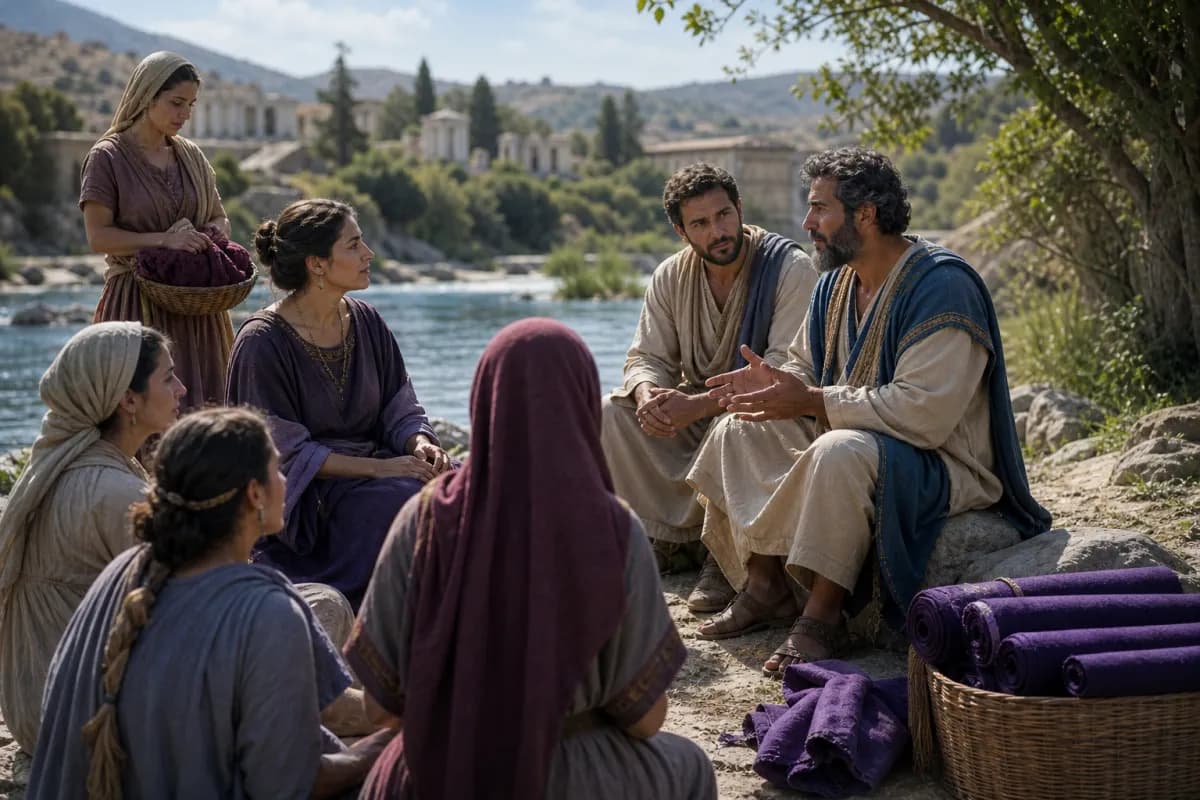
16:13On the Sabbath day we went outside of the city by a riverside, where we supposed there was a place of prayer, and we sat down and spoke to the women who had come together.
16:14A certain woman named Lydia, a seller of purple, of the city of Thyatira, one who worshiped God, heard us. The Lord opened her heart to listen to the things which were spoken by Paul.
16:15When she and her household were baptized, she begged us, saying, “If you have judged me to be faithful to the Lord, come into my house and stay.” So she persuaded us.
16:16As we were going to prayer, a certain girl having a spirit of divination met us, who brought her masters much gain by fortune telling.
16:17Following Paul and us, she cried out, “These men are servants of the Most High God, who proclaim to us a way of salvation!”
16:18She was doing this for many days. But Paul, becoming greatly annoyed, turned and said to the spirit, “I command you in the name of Jesus Christ to come out of her!” It came out that very hour.
16:19But when her masters saw that the hope of their gain was gone, they seized Paul and Silas and dragged them into the marketplace before the rulers.
16:20When they had brought them to the magistrates, they said, “These men, being Jews, are agitating our city
16:21and advocate customs which it is not lawful for us to accept or to observe, being Romans.”
16:22The multitude rose up together against them and the magistrates tore their clothes from them, then commanded them to be beaten with rods.
16:23When they had laid many stripes on them, they threw them into prison, charging the jailer to keep them safely.
16:24Having received such a command, he threw them into the inner prison and secured their feet in the stocks.
16:25But about midnight Paul and Silas were praying and singing hymns to God, and the prisoners were listening to them.
16:26Suddenly there was a great earthquake, so that the foundations of the prison were shaken; and immediately all the doors were opened, and everyone’s bonds were loosened.
16:27The jailer, being roused out of sleep and seeing the prison doors open, drew his sword and was about to kill himself, supposing that the prisoners had escaped.
16:28But Paul cried with a loud voice, saying, “Don’t harm yourself, for we are all here!”
16:29He called for lights, sprang in, fell down trembling before Paul and Silas,
16:30brought them out, and said, “Sirs, what must I do to be saved?”
16:31They said, “Believe in the Lord Jesus Christ, and you will be saved, you and your household.”
16:32They spoke the word of the Lord to him, and to all who were in his house.
16:33He took them the same hour of the night and washed their stripes, and was immediately baptized, he and all his household.
16:34He brought them up into his house and set food before them, and rejoiced greatly with all his household, having believed in God.
16:35But when it was day, the magistrates sent the sergeants, saying, “Let those men go.”
16:36The jailer reported these words to Paul, saying, “The magistrates have sent to let you go; now therefore come out and go in peace.”
16:37But Paul said to them, “They have beaten us publicly without a trial, men who are Romans, and have cast us into prison! Do they now release us secretly? No, most certainly, but let them come themselves and bring us out!”
16:38The sergeants reported these words to the magistrates, and they were afraid when they heard that they were Romans,
16:39and they came and begged them. When they had brought them out, they asked them to depart from the city.
16:40They went out of the prison and entered into Lydia’s house. When they had seen the brothers, they encouraged them, then departed.
CONTEXTUAL OVERVIEW
The crisis in Antioch concerns the terms on which Gentiles may belong to God’s people. Some teachers insist that salvation requires circumcision according to Moses’ custom. Paul and Barnabas do not treat the demand as a minor cultural preference, because it makes Christ’s grace insufficient. Their journey to Jerusalem brings the issue before apostles and elders, while testimony about Peter’s visit to Cornelius and Paul’s Gentile mission keeps the debate tied to God’s visible work.
After the council’s letter, Luke follows Paul and Silas toward Macedonia. The movement is not a simple itinerary: the Spirit prevents them from speaking in one region and does not permit their route into Bithynia. The night vision of a Macedonian man supplies the next direction. At Philippi, the gospel meets a businesswoman at a riverside place of prayer, an exploited slave girl, city magistrates, prisoners, and a jailer—people whose lives are changed by Jesus rather than by a shared social rank.
HISTORICAL AND LITERARY CONTEXT
Jerusalem carries authority as the city where the apostolic witness began, but Acts does not describe the council as inventing a new gospel. Peter recalls that God gave Gentiles the Holy Spirit and cleansed their hearts by faith; Paul and Barnabas report signs among the nations; James uses Amos to show that the restoration of David’s fallen tent includes the nations called by God’s name. The letter’s requested abstentions aim at fellowship and holiness in mixed Jewish-Gentile churches, not at adding works as a means of salvation.
Philippi was a Roman colony, and Luke’s account gives unusual attention to citizenship, public beating, and imprisonment. Paul and Silas are accused of disturbing the city and advocating unlawful customs, then beaten without a trial and placed in the inner cell. Their later disclosure of Roman citizenship exposes the magistrates’ injustice, yet they leave after encouraging the believers rather than using their status to seek retaliation.
SECTION-BY-SECTION ANALYSIS
- Saved through the grace of the Lord Jesus · Acts 15:11The council refuses to make law observance the entrance requirement for Gentiles, grounding salvation in Christ’s grace received by faith.
- The Spirit of Jesus did not allow them · Acts 15:8Paul’s team learns that closed doors may be active guidance, preparing them for the Macedonian call rather than ending their mission.
- The Lord opened her heart · Acts 16:14Lydia’s attentive response is presented as God’s gracious initiative, followed by baptism and practical welcome.
CHRIST IN THIS PASSAGE
Jesus’ saving work is the council’s center. Peter does not say that Gentiles are excused from salvation’s demands because their culture differs; he says every sinner, Jew and Gentile alike, is saved through the grace of the Lord Jesus. The gift of the Spirit to Gentiles and the cleansing of hearts by faith show that the crucified and risen Christ has created one people without requiring Gentiles to become Jews first.
At Philippi, the Lord Jesus continues this mission through a preached word that reaches Lydia and the jailer in distinct circumstances. The prison hymn does not deny suffering, and the earthquake is not a spectacle that saves by itself. The jailer hears the word about the Lord Jesus, believes, and receives a new household marked by mercy. Christ’s grace changes both the boundary dispute in Jerusalem and the fearful man before Paul’s cell.
REFLECTION
Acts 15 asks whether we quietly attach credentials, culture, or performance to the grace of Christ. Receive the council’s verdict personally: you are not made acceptable by a religious badge but by the Lord Jesus. Then examine whether a preference you call faithfulness is actually making it harder for someone else to hear the gospel’s free promise.
The prison scene gives a concrete pattern for pressure. Paul and Silas pray, sing, protect a frightened jailer, and speak the word when he asks. In a difficult setting this week, choose one response that reflects Christ’s grace—a prayer rather than resentment, truthful speech rather than escape, or hospitality toward someone whose life is unlike yours.
Original Greek Word Study
Acts 15:11
χάρις
charis · G5485
Usually translated: grace, favor, or gift
Charis means grace or gift. The council confesses that Jews and Gentiles are saved through the grace of the Lord Jesus, guarding the gospel from added requirements that cannot save.
Follow the Scripture trail
Grace Guarded at Jerusalem, the Gospel Carried into Macedonia in the larger story
The connection: The Jerusalem council safeguards the saving mission of Jesus from any requirement that competes with His grace. The Macedonian mission then displays that grace crossing geography, class, and imprisonment as the risen Lord gathers Gentiles by faith into His people.
Respond to the passage
Thank Jesus that His grace, not your religious performance, is the ground of salvation. Identify one person or setting where you can make that grace clearer through patient welcome and truthful witness.
- What did the council say was wrong with requiring Gentiles to be circumcised for salvation?
- Why is Timothy’s circumcision different from the demand rejected at Jerusalem?
- How do Lydia and the jailer each show a distinct response to the word about Jesus?
Prayer
Lord Jesus, keep me from adding anything to Your grace. Open hearts through Your word, make me faithful when plans change, and teach me to meet pressure with prayer, mercy, and clear witness. Amen.