Passage Study
Jesus Proclaimed from Thessalonica to Ephesus
Acts 17:1–19:20
Acts 17:1–19:20 follows Paul through synagogue debate, public philosophy, house-church formation, and confrontation with idolatry. He reasons from Scripture that the Messiah had to suffer and rise, announces the risen Jesus to Athenians, receives the Lord’s encouragement in Corinth, and teaches Ephesians whose repentance becomes visible when costly magic practices are abandoned. The word of the Lord grows because Jesus is Lord over every city’s rival loyalty.
- In this study
- 82 verses · 5 movements
Acts 17
17:1Now when they had passed through Amphipolis and Apollonia, they came to Thessalonica, where there was a Jewish synagogue.
17:2Paul, as was his custom, went in to them; and for three Sabbath days reasoned with them from the Scriptures,
17:3explaining and demonstrating that the Christ had to suffer and rise again from the dead, and saying, “This Jesus, whom I proclaim to you, is the Christ.”
17:4Some of them were persuaded and joined Paul and Silas: of the devout Greeks a great multitude, and not a few of the chief women.
17:5But the unpersuaded Jews took along some wicked men from the marketplace and gathering a crowd, set the city in an uproar. Assaulting the house of Jason, they sought to bring them out to the people.
17:6When they didn’t find them, they dragged Jason and certain brothers before the rulers of the city, crying, “These who have turned the world upside down have come here also,
17:7whom Jason has received. These all act contrary to the decrees of Caesar, saying that there is another king, Jesus!”
17:8The multitude and the rulers of the city were troubled when they heard these things.
17:9When they had taken security from Jason and the rest, they let them go.
17:10The brothers immediately sent Paul and Silas away by night to Beroea. When they arrived, they went into the Jewish synagogue.
17:11Now these were more noble than those in Thessalonica, in that they received the word with all readiness of mind, examining the Scriptures daily to see whether these things were so.
17:12Many of them therefore believed; also of the prominent Greek women, and not a few men.
17:13But when the Jews of Thessalonica had knowledge that the word of God was proclaimed by Paul at Beroea also, they came there likewise, agitating the multitudes.
17:14Then the brothers immediately sent out Paul to go as far as to the sea, and Silas and Timothy still stayed there.
17:15But those who escorted Paul brought him as far as Athens. Receiving a commandment to Silas and Timothy that they should come to him very quickly, they departed.
17:16Now while Paul waited for them at Athens, his spirit was provoked within him as he saw the city full of idols.
17:17So he reasoned in the synagogue with the Jews and the devout persons, and in the marketplace every day with those who met him.
17:18Some of the Epicurean and Stoic philosophers also were conversing with him. Some said, “What does this babbler want to say?” Others said, “He seems to be advocating foreign deities,” because he preached Jesus and the resurrection.
17:19They took hold of him and brought him to the Areopagus, saying, “May we know what this new teaching is, which you are speaking about?
17:20For you bring certain strange things to our ears. We want to know therefore what these things mean.”
17:21Now all the Athenians and the strangers living there spent their time in nothing else, but either to tell or to hear some new thing.
17:22Paul stood in the middle of the Areopagus and said, “You men of Athens, I perceive that you are very religious in all things.
17:23For as I passed along and observed the objects of your worship, I also found an altar with this inscription: ‘TO AN UNKNOWN GOD.’ What therefore you worship in ignorance, I announce to you.
17:24The God who made the world and all things in it, he, being Lord of heaven and earth, doesn’t dwell in temples made with hands.
17:25He isn’t served by men’s hands, as though he needed anything, seeing he himself gives to all life and breath and all things.
17:26He made from one blood every nation of men to dwell on all the surface of the earth, having determined appointed seasons and the boundaries of their dwellings,
17:27that they should seek the Lord, if perhaps they might reach out for him and find him, though he is not far from each one of us.
17:28‘For in him we live, move, and have our being.’ As some of your own poets have said, ‘For we are also his offspring.’
17:29Being then the offspring of God, we ought not to think that the Divine Nature is like gold, or silver, or stone, engraved by art and design of man.
17:30The times of ignorance therefore God overlooked. But now he commands that all people everywhere should repent,
17:31because he has appointed a day in which he will judge the world in righteousness by the man whom he has ordained; of which he has given assurance to all men, in that he has raised him from the dead.”
17:32Now when they heard of the resurrection of the dead, some mocked; but others said, “We want to hear you again concerning this.”
17:33Thus Paul went out from among them.
17:34But certain men joined with him and believed, including Dionysius the Areopagite, and a woman named Damaris, and others with them.
Acts 18
18:1After these things Paul departed from Athens and came to Corinth.
18:2He found a certain Jew named Aquila, a man of Pontus by race, who had recently come from Italy with his wife Priscilla, because Claudius had commanded all the Jews to depart from Rome. He came to them,
18:3and because he practiced the same trade, he lived with them and worked, for by trade they were tent makers.
18:4He reasoned in the synagogue every Sabbath and persuaded Jews and Greeks.
18:5When Silas and Timothy came down from Macedonia, Paul was compelled by the Spirit, testifying to the Jews that Jesus was the Christ.
18:6When they opposed him and blasphemed, he shook out his clothing and said to them, “Your blood be on your own heads! I am clean. From now on, I will go to the Gentiles!”
18:7He departed there and went into the house of a certain man named Justus, one who worshiped God, whose house was next door to the synagogue.
18:8Crispus, the ruler of the synagogue, believed in the Lord with all his house. Many of the Corinthians, when they heard, believed and were baptized.
18:9The Lord said to Paul in the night by a vision, “Don’t be afraid, but speak and don’t be silent;
18:10for I am with you, and no one will attack you to harm you, for I have many people in this city.”
18:11He lived there a year and six months, teaching the word of God among them.
18:12But when Gallio was proconsul of Achaia, the Jews with one accord rose up against Paul and brought him before the judgment seat,
18:13saying, “This man persuades men to worship God contrary to the law.”
18:14But when Paul was about to open his mouth, Gallio said to the Jews, “If indeed it were a matter of wrong or of wicked crime, you Jews, it would be reasonable that I should bear with you;
18:15but if they are questions about words and names and your own law, look to it yourselves. For I don’t want to be a judge of these matters.”
18:16So he drove them from the judgment seat.
18:17Then all the Greeks seized Sosthenes, the ruler of the synagogue, and beat him before the judgment seat. Gallio didn’t care about any of these things.
18:18Paul, having stayed after this many more days, took his leave of the brothers, and sailed from there for Syria, together with Priscilla and Aquila. He shaved his head in Cenchreae, for he had a vow.
18:19He came to Ephesus, and he left them there; but he himself entered into the synagogue and reasoned with the Jews.
18:20When they asked him to stay with them a longer time, he declined;
18:21but taking his leave of them, he said, “I must by all means keep this coming feast in Jerusalem, but I will return again to you if God wills.” Then he set sail from Ephesus.
18:22When he had landed at Caesarea, he went up and greeted the assembly, and went down to Antioch.
18:23Having spent some time there, he departed and went through the region of Galatia and Phrygia, in order, establishing all the disciples.
18:24Now a certain Jew named Apollos, an Alexandrian by race, an eloquent man, came to Ephesus. He was mighty in the Scriptures.
18:25This man had been instructed in the way of the Lord; and being fervent in spirit, he spoke and taught accurately the things concerning Jesus, although he knew only the baptism of John.
18:26He began to speak boldly in the synagogue. But when Priscilla and Aquila heard him, they took him aside, and explained to him the way of God more accurately.
18:27When he had determined to pass over into Achaia, the brothers encouraged him; and wrote to the disciples to receive him. When he had come, he greatly helped those who had believed through grace;
18:28for he powerfully refuted the Jews, publicly showing by the Scriptures that Jesus was the Christ.
Acts 19
19:1While Apollos was at Corinth, Paul, having passed through the upper country, came to Ephesus and found certain disciples.
19:2He said to them, “Did you receive the Holy Spirit when you believed?” They said to him, “No, we haven’t even heard that there is a Holy Spirit.”
19:3He said, “Into what then were you baptized?” They said, “Into John’s baptism.”
19:4Paul said, “John indeed baptized with the baptism of repentance, saying to the people that they should believe in the one who would come after him, that is, in Christ Jesus.”
19:5When they heard this, they were baptized in the name of the Lord Jesus.
19:6When Paul had laid his hands on them, the Holy Spirit came on them and they spoke with other languages and prophesied.
19:7They were about twelve men in all.
19:8He entered into the synagogue and spoke boldly for a period of three months, reasoning and persuading about the things concerning God’s Kingdom.
19:9But when some were hardened and disobedient, speaking evil of the Way before the multitude, he departed from them and separated the disciples, reasoning daily in the school of Tyrannus.
19:10This continued for two years, so that all those who lived in Asia heard the word of the Lord Jesus, both Jews and Greeks.
19:11God worked special miracles by the hands of Paul,
19:12so that even handkerchiefs or aprons were carried away from his body to the sick, and the diseases departed from them, and the evil spirits went out.
19:13But some of the itinerant Jews, exorcists, took on themselves to invoke over those who had the evil spirits the name of the Lord Jesus, saying, “We adjure you by Jesus whom Paul preaches.”
19:14There were seven sons of one Sceva, a Jewish chief priest, who did this.
19:15The evil spirit answered, “Jesus I know, and Paul I know, but who are you?”
19:16The man in whom the evil spirit was leaped on them, overpowered them, and prevailed against them, so that they fled out of that house naked and wounded.
19:17This became known to all, both Jews and Greeks, who lived at Ephesus. Fear fell on them all, and the name of the Lord Jesus was magnified.
19:18Many also of those who had believed came, confessing and declaring their deeds.
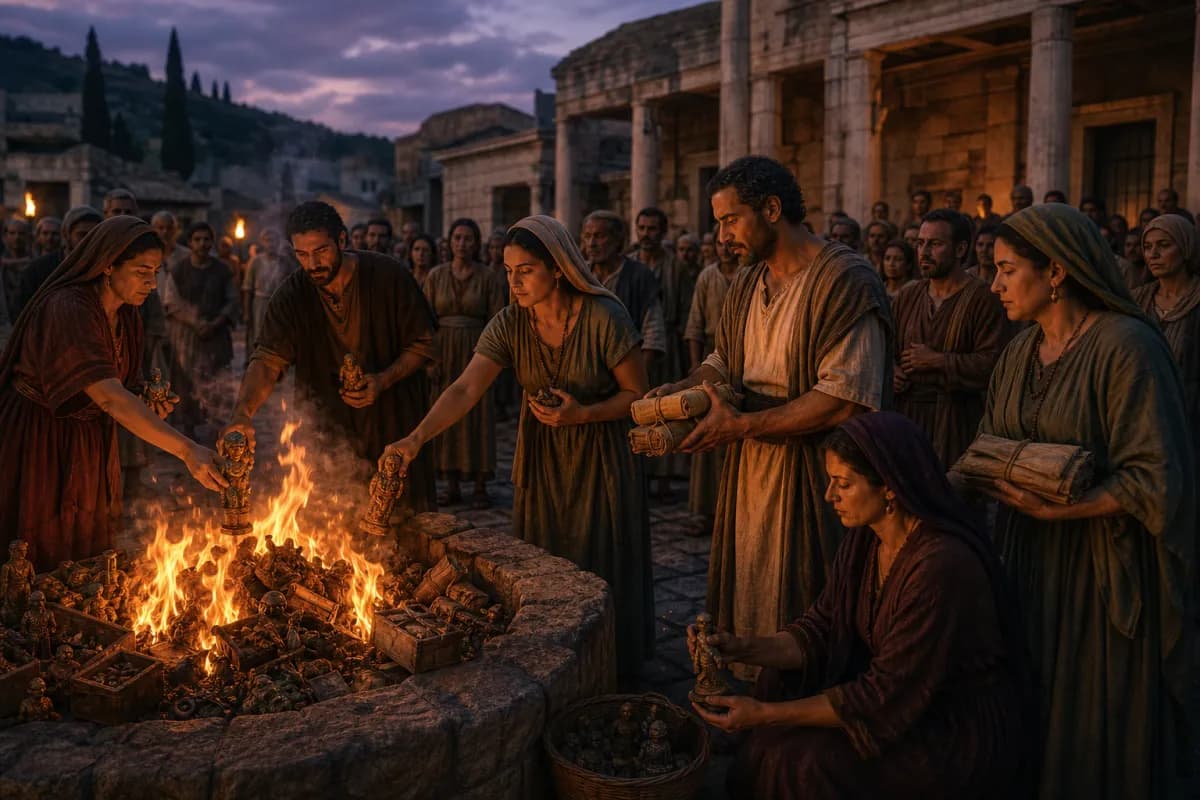
19:19Many of those who practiced magical arts brought their books together and burned them in the sight of all. They counted their price, and found it to be fifty thousand pieces of silver.
19:20So the word of the Lord was growing and becoming mighty.
CONTEXTUAL OVERVIEW
This section repeatedly asks what authority will shape a city. In Thessalonica, opponents accuse Christians of claiming another king, Jesus. In Athens, Paul speaks among altars and philosophers who want to classify his “new teaching.” In Corinth, fear and hostility accompany synagogue and civic opposition. In Ephesus, the name of Jesus exposes people who treat spiritual power as a tool and brings a public break with profitable magic. Luke traces the gospel into settings where religion, politics, commerce, and identity are closely joined.
Paul adapts his starting point without changing his message. In Thessalonica and Berea he opens and interprets Scripture to show that the Messiah had to suffer and rise. In Athens he begins with the Creator and their altar to an unknown god, then moves to God’s command to repent and His appointed judgment through the man raised from the dead. In Ephesus he teaches about the Lord Jesus until allegiance to Him alters practices that had defined people’s former lives.
HISTORICAL AND LITERARY CONTEXT
Thessalonica had a synagogue where Paul’s customary Scripture reasoning could begin, while Berean listeners are praised for examining the Scriptures daily to test his message. Athens was known as a center of intellectual and religious conversation; Luke names Epicurean and Stoic philosophers, but does not reduce their differences to a single worldview. Paul’s speech answers the immediate setting by naming the God who made the world and cannot be contained in human shrines.
Corinth’s mixed commercial and Roman setting helps explain Paul’s work with tentmakers Priscilla and Aquila and his hearing before Gallio. Ephesus was a major city where Acts later identifies practices of magic as economically and socially meaningful. The burning of books after public confession is not a generic rejection of learning; it is a costly renunciation of practices used to seek power apart from the Lord Jesus.
Did you know?
A letter from Emperor Claudius, preserved in stone fragments at Delphi, names Gallio as his friend and proconsul. Dated around 52 CE, the inscription helps historians place Paul’s appearance before Gallio on a calendar.
Why it matters: An ordinary imperial administrative letter provides a chronological anchor for Paul’s ministry in Corinth.
SECTION-BY-SECTION ANALYSIS
- The Messiah had to suffer and rise · Acts 17:3Paul’s synagogue argument treats Jesus’ death and resurrection as the scriptural necessity of the Messiah’s mission.
- He has fixed a day · Acts 17:31Athens hears that the Creator will judge the world through the risen man He has appointed, making repentance urgent rather than theoretical.
- The name of the Lord Jesus was extolled · Acts 19:17Ephesus learns that Jesus’ name cannot be used as spiritual equipment; His authority calls for genuine faith and repentance.
CHRIST IN THIS PASSAGE
Jesus is the suffering and risen Messiah whom Paul proves from Israel’s Scriptures. His resurrection also anchors the Athenian proclamation: God has appointed Him as judge of the world and given assurance by raising Him from death. Paul does not offer Athens a spiritual supplement to its many altars. He calls hearers away from idols to the living Creator whose saving purpose is now publicly declared in the risen Jesus.
The Ephesus stories clarify that Christ’s name is not a charm. The sons of Sceva know language about Jesus but lack the trusting allegiance shown by those who confess, receive baptism into Him, and abandon magic practices. Jesus’ saving mission frees people from false powers and claims their whole lives; the costly book burning is fruit of repentance, not payment for mercy.
REFLECTION
Acts 17 invites you to name the particular idols that promise life while leaving the Creator out of account—approval, control, money, expertise, or spiritual technique. Bring one of them to Jesus in repentance, remembering that His resurrection means your life is moving toward His judgment and mercy, not toward anonymity.
The Bereans and the Ephesians give complementary practices: test teaching by Scripture, and let received truth interrupt habits that compete with Christ. Identify a practice that you defend because it gives a sense of control. Ask a mature believer to help you replace it with a concrete act of trust in the Lord Jesus.
Original Greek Word Study
Acts 17:30
μετανοέω
metanoeo · G3340
Usually translated: to repent or turn in mind and life
Metanoeo means to repent. Paul’s Athenian address calls every people to turn from idolatry to the Creator, because God has appointed a day of judgment through the risen man He has chosen.
Follow the Scripture trail
Jesus Proclaimed from Thessalonica to Ephesus in the larger story
The connection: The risen Jesus is not a local deity among competing loyalties. Scripture identifies Him as the Messiah who suffered and rose; the Creator appoints Him as judge; and His name liberates hearers from false worship so that the gospel reaches cities shaped by very different stories.
Respond to the passage
Test one belief or practice that shapes your decisions by the Scriptures and the risen Jesus’ call to repent. Then explain to one person why Christ’s resurrection changes more than private religious feeling.
- What is Paul proving from Scripture in Thessalonica and Berea?
- Why does Paul begin his Athenian address with God as Creator?
- What does the Ephesian response to magic show about repentance in Jesus’ name?
Prayer
Risen Lord Jesus, turn me from every rival loyalty. Give me courage to speak of Your cross and resurrection, wisdom to test what I hear, and repentance that changes the practices through which I have sought control. Amen.