Passage Study
Bound in the Spirit toward Jerusalem
Acts 19:21–21:16
Acts 19:21–21:16 follows Paul from the riot in Ephesus through Macedonia, Greece, Troas, Miletus, Tyre, and Caesarea as he travels toward Jerusalem. He is resolved in the Spirit despite repeated warnings of imprisonment, entrusts the Ephesian elders to God’s grace, raises Eutychus after a midnight fall, and accepts Agabus’s warning without abandoning the calling. The road mirrors costly obedience to the Lord Jesus, not a search for danger.
- In this study
- 75 verses · 5 movements
Acts 19
19:21Now after these things had ended, Paul determined in the Spirit, when he had passed through Macedonia and Achaia, to go to Jerusalem, saying, “After I have been there, I must also see Rome.”
19:22Having sent into Macedonia two of those who served him, Timothy and Erastus, he himself stayed in Asia for a while.
19:23About that time there arose no small disturbance concerning the Way.
19:24For a certain man named Demetrius, a silversmith who made silver shrines of Artemis, brought no little business to the craftsmen,
19:25whom he gathered together with the workmen of like occupation, and said, “Sirs, you know that by this business we have our wealth.
19:26You see and hear that not at Ephesus alone, but almost throughout all Asia, this Paul has persuaded and turned away many people, saying that they are no gods that are made with hands.
19:27Not only is there danger that this our trade come into disrepute, but also that the temple of the great goddess Artemis will be counted as nothing and her majesty destroyed, whom all Asia and the world worships.”
19:28When they heard this they were filled with anger, and cried out, saying, “Great is Artemis of the Ephesians!”
19:29The whole city was filled with confusion, and they rushed with one accord into the theater, having seized Gaius and Aristarchus, men of Macedonia, Paul’s companions in travel.
19:30When Paul wanted to enter in to the people, the disciples didn’t allow him.
19:31Certain also of the Asiarchs, being his friends, sent to him and begged him not to venture into the theater.
19:32Some therefore cried one thing, and some another, for the assembly was in confusion. Most of them didn’t know why they had come together.
19:33They brought Alexander out of the multitude, the Jews putting him forward. Alexander beckoned with his hand, and would have made a defense to the people.
19:34But when they perceived that he was a Jew, all with one voice for a time of about two hours cried out, “Great is Artemis of the Ephesians!”
19:35When the town clerk had quieted the multitude, he said, “You men of Ephesus, what man is there who doesn’t know that the city of the Ephesians is temple keeper of the great goddess Artemis, and of the image which fell down from Zeus?
19:36Seeing then that these things can’t be denied, you ought to be quiet and to do nothing rash.
19:37For you have brought these men here, who are neither robbers of temples nor blasphemers of your goddess.
19:38If therefore Demetrius and the craftsmen who are with him have a matter against anyone, the courts are open and there are proconsuls. Let them press charges against one another.
19:39But if you seek anything about other matters, it will be settled in the regular assembly.
19:40For indeed we are in danger of being accused concerning today’s riot, there being no cause. Concerning it, we wouldn’t be able to give an account of this commotion.”
19:41When he had thus spoken, he dismissed the assembly.
Acts 20
20:1After the uproar had ceased, Paul sent for the disciples, took leave of them, and departed to go into Macedonia.
20:2When he had gone through those parts and had encouraged them with many words, he came into Greece.
20:3When he had spent three months there, and a plot was made against him by Jews as he was about to set sail for Syria, he determined to return through Macedonia.
20:4These accompanied him as far as Asia: Sopater of Beroea, Aristarchus and Secundus of the Thessalonians, Gaius of Derbe, Timothy, and Tychicus and Trophimus of Asia.
20:5But these had gone ahead, and were waiting for us at Troas.
20:6We sailed away from Philippi after the days of Unleavened Bread, and came to them at Troas in five days, where we stayed seven days.
20:7On the first day of the week, when the disciples were gathered together to break bread, Paul talked with them, intending to depart on the next day; and continued his speech until midnight.
20:8There were many lights in the upper room where we were gathered together.
20:9A certain young man named Eutychus sat in the window, weighed down with deep sleep. As Paul spoke still longer, being weighed down by his sleep, he fell down from the third floor and was taken up dead.
20:10Paul went down and fell upon him, and embracing him said, “Don’t be troubled, for his life is in him.”
20:11When he had gone up, had broken bread and eaten, and had talked with them a long while, even until break of day, he departed.
20:12They brought the boy in alive, and were greatly comforted.
20:13But we, going ahead to the ship, set sail for Assos, intending to take Paul aboard there; for he had so arranged, intending himself to go by land.
20:14When he met us at Assos, we took him aboard and came to Mitylene.
20:15Sailing from there, we came the following day opposite Chios. The next day we touched at Samos and stayed at Trogyllium, and the day after we came to Miletus.
20:16For Paul had determined to sail past Ephesus, that he might not have to spend time in Asia; for he was hastening, if it were possible for him, to be in Jerusalem on the day of Pentecost.
20:17From Miletus he sent to Ephesus and called to himself the elders of the assembly.
20:18When they had come to him, he said to them, “You yourselves know, from the first day that I set foot in Asia, how I was with you all the time,
20:19serving the Lord with all humility, with many tears, and with trials which happened to me by the plots of the Jews;
20:20how I didn’t shrink from declaring to you anything that was profitable, teaching you publicly and from house to house,
20:21testifying both to Jews and to Greeks repentance toward God and faith toward our Lord Jesus.
20:22Now, behold, I go bound by the Spirit to Jerusalem, not knowing what will happen to me there;
20:23except that the Holy Spirit testifies in every city, saying that bonds and afflictions wait for me.
20:24But these things don’t count; nor do I hold my life dear to myself, so that I may finish my race with joy, and the ministry which I received from the Lord Jesus, to fully testify to the Good News of the grace of God.
20:25“Now, behold, I know that you all, among whom I went about preaching God’s Kingdom, will see my face no more.
20:26Therefore I testify to you today that I am clean from the blood of all men,
20:27for I didn’t shrink from declaring to you the whole counsel of God.
20:28Take heed, therefore, to yourselves and to all the flock, in which the Holy Spirit has made you overseers, to shepherd the assembly of the Lord and God which he purchased with his own blood.
20:29For I know that after my departure, vicious wolves will enter in among you, not sparing the flock.
20:30Men will arise from among your own selves, speaking perverse things, to draw away the disciples after them.
20:31Therefore watch, remembering that for a period of three years I didn’t cease to admonish everyone night and day with tears.
20:32Now, brothers, I entrust you to God and to the word of his grace, which is able to build up and to give you the inheritance among all those who are sanctified.
20:33I coveted no one’s silver, gold, or clothing.
20:34You yourselves know that these hands served my necessities, and those who were with me.
20:35In all things I gave you an example, that so laboring you ought to help the weak, and to remember the words of the Lord Jesus, that he himself said, ‘It is more blessed to give than to receive.’ ”
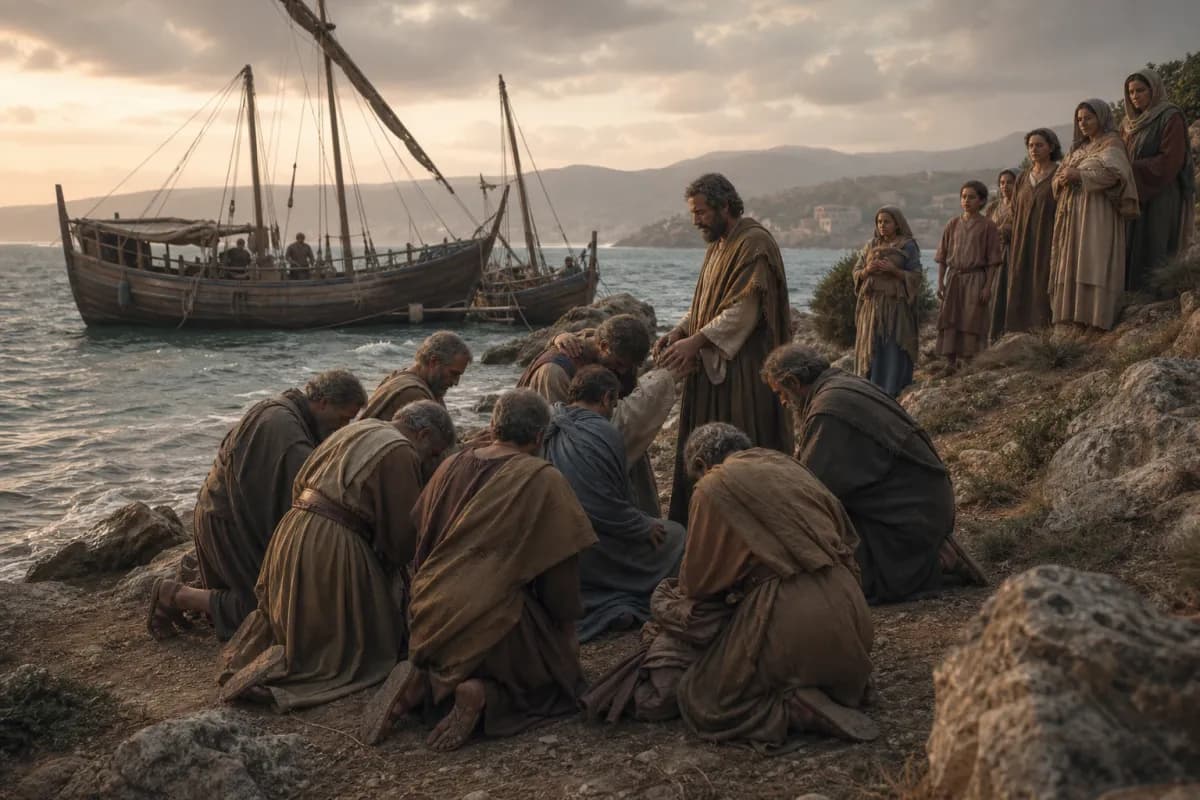
20:36When he had spoken these things, he knelt down and prayed with them all.
20:37They all wept freely, and fell on Paul’s neck and kissed him,
20:38sorrowing most of all because of the word which he had spoken, that they should see his face no more. Then they accompanied him to the ship.
Acts 21
21:1When we had departed from them and had set sail, we came with a straight course to Cos, and the next day to Rhodes, and from there to Patara.
21:2Having found a ship crossing over to Phoenicia, we went aboard and set sail.
21:3When we had come in sight of Cyprus, leaving it on the left hand, we sailed to Syria and landed at Tyre, for the ship was there to unload her cargo.
21:4Having found disciples, we stayed there seven days. These said to Paul through the Spirit that he should not go up to Jerusalem.
21:5When those days were over, we departed and went on our journey. They all, with wives and children, brought us on our way until we were out of the city. Kneeling down on the beach, we prayed.
21:6After saying goodbye to each other, we went on board the ship, and they returned home again.
21:7When we had finished the voyage from Tyre, we arrived at Ptolemais. We greeted the brothers and stayed with them one day.
21:8On the next day, we who were Paul’s companions departed and came to Caesarea. We entered into the house of Philip the evangelist, who was one of the seven, and stayed with him.
21:9Now this man had four virgin daughters who prophesied.
21:10As we stayed there some days, a certain prophet named Agabus came down from Judea.
21:11Coming to us and taking Paul’s belt, he bound his own feet and hands, and said, “The Holy Spirit says: ‘So the Jews at Jerusalem will bind the man who owns this belt, and will deliver him into the hands of the Gentiles.’”
21:12When we heard these things, both we and the people of that place begged him not to go up to Jerusalem.
21:13Then Paul answered, “What are you doing, weeping and breaking my heart? For I am ready not only to be bound, but also to die at Jerusalem for the name of the Lord Jesus.”
21:14When he would not be persuaded, we ceased, saying, “The Lord’s will be done.”
21:15After these days we took up our baggage and went up to Jerusalem.
21:16Some of the disciples from Caesarea also went with us, bringing one Mnason of Cyprus, an early disciple, with whom we would stay.
CONTEXTUAL OVERVIEW
Paul’s proposed journey begins after the word has prevailed in Ephesus, but it immediately exposes the economic cost of abandoning idols. Demetrius’s trade in silver shrines of Artemis gives him a reason to stir fellow artisans, and the theater crowd becomes confused enough that many do not know why they have assembled. The riot shows that the gospel’s challenge to false worship touches livelihoods and civic pride, even when Paul has not led a political revolt.
From this unrest Luke shifts to farewell scenes. Paul’s final words to Ephesian elders carry unusual emotional weight because he expects imprisonment and does not expect to see them again. The warnings along the route are not dismissed; the Spirit is plainly preparing both Paul and the churches for suffering. Yet Paul reads the warnings as a call to readiness rather than a command to turn back from the ministry he received from the Lord Jesus.
HISTORICAL AND LITERARY CONTEXT
Ephesus’s public identity was strongly associated with Artemis and her temple, so Demetrius can frame his economic grievance as concern for the city’s honor and the goddess’s reputation. Luke’s city clerk calms the crowd by insisting that formal accusations belong before proper authorities. The narrative neither celebrates mob action nor claims the church won influence through coercion; it distinguishes Paul’s gospel from a civic disturbance.
Miletus allows Paul to summon Ephesian elders without returning to Ephesus. His address is a pastoral charge shaped by his own ministry among them: humility, tears, trials, public and house-to-house teaching, and the announcement of repentance toward God and faith toward Jesus. At Tyre and Caesarea, the physical departure scenes—kneeling on the beach, families accompanying the travelers, Agabus binding himself—make the coming arrest concrete rather than abstract.
SECTION-BY-SECTION ANALYSIS
- Bound in the Spirit · Acts 20:22Paul’s resolve is Spirit-shaped obedience in the face of unknown details, not confidence that suffering will be avoided.
- The church of God, obtained with his own blood · Acts 20:28Paul’s charge to the elders grounds their care for the flock in Christ’s costly purchase of it.
- Ready to die ... for the name of the Lord Jesus · Acts 21:13Paul’s response to Agabus accepts suffering as a possible consequence of his assigned witness without making suffering itself the goal.
CHRIST IN THIS PASSAGE
Paul’s road is explicitly governed by the ministry he received from the Lord Jesus: testifying to the good news of God’s grace. His willingness to face bonds serves that gospel rather than proving personal toughness. The elders’ flock belongs to God because it was obtained with blood, a direct reference to the costly saving work of Christ that gives pastoral ministry its weight.
The journey also provides a sober echo of Jesus’ own movement toward Jerusalem: neither man turns suffering into spectacle, yet both obey the Father’s purpose despite mounting opposition. The connection is an analogy in discipleship, not an identification of Paul’s suffering with Jesus’ atoning death. Only Christ’s blood obtains the church; Paul bears witness to that finished saving work.
REFLECTION
Paul’s example helps distinguish wisdom from avoidance. He changes routes when a plot is known, receives warnings seriously, and accepts help from companions; still, he will not abandon the gospel task because it may cost him. Ask where fear has made you confuse a costly act of obedience with an irresponsible one, and seek counsel that takes both prudence and Christ’s call seriously.
For those entrusted with others, the Miletus address asks whether care is shaped by Christ’s blood or by control, image, and convenience. Pray for a pastor, elder, parent, or ministry leader by name. Consider one way to strengthen their care for people rather than adding to their burden.
Original Greek Word Study
Acts 20:22
δέω
deo · G1210
Usually translated: to bind or tie
Deo means to bind. Paul is bound in the Spirit toward Jerusalem, expressing a constrained obedience that moves forward even when suffering and uncertainty lie ahead.
Follow the Scripture trail
Bound in the Spirit toward Jerusalem in the larger story
The connection: Christ’s blood has already purchased the church, and Paul’s journey exists to testify to that grace. His road toward Jerusalem echoes the costly obedience of discipleship under the Lord Jesus while preserving the unique saving power of Jesus’ death.
Respond to the passage
Name a gospel-shaped responsibility you have been tempted to abandon because it may bring discomfort. Seek wise counsel, take the next faithful step, and entrust the outcome to the Lord rather than to your ability to control it.
- How does the Ephesian riot reveal the effect of the gospel on idolatry and commerce?
- What does Paul say is more important than preserving his own life?
- Why should Agabus’s warning be read as preparation rather than proof that Paul disobeyed God?
Prayer
Lord Jesus, whose blood obtained Your people, make me wise without making me fearful. Help me receive warning, love Your church, and finish the particular witness You have given me in the strength of Your grace. Amen.