Passage Study
The Arrested Apostle Bears Witness before Jerusalem
Acts 21:17–23:35
Acts 21:17–23:35 turns Paul’s arrest into public testimony. Rumors about his teaching produce a temple riot; Roman soldiers rescue him; Paul recounts his encounter with the risen Jesus and his commission to the Gentiles; he declares a resurrection hope before the council; and a plot to kill him is uncovered. Jesus’ promise that Paul will testify in Rome gives the section its center: hostile Jerusalem cannot cancel His mission.
- In this study
- 89 verses · 5 movements
Acts 21
21:17When we had come to Jerusalem, the brothers received us gladly.
21:18The day following, Paul went in with us to James; and all the elders were present.
21:19When he had greeted them, he reported one by one the things which God had worked among the Gentiles through his ministry.
21:20They, when they heard it, glorified God. They said to him, “You see, brother, how many thousands there are among the Jews of those who have believed, and they are all zealous for the law.
21:21They have been informed about you, that you teach all the Jews who are among the Gentiles to forsake Moses, telling them not to circumcise their children and not to walk after the customs.
21:22What then? The assembly must certainly meet, for they will hear that you have come.
21:23Therefore do what we tell you. We have four men who have taken a vow.
21:24Take them and purify yourself with them, and pay their expenses for them, that they may shave their heads. Then all will know that there is no truth in the things that they have been informed about you, but that you yourself also walk keeping the law.
21:25But concerning the Gentiles who believe, we have written our decision that they should observe no such thing, except that they should keep themselves from food offered to idols, from blood, from strangled things, and from sexual immorality.”
21:26Then Paul took the men, and the next day purified himself and went with them into the temple, declaring the fulfillment of the days of purification, until the offering was offered for every one of them.
21:27When the seven days were almost completed, the Jews from Asia, when they saw him in the temple, stirred up all the multitude and laid hands on him,
21:28crying out, “Men of Israel, help! This is the man who teaches all men everywhere against the people, and the law, and this place. Moreover, he also brought Greeks into the temple and has defiled this holy place!”
21:29For they had seen Trophimus the Ephesian with him in the city, and they supposed that Paul had brought him into the temple.
21:30All the city was moved and the people ran together. They seized Paul and dragged him out of the temple. Immediately the doors were shut.
21:31As they were trying to kill him, news came up to the commanding officer of the regiment that all Jerusalem was in an uproar.
21:32Immediately he took soldiers and centurions and ran down to them. They, when they saw the chief captain and the soldiers, stopped beating Paul.
21:33Then the commanding officer came near, arrested him, commanded him to be bound with two chains, and inquired who he was and what he had done.
21:34Some shouted one thing and some another, among the crowd. When he couldn’t find out the truth because of the noise, he commanded him to be brought into the barracks.
21:35When he came to the stairs, he was carried by the soldiers because of the violence of the crowd;
21:36for the multitude of the people followed after, crying out, “Away with him!”
21:37As Paul was about to be brought into the barracks, he asked the commanding officer, “May I speak to you?” He said, “Do you know Greek?
21:38Aren’t you then the Egyptian who before these days stirred up to sedition and led out into the wilderness the four thousand men of the Assassins?”
21:39But Paul said, “I am a Jew from Tarsus in Cilicia, a citizen of no insignificant city. I beg you, allow me to speak to the people.”
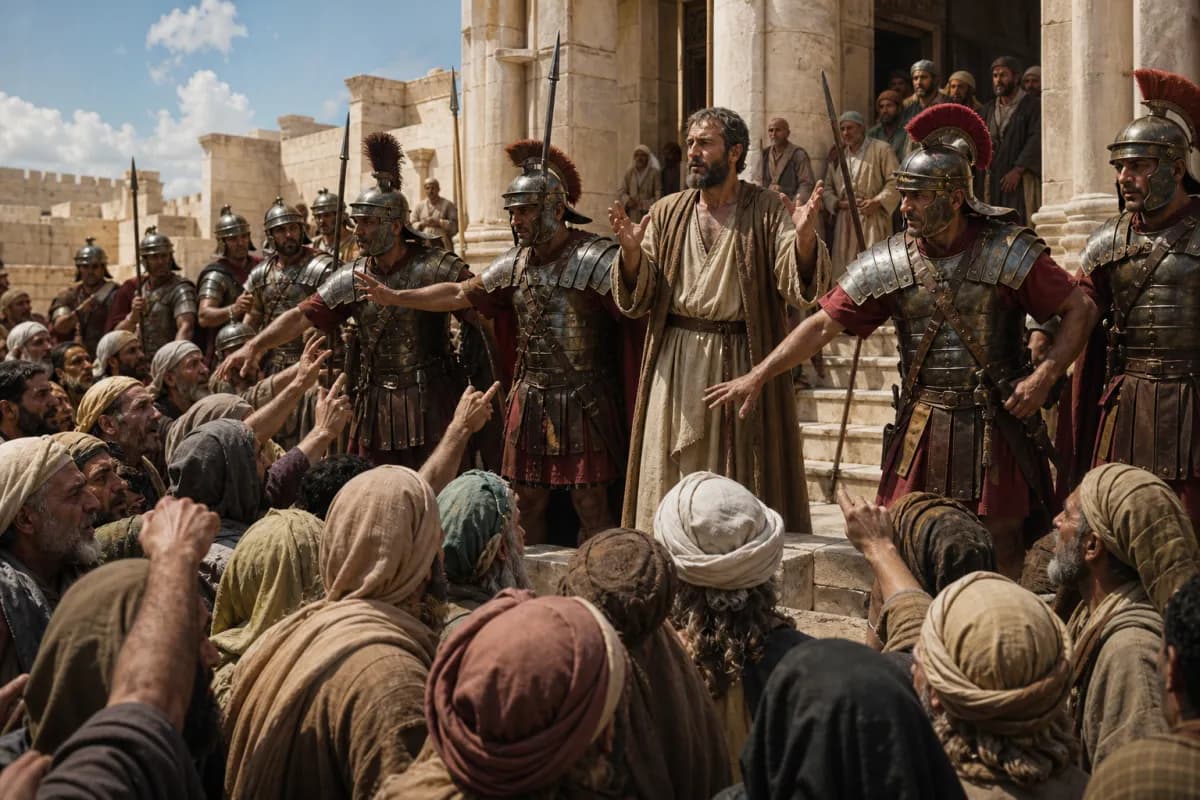
21:40When he had given him permission, Paul, standing on the stairs, beckoned with his hand to the people. When there was a great silence, he spoke to them in the Hebrew language, saying,
Acts 22
22:1“Brothers and fathers, listen to the defense which I now make to you.”
22:2When they heard that he spoke to them in the Hebrew language, they were even more quiet. He said,
22:3“I am indeed a Jew, born in Tarsus of Cilicia, but brought up in this city at the feet of Gamaliel, instructed according to the strict tradition of the law of our fathers, being zealous for God, even as you all are today.
22:4I persecuted this Way to the death, binding and delivering into prisons both men and women,
22:5as also the high priest and all the council of the elders testify, from whom also I received letters to the brothers, and traveled to Damascus to bring them also who were there to Jerusalem in bonds to be punished.
22:6“As I made my journey and came close to Damascus, about noon suddenly a great light shone around me from the sky.
22:7I fell to the ground and heard a voice saying to me, ‘Saul, Saul, why are you persecuting me?’
22:8I answered, ‘Who are you, Lord?’ He said to me, ‘I am Jesus of Nazareth, whom you persecute.’
22:9“Those who were with me indeed saw the light and were afraid, but they didn’t understand the voice of him who spoke to me.
22:10I said, ‘What shall I do, Lord?’ The Lord said to me, ‘Arise, and go into Damascus. There you will be told about all things which are appointed for you to do.’
22:11When I couldn’t see for the glory of that light, being led by the hand of those who were with me, I came into Damascus.
22:12“One Ananias, a devout man according to the law, well reported of by all the Jews who lived in Damascus,
22:13came to me, and standing by me said to me, ‘Brother Saul, receive your sight!’ In that very hour I looked up at him.
22:14He said, ‘The God of our fathers has appointed you to know his will, and to see the Righteous One, and to hear a voice from his mouth.
22:15For you will be a witness for him to all men of what you have seen and heard.
22:16Now why do you wait? Arise, be baptized, and wash away your sins, calling on the name of the Lord.’
22:17“When I had returned to Jerusalem and while I prayed in the temple, I fell into a trance
22:18and saw him saying to me, ‘Hurry and get out of Jerusalem quickly, because they will not receive testimony concerning me from you.’
22:19I said, ‘Lord, they themselves know that I imprisoned and beat in every synagogue those who believed in you.
22:20When the blood of Stephen, your witness, was shed, I also was standing by, consenting to his death, and guarding the cloaks of those who killed him.’
22:21“He said to me, ‘Depart, for I will send you out far from here to the Gentiles.’ ”
22:22They listened to him until he said that; then they lifted up their voice and said, “Rid the earth of this fellow, for he isn’t fit to live!”
22:23As they cried out, threw off their cloaks, and threw dust into the air,
22:24the commanding officer commanded him to be brought into the barracks, ordering him to be examined by scourging, that he might know for what crime they shouted against him like that.
22:25When they had tied him up with straps, Paul asked the centurion who stood by, “Is it lawful for you to scourge a man who is a Roman, and not found guilty?”
22:26When the centurion heard it, he went to the commanding officer and told him, “Watch what you are about to do, for this man is a Roman!”
22:27The commanding officer came and asked him, “Tell me, are you a Roman?” He said, “Yes.”
22:28The commanding officer answered, “I bought my citizenship for a great price.” Paul said, “But I was born a Roman.”
22:29Immediately those who were about to examine him departed from him, and the commanding officer also was afraid when he realized that he was a Roman, because he had bound him.
22:30But on the next day, desiring to know the truth about why he was accused by the Jews, he freed him from the bonds and commanded the chief priests and all the council to come together, and brought Paul down and set him before them.
Acts 23
23:1Paul, looking steadfastly at the council, said, “Brothers, I have lived before God in all good conscience until today.”
23:2The high priest, Ananias, commanded those who stood by him to strike him on the mouth.
23:3Then Paul said to him, “God will strike you, you whitewashed wall! Do you sit to judge me according to the law, and command me to be struck contrary to the law?”
23:4Those who stood by said, “Do you malign God’s high priest?”
23:5Paul said, “I didn’t know, brothers, that he was high priest. For it is written, ‘You shall not speak evil of a ruler of your people.’”
23:6But when Paul perceived that the one part were Sadducees and the other Pharisees, he cried out in the council, “Men and brothers, I am a Pharisee, a son of Pharisees. Concerning the hope and resurrection of the dead I am being judged!”
23:7When he had said this, an argument arose between the Pharisees and Sadducees, and the crowd was divided.
23:8For the Sadducees say that there is no resurrection, nor angel, nor spirit; but the Pharisees confess all of these.
23:9A great clamor arose, and some of the scribes of the Pharisees’ part stood up, and contended, saying, “We find no evil in this man. But if a spirit or angel has spoken to him, let’s not fight against God!”
23:10When a great argument arose, the commanding officer, fearing that Paul would be torn in pieces by them, commanded the soldiers to go down and take him by force from among them and bring him into the barracks.
23:11The following night, the Lord stood by him and said, “Cheer up, Paul, for as you have testified about me at Jerusalem, so you must testify also at Rome.”
23:12When it was day, some of the Jews banded together and bound themselves under a curse, saying that they would neither eat nor drink until they had killed Paul.
23:13There were more than forty people who had made this conspiracy.
23:14They came to the chief priests and the elders, and said, “We have bound ourselves under a great curse to taste nothing until we have killed Paul.
23:15Now therefore, you with the council inform the commanding officer that he should bring him down to you tomorrow, as though you were going to judge his case more exactly. We are ready to kill him before he comes near.”
23:16But Paul’s sister’s son heard they were lying in wait, and he came and entered into the barracks and told Paul.
23:17Paul summoned one of the centurions and said, “Bring this young man to the commanding officer, for he has something to tell him.”
23:18So he took him and brought him to the commanding officer and said, “Paul, the prisoner, summoned me and asked me to bring this young man to you. He has something to tell you.”
23:19The commanding officer took him by the hand, and going aside, asked him privately, “What is it that you have to tell me?”
23:20He said, “The Jews have agreed to ask you to bring Paul down to the council tomorrow, as though intending to inquire somewhat more accurately concerning him.
23:21Therefore don’t yield to them, for more than forty men lie in wait for him, who have bound themselves under a curse to neither eat nor drink until they have killed him. Now they are ready, looking for the promise from you.”
23:22So the commanding officer let the young man go, charging him, “Tell no one that you have revealed these things to me.”
23:23He called to himself two of the centurions, and said, “Prepare two hundred soldiers to go as far as Caesarea, with seventy horsemen and two hundred men armed with spears, at the third hour of the night.”
23:24He asked them to provide mounts, that they might set Paul on one, and bring him safely to Felix the governor.
23:25He wrote a letter like this:
23:26“Claudius Lysias to the most excellent governor Felix: Greetings.
23:27“This man was seized by the Jews, and was about to be killed by them when I came with the soldiers and rescued him, having learned that he was a Roman.
23:28Desiring to know the cause why they accused him, I brought him down to their council.
23:29I found him to be accused about questions of their law, but not to be charged with anything worthy of death or of imprisonment.
23:30When I was told that the Jews lay in wait for the man, I sent him to you immediately, charging his accusers also to bring their accusations against him before you. Farewell.”
23:31So the soldiers, carrying out their orders, took Paul and brought him by night to Antipatris.
23:32But on the next day they left the horsemen to go with him, and returned to the barracks.
23:33When they came to Caesarea and delivered the letter to the governor, they also presented Paul to him.
23:34When the governor had read it, he asked what province he was from. When he understood that he was from Cilicia, he said,
23:35“I will hear you fully when your accusers also arrive.” He commanded that he be kept in Herod’s palace.
CONTEXTUAL OVERVIEW
Paul arrives in Jerusalem with reports of Gentile churches and meets James and the elders. They glorify God for the mission but know that rumors portray Paul as teaching Jews to abandon Moses. His participation in a purification rite is a voluntary act meant to demonstrate that he does not despise Jewish practices. It does not reverse the council’s earlier decision that Gentiles need not be circumcised to be saved.
The temple scene explodes when Jews from Asia recognize Paul and falsely claim that he has brought Greeks into the restricted area. The city is stirred, Paul is dragged from the temple, and Roman soldiers intervene before the crowd kills him. From the stairs Paul gains permission to address the crowd in their language, turning an attempted lynching into an account of Jesus’ appearance, Ananias’s welcome, baptism, and commission.
HISTORICAL AND LITERARY CONTEXT
The temple’s courts involved distinct access boundaries, which explains why the accusation of bringing a Gentile inside could ignite such anger. Luke says the charge arose from an inference: the accusers had seen Trophimus the Ephesian with Paul in the city. The claim is not presented as established fact. Roman authority enters because disorder at the temple threatens public order, and the tribune initially misunderstands Paul’s identity.
The council contains both Sadducees and Pharisees, groups divided over resurrection, angels, and spirits. Paul’s declaration that he is on trial because of the hope and resurrection of the dead brings that theological division into the open. The subsequent plot by more than forty men and the escort to Caesarea show that the danger is not rhetorical. Yet Luke’s narration keeps returning to God’s direction rather than treating Roman protection as the ultimate source of safety.
SECTION-BY-SECTION ANALYSIS
- Calling on his name · Acts 22:16Paul’s baptism account connects cleansing from sin with invocation of Jesus, not merely with a change in public allegiance.
- The hope and the resurrection of the dead · Acts 23:6Paul identifies the resurrection as the issue at stake before the council, locating his witness in God’s promised victory over death.
- So you must testify also in Rome · Acts 23:11The Lord’s promise gives Paul’s dangerous transfer a mission horizon that hostile planners cannot close.
CHRIST IN THIS PASSAGE
Paul’s defense is Christ-centered from beginning to end. The risen Jesus meets him, sends Ananias, receives his invoked name in baptism, and commissions him to the Gentiles. Paul does not defend himself by narrating moral improvement alone; he bears witness to the Lord who interrupted his violence and made him a servant of the message he had tried to destroy.
Jesus’ statement that Paul will testify in Rome gives the arrest its saving-mission purpose. The resurrection hope Paul announces is not a philosophical survival claim but the hope secured by the risen Christ. The parallels with Jesus’ arrest in Jerusalem are real as a pattern of rejected witness, yet Paul’s suffering does not atone. He points to the one Savior whose death and resurrection cleanse sinners and whose mission moves onward.
REFLECTION
Paul’s speech before the crowd shows that a personal testimony can be specific without making the speaker the hero. He names his former violence, Jesus’ interruption, Ananias’s words, and his commission. Consider writing a short account of how Christ met you that puts His mercy, rather than your spiritual achievement, at the center.
The Lord does not promise Paul an easy exit from Jerusalem; He promises a continuing witness in Rome. When opposition or misunderstanding feels like a closed future, ask Jesus to show the next truthful word or act. His mission may continue through circumstances you would never choose.
Original Greek Word Study
Acts 22:15
μαρτυρέω
martyreo · G3140
Usually translated: to bear witness or testify
Martyreo means to bear witness or testify. Paul’s defense turns his arrest into testimony, recounting the risen Jesus who made him a witness before all people.
Follow the Scripture trail
The Arrested Apostle Bears Witness before Jerusalem in the larger story
The connection: The risen Jesus transforms Paul from persecutor to witness, sends him toward Gentiles, and promises testimony in Rome. Paul’s arrest advances rather than defeats the mission of the Savior whose resurrection establishes the hope he proclaims.
Respond to the passage
Tell the truth about one way Jesus has redirected your life, giving Him rather than yourself the credit. Pray for courage to speak of His resurrection when the setting is tense, and trust Him with the results.
- Why does Paul join the purification rite after the Jerusalem council’s decision about Gentiles?
- What part of Paul’s testimony causes the crowd to erupt?
- How does Jesus’ promise about Rome change the meaning of the arrest?
Prayer
Risen Jesus, thank You for meeting enemies with mercy and sending witnesses to the nations. Give me a truthful testimony, courage under misunderstanding, and confidence that Your mission is not stopped by opposition. Amen.