Passage Study
The Gospel Reaches Rome through Trials, Storm, and Witness
Acts 24:1–28:31
Acts 24:1–28:31 follows Paul through hearings before Felix, Festus, and Agrippa, a dangerous sea voyage, shipwreck on Malta, and guarded proclamation in Rome. He defends the resurrection hope and the Way without flattery or violence, appeals to Caesar, survives the storm through God’s promise, and teaches openly about God’s kingdom and the Lord Jesus. The book closes not with Paul’s verdict but with the unhindered advance of Christ’s message in the empire’s capital.
- In this study
- 161 verses · 5 movements
Acts 24
24:1After five days, the high priest, Ananias, came down with certain elders and an orator, one Tertullus. They informed the governor against Paul.
24:2When he was called, Tertullus began to accuse him, saying, “Seeing that by you we enjoy much peace, and that prosperity is coming to this nation by your foresight,
24:3we accept it in all ways and in all places, most excellent Felix, with all thankfulness.
24:4But that I don’t delay you, I entreat you to bear with us and hear a few words.
24:5For we have found this man to be a plague, an instigator of insurrections among all the Jews throughout the world, and a ringleader of the sect of the Nazarenes.
24:6He even tried to profane the temple, and we arrested him.
24:8By examining him yourself you may ascertain all these things of which we accuse him.”
24:9The Jews also joined in the attack, affirming that these things were so.
24:10When the governor had beckoned to him to speak, Paul answered, “Because I know that you have been a judge of this nation for many years, I cheerfully make my defense,
24:11seeing that you can verify that it is not more than twelve days since I went up to worship at Jerusalem.
24:12In the temple they didn’t find me disputing with anyone or stirring up a crowd, either in the synagogues or in the city.
24:13Nor can they prove to you the things of which they now accuse me.
24:14But this I confess to you, that according to the Way, which they call a sect, so I serve the God of our fathers, believing all things which are according to the law, and which are written in the prophets;
24:15having hope toward God, which these also themselves look for, that there will be a resurrection of the dead, both of the just and unjust.
24:16In this I also practice always having a conscience void of offense toward God and men.
24:17Now after some years, I came to bring gifts for the needy to my nation, and offerings;
24:18amid which certain Jews from Asia found me purified in the temple, not with a mob, nor with turmoil.
24:19They ought to have been here before you and to make accusation if they had anything against me.
24:20Or else let these men themselves say what injustice they found in me when I stood before the council,
24:21unless it is for this one thing that I cried standing among them, ‘Concerning the resurrection of the dead I am being judged before you today!’”
24:22But Felix, having more exact knowledge concerning the Way, deferred them, saying, “When Lysias, the commanding officer, comes down, I will decide your case.”
24:23He ordered the centurion that Paul should be kept in custody and should have some privileges, and not to forbid any of his friends to serve him or to visit him.
24:24After some days, Felix came with Drusilla his wife, who was a Jewess, and sent for Paul and heard him concerning the faith in Christ Jesus.
24:25As he reasoned about righteousness, self-control, and the judgment to come, Felix was terrified, and answered, “Go your way for this time, and when it is convenient for me, I will summon you.”
24:26Meanwhile, he also hoped that money would be given to him by Paul, that he might release him. Therefore also he sent for him more often and talked with him.
24:27But when two years were fulfilled, Felix was succeeded by Porcius Festus, and desiring to gain favor with the Jews, Felix left Paul in bonds.
Acts 25
25:1Festus therefore, having come into the province, after three days went up to Jerusalem from Caesarea.
25:2Then the high priest and the principal men of the Jews informed him against Paul, and they begged him,
25:3asking a favor against him, that he would summon him to Jerusalem, plotting to kill him on the way.
25:4However Festus answered that Paul should be kept in custody at Caesarea, and that he himself was about to depart shortly.
25:5“Let them therefore”, he said, “that are in power among you go down with me, and if there is anything wrong in the man, let them accuse him.”
25:6When he had stayed among them more than ten days, he went down to Caesarea, and on the next day he sat on the judgment seat, and commanded Paul to be brought.
25:7When he had come, the Jews who had come down from Jerusalem stood around him, bringing against him many and grievous charges which they could not prove,
25:8while he said in his defense, “Neither against the law of the Jews, nor against the temple, nor against Caesar, have I sinned at all.”
25:9But Festus, desiring to gain favor with the Jews, answered Paul and said, “Are you willing to go up to Jerusalem and be judged by me there concerning these things?”
25:10But Paul said, “I am standing before Caesar’s judgment seat, where I ought to be tried. I have done no wrong to the Jews, as you also know very well.
25:11For if I have done wrong and have committed anything worthy of death, I don’t refuse to die; but if none of those things is true that they accuse me of, no one can give me up to them. I appeal to Caesar!”
25:12Then Festus, when he had conferred with the council, answered, “You have appealed to Caesar. To Caesar you shall go.”
25:13Now when some days had passed, King Agrippa and Bernice arrived at Caesarea and greeted Festus.
25:14As he stayed there many days, Festus laid Paul’s case before the king, saying, “There is a certain man left a prisoner by Felix;
25:15about whom, when I was at Jerusalem, the chief priests and the elders of the Jews informed me, asking for a sentence against him.
25:16I answered them that it is not the custom of the Romans to give up any man to destruction before the accused has met the accusers face to face and has had opportunity to make his defense concerning the matter laid against him.
25:17When therefore they had come together here, I didn’t delay, but on the next day sat on the judgment seat and commanded the man to be brought.
25:18When the accusers stood up, they brought no charges against him of such things as I supposed;
25:19but had certain questions against him about their own religion and about one Jesus, who was dead, whom Paul affirmed to be alive.
25:20Being perplexed how to inquire concerning these things, I asked whether he was willing to go to Jerusalem and there be judged concerning these matters.
25:21But when Paul had appealed to be kept for the decision of the emperor, I commanded him to be kept until I could send him to Caesar.”
25:22Agrippa said to Festus, “I also would like to hear the man myself.” “Tomorrow,” he said, “you shall hear him.”
25:23So on the next day, when Agrippa and Bernice had come with great pomp, and they had entered into the place of hearing with the commanding officers and the principal men of the city, at the command of Festus, Paul was brought in.
25:24Festus said, “King Agrippa, and all men who are here present with us, you see this man about whom all the multitude of the Jews petitioned me, both at Jerusalem and here, crying that he ought not to live any longer.
25:25But when I found that he had committed nothing worthy of death, and as he himself appealed to the emperor, I determined to send him,
25:26of whom I have no certain thing to write to my lord. Therefore I have brought him out before you, and especially before you, King Agrippa, that, after examination I may have something to write.
25:27For it seems to me unreasonable, in sending a prisoner, not to also specify the charges against him.”
Acts 26
26:1Agrippa said to Paul, “You may speak for yourself.” Then Paul stretched out his hand, and made his defense.
26:2“I think myself happy, King Agrippa, that I am to make my defense before you today concerning all the things that I am accused by the Jews,
26:3especially because you are expert in all customs and questions which are among the Jews. Therefore I beg you to hear me patiently.
26:4“Indeed, all the Jews know my way of life from my youth up, which was from the beginning among my own nation and at Jerusalem;
26:5having known me from the first, if they are willing to testify, that after the strictest sect of our religion I lived a Pharisee.
26:6Now I stand here to be judged for the hope of the promise made by God to our fathers,
26:7which our twelve tribes, earnestly serving night and day, hope to attain. Concerning this hope I am accused by the Jews, King Agrippa!
26:8Why is it judged incredible with you if God does raise the dead?
26:9“I myself most certainly thought that I ought to do many things contrary to the name of Jesus of Nazareth.
26:10I also did this in Jerusalem. I both shut up many of the saints in prisons, having received authority from the chief priests; and when they were put to death I gave my vote against them.
26:11Punishing them often in all the synagogues, I tried to make them blaspheme. Being exceedingly enraged against them, I persecuted them even to foreign cities.
26:12“Whereupon as I traveled to Damascus with the authority and commission from the chief priests,
26:13at noon, O king, I saw on the way a light from the sky, brighter than the sun, shining around me and those who traveled with me.
26:14When we had all fallen to the earth, I heard a voice saying to me in the Hebrew language, ‘Saul, Saul, why are you persecuting me? It is hard for you to kick against the goads.’
26:15“I said, ‘Who are you, Lord?’ “He said, ‘I am Jesus, whom you are persecuting.
26:16But arise, and stand on your feet, for I have appeared to you for this purpose: to appoint you a servant and a witness both of the things which you have seen and of the things which I will reveal to you;
26:17delivering you from the people and from the Gentiles, to whom I send you,
26:18to open their eyes, that they may turn from darkness to light and from the power of Satan to God, that they may receive remission of sins and an inheritance among those who are sanctified by faith in me.’
26:19“Therefore, King Agrippa, I was not disobedient to the heavenly vision,
26:20but declared first to them of Damascus, at Jerusalem, and throughout all the country of Judea, and also to the Gentiles, that they should repent and turn to God, doing works worthy of repentance.
26:21For this reason the Jews seized me in the temple and tried to kill me.
26:22Having therefore obtained the help that is from God, I stand to this day testifying both to small and great, saying nothing but what the prophets and Moses said would happen,
26:23how the Christ must suffer, and how, by the resurrection of the dead, he would be first to proclaim light both to these people and to the Gentiles.”
26:24As he thus made his defense, Festus said with a loud voice, “Paul, you are crazy! Your great learning is driving you insane!”
26:25But he said, “I am not crazy, most excellent Festus, but boldly declare words of truth and reasonableness.
26:26For the king knows of these things, to whom also I speak freely. For I am persuaded that none of these things is hidden from him, for this has not been done in a corner.
26:27King Agrippa, do you believe the prophets? I know that you believe.”
26:28Agrippa said to Paul, “With a little persuasion are you trying to make me a Christian?”
26:29Paul said, “I pray to God, that whether with little or with much, not only you, but also all that hear me today, might become such as I am, except for these bonds.”
26:30The king rose up with the governor and Bernice, and those who sat with them.
26:31When they had withdrawn, they spoke to one another, saying, “This man does nothing worthy of death or of bonds.”
26:32Agrippa said to Festus, “This man might have been set free if he had not appealed to Caesar.”
Acts 27
27:1When it was determined that we should sail for Italy, they delivered Paul and certain other prisoners to a centurion named Julius, of the Augustan band.
27:2Embarking in a ship of Adramyttium, which was about to sail to places on the coast of Asia, we put to sea, Aristarchus, a Macedonian of Thessalonica being with us.
27:3The next day, we touched at Sidon. Julius treated Paul kindly and gave him permission to go to his friends and refresh himself.
27:4Putting to sea from there, we sailed under the lee of Cyprus, because the winds were contrary.
27:5When we had sailed across the sea which is off Cilicia and Pamphylia, we came to Myra, a city of Lycia.
27:6There the centurion found a ship of Alexandria sailing for Italy, and he put us on board.
27:7When we had sailed slowly many days, and had come with difficulty opposite Cnidus, the wind not allowing us further, we sailed under the lee of Crete, opposite Salmone.
27:8With difficulty sailing along it we came to a certain place called Fair Havens, near the city of Lasea.
27:9When much time had passed and the voyage was now dangerous because the Fast had now already gone by, Paul admonished them
27:10and said to them, “Sirs, I perceive that the voyage will be with injury and much loss, not only of the cargo and the ship, but also of our lives.”
27:11But the centurion gave more heed to the master and to the owner of the ship than to those things which were spoken by Paul.
27:12Because the haven was not suitable to winter in, the majority advised going to sea from there, if by any means they could reach Phoenix and winter there, which is a port of Crete, looking southwest and northwest.
27:13When the south wind blew softly, supposing that they had obtained their purpose, they weighed anchor and sailed along Crete, close to shore.
27:14But before long, a stormy wind beat down from shore, which is called Euroclydon.
27:15When the ship was caught and couldn’t face the wind, we gave way to it and were driven along.
27:16Running under the lee of a small island called Clauda, we were able, with difficulty, to secure the boat.
27:17After they had hoisted it up, they used cables to help reinforce the ship. Fearing that they would run aground on the Syrtis sand bars, they lowered the sea anchor, and so were driven along.
27:18As we labored exceedingly with the storm, the next day they began to throw things overboard.
27:19On the third day, they threw out the ship’s tackle with their own hands.
27:20When neither sun nor stars shone on us for many days, and no small storm pressed on us, all hope that we would be saved was now taken away.
27:21When they had been long without food, Paul stood up in the middle of them and said, “Sirs, you should have listened to me, and not have set sail from Crete and have gotten this injury and loss.
27:22Now I exhort you to cheer up, for there will be no loss of life among you, but only of the ship.
27:23For there stood by me this night an angel, belonging to the God whose I am and whom I serve,
27:24saying, ‘Don’t be afraid, Paul. You must stand before Caesar. Behold, God has granted you all those who sail with you.’
27:25Therefore, sirs, cheer up! For I believe God, that it will be just as it has been spoken to me.
27:26But we must run aground on a certain island.”
27:27But when the fourteenth night had come, as we were driven back and forth in the Adriatic Sea, about midnight the sailors surmised that they were drawing near to some land.
27:28They took soundings and found twenty fathoms. After a little while, they took soundings again, and found fifteen fathoms.
27:29Fearing that we would run aground on rocky ground, they let go four anchors from the stern, and wished for daylight.
27:30As the sailors were trying to flee out of the ship and had lowered the boat into the sea, pretending that they would lay out anchors from the bow,
27:31Paul said to the centurion and to the soldiers, “Unless these stay in the ship, you can’t be saved.”
27:32Then the soldiers cut away the ropes of the boat and let it fall off.
27:33While the day was coming on, Paul begged them all to take some food, saying, “Today is the fourteenth day that you wait and continue fasting, having taken nothing.
27:34Therefore I beg you to take some food, for this is for your safety; for not a hair will perish from any of your heads.”
27:35When he had said this and had taken bread, he gave thanks to God in the presence of all; then he broke it and began to eat.
27:36Then they all cheered up, and they also took food.
27:37In all, we were two hundred seventy-six souls on the ship.
27:38When they had eaten enough, they lightened the ship, throwing out the wheat into the sea.
27:39When it was day, they didn’t recognize the land, but they noticed a certain bay with a beach, and they decided to try to drive the ship onto it.
27:40Casting off the anchors, they left them in the sea, at the same time untying the rudder ropes. Hoisting up the foresail to the wind, they made for the beach.
27:41But coming to a place where two seas met, they ran the vessel aground. The bow struck and remained immovable, but the stern began to break up by the violence of the waves.
27:42The soldiers’ counsel was to kill the prisoners, so that none of them would swim out and escape.
27:43But the centurion, desiring to save Paul, stopped them from their purpose, and commanded that those who could swim should throw themselves overboard first to go toward the land;
27:44and the rest should follow, some on planks and some on other things from the ship. So they all escaped safely to the land.
Acts 28
28:1When we had escaped, then they learned that the island was called Malta.
28:2The natives showed us uncommon kindness; for they kindled a fire and received us all, because of the present rain and because of the cold.
28:3But when Paul had gathered a bundle of sticks and laid them on the fire, a viper came out because of the heat and fastened on his hand.
28:4When the natives saw the creature hanging from his hand, they said to one another, “No doubt this man is a murderer, whom, though he has escaped from the sea, yet Justice has not allowed to live.”
28:5However he shook off the creature into the fire, and wasn’t harmed.
28:6But they expected that he would have swollen or fallen down dead suddenly, but when they watched for a long time and saw nothing bad happen to him, they changed their minds and said that he was a god.
28:7Now in the neighborhood of that place were lands belonging to the chief man of the island, named Publius, who received us and courteously entertained us for three days.
28:8The father of Publius lay sick of fever and dysentery. Paul entered in to him, prayed, and laying his hands on him, healed him.
28:9Then when this was done, the rest also who had diseases in the island came and were cured.
28:10They also honored us with many honors; and when we sailed, they put on board the things that we needed.
28:11After three months, we set sail in a ship of Alexandria which had wintered in the island, whose figurehead was “The Twin Brothers.”
28:12Touching at Syracuse, we stayed there three days.
28:13From there we circled around and arrived at Rhegium. After one day, a south wind sprang up, and on the second day we came to Puteoli,
28:14where we found brothers, and were entreated to stay with them for seven days. So we came to Rome.
28:15From there the brothers, when they heard of us, came to meet us as far as The Market of Appius and The Three Taverns. When Paul saw them, he thanked God and took courage.
28:16When we entered into Rome, the centurion delivered the prisoners to the captain of the guard, but Paul was allowed to stay by himself with the soldier who guarded him.
28:17After three days Paul called together those who were the leaders of the Jews. When they had come together, he said to them, “I, brothers, though I had done nothing against the people or the customs of our fathers, still was delivered prisoner from Jerusalem into the hands of the Romans,
28:18who, when they had examined me, desired to set me free, because there was no cause of death in me.
28:19But when the Jews spoke against it, I was constrained to appeal to Caesar, not that I had anything about which to accuse my nation.
28:20For this cause therefore I asked to see you and to speak with you. For because of the hope of Israel I am bound with this chain.”
28:21They said to him, “We neither received letters from Judea concerning you, nor did any of the brothers come here and report or speak any evil of you.
28:22But we desire to hear from you what you think. For, as concerning this sect, it is known to us that everywhere it is spoken against.”
28:23When they had appointed him a day, many people came to him at his lodging. He explained to them, testifying about God’s Kingdom, and persuading them concerning Jesus, both from the law of Moses and from the prophets, from morning until evening.
28:24Some believed the things which were spoken, and some disbelieved.
28:25When they didn’t agree among themselves, they departed after Paul had spoken one message: “The Holy Spirit spoke rightly through Isaiah the prophet to our fathers,
28:26saying, ‘Go to this people and say, in hearing, you will hear, but will in no way understand. In seeing, you will see, but will in no way perceive.
28:27For this people’s heart has grown callous. Their ears are dull of hearing. Their eyes they have closed. Lest they should see with their eyes, hear with their ears, understand with their heart, and would turn again, then I would heal them.’
28:28“Be it known therefore to you that the salvation of God is sent to the nations, and they will listen.”
28:29When he had said these words, the Jews departed, having a great dispute among themselves.
28:30Paul stayed two whole years in his own rented house and received all who were coming to him,
28:31preaching God’s Kingdom and teaching the things concerning the Lord Jesus Christ with all boldness, without hindrance.
CONTEXTUAL OVERVIEW
Acts’ final movement places the gospel before governors, a king, soldiers, sailors, and Rome’s Jewish leaders. Paul faces formal accusations, but each hearing becomes an occasion to state his conscience before God, his hope in the resurrection, and his encounter with the risen Jesus. Luke records real injustice—Felix hopes for a bribe and leaves Paul imprisoned to please people—without suggesting that political access itself is the church’s salvation.
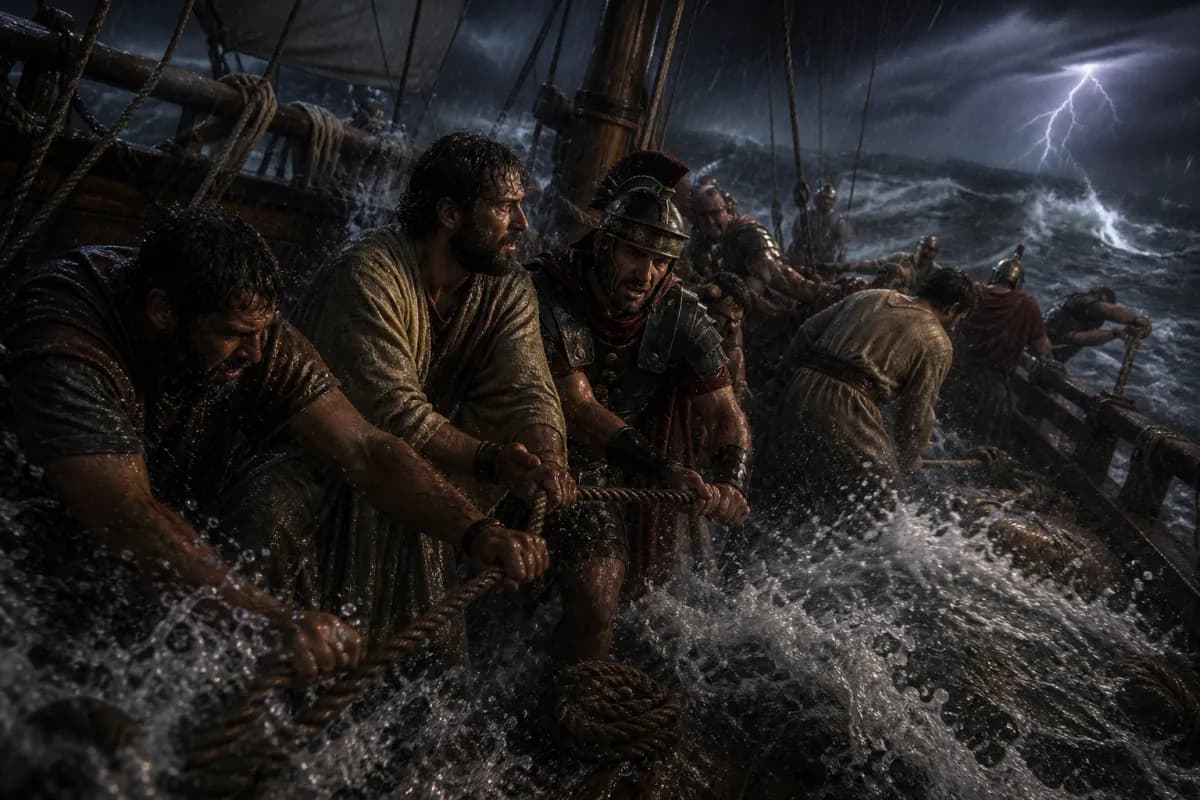
The voyage turns Paul from prisoner into a calm, trusted voice amid a storm. He does not control the sea or erase the sailors’ fear, but he receives an angelic promise that he will stand before Caesar and that God has granted the lives of those sailing with him. The ship is lost, yet all reach land. At Rome, Paul remains under guard but receives visitors freely and uses that constrained setting to explain the kingdom of God and teach about the Lord Jesus.
HISTORICAL AND LITERARY CONTEXT
Felix, Festus, and Agrippa represent different levels of Roman and Herodian authority. Tertullus’s speech uses flattering political language and portrays Paul as a danger, while Paul answers by distinguishing his worship of Israel’s God from incitement. His appeal to Caesar is a legal use of Roman citizenship after Festus proposes a Jerusalem trial. Luke presents the appeal as part of the path toward Rome promised by Jesus, not as a claim that Roman courts are consistently just.
Mediterranean sea travel was hazardous after the fast, and the narrative’s detail about anchors, a skiff, grain, and a reef gives the storm its physical force. Paul’s shipboard counsel includes practical commands: the sailors must remain aboard, passengers must eat, and everyone must act. God’s promise of rescue does not make human action irrelevant. Malta then becomes an unexpected place of welcome and healing before the final voyage to Italy.
SECTION-BY-SECTION ANALYSIS
- Hope in the resurrection · Acts 24:15Paul’s courtroom defense identifies the resurrection as the theological center of his case, not merely a point in a personal dispute.
- You must stand before the emperor · Acts 27:24The angel’s promise connects survival in the storm to Jesus’ earlier assurance that Paul will testify in Rome.
- With all boldness and without hindrance · Acts 28:31Acts ends with a guarded prisoner freely teaching about God’s kingdom and the Lord Jesus, showing that confinement has not confined the gospel.
CHRIST IN THIS PASSAGE
Paul’s message before rulers is explicitly about faith in Christ Jesus, resurrection, forgiveness, and light for Jews and Gentiles. His personal defense reaches back to the risen Lord who commissioned him, and his public hope reaches forward to the resurrection of the dead. Jesus is not invoked to secure Paul’s acquittal alone; He is the Lord whose saving mission calls every hearer, including governors and kings, to repentance and faith.
The Rome ending completes the movement announced in Acts 1:8 without claiming that every person believes. Jesus’ kingdom is proclaimed in the imperial capital by a prisoner under guard, and the word is unhindered because the risen Lord remains its true king. The storm, trial, and house arrest do not add to Christ’s atonement; they become settings in which His completed saving work is explained to new hearers.
REFLECTION
Paul speaks of righteousness, self-control, and judgment before Felix because faith in Christ is not a safe topic for someone with power. Ask where you soften Jesus’ call in order to keep a conversation comfortable. Pray for courage to speak clearly and respectfully about both His mercy and His authority.
The shipwreck teaches active trust. Paul believes God’s promise, warns against abandoning the ship, gives thanks before eating, and helps frightened people act. In a present uncertainty, identify the faithful action available to you while entrusting the outcome to Christ—seek help, tell the truth, prepare carefully, or encourage someone who has lost hope.
Original Greek Word Study
Acts 28:31
βασιλεία
basileia · G932
Usually translated: kingdom, reign, or royal rule
Basileia means kingdom or royal reign. Acts closes with Paul proclaiming God’s kingdom and teaching about the Lord Jesus openly in Rome, showing that the gospel has reached the empire without losing its center.
Follow the Scripture trail
The Gospel Reaches Rome through Trials, Storm, and Witness in the larger story
The connection: The risen Jesus carries His witnesses to Rome, exactly as He promised, through courts and a storm no human strategy can master. Paul’s constrained proclamation keeps Jesus’ saving mission central: forgiveness and resurrection hope are offered to Jews and Gentiles under the reign of God’s true King.
Respond to the passage
Bring one fearful circumstance to the risen Jesus and ask what faithful action is yours to take today. Then look for an opportunity to explain the hope of His resurrection with the honest clarity Paul shows before powerful people.
- Why does Paul speak about resurrection before Felix, Festus, and Agrippa?
- How do God’s promise and the sailors’ actions work together in the storm?
- Why does Luke end Acts with Paul teaching in Rome rather than reporting the final legal verdict?
Prayer
Lord Jesus, King over every court and storm, anchor me in Your resurrection hope. Give me courage to speak Your saving truth, wisdom to act faithfully in uncertainty, and joy that Your word is never finally hindered. Amen.