Passage Study
The Word Spreads from Stephen’s Witness to Samaria’s Joy
Acts 6:1–8:40
Acts 6:1–8:40 follows the gospel beyond its first Jerusalem growth. The church appoints seven trusted servants to address neglected widows; Stephen’s Spirit-filled witness identifies Jesus as the Righteous One and leads to his death; persecution scatters believers; Philip proclaims the Messiah in Samaria and explains Isaiah to an Ethiopian official; and the word advances through suffering, service, Scripture, baptism, and joy.
- In this study
- 115 verses · 5 movements
Acts 6
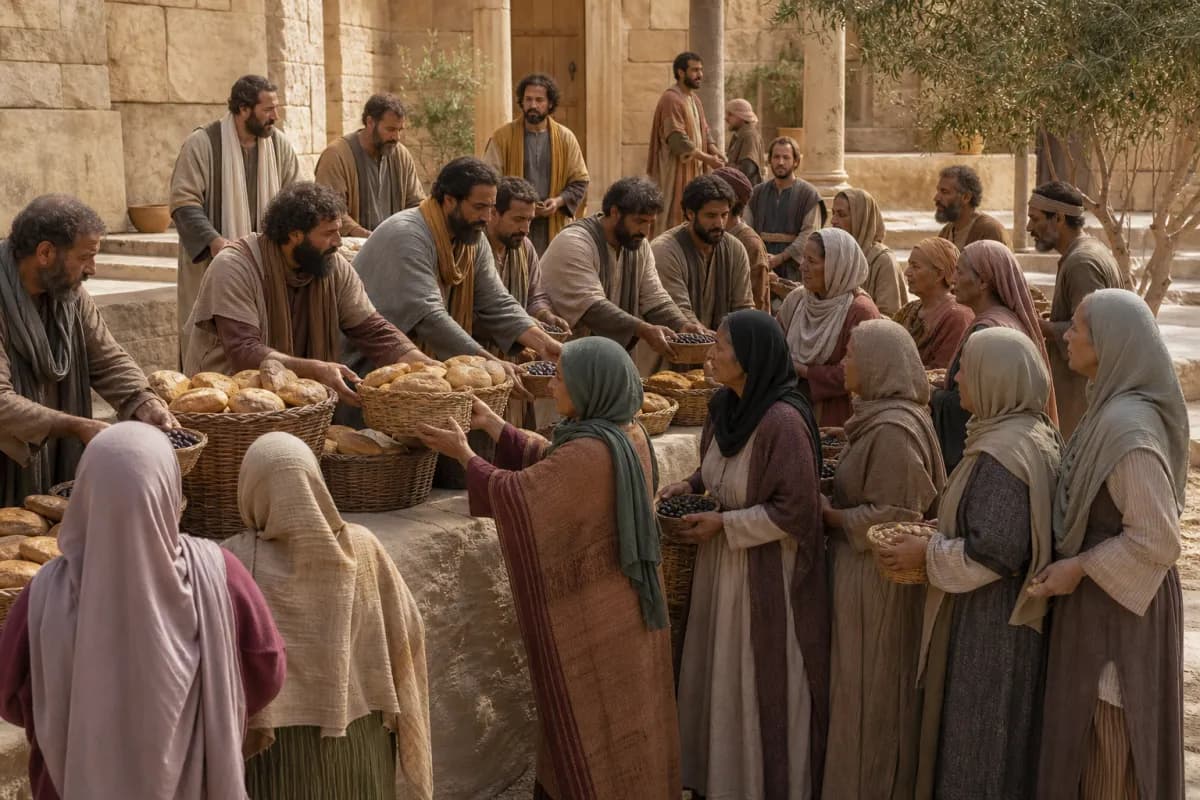
6:1Now in those days, when the number of the disciples was multiplying, a complaint arose from the Hellenists against the Hebrews, because their widows were neglected in the daily service.
6:2The twelve summoned the multitude of the disciples and said, “It is not appropriate for us to forsake the word of God and serve tables.
6:3Therefore, select from among you, brothers, seven men of good report, full of the Holy Spirit and of wisdom, whom we may appoint over this business.
6:4But we will continue steadfastly in prayer and in the ministry of the word.”
6:5These words pleased the whole multitude. They chose Stephen, a man full of faith and of the Holy Spirit, Philip, Prochorus, Nicanor, Timon, Parmenas, and Nicolaus, a proselyte of Antioch,
6:6whom they set before the apostles. When they had prayed, they laid their hands on them.
6:7The word of God increased and the number of the disciples greatly multiplied in Jerusalem. A great company of the priests were obedient to the faith.
6:8Stephen, full of faith and power, performed great wonders and signs among the people.
6:9But some of those who were of the synagogue called “The Libertines”, and of the Cyrenians, of the Alexandrians, and of those of Cilicia and Asia arose, disputing with Stephen.
6:10They weren’t able to withstand the wisdom and the Spirit by which he spoke.
6:11Then they secretly induced men to say, “We have heard him speak blasphemous words against Moses and God.”
6:12They stirred up the people, the elders, and the scribes, and came against him and seized him, then brought him in to the council,
6:13and set up false witnesses who said, “This man never stops speaking blasphemous words against this holy place and the law.
6:14For we have heard him say that this Jesus of Nazareth will destroy this place, and will change the customs which Moses delivered to us.”
6:15All who sat in the council, fastening their eyes on him, saw his face like it was the face of an angel.
Acts 7
7:1The high priest said, “Are these things so?”
7:2He said, “Brothers and fathers, listen. The God of glory appeared to our father Abraham when he was in Mesopotamia, before he lived in Haran,
7:3and said to him, ‘Get out of your land and away from your relatives, and come into a land which I will show you.’
7:4Then he came out of the land of the Chaldaeans and lived in Haran. From there, when his father was dead, God moved him into this land where you are now living.
7:5He gave him no inheritance in it, no, not so much as to set his foot on. He promised that he would give it to him for a possession, and to his offspring after him, when he still had no child.
7:6God spoke in this way: that his offspring would live as aliens in a strange land, and that they would be enslaved and mistreated for four hundred years.
7:7‘I will judge the nation to which they will be in bondage,’ said God, ‘and after that they will come out and serve me in this place.’
7:8He gave him the covenant of circumcision. So Abraham became the father of Isaac, and circumcised him the eighth day. Isaac became the father of Jacob, and Jacob became the father of the twelve patriarchs.
7:9“The patriarchs, moved with jealousy against Joseph, sold him into Egypt. God was with him
7:10and delivered him out of all his afflictions, and gave him favor and wisdom before Pharaoh, king of Egypt. He made him governor over Egypt and all his house.
7:11Now a famine came over all the land of Egypt and Canaan, and great affliction. Our fathers found no food.
7:12But when Jacob heard that there was grain in Egypt, he sent out our fathers the first time.
7:13On the second time Joseph was made known to his brothers, and Joseph’s family was revealed to Pharaoh.
7:14Joseph sent and summoned Jacob his father and all his relatives, seventy-five souls.
7:15Jacob went down into Egypt and he died, himself and our fathers;
7:16and they were brought back to Shechem and laid in the tomb that Abraham bought for a price in silver from the children of Hamor of Shechem.
7:17“But as the time of the promise came close which God had sworn to Abraham, the people grew and multiplied in Egypt,
7:18until there arose a different king who didn’t know Joseph.
7:19The same took advantage of our race and mistreated our fathers, and forced them to abandon their babies, so that they wouldn’t stay alive.
7:20At that time Moses was born, and was exceedingly handsome to God. He was nourished three months in his father’s house.
7:21When he was abandoned, Pharaoh’s daughter took him up and reared him as her own son.
7:22Moses was instructed in all the wisdom of the Egyptians. He was mighty in his words and works.
7:23But when he was forty years old, it came into his heart to visit his brothers, the children of Israel.
7:24Seeing one of them suffer wrong, he defended him and avenged him who was oppressed, striking the Egyptian.
7:25He supposed that his brothers understood that God, by his hand, was giving them deliverance; but they didn’t understand.
7:26“The day following, he appeared to them as they fought, and urged them to be at peace again, saying, ‘Sirs, you are brothers. Why do you wrong one another?’
7:27But he who did his neighbor wrong pushed him away, saying, ‘Who made you a ruler and a judge over us?
7:28Do you want to kill me as you killed the Egyptian yesterday?’
7:29Moses fled at this saying, and became a stranger in the land of Midian, where he became the father of two sons.
7:30“When forty years were fulfilled, an angel of the Lord appeared to him in the wilderness of Mount Sinai, in a flame of fire in a bush.
7:31When Moses saw it, he wondered at the sight. As he came close to see, the voice of the Lord came to him,
7:32‘I am the God of your fathers: the God of Abraham, the God of Isaac, and the God of Jacob.’ Moses trembled and dared not look.
7:33The Lord said to him, ‘Take off your sandals, for the place where you stand is holy ground.
7:34I have surely seen the affliction of my people who are in Egypt, and have heard their groaning. I have come down to deliver them. Now come, I will send you into Egypt.’
7:35“This Moses whom they refused, saying, ‘Who made you a ruler and a judge?’—God has sent him as both a ruler and a deliverer by the hand of the angel who appeared to him in the bush.
7:36This man led them out, having worked wonders and signs in Egypt, in the Red Sea, and in the wilderness for forty years.
7:37This is that Moses who said to the children of Israel, ‘The Lord our God will raise up a prophet for you from among your brothers, like me.’
7:38This is he who was in the assembly in the wilderness with the angel that spoke to him on Mount Sinai, and with our fathers, who received living revelations to give to us,
7:39to whom our fathers wouldn’t be obedient, but rejected him and turned back in their hearts to Egypt,
7:40saying to Aaron, ‘Make us gods that will go before us, for as for this Moses who led us out of the land of Egypt, we don’t know what has become of him.’
7:41They made a calf in those days, and brought a sacrifice to the idol, and rejoiced in the works of their hands.
7:42But God turned away and gave them up to serve the army of the sky, as it is written in the book of the prophets, ‘Did you offer to me slain animals and sacrifices forty years in the wilderness, O house of Israel?
7:43You took up the tabernacle of Moloch, the star of your god Rephan, the figures which you made to worship, so I will carry you away beyond Babylon.’
7:44“Our fathers had the tabernacle of the testimony in the wilderness, even as he who spoke to Moses commanded him to make it according to the pattern that he had seen;
7:45which also our fathers, in their turn, brought in with Joshua when they entered into the possession of the nations whom God drove out before the face of our fathers to the days of David,
7:46who found favor in the sight of God, and asked to find a habitation for the God of Jacob.
7:47But Solomon built him a house.
7:48However, the Most High doesn’t dwell in temples made with hands, as the prophet says,
7:49‘heaven is my throne, and the earth a footstool for my feet. What kind of house will you build me?’ says the Lord. ‘Or what is the place of my rest?
7:50Didn’t my hand make all these things?’
7:51“You stiff-necked and uncircumcised in heart and ears, you always resist the Holy Spirit! As your fathers did, so you do.
7:52Which of the prophets didn’t your fathers persecute? They killed those who foretold the coming of the Righteous One, of whom you have now become betrayers and murderers.
7:53You received the law as it was ordained by angels, and didn’t keep it!”
7:54Now when they heard these things, they were cut to the heart, and they gnashed at him with their teeth.
7:55But he, being full of the Holy Spirit, looked up steadfastly into heaven and saw the glory of God, and Jesus standing on the right hand of God,
7:56and said, “Behold, I see the heavens opened and the Son of Man standing at the right hand of God!”
7:57But they cried out with a loud voice and stopped their ears, then rushed at him with one accord.
7:58They threw him out of the city and stoned him. The witnesses placed their garments at the feet of a young man named Saul.
7:59They stoned Stephen as he called out, saying, “Lord Jesus, receive my spirit!”
7:60He kneeled down and cried with a loud voice, “Lord, don’t hold this sin against them!” When he had said this, he fell asleep.
Acts 8
8:1Saul was consenting to his death. A great persecution arose against the assembly which was in Jerusalem in that day. They were all scattered abroad throughout the regions of Judea and Samaria, except for the apostles.
8:2Devout men buried Stephen and lamented greatly over him.
8:3But Saul ravaged the assembly, entering into every house and dragged both men and women off to prison.
8:4Therefore those who were scattered abroad went around preaching the word.
8:5Philip went down to the city of Samaria and proclaimed to them the Christ.
8:6The multitudes listened with one accord to the things that were spoken by Philip when they heard and saw the signs which he did.
8:7For unclean spirits came out of many of those who had them. They came out, crying with a loud voice. Many who had been paralyzed and lame were healed.
8:8There was great joy in that city.
8:9But there was a certain man, Simon by name, who used to practice sorcery in the city and amazed the people of Samaria, making himself out to be some great one,
8:10to whom they all listened, from the least to the greatest, saying, “This man is that great power of God.”
8:11They listened to him because for a long time he had amazed them with his sorceries.
8:12But when they believed Philip preaching good news concerning God’s Kingdom and the name of Jesus Christ, they were baptized, both men and women.
8:13Simon himself also believed. Being baptized, he continued with Philip. Seeing signs and great miracles occurring, he was amazed.
8:14Now when the apostles who were at Jerusalem heard that Samaria had received the word of God, they sent Peter and John to them,
8:15who, when they had come down, prayed for them, that they might receive the Holy Spirit;
8:16for as yet he had fallen on none of them. They had only been baptized in the name of Christ Jesus.
8:17Then they laid their hands on them, and they received the Holy Spirit.
8:18Now when Simon saw that the Holy Spirit was given through the laying on of the apostles’ hands, he offered them money,
8:19saying, “Give me also this power, that whomever I lay my hands on may receive the Holy Spirit.”
8:20But Peter said to him, “May your silver perish with you, because you thought you could obtain the gift of God with money!
8:21You have neither part nor lot in this matter, for your heart isn’t right before God.
8:22Repent therefore of this, your wickedness, and ask God if perhaps the thought of your heart may be forgiven you.
8:23For I see that you are in the poison of bitterness and in the bondage of iniquity.”
8:24Simon answered, “Pray for me to the Lord, that none of the things which you have spoken happen to me.”
8:25They therefore, when they had testified and spoken the word of the Lord, returned to Jerusalem, and preached the Good News to many villages of the Samaritans.
8:26Then an angel of the Lord spoke to Philip, saying, “Arise, and go toward the south to the way that goes down from Jerusalem to Gaza. This is a desert.”
8:27He arose and went; and behold, there was a man of Ethiopia, a eunuch of great authority under Candace, queen of the Ethiopians, who was over all her treasure, who had come to Jerusalem to worship.
8:28He was returning and sitting in his chariot, and was reading the prophet Isaiah.
8:29The Spirit said to Philip, “Go near, and join yourself to this chariot.”
8:30Philip ran to him, and heard him reading Isaiah the prophet, and said, “Do you understand what you are reading?”
8:31He said, “How can I, unless someone explains it to me?” He begged Philip to come up and sit with him.
8:32Now the passage of the Scripture which he was reading was this, “He was led as a sheep to the slaughter. As a lamb before his shearer is silent, so he doesn’t open his mouth.
8:33In his humiliation, his judgment was taken away. Who will declare His generation? For his life is taken from the earth.”
8:34The eunuch answered Philip, “Who is the prophet talking about? About himself, or about someone else?”
8:35Philip opened his mouth, and beginning from this Scripture, preached to him about Jesus.
8:36As they went on the way, they came to some water; and the eunuch said, “Behold, here is water. What is keeping me from being baptized?”
8:38He commanded the chariot to stand still, and they both went down into the water, both Philip and the eunuch, and he baptized him.
8:39When they came up out of the water, the Spirit of the Lord caught Philip away, and the eunuch didn’t see him any more, for he went on his way rejoicing.
8:40But Philip was found at Azotus. Passing through, he preached the Good News to all the cities until he came to Caesarea.
CONTEXTUAL OVERVIEW
Acts 6 begins with a practical wound inside a growing church: Greek-speaking widows are overlooked in the daily distribution. The apostles do not dismiss the complaint as unspiritual, nor do they abandon prayer and the ministry of the word. The appointment of seven reputable, Spirit-filled people treats material care and public proclamation as indispensable parts of the same community under Christ.
Stephen’s arrest moves the story from service to testimony. Charges about the temple, Moses, and customs bring him before the council that had opposed the apostles. His long speech does not avoid Israel’s Scriptures; it retells Abraham, Joseph, Moses, the tabernacle, and the temple to show a repeated pattern of resisting God’s sent deliverers. That pattern reaches its climax, Stephen says, in the betrayal and murder of the Righteous One.
HISTORICAL AND LITERARY CONTEXT
The distinction between Hebrew-speaking and Greek-speaking Jews in Jerusalem helps explain why a daily distribution could become a source of neglect. The names of the seven are Greek, though Luke does not portray the appointment as a separate church. The whole group selects servants, the apostles pray and lay hands on them, and the word of God continues to spread.
Samaria carried a long history of division with Judea, so Philip’s welcome there marks a real expansion of the Acts 1:8 program. The Ethiopian official is a court servant from a distant kingdom returning from Jerusalem and reading Isaiah while traveling south. Luke gives no romanticized claim that all social barriers disappeared at once; instead, he records particular people receiving Christ through the word and baptism as the gospel crosses established boundaries.
SECTION-BY-SECTION ANALYSIS
- Full of the Spirit and wisdom · Acts 6:3The seven are selected for a concrete ministry of fair distribution, showing that Spirit-filled service attends to overlooked people.
- The Righteous One · Acts 7:52Stephen names Jesus as the final righteous messenger whom the council’s hearers have betrayed and murdered.
- Beginning with this scripture · Acts 8:35Philip does not merely identify Isaiah’s subject; he announces Jesus from the servant passage the Ethiopian is reading.
CHRIST IN THIS PASSAGE
Stephen identifies Jesus as the Righteous One and sees Him standing at God’s right hand, language that directly connects the rejected witness to the exalted Lord. Stephen’s death resembles Jesus’ in significant narrative ways: both face false accusation, both entrust themselves to God, and both pray for their enemies. Stephen is not another savior, however. His witness points beyond himself to the crucified and risen Jesus whose name he invokes.
Philip’s conversation with the Ethiopian makes the Christ connection explicit through Isaiah’s suffering servant. The official asks who the prophet means; Philip begins there and tells him the good news about Jesus. The gospel now reaches Samaritans and a traveler from beyond Israel because Jesus’ saving mission fulfills Scripture and creates a people gathered not by ethnic access or temple location but by faith in Him.
REFLECTION
The overlooked widows call churches to examine where normal systems leave actual people unseen. Faithful attention to distribution, care, and representation is not a distraction from ministry; Acts calls it wise Spirit-filled service. Look for one person whose need is easy to miss because they are outside your usual language group, generation, schedule, or circle.
Stephen and Philip also show two forms of witness under pressure. Stephen speaks the truth when it costs him everything; Philip patiently begins with a traveler’s real question and opens Scripture. Ask Jesus for discernment to know whether today requires public courage, careful explanation, or both, and remember that the gospel’s advance never depends on your ability to control the outcome.
Original Greek Word Study
Acts 6:4
διακονία
diakonia · G1248
Usually translated: service or ministry
Diakonia means service or ministry. The church addresses a real need in the shared distribution of food while protecting the ministry of prayer and the word, showing that both forms of service matter.
Follow the Scripture trail
The Word Spreads from Stephen’s Witness to Samaria’s Joy in the larger story
The connection: Stephen’s witness to the exalted Righteous One and Philip’s explanation of Isaiah both center the gospel on Jesus’ death and resurrection. Persecution does not cancel His mission; the risen Lord uses scattered witnesses to carry the good news across Jerusalem’s religious and ethnic boundaries.
Respond to the passage
Notice one overlooked person or practical need in your church and respond with the careful service Acts 6 commends. Then ask God to give you Philip’s patience to begin with an actual question and explain why Jesus’ death and resurrection are good news.
- Why does the church appoint the seven rather than treating the widows’ complaint as secondary?
- How does Stephen’s retelling of Israel’s history explain his charge that the council has resisted the Holy Spirit?
- Why is the Ethiopian’s question about Isaiah 53 the right place for Philip to announce Jesus?
Prayer
Lord Jesus, Righteous One at the Father’s right hand, make Your church attentive to those who are overlooked. Give me courage like Stephen, patient clarity like Philip, and joy in sharing Your good news with people I might never have expected to meet. Amen.