Passage Study
Chosen in Christ and Made One by His Cross
Ephesians 1:1–2:22
Ephesians 1:1–2:22 praises the Father for every saving blessing given in Christ: election, adoption, redemption, forgiveness, inheritance, and the Spirit’s seal. Paul then shows the same grace at work in people who were dead in sin and in the reconciliation of Jews and Gentiles. Christ’s cross makes peace, creates one new humanity, and builds both peoples into God’s dwelling place.
- In this study
- 45 verses · 5 movements
Ephesians 1
1:1Paul, an apostle of Christ Jesus through the will of God, to the saints who are at Ephesus, and the faithful in Christ Jesus:
1:2Grace to you and peace from God our Father and the Lord Jesus Christ.
1:3Blessed be the God and Father of our Lord Jesus Christ, who has blessed us with every spiritual blessing in the heavenly places in Christ,
1:4even as he chose us in him before the foundation of the world, that we would be holy and without defect before him in love,
1:5having predestined us for adoption as children through Jesus Christ to himself, according to the good pleasure of his desire,
1:6to the praise of the glory of his grace, by which he freely gave us favor in the Beloved.
1:7In him we have our redemption through his blood, the forgiveness of our trespasses, according to the riches of his grace
1:8which he made to abound toward us in all wisdom and prudence,
1:9making known to us the mystery of his will, according to his good pleasure which he purposed in him
1:10to an administration of the fullness of the times, to sum up all things in Christ, the things in the heavens and the things on the earth, in him.
1:11We were also assigned an inheritance in him, having been foreordained according to the purpose of him who does all things after the counsel of his will,
1:12to the end that we should be to the praise of his glory, we who had before hoped in Christ.
1:13In him you also, having heard the word of the truth, the Good News of your salvation—in whom, having also believed, you were sealed with the promised Holy Spirit,
1:14who is a pledge of our inheritance, to the redemption of God’s own possession, to the praise of his glory.
1:15For this cause I also, having heard of the faith in the Lord Jesus which is among you and the love which you have toward all the saints,
1:16don’t cease to give thanks for you, making mention of you in my prayers,
1:17that the God of our Lord Jesus Christ, the Father of glory, may give to you a spirit of wisdom and revelation in the knowledge of him,
1:18having the eyes of your hearts enlightened, that you may know what is the hope of his calling, and what are the riches of the glory of his inheritance in the saints,
1:19and what is the exceeding greatness of his power toward us who believe, according to that working of the strength of his might
1:20which he worked in Christ when he raised him from the dead and made him to sit at his right hand in the heavenly places,
1:21far above all rule, authority, power, dominion, and every name that is named, not only in this age, but also in that which is to come.
1:22He put all things in subjection under his feet, and gave him to be head over all things for the assembly,
1:23which is his body, the fullness of him who fills all in all.
Ephesians 2
2:1You were made alive when you were dead in transgressions and sins,
2:2in which you once walked according to the course of this world, according to the prince of the power of the air, the spirit who now works in the children of disobedience.
2:3We also all once lived among them in the lusts of our flesh, doing the desires of the flesh and of the mind, and were by nature children of wrath, even as the rest.
2:4But God, being rich in mercy, for his great love with which he loved us,
2:5even when we were dead through our trespasses, made us alive together with Christ—by grace you have been saved—
2:6and raised us up with him, and made us to sit with him in the heavenly places in Christ Jesus,
2:7that in the ages to come he might show the exceeding riches of his grace in kindness toward us in Christ Jesus;
2:8for by grace you have been saved through faith, and that not of yourselves; it is the gift of God,
2:9not of works, that no one would boast.
2:10For we are his workmanship, created in Christ Jesus for good works, which God prepared before that we would walk in them.
2:11Therefore remember that once you, the Gentiles in the flesh, who are called “uncircumcision” by that which is called “circumcision” (in the flesh, made by hands),
2:12that you were at that time separate from Christ, alienated from the commonwealth of Israel, and strangers from the covenants of the promise, having no hope and without God in the world.
2:13But now in Christ Jesus you who once were far off are made near in the blood of Christ.
2:14For he is our peace, who made both one, and broke down the middle wall of separation,
2:15having abolished in his flesh the hostility, the law of commandments contained in ordinances, that he might create in himself one new man of the two, making peace,
2:16and might reconcile them both in one body to God through the cross, having killed the hostility through it.
2:17He came and preached peace to you who were far off and to those who were near.
2:18For through him we both have our access in one Spirit to the Father.
2:19So then you are no longer strangers and foreigners, but you are fellow citizens with the saints and of the household of God,
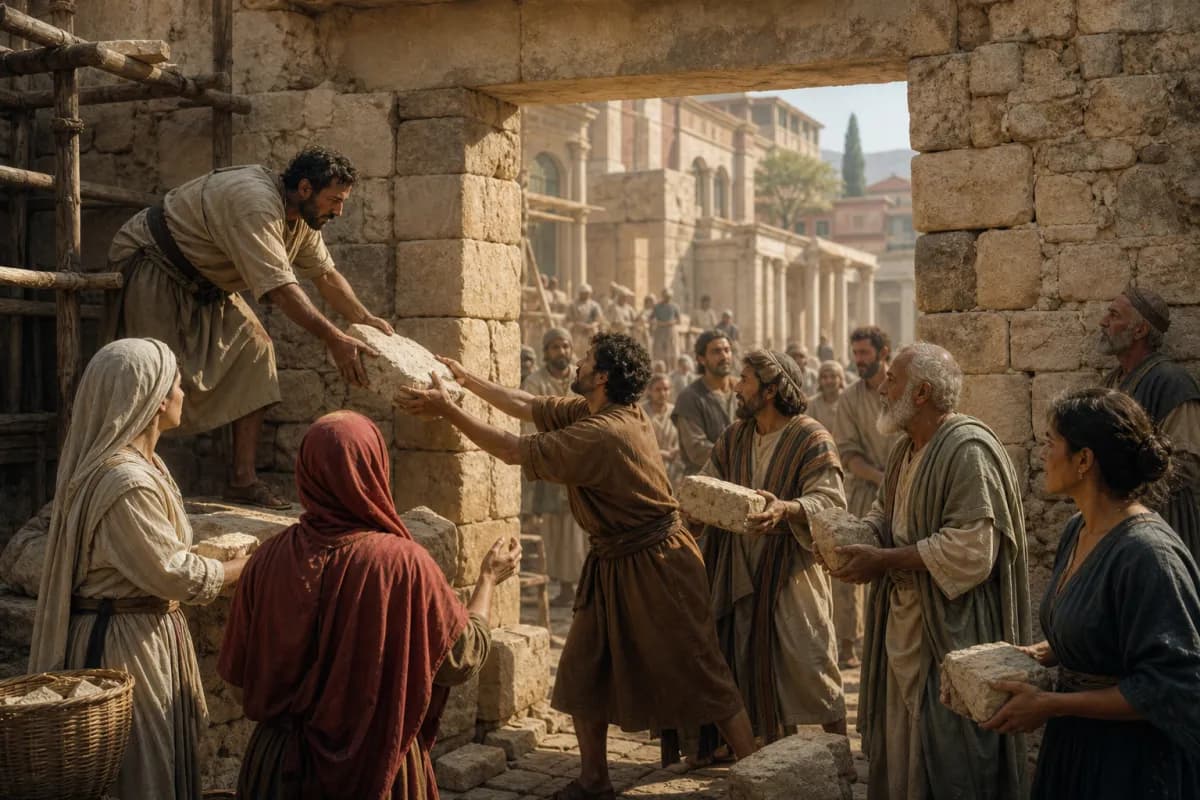
2:20being built on the foundation of the apostles and prophets, Christ Jesus himself being the chief cornerstone;
2:21in whom the whole building, fitted together, grows into a holy temple in the Lord;
2:22in whom you also are built together for a habitation of God in the Spirit.
CONTEXTUAL OVERVIEW
The opening blessing of Ephesians is deliberately God-centered. Before Paul asks the church to do anything, he names what the Father has done “in Christ”: He chose, predestined for adoption, redeemed, forgave, disclosed His purpose, granted an inheritance, and sealed believers with the Holy Spirit. The repeated location “in Christ” matters. The blessings are not prizes earned by a religiously impressive people; they belong to those joined to the beloved Son.
The movement then becomes painfully personal and socially visible. Gentile believers had been dead in trespasses, following the age and ruler opposed to God; Jewish believers, Paul includes himself, also lived under fleshly desires and wrath. God makes both alive with Christ by grace. The same Christ who raises the spiritually dead also brings near Gentiles who were once “far off,” dismantling the hostility that separated them from Israel’s covenant privileges and from one another.
HISTORICAL AND LITERARY CONTEXT
Ephesians opens its theological argument with praise and prayer, then moves into a before-and-after account of salvation. The first half of chapter 2 does not reduce sin to lack of information or bad circumstances: people are dead, enslaved to disordered desires, and unable to produce their own rescue. The turn in 2:4, “But God,” gives the passage its decisive actor. Mercy, love, and grace explain the change from death to life.
In 2:11–22, circumcision and uncircumcision identify a real first-century division. Gentiles had been excluded from Israel’s commonwealth and the covenants of promise; Jews possessed the covenantal signs and promises. Paul does not erase Israel’s story or pretend the division was imaginary. He says that Christ’s flesh and cross have dealt with the hostility, so that access to the Father is now shared through one Spirit. The church is described as household, building, and holy temple; these are claims about a reconciled people, not decorations around individual spirituality.
SECTION-BY-SECTION ANALYSIS
- Ephesians 1:1–14 · Ephesians 1:3The Father gives adoption, redemption, inheritance, and the Spirit’s seal in His beloved Son, so every saving blessing is received in Christ.
- Ephesians 1:15–23 · Ephesians 2:10The resurrection and enthronement of Christ reveal the power by which God fulfills His calling and gives the church its reigning head.
- Ephesians 2:1–22 · Ephesians 2:5God raises the spiritually dead by grace and, through Christ’s cross, brings formerly divided Jews and Gentiles into one household and temple.
CHRIST IN THIS PASSAGE
Jesus is not merely the messenger of blessing in this passage; He is the sphere and means of every blessing Paul names. In Him the Father adopts His people, through His blood He redeems and forgives them, and in His resurrection they are made alive and seated with Him. The gospel has a personal center: sinners who were dead cannot generate their own new life, but the risen Christ shares the life God has given Him with those saved by grace.
The reconciliation of 2:11–22 is an explicit work of Christ’s saving mission. His cross does not ask hostile peoples simply to become friendlier. By His death He abolishes the divisive hostility, creates one new humanity, and reconciles both to God. The result is shared access to the Father and a holy dwelling built on the apostolic and prophetic foundation with Christ as cornerstone. Mission therefore includes the visible formation of a people who receive one another because they have been received through His blood.
REFLECTION
When you are tempted to measure your standing with God by achievement, return to Paul’s order: dead people are made alive by mercy; salvation is gift; good works follow as God’s prepared path. Name the work, reputation, or moral comparison that has become a reason to boast, and receive again the grace given in Christ’s blood rather than presenting that claim to God.
Christ’s peace also searches the boundaries of a congregation. Ask whether a habit of speech, welcome, leadership, or table fellowship communicates that some believers need a second credential to belong. Because Jews and Gentiles are brought near in one body through the cross, take one concrete step toward shared worship, listening, or hospitality with a Christian you have treated as distant.
Original Greek Word Study
Ephesians 2:8
χάρις
charis · G5485
Usually translated: grace, favor, or gift
Charis means grace or gift. Salvation comes by God’s undeserved favor through faith, creating one new people in Christ rather than rewarding any group for its own achievement.
Follow the Scripture trail
Chosen in Christ and Made One by His Cross in the larger story
The connection: God’s covenant purpose to bless a people and bring the distant near reaches its saving fulfillment in Jesus. Through His blood and resurrection, He forgives the dead, creates a reconciled new humanity, and gathers them as God’s dwelling place for the praise of His glory.
Respond to the passage
Receive God’s grace as the basis of your standing rather than treating your works as a second foundation. Then consider one relationship or church boundary where Christ’s reconciling peace calls you to pursue truthful welcome and fellowship.
- What blessings does Paul locate specifically “in Christ” in Ephesians 1?
- How does Paul describe the movement from spiritual death to life in Ephesians 2:1–10?
- What does the cross accomplish between Jews and Gentiles in 2:11–22?
Prayer
Father, thank You for choosing, redeeming, and making Your people alive in Your Son. Keep me from boasting in myself. Through Christ’s cross, make me a faithful part of the one household You are building by Your Spirit. Amen.