Passage Study
Abram’s Journey: Blessed to Bless the Nations
Genesis 12:1–13:18
Genesis 12:1–13:18 begins God’s covenant mission through Abram. God calls him from country and kin, promises land, offspring, a great name, and blessing for all families of the earth. Abram’s faith is real yet mixed with fear, showing that the promise rests on God’s grace and reaches its fulfillment in Jesus Christ, the blessing for the nations.
- In this study
- 38 verses · 5 movements
Genesis 12
12:1Now the LORD said to Abram, “Leave your country, and your relatives, and your father’s house, and go to the land that I will show you.
12:2I will make of you a great nation. I will bless you and make your name great. You will be a blessing.
12:3I will bless those who bless you, and I will curse him who treats you with contempt. All the families of the earth will be blessed through you.”
12:4So Abram went, as the LORD had told him. Lot went with him. Abram was seventy-five years old when he departed from Haran.
12:5Abram took Sarai his wife, Lot his brother’s son, all their possessions that they had gathered, and the people whom they had acquired in Haran, and they went to go into the land of Canaan. They entered into the land of Canaan.
12:6Abram passed through the land to the place of Shechem, to the oak of Moreh. At that time, Canaanites were in the land.
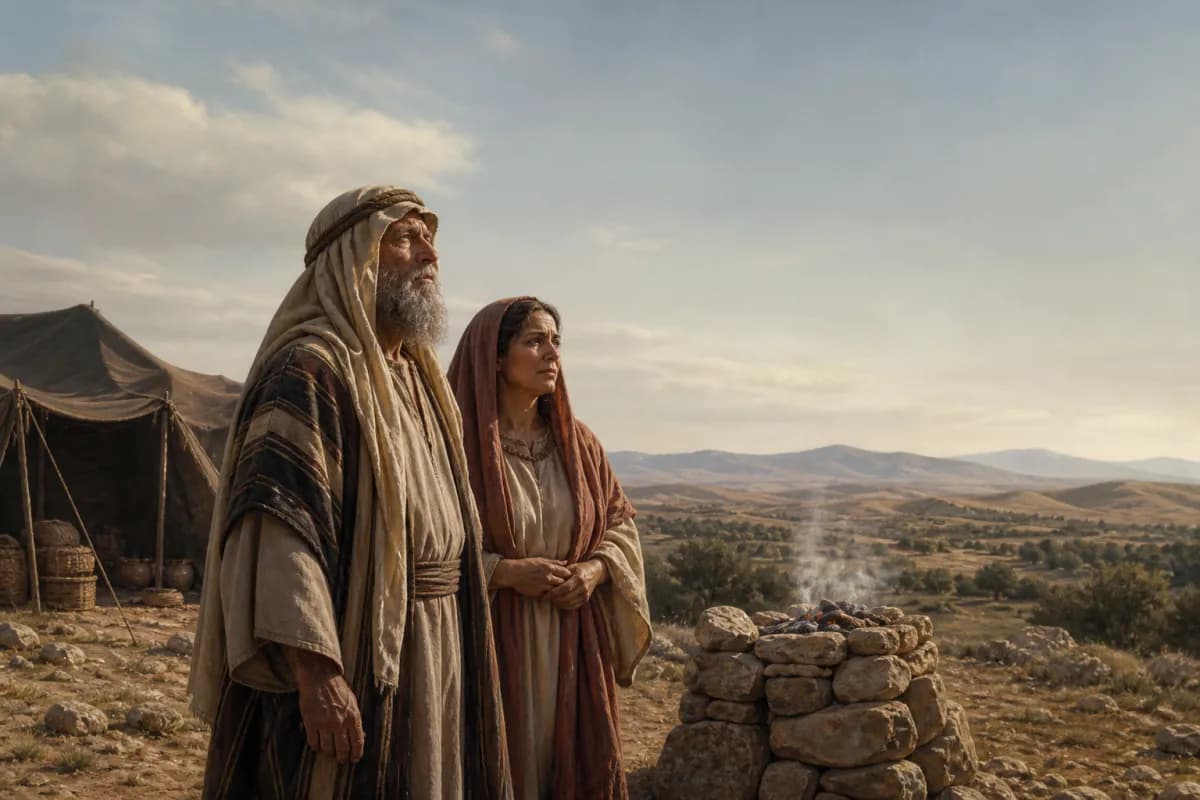
12:7The LORD appeared to Abram and said, “I will give this land to your offspring.” He built an altar there to the LORD, who had appeared to him.
12:8He left from there to go to the mountain on the east of Bethel and pitched his tent, having Bethel on the west, and Ai on the east. There he built an altar to the LORD and called on the LORD’s name.
12:9Abram traveled, still going on toward the South.
12:10There was a famine in the land. Abram went down into Egypt to live as a foreigner there, for the famine was severe in the land.
12:11When he had come near to enter Egypt, he said to Sarai his wife, “See now, I know that you are a beautiful woman to look at.
12:12It will happen that when the Egyptians see you, they will say, ‘This is his wife.’ They will kill me, but they will save you alive.
12:13Please say that you are my sister, that it may be well with me for your sake, and that my soul may live because of you.”
12:14When Abram had come into Egypt, some Egyptians saw that the woman was very beautiful.
12:15The princes of Pharaoh saw her, and praised her to Pharaoh; and the woman was taken into Pharaoh’s house.
12:16He dealt well with Abram for her sake. He had sheep, cattle, male donkeys, male servants, female servants, female donkeys, and camels.
12:17The LORD afflicted Pharaoh and his house with great plagues because of Sarai, Abram’s wife.
12:18Pharaoh called Abram and said, “What is this that you have done to me? Why didn’t you tell me that she was your wife?
12:19Why did you say, ‘She is my sister,’ so that I took her to be my wife? Now therefore, see your wife, take her, and go your way.”
12:20Pharaoh commanded men concerning him, and they escorted him away with his wife and all that he had.
Genesis 13
13:1Abram went up out of Egypt—he, his wife, all that he had, and Lot with him—into the South.
13:2Abram was very rich in livestock, in silver, and in gold.
13:3He went on his journeys from the South as far as Bethel, to the place where his tent had been at the beginning, between Bethel and Ai,
13:4to the place of the altar, which he had made there at the first. There Abram called on the LORD’s name.
13:5Lot also, who went with Abram, had flocks, herds, and tents.
13:6The land was not able to bear them, that they might live together; for their possessions were so great that they couldn’t live together.
13:7There was strife between the herdsmen of Abram’s livestock and the herdsmen of Lot’s livestock. The Canaanites and the Perizzites lived in the land at that time.
13:8Abram said to Lot, “Please, let there be no strife between you and me, and between your herdsmen and my herdsmen; for we are relatives.
13:9Isn’t the whole land before you? Please separate yourself from me. If you go to the left hand, then I will go to the right. Or if you go to the right hand, then I will go to the left.”
13:10Lot lifted up his eyes, and saw all the plain of the Jordan, that it was well-watered everywhere, before the LORD destroyed Sodom and Gomorrah, like the garden of the LORD, like the land of Egypt, as you go to Zoar.
13:11So Lot chose the Plain of the Jordan for himself. Lot traveled east, and they separated themselves from one another.
13:12Abram lived in the land of Canaan, and Lot lived in the cities of the plain, and moved his tent as far as Sodom.
13:13Now the men of Sodom were exceedingly wicked and sinners against the LORD.
13:14The LORD said to Abram, after Lot was separated from him, “Now, lift up your eyes, and look from the place where you are, northward and southward and eastward and westward,
13:15for I will give all the land which you see to you and to your offspring forever.
13:16I will make your offspring as the dust of the earth, so that if a man can count the dust of the earth, then your offspring may also be counted.
13:17Arise, walk through the land in its length and in its width; for I will give it to you.”
13:18Abram moved his tent, and came and lived by the oaks of Mamre, which are in Hebron, and built an altar there to the LORD.
CONTEXTUAL OVERVIEW
Genesis 12 follows Babel’s failed attempt to make a name. God now addresses one man with a different kind of promise: He will make Abram’s name great so that blessing, not self-exaltation, may reach every family of the earth.
Abram leaves without controlling the destination, builds altars in the land he does not yet possess, and calls on the Lord’s name. His journey shows faith as a response to God’s promise before its visible fulfillment.
HISTORICAL AND LITERARY CONTEXT
The call of Abram redirects Genesis from the nations in general to the covenant family through whom God will address the nations. Land, descendants, and blessing become the thread that runs through the rest of Genesis and the Bible’s larger story.
The Egypt episode keeps the narrative honest. Abram’s faith does not make him fearless or morally sufficient. His deception puts Sarai at risk, yet the Lord intervenes to protect the woman through whom His promise will continue.
SECTION-BY-SECTION ANALYSIS
- The call · Genesis 12:4Abram’s departure shows trust in God’s word when the future cannot be secured by familiarity or control.
- The altar · Genesis 12:7Worship anchors Abram’s journey because the promised land belongs first to the God who speaks and gives.
- The separation · Genesis 12:14God’s promise remains secure even when Abram must release what appears advantageous.
CHRIST IN THIS PASSAGE
The New Testament explicitly identifies the promise of blessing for the nations as gospel in advance. Jesus is Abraham’s offspring through whom Gentiles receive the promised blessing, not by ethnic privilege or human achievement but by faith in Him.
Christ also fulfills the journey’s deeper need. Abram leaves home in faith, but Jesus leaves the Father’s glory to bring alienated sinners into God’s household. His mission creates the multinational family promised to Abraham and sends that family to bless the nations with the gospel.
REFLECTION
God’s call may require leaving a familiar source of identity, but it never asks believers to create their own future. Abram’s journey teaches trust in a promise whose fulfillment unfolds slowly and often through circumstances that expose fear and weakness.
Jesus meets that weakness with covenant faithfulness. He calls His people to follow, worship, and bless others, not because they have mastered the road, but because the God who called Abram has kept His promise in the risen Christ.
Original Hebrew Word Study
Genesis 12:2
בָּרַךְ
barakh · H1288
Usually translated: to bless
Barakh means to bless. God calls Abram away from his country so that the blessing given to one family will become His means of blessing all the families of the earth.
Follow the Scripture trail
Abram’s Journey: Blessed to Bless the Nations in the larger story
The connection: God answers Babel’s proud self-making with a gracious promise through Abram: blessing will reach all families of the earth. Jesus fulfills that covenant mission as Abraham’s promised offspring, reconciling the nations to God and sending His church with the gospel.
Respond to the passage
Trust God with the place where obedience requires you to release control. Jesus has already secured your belonging in God’s family, and He sends you to become a blessing rather than to build a life around self-protection.
- How does God’s promise to Abram answer the self-made name sought at Babel?
- Where does Abram’s journey show both real faith and real fear?
- How does Jesus fulfill the promise that all families of the earth will be blessed?
Prayer
Faithful God, thank You for calling Abram so that blessing might reach the nations. Thank You for fulfilling Your promise in Jesus. Teach me to trust Your word, worship You in uncertainty, and join Your mission of blessing others with the gospel. Amen.