Passage Study
Abram’s Rescue and the Blessing of the Most High
Genesis 14:1–14:24
Genesis 14:1–24 sets Abram’s rescue of Lot inside a war between regional kings, then turns the victory away from Abram’s self-interest. Melchizedek blesses God Most High, and Abram refuses the king of Sodom’s wealth. The passage teaches that deliverance and blessing belong to God, preparing a priestly and royal pattern fulfilled in Jesus.
- In this study
- 24 verses · 5 movements
Genesis 14
14:1In the days of Amraphel, king of Shinar; Arioch, king of Ellasar; Chedorlaomer, king of Elam; and Tidal, king of Goiim,
14:2they made war with Bera, king of Sodom; Birsha, king of Gomorrah; Shinab, king of Admah; Shemeber, king of Zeboiim; and the king of Bela (also called Zoar).
14:3All these joined together in the valley of Siddim (also called the Salt Sea).
14:4They served Chedorlaomer for twelve years, and in the thirteenth year they rebelled.
14:5In the fourteenth year Chedorlaomer and the kings who were with him came and struck the Rephaim in Ashteroth Karnaim, the Zuzim in Ham, the Emim in Shaveh Kiriathaim,
14:6and the Horites in their Mount Seir, to El Paran, which is by the wilderness.
14:7They returned, and came to En Mishpat (also called Kadesh), and struck all the country of the Amalekites, and also the Amorites, that lived in Hazazon Tamar.
14:8The king of Sodom, and the king of Gomorrah, the king of Admah, the king of Zeboiim, and the king of Bela (also called Zoar) went out; and they set the battle in array against them in the valley of Siddim
14:9against Chedorlaomer king of Elam, Tidal king of Goiim, Amraphel king of Shinar, and Arioch king of Ellasar; four kings against the five.
14:10Now the valley of Siddim was full of tar pits; and the kings of Sodom and Gomorrah fled, and some fell there. Those who remained fled to the hills.
14:11They took all the goods of Sodom and Gomorrah, and all their food, and went their way.
14:12They took Lot, Abram’s brother’s son, who lived in Sodom, and his goods, and departed.
14:13One who had escaped came and told Abram, the Hebrew. At that time, he lived by the oaks of Mamre, the Amorite, brother of Eshcol and brother of Aner. They were allies of Abram.
14:14When Abram heard that his relative was taken captive, he led out his three hundred eighteen trained men, born in his house, and pursued as far as Dan.
14:15He divided himself against them by night, he and his servants, and struck them, and pursued them to Hobah, which is on the left hand of Damascus.
14:16He brought back all the goods, and also brought back his relative Lot and his goods, and the women also, and the other people.
14:17The king of Sodom went out to meet him after his return from the slaughter of Chedorlaomer and the kings who were with him, at the valley of Shaveh (that is, the King’s Valley).
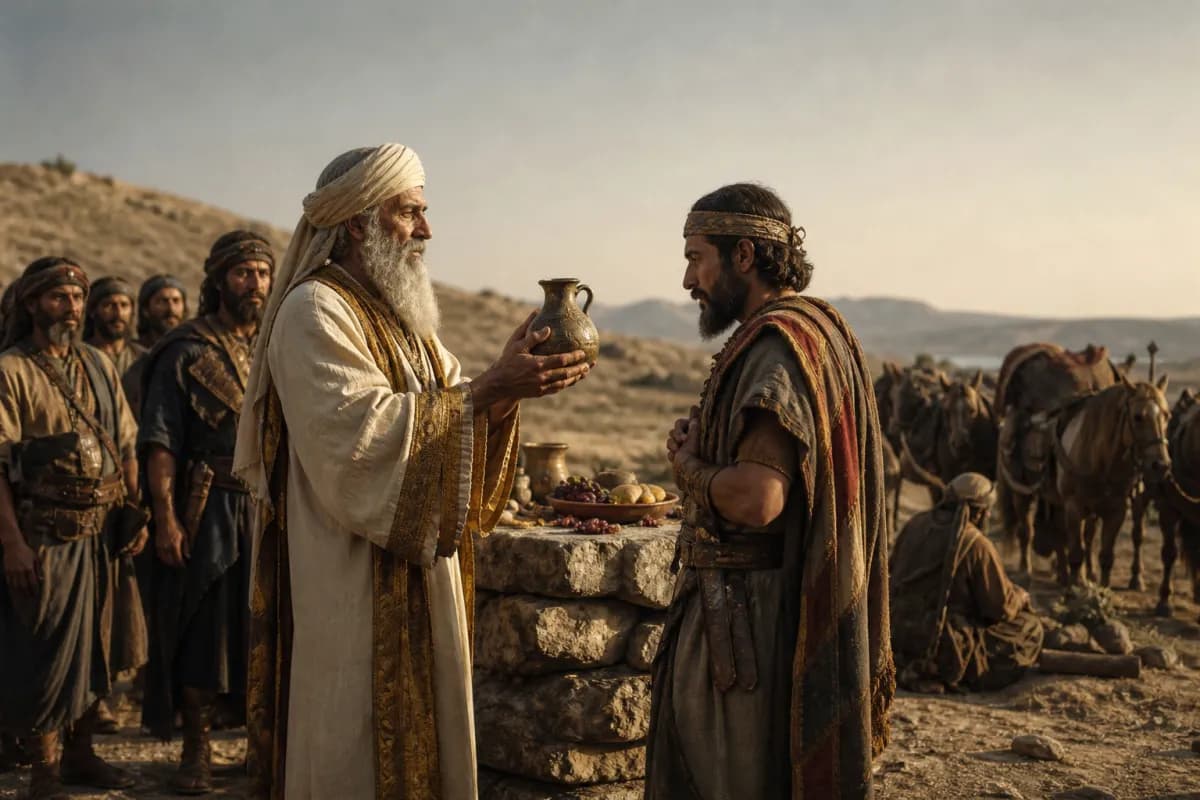
14:18Melchizedek king of Salem brought out bread and wine. He was priest of God Most High.
14:19He blessed him, and said, “Blessed be Abram of God Most High, possessor of heaven and earth.
14:20Blessed be God Most High, who has delivered your enemies into your hand.” Abram gave him a tenth of all.
14:21The king of Sodom said to Abram, “Give me the people, and take the goods for yourself.”
14:22Abram said to the king of Sodom, “I have lifted up my hand to the LORD, God Most High, possessor of heaven and earth,
14:23that I will not take a thread nor a sandal strap nor anything that is yours, lest you should say, ‘I have made Abram rich.’
14:24I will accept nothing from you except that which the young men have eaten, and the portion of the men who went with me: Aner, Eshcol, and Mamre. Let them take their portion.”
CONTEXTUAL OVERVIEW
Lot has separated from Abram and chosen the well-watered Jordan valley near Sodom. When the war reaches Sodom, Lot’s household is carried away with the city’s goods. Abram’s response is concrete: he hears, arms his household servants, pursues the invaders, and brings his nephew back.
The rescue is followed by two sharply different meetings. The king of Sodom wants to divide the recovered people and possessions; Melchizedek brings bread and wine, blesses Abram, and names God as “Most High, maker of heaven and earth.” Abram’s choices show whose gift and whose name will define the victory.
HISTORICAL AND LITERARY CONTEXT
Genesis presents a coalition war in the Jordan region without giving enough external detail to reconstruct each ruler with confidence. The narrative’s own emphasis is clearer: the conflict exposes Lot’s vulnerability after his move toward Sodom, and it tests whether Abram will seek security through wealth and alliance.
Melchizedek appears briefly as king of Salem and priest of God Most High. The text does not tell his ancestry or establish a continuing order in Genesis, but it gives his blessing unusual weight. Later Scripture returns to this priest-king figure to speak about the Messiah.
SECTION-BY-SECTION ANALYSIS
- Lot · Genesis 14:12Lot’s capture shows that his choice of a fertile place did not secure him from the danger attached to Sodom.
- Melchizedek · Genesis 14:18The priest-king blesses Abram by directing praise to the God who delivered Abram’s enemies into his hand.
- Abram’s oath · Genesis 14:13Abram accepts provisions for his allies but refuses personal enrichment that would obscure God’s promised provision.
CHRIST IN THIS PASSAGE
Melchizedek is a strong canonical pattern, though Genesis 14 does not directly name Jesus. Psalm 110 and Hebrews 5–7 identify the Messiah’s priesthood as “according to the order of Melchizedek”: a priesthood joined to royal authority and not limited by Aaron’s line.
Abram’s rescue also gives a thematic echo of Christ’s saving mission. Jesus does not enrich Himself by exploiting those He saves; He gives Himself to deliver people from sin and death. The greater rescue is accomplished by His cross and resurrection, where He brings captives into the blessing of God.
REFLECTION
Abram does not abandon Lot because Lot made a costly choice. He acts to rescue him, then refuses to turn another person’s disaster into personal gain. Christians can imitate that costly neighbor-love while remembering that God alone is the source of lasting security.
The king of Sodom’s offer raises a searching question about the stories that make us feel secure. Jesus frees His people from the need to prove that wealth, status, or a powerful patron made them. His saving grace lets us receive God’s gifts with gratitude and reject bargains that would cloud our witness.
Original Hebrew Word Study
Genesis 14:18
עֶלְיוֹן
elyon · H5945
Usually translated: Most High
Elyon means Most High. Melchizedek’s blessing names God as the One above every local ruler and battle, placing Abram’s victory under the Creator who possesses heaven and earth.
Follow the Scripture trail
Abram’s Rescue and the Blessing of the Most High in the larger story
The connection: Abram’s encounter with Melchizedek provides a strong canonical pattern for Jesus, the eternal priest-king who brings God’s blessing to His people. His saving mission is the greater deliverance from sin’s captivity into the kingdom of the God Most High.
Respond to the passage
Ask where you are tempted to treat success as proof that the right person or system has made you secure. Turn to Jesus, whose grace—not personal gain—defines your standing before God, and look for a concrete way to protect rather than exploit a vulnerable neighbor.
- Why does the narrative pause over Melchizedek’s blessing after Abram’s military success?
- What does Abram’s refusal of Sodom’s wealth protect about God’s promise and Abram’s witness?
- How does Christ’s priestly rescue reshape the way you use influence when someone near you is in trouble?
Prayer
God Most High, maker of heaven and earth, keep me from claiming Your gifts as my achievement. Thank You for Jesus, my true priest and King, who gave Himself to rescue sinners. Make me ready to serve the vulnerable with clean hands and a clear witness. Amen.