Passage Study
The Garden and the First Promise of Rescue
Genesis 2:4–3:24
Genesis 2:4–3:24 shows humanity receiving God’s abundant gift, distrusting His word, and losing the fellowship for which it was made. Yet in the judgment God also speaks the first promise that evil will not finally prevail: the woman’s offspring will crush the serpent, opening the Bible’s long road to Jesus Christ.
- In this study
- 46 verses · 5 movements
Genesis 2
2:4This is the history of the generations of the heavens and of the earth when they were created, in the day that the LORD God made the earth and the heavens.
2:5No plant of the field was yet in the earth, and no herb of the field had yet sprung up; for the LORD God had not caused it to rain on the earth. There was not a man to till the ground,
2:6but a mist went up from the earth, and watered the whole surface of the ground.
2:7The LORD God formed man from the dust of the ground, and breathed into his nostrils the breath of life; and man became a living soul.
2:8The LORD God planted a garden eastward, in Eden, and there he put the man whom he had formed.
2:9Out of the ground the LORD God made every tree to grow that is pleasant to the sight, and good for food, including the tree of life in the middle of the garden and the tree of the knowledge of good and evil.
2:10A river went out of Eden to water the garden; and from there it was parted, and became the source of four rivers.
2:11The name of the first is Pishon: it flows through the whole land of Havilah, where there is gold;
2:12and the gold of that land is good. Bdellium and onyx stone are also there.
2:13The name of the second river is Gihon. It is the same river that flows through the whole land of Cush.
2:14The name of the third river is Hiddekel. This is the one which flows in front of Assyria. The fourth river is the Euphrates.
2:15The LORD God took the man, and put him into the garden of Eden to cultivate and keep it.
2:16The LORD God commanded the man, saying, “You may freely eat of every tree of the garden;
2:17but you shall not eat of the tree of the knowledge of good and evil; for in the day that you eat of it, you will surely die.”
2:18The LORD God said, “It is not good for the man to be alone. I will make him a helper comparable to him.”
2:19Out of the ground the LORD God formed every animal of the field, and every bird of the sky, and brought them to the man to see what he would call them. Whatever the man called every living creature became its name.
2:20The man gave names to all livestock, and to the birds of the sky, and to every animal of the field; but for man there was not found a helper comparable to him.
2:21The LORD God caused the man to fall into a deep sleep. As the man slept, he took one of his ribs, and closed up the flesh in its place.
2:22The LORD God made a woman from the rib which he had taken from the man, and brought her to the man.
2:23The man said, “This is now bone of my bones, and flesh of my flesh. She will be called ‘woman,’ because she was taken out of Man.”
2:24Therefore a man will leave his father and his mother, and will join with his wife, and they will be one flesh.
2:25The man and his wife were both naked, and they were not ashamed.
Genesis 3
3:1Now the serpent was more subtle than any animal of the field which the LORD God had made. He said to the woman, “Has God really said, ‘You shall not eat of any tree of the garden’?”
3:2The woman said to the serpent, “We may eat fruit from the trees of the garden,
3:3but not the fruit of the tree which is in the middle of the garden. God has said, ‘You shall not eat of it. You shall not touch it, lest you die.’”
3:4The serpent said to the woman, “You won’t really die,
3:5for God knows that in the day you eat it, your eyes will be opened, and you will be like God, knowing good and evil.”
3:6When the woman saw that the tree was good for food, and that it was a delight to the eyes, and that the tree was to be desired to make one wise, she took some of its fruit, and ate. Then she gave some to her husband with her, and he ate it, too.
3:7Their eyes were opened, and they both knew that they were naked. They sewed fig leaves together, and made coverings for themselves.
3:8They heard the LORD God’s voice walking in the garden in the cool of the day, and the man and his wife hid themselves from the presence of the LORD God among the trees of the garden.
3:9The LORD God called to the man, and said to him, “Where are you?”
3:10The man said, “I heard your voice in the garden, and I was afraid, because I was naked; so I hid myself.”
3:11God said, “Who told you that you were naked? Have you eaten from the tree that I commanded you not to eat from?”
3:12The man said, “The woman whom you gave to be with me, she gave me fruit from the tree, and I ate it.”
3:13The LORD God said to the woman, “What have you done?” The woman said, “The serpent deceived me, and I ate.”
3:14The LORD God said to the serpent, “Because you have done this, you are cursed above all livestock, and above every animal of the field. You shall go on your belly and you shall eat dust all the days of your life.
3:15I will put hostility between you and the woman, and between your offspring and her offspring. He will bruise your head, and you will bruise his heel.”
3:16To the woman he said, “I will greatly multiply your pain in childbirth. You will bear children in pain. Your desire will be for your husband, and he will rule over you.”
3:17To Adam he said, “Because you have listened to your wife’s voice, and have eaten from the tree, about which I commanded you, saying, ‘You shall not eat of it,’ the ground is cursed for your sake. You will eat from it with much labor all the days of your life.
3:18It will yield thorns and thistles to you; and you will eat the herb of the field.
3:19You will eat bread by the sweat of your face until you return to the ground, for you were taken out of it. For you are dust, and you shall return to dust.”
3:20The man called his wife Eve because she would be the mother of all the living.
3:21The LORD God made garments of animal skins for Adam and for his wife, and clothed them.
3:22The LORD God said, “Behold, the man has become like one of us, knowing good and evil. Now, lest he reach out his hand, and also take of the tree of life, and eat, and live forever—”
3:23Therefore the LORD God sent him out from the garden of Eden, to till the ground from which he was taken.
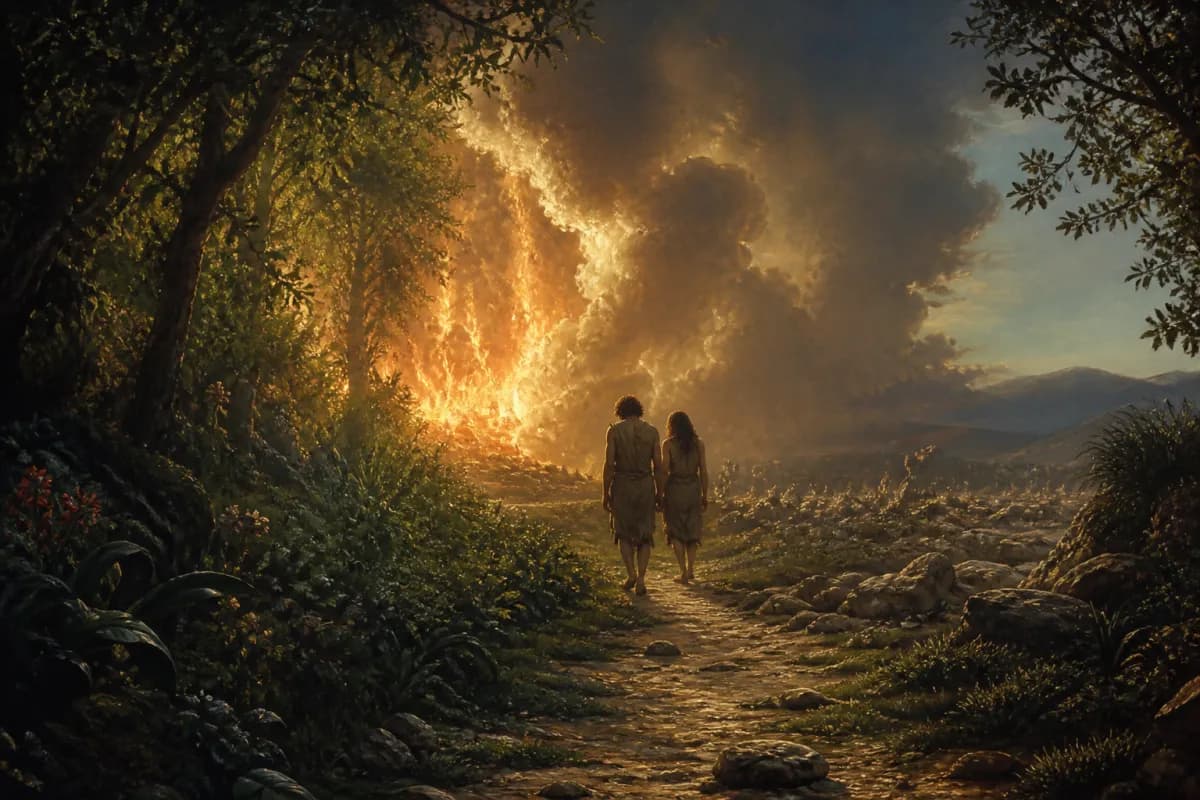
3:24So he drove out the man; and he placed cherubim at the east of the garden of Eden, and a flaming sword which turned every way, to guard the way to the tree of life.
CONTEXTUAL OVERVIEW
Genesis places the garden after God has declared creation good. The man receives life, a place, work, and a command before he faces temptation. The woman is given as his corresponding partner, and their unashamed union presents human life as open fellowship with God and one another.
The tree of the knowledge of good and evil makes the central question personal: will humanity receive good and evil from the Creator, or seize moral authority for itself? The serpent’s promise is not merely pleasure. It invites the couple to mistrust God’s goodness and define life apart from His word.
HISTORICAL AND LITERARY CONTEXT
This is the opening movement of Genesis’s primeval history, where the Bible explains the fracture visible in every later human story: shame, blame, toil, pain, alienation, death, and exile. The text gives a theological account of humanity’s rebellion; it does not pause to identify the serpent with later biblical language until the canon itself develops that identification.
The immediate context is crucial. Genesis 1 celebrates God’s good world, and Genesis 2 draws near to the human calling within it. Genesis 3 does not blame creation, embodiment, marriage, or work. It names rebellion against God as the source of the rupture that distorts each gift.
SECTION-BY-SECTION ANALYSIS
- The command · Genesis 2:16God’s prohibition is set inside lavish provision, so obedience rests on trust in His generosity.
- The hiding · Genesis 2:22Sin immediately fractures relationship: the man hides from God and shifts blame to the woman and, indirectly, to God.
- The exile · Genesis 2:9The guarded way to the tree of life shows that death and distance from God are not problems human effort can solve.
CHRIST IN THIS PASSAGE
Genesis 3:15 is a strong canonical promise of conflict and victory, not a detailed prediction whose every element can be decoded. The New Testament identifies the ancient serpent with the devil and portrays Christ’s death and resurrection as the decisive defeat of the evil that enslaves and accuses humanity. Jesus enters the world’s curse to undo what Adam’s rebellion brought upon it.
Paul sets Adam and Christ side by side in Romans 5:12–21: through one man sin and death enter, and through Christ grace and life reign. Jesus is the faithful Son where the first humans distrusted the Father. His mission does more than offer private comfort; He reconciles sinners to God and begins the new creation that will end in unguarded fellowship with God.
REFLECTION
The oldest temptation is still persuasive: imagine that God’s command keeps us from life and that freedom means self-rule. Genesis exposes the bitter result without leaving the reader in despair. God comes searching, speaks truth into hiding, and gives a promise before the long history of redemption unfolds.
Jesus meets the shame that drives people into concealment. Confession is not a way to win His attention; it is the return of people already sought by grace. His mission also sends His church into a hiding world with the honest message that sin is real, forgiveness is costly, and life with God is restored through the crucified and risen King.
Original Hebrew Word Study
Genesis 2:15
עָבַד
avad · H5647
Usually translated: to work, serve, or cultivate
Avad can mean to work or serve. Humanity’s first task in the garden is worshipful cultivation under God’s authority, which gives work dignity before sin turns it into toil.
Follow the Scripture trail
The Garden and the First Promise of Rescue in the larger story
The connection: The garden’s lost fellowship and the promise concerning the woman’s offspring set the Bible’s redemptive story in motion. Jesus fulfills that mission as the obedient Son who defeats the serpent’s work, bears the curse, and brings His people toward the restored presence of God.
Respond to the passage
Name the place where you are tempted to treat God’s wisdom as a limit on your life. Bring that distrust to Jesus, who gave Himself to bring sinners out of hiding and back to the Father. His grace calls for honest repentance and gives real hope for a new way of living.
- What does the serpent’s question make the woman doubt about God, and where does that same doubt surface in you?
- How do shame and blame appear after the man and woman eat, and what does Jesus offer to people caught in that pattern?
- Why does the guarded tree of life make the promise of Christ’s new creation necessary rather than optional?
Prayer
Father, forgive my distrust of Your goodness and my attempts to define life apart from Your word. Thank You for sending Jesus to bear the curse of sin and bring me near. Make me honest in repentance, steady in faith, and hopeful in Your promised new creation. Amen.