Passage Study
The Lord Who Calls Jeremiah and Remembers Judah’s First Love
Jeremiah 1:1–3:25
Jeremiah 1–3 opens with the Lord appointing a reluctant young prophet to uproot and build, then exposing Judah’s betrayal through the image of a faithless spouse. God’s judgment is real, yet His repeated call to return reveals covenant mercy. The passage prepares readers for Jesus, who gathers an unfaithful people through His saving love and makes them new by His Spirit.
- In this study
- 81 verses · 5 movements
Jeremiah 1
1:1The words of Jeremiah the son of Hilkiah, one of the priests who were in Anathoth in the land of Benjamin.
1:2The LORD’s word came to him in the days of Josiah the son of Amon, king of Judah, in the thirteenth year of his reign.
1:3It came also in the days of Jehoiakim the son of Josiah, king of Judah, to the end of the eleventh year of Zedekiah, the son of Josiah, king of Judah, to the carrying away of Jerusalem captive in the fifth month.
1:4Now the LORD’s word came to me, saying,
1:5“Before I formed you in the womb, I knew you. Before you were born, I sanctified you. I have appointed you a prophet to the nations.”
1:6Then I said, “Ah, Lord GOD! Behold, I don’t know how to speak; for I am a child.”
1:7But the LORD said to me, “Don’t say, ‘I am a child;’ for you must go to whomever I send you, and you must say whatever I command you.
1:8Don’t be afraid because of them, for I am with you to rescue you,” says the LORD.
1:9Then the LORD stretched out his hand and touched my mouth. Then the LORD said to me, “Behold, I have put my words in your mouth.
1:10Behold, I have today set you over the nations and over the kingdoms, to uproot and to tear down, to destroy and to overthrow, to build and to plant.”
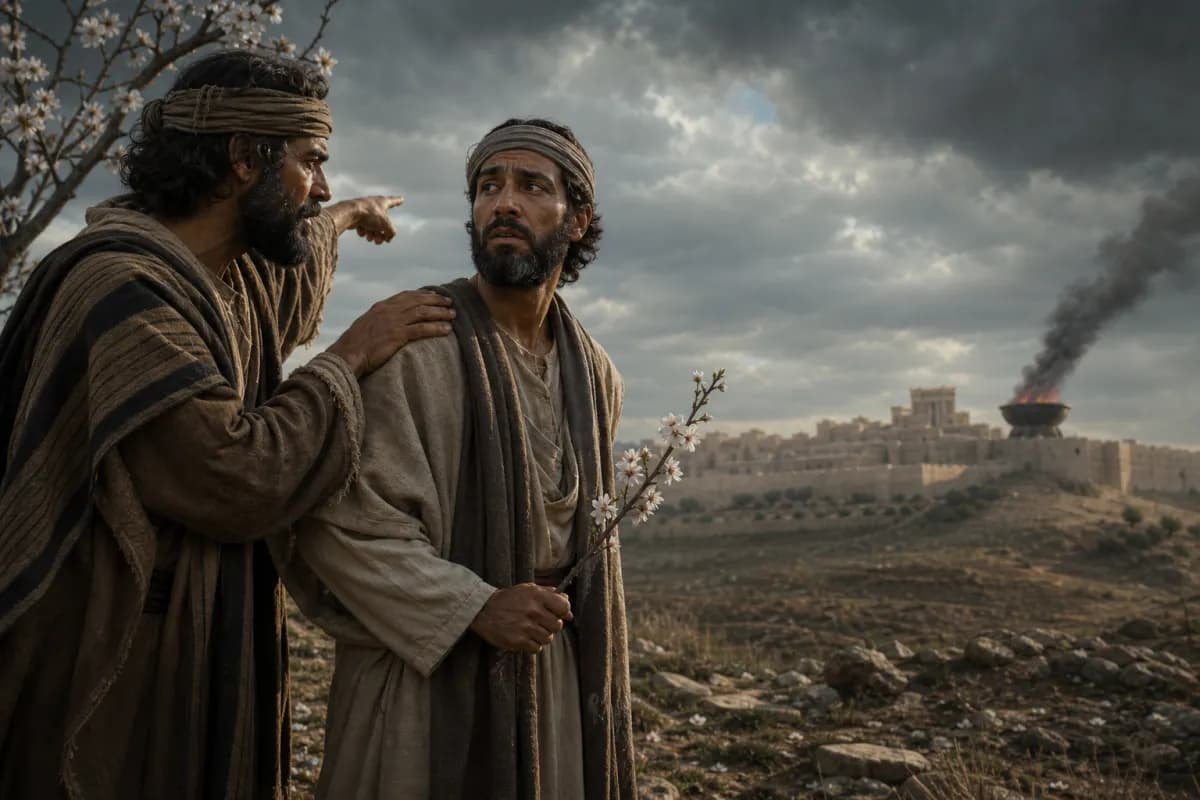
1:11Moreover the LORD’s word came to me, saying, “Jeremiah, what do you see?” I said, “I see a branch of an almond tree.”
1:12Then the LORD said to me, “You have seen well; for I watch over my word to perform it.”
1:13The LORD’s word came to me the second time, saying, “What do you see?” I said, “I see a boiling cauldron; and it is tipping away from the north.”
1:14Then the LORD said to me, “Out of the north, evil will break out on all the inhabitants of the land.
1:15For behold, I will call all the families of the kingdoms of the north,” says the LORD. “They will come, and they will each set his throne at the entrance of the gates of Jerusalem, and against all its walls all around, and against all the cities of Judah.
1:16I will utter my judgments against them concerning all their wickedness, in that they have forsaken me, and have burned incense to other gods, and worshiped the works of their own hands.
1:17“You therefore put your belt on your waist, arise, and say to them all that I command you. Don’t be dismayed at them, lest I dismay you before them.
1:18For behold, I have made you today a fortified city, an iron pillar, and bronze walls against the whole land—against the kings of Judah, against its princes, against its priests, and against the people of the land.
1:19They will fight against you, but they will not prevail against you; for I am with you”, says the LORD, “to rescue you.”
Jeremiah 2
2:1The LORD’s word came to me, saying,
2:2“Go and proclaim in the ears of Jerusalem, saying, ‘The LORD says, “I remember for you the kindness of your youth, your love as a bride, how you went after me in the wilderness, in a land that was not sown.
2:3Israel was holiness to the LORD, the first fruits of his increase. All who devour him will be held guilty. Evil will come on them,”’ says the LORD.”
2:4Hear the LORD’s word, O house of Jacob, and all the families of the house of Israel!
2:5The LORD says, “What unrighteousness have your fathers found in me, that they have gone far from me, and have walked after worthless vanity, and have become worthless?
2:6They didn’t say, ‘Where is the LORD who brought us up out of the land of Egypt, who led us through the wilderness, through a land of deserts and of pits, through a land of drought and of the shadow of death, through a land that no one passed through, and where no man lived?’
2:7I brought you into a plentiful land to eat its fruit and its goodness; but when you entered, you defiled my land, and made my heritage an abomination.
2:8The priests didn’t say, ‘Where is the LORD?’ and those who handle the law didn’t know me. The rulers also transgressed against me, and the prophets prophesied by Baal and followed things that do not profit.
2:9“Therefore I will yet contend with you,” says the LORD, “and I will contend with your children’s children.
2:10For pass over to the islands of Kittim, and see. Send to Kedar, and consider diligently, and see if there has been such a thing.
2:11Has a nation changed its gods, which really are no gods? But my people have changed their glory for that which doesn’t profit.
2:12“Be astonished, you heavens, at this and be horribly afraid. Be very desolate,” says the LORD.
2:13“For my people have committed two evils: they have forsaken me, the spring of living waters, and cut out cisterns for themselves: broken cisterns that can’t hold water.
2:14Is Israel a slave? Is he born into slavery? Why has he become a captive?
2:15The young lions have roared at him and raised their voices. They have made his land waste. His cities are burned up, without inhabitant.
2:16The children also of Memphis and Tahpanhes have broken the crown of your head.
2:17“Haven’t you brought this on yourself, in that you have forsaken the LORD your God, when he led you by the way?
2:18Now what do you gain by going to Egypt, to drink the waters of the Shihor? Or why do you go on the way to Assyria, to drink the waters of the River?
2:19“Your own wickedness will correct you, and your backsliding will rebuke you. Know therefore and see that it is an evil and bitter thing, that you have forsaken the LORD your God, and that my fear is not in you,” says the Lord, GOD of Armies.
2:20“For long ago I broke off your yoke, and burst your bonds. You said, ‘I will not serve;’ for on every high hill and under every green tree you bowed yourself, playing the prostitute.
2:21Yet I had planted you a noble vine, a pure and faithful seed. How then have you turned into the degenerate branches of a foreign vine to me?
2:22For though you wash yourself with lye, and use much soap, yet your iniquity is marked before me,” says the Lord GOD.
2:23“How can you say, ‘I am not defiled. I have not gone after the Baals’? See your way in the valley. Know what you have done. You are a swift dromedary traversing her ways,
2:24a wild donkey used to the wilderness, that sniffs the wind in her craving. When she is in heat, who can turn her away? All those who seek her will not weary themselves. In her month, they will find her.
2:25“Keep your feet from being bare, and your throat from thirst. But you said, ‘It is in vain. No, for I have loved strangers, and I will go after them.’
2:26As the thief is ashamed when he is found, so the house of Israel is ashamed— they, their kings, their princes, their priests, and their prophets,
2:27who tell wood, ‘You are my father,’ and a stone, ‘You have given birth to me,’ for they have turned their back to me, and not their face, but in the time of their trouble they will say, ‘Arise, and save us!’
2:28“But where are your gods that you have made for yourselves? Let them arise, if they can save you in the time of your trouble, for you have as many gods as you have towns, O Judah.
2:29“Why will you contend with me? You all have transgressed against me,” says the LORD.
2:30“I have struck your children in vain. They received no correction. Your own sword has devoured your prophets, like a destroying lion.
2:31Generation, consider the LORD’s word. Have I been a wilderness to Israel? Or a land of thick darkness? Why do my people say, ‘We have broken loose. We will come to you no more’?
2:32“Can a virgin forget her ornaments, or a bride her attire? Yet my people have forgotten me for days without number.
2:33How well you prepare your way to seek love! Therefore you have even taught the wicked women your ways.
2:34Also the blood of the souls of the innocent poor is found in your skirts. You didn’t find them breaking in, but it is because of all these things.
2:35“Yet you said, ‘I am innocent. Surely his anger has turned away from me.’ “Behold, I will judge you, because you say, ‘I have not sinned.’
2:36Why do you go about so much to change your ways? You will be ashamed of Egypt also, as you were ashamed of Assyria.
2:37You will also leave that place with your hands on your head; for the LORD has rejected those in whom you trust, and you won’t prosper with them.
Jeremiah 3
3:1“They say, ‘If a man puts away his wife, and she goes from him, and becomes another man’s, should he return to her again?’ Wouldn’t that land be greatly polluted? But you have played the prostitute with many lovers; yet return again to me,” says the LORD.
3:2“Lift up your eyes to the bare heights, and see! Where have you not been lain with? You have sat waiting for them by the road, as an Arabian in the wilderness. You have polluted the land with your prostitution and with your wickedness.
3:3Therefore the showers have been withheld and there has been no latter rain; yet you have had a prostitute’s forehead and you refused to be ashamed.
3:4Will you not from this time cry to me, ‘My Father, you are the guide of my youth!’?
3:5“‘Will he retain his anger forever? Will he keep it to the end?’ Behold, you have spoken and have done evil things, and have had your way.”
3:6Moreover, the LORD said to me in the days of Josiah the king, “Have you seen that which backsliding Israel has done? She has gone up on every high mountain and under every green tree, and has played the prostitute there.
3:7I said after she had done all these things, ‘She will return to me;’ but she didn’t return, and her treacherous sister Judah saw it.
3:8I saw when, for this very cause, that backsliding Israel had committed adultery, I had put her away and given her a certificate of divorce, yet treacherous Judah, her sister, had no fear, but she also went and played the prostitute.
3:9Because she took her prostitution lightly, the land was polluted, and she committed adultery with stones and with wood.
3:10Yet for all this her treacherous sister, Judah, has not returned to me with her whole heart, but only in pretense,” says the LORD.
3:11The LORD said to me, “Backsliding Israel has shown herself more righteous than treacherous Judah.
3:12Go, and proclaim these words toward the north, and say, ‘Return, you backsliding Israel,’ says the LORD; ‘I will not look in anger on you, for I am merciful,’ says the LORD. ‘I will not keep anger forever.
3:13Only acknowledge your iniquity, that you have transgressed against the LORD your God, and have scattered your ways to the strangers under every green tree, and you have not obeyed my voice,’” says the LORD.
3:14“Return, backsliding children,” says the LORD, “for I am a husband to you. I will take one of you from a city, and two from a family, and I will bring you to Zion.
3:15I will give you shepherds according to my heart, who will feed you with knowledge and understanding.
3:16It will come to pass, when you are multiplied and increased in the land in those days,” says the LORD, “they will no longer say, ‘the ark of the LORD’s covenant!’ It will not come to mind. They won’t remember it. They won’t miss it, nor will another be made.
3:17At that time they will call Jerusalem ‘The LORD’s Throne;’ and all the nations will be gathered to it, to the LORD’s name, to Jerusalem. They will no longer walk after the stubbornness of their evil heart.
3:18In those days the house of Judah will walk with the house of Israel, and they will come together out of the land of the north to the land that I gave for an inheritance to your fathers.
3:19“But I said, ‘How I desire to put you among the children, and give you a pleasant land, a goodly heritage of the armies of the nations!’ and I said, ‘You shall call me “My Father”, and shall not turn away from following me.’
3:20“Surely as a wife treacherously departs from her husband, so you have dealt treacherously with me, house of Israel,” says the LORD.
3:21A voice is heard on the bare heights, the weeping and the petitions of the children of Israel; because they have perverted their way, they have forgotten the LORD their God.
3:22Return, you backsliding children, and I will heal your backsliding. “Behold, we have come to you; for you are the LORD our God.
3:23Truly help from the hills, the tumult on the mountains, is in vain. Truly the salvation of Israel is in the LORD our God.
3:24But the shameful thing has devoured the labor of our fathers from our youth, their flocks and their herds, their sons and their daughters.
3:25Let us lie down in our shame, and let our confusion cover us; for we have sinned against the LORD our God, we and our fathers, from our youth even to this day. We have not obeyed the LORD our God’s voice.”
CONTEXTUAL OVERVIEW
Jeremiah begins with a call that overwhelms the man receiving it. He protests that he is only a boy and does not know how to speak, but the Lord answers by placing His words in Jeremiah’s mouth. The prophet’s authority will not rest on force of personality, age, or political influence; it rests on the God who sends him.
The call immediately opens onto Judah’s covenant crisis. God remembers Israel following Him in the wilderness, then asks what fault their ancestors found in Him that they went after worthless things. The marriage language of chapters 2–3 makes the sin personal: Judah has not simply broken regulations but deserted the Lord who gave her land, water, and a name.
HISTORICAL AND LITERARY CONTEXT
Jeremiah’s ministry begins in the thirteenth year of King Josiah and continues into the last years of Judah before Jerusalem’s fall. The book addresses a people living with the memory of Assyrian power, the pressure of changing empires, and the temptation to secure themselves through idols and alliances rather than through covenant faithfulness.
The almond branch and boiling pot are prophetic signs, not decorative details. The branch is linked to the Lord’s watchfulness over His word, while the pot tipping from the north signals approaching disaster. Chapters 2–3 then use lawsuit and marital imagery: God lays out Judah’s history of received mercy, pursued idols, and stubborn refusal to return.
SECTION-BY-SECTION ANALYSIS
- I am watching over my word · Jeremiah 1:12The almond-branch sign assures Jeremiah that the difficult message will be carried forward by the Lord’s own faithfulness.
- The fountain of living water · Jeremiah 2:13Judah’s idolatry is exposed as exchanging the life-giving God for containers that cannot hold water.
- Return, faithless Israel · Jeremiah 3:12God’s summons to return comes after He has named betrayal plainly, so mercy never treats sin as harmless.
CHRIST IN THIS PASSAGE
Jeremiah’s call and Judah’s adultery establish the human need that Jesus addresses: God’s people cannot restore themselves by religious effort or political strategy. Jesus identifies Himself as the giver of living water, a strong canonical echo of Jeremiah’s accusation. Through His death and resurrection, He bears the judgment sinners deserve and brings those who return to God into a renewed covenant relationship.
The promised shepherds in Jeremiah 3 point thematically toward Jesus, the good Shepherd who knows His sheep and gives His life for them. This is not a claim that every image in Jeremiah’s call narrative directly predicts Jesus. Rather, the prophet’s contrast between faithless leaders and God-given shepherding finds its saving fulfillment in Christ’s faithful care for a people who had wandered.
REFLECTION
Jeremiah makes idolatry concrete by asking where Judah went for life, protection, and identity. The same question reaches modern disciples: what do we treat as a fountain when fear rises—approval, money, control, a relationship, or political power? Jesus does not invite us to hide those substitutes; He calls us to come to Him for the life they cannot give.
If you feel inadequate for an obedient task, remember that Jeremiah’s confidence was not self-confidence. Bring both your fear and your divided loyalties to Christ. Ask Him to replace one cracked cistern you keep returning to with a specific practice of trust, truthfulness, or costly faithfulness this week.
Original Hebrew Word Study
Jeremiah 1:5
נָבִיא
navi · H5030
Usually translated: prophet
Navi means prophet, one called to speak God’s word. Jeremiah’s vocation begins before his public conflict, making clear that his hard message arises from the Lord’s initiative rather than personal ambition.
Follow the Scripture trail
The Lord Who Calls Jeremiah and Remembers Judah’s First Love in the larger story
The connection: Jeremiah is sent to expose Judah’s abandonment of the living God and to summon a faithless people home. Jesus gives the living water Judah refused, bears sin’s judgment, and shepherds those He restores into covenant fellowship with God.
Respond to the passage
Name one false source of security that has become a cracked cistern for you. Turn to Jesus in prayer, ask for His living water, and take one concrete step that places your trust under His shepherding care.
- Why does Jeremiah’s call include both tearing down and building up?
- What does the image of broken cisterns reveal about Judah’s idols?
- How does Jesus’ promise of living water answer Jeremiah’s call to return?
Prayer
Lord Jesus, forgive me for seeking life in things that cannot hold it. Give me Your living water, steady me when obedience feels beyond me, and lead me home under Your faithful care. Amen.