Passage Study
The Word That Cannot Be Replaced by a Peaceful Lie
Jeremiah 26:1–29:32
Jeremiah 26–29 sets the Lord’s costly word against messages of safety that He has not spoken. Jeremiah risks death at the temple, contends with Hananiah’s broken-yoke prophecy, and writes exiles to seek Babylon’s welfare while they wait for God’s promised restoration. The chapters teach that true hope submits to God’s word, and they prepare us for Christ, whose peace comes through His saving obedience rather than denial of sin or judgment.
- In this study
- 95 verses · 5 movements
Jeremiah 26
26:1In the beginning of the reign of Jehoiakim the son of Josiah, king of Judah, this word came from the LORD:
26:2“The LORD says: ‘Stand in the court of the LORD’s house, and speak to all the cities of Judah which come to worship in the LORD’s house, all the words that I command you to speak to them. Don’t omit a word.
26:3It may be they will listen, and every man turn from his evil way, that I may relent from the evil which I intend to do to them because of the evil of their doings.’”
26:4You shall tell them, “The LORD says: ‘If you will not listen to me, to walk in my law which I have set before you,
26:5to listen to the words of my servants the prophets whom I send to you, even rising up early and sending them—but you have not listened—
26:6then I will make this house like Shiloh, and will make this city a curse to all the nations of the earth.’”
26:7The priests and the prophets and all the people heard Jeremiah speaking these words in the LORD’s house.
26:8When Jeremiah had finished speaking all that the LORD had commanded him to speak to all the people, the priests and the prophets and all the people seized him, saying, “You shall surely die!
26:9Why have you prophesied in the LORD’s name, saying, ‘This house will be like Shiloh, and this city will be desolate, without inhabitant’?” All the people were crowded around Jeremiah in the LORD’s house.
26:10When the princes of Judah heard these things, they came up from the king’s house to the LORD’s house; and they sat in the entry of the new gate of the LORD’s house.
26:11Then the priests and the prophets spoke to the princes and to all the people, saying, “This man is worthy of death, for he has prophesied against this city, as you have heard with your ears.”
26:12Then Jeremiah spoke to all the princes and to all the people, saying, “The LORD sent me to prophesy against this house and against this city all the words that you have heard.
26:13Now therefore amend your ways and your doings, and obey the LORD your God’s voice; then the LORD will relent from the evil that he has pronounced against you.
26:14But as for me, behold, I am in your hand. Do with me what is good and right in your eyes.
26:15Only know for certain that if you put me to death, you will bring innocent blood on yourselves, on this city, and on its inhabitants; for in truth the LORD has sent me to you to speak all these words in your ears.”
26:16Then the princes and all the people said to the priests and to the prophets: “This man is not worthy of death; for he has spoken to us in the name of the LORD our God.”
26:17Then certain of the elders of the land rose up, and spoke to all the assembly of the people, saying,
26:18“Micah the Morashtite prophesied in the days of Hezekiah king of Judah; and he spoke to all the people of Judah, saying, ‘The LORD of Armies says: “‘Zion will be plowed as a field, and Jerusalem will become heaps, and the mountain of the house as the high places of a forest.’
26:19Did Hezekiah king of Judah and all Judah put him to death? Didn’t he fear the LORD, and entreat the favor of the LORD, and the LORD relented of the disaster which he had pronounced against them? We would commit great evil against our own souls that way!”
26:20There was also a man who prophesied in the LORD’s name, Uriah the son of Shemaiah of Kiriath Jearim; and he prophesied against this city and against this land according to all the words of Jeremiah.
26:21When Jehoiakim the king, with all his mighty men and all the princes heard his words, the king sought to put him to death; but when Uriah heard it, he was afraid, and fled, and went into Egypt.
26:22Then Jehoiakim the king sent Elnathan the son of Achbor and certain men with him into Egypt.
26:23They fetched Uriah out of Egypt and brought him to Jehoiakim the king, who killed him with the sword and cast his dead body into the graves of the common people.
26:24But the hand of Ahikam the son of Shaphan was with Jeremiah, so that they didn’t give him into the hand of the people to put him to death.
Jeremiah 27
27:1In the beginning of the reign of Jehoiakim the son of Josiah, king of Judah, this word came to Jeremiah from the LORD, saying,
27:2the LORD says to me: “Make bonds and bars, and put them on your neck.
27:3Then send them to the king of Edom, to the king of Moab, to the king of the children of Ammon, to the king of Tyre, and to the king of Sidon, by the hand of the messengers who come to Jerusalem to Zedekiah king of Judah.
27:4Give them a command to their masters, saying, ‘The LORD of Armies, the God of Israel says, “You shall tell your masters:
27:5‘I have made the earth, the men, and the animals that are on the surface of the earth by my great power and by my outstretched arm. I give it to whom it seems right to me.
27:6Now I have given all these lands into the hand of Nebuchadnezzar the king of Babylon, my servant. I have also given the animals of the field to him to serve him.
27:7All the nations will serve him, his son, and his son’s son, until the time of his own land comes. Then many nations and great kings will make him their bondservant.
27:8“‘“‘It will happen that I will punish the nation and the kingdom which will not serve the same Nebuchadnezzar king of Babylon, and that will not put their neck under the yoke of the king of Babylon,’ says the LORD, ‘with the sword, with famine, and with pestilence, until I have consumed them by his hand.
27:9But as for you, don’t listen to your prophets, to your diviners, to your dreams, to your soothsayers, or to your sorcerers, who speak to you, saying, “You shall not serve the king of Babylon;”
27:10for they prophesy a lie to you, to remove you far from your land, so that I would drive you out, and you would perish.
27:11But the nation that brings their neck under the yoke of the king of Babylon and serves him, that nation I will let remain in their own land,’ says the LORD; ‘and they will till it and dwell in it.’”’”
27:12I spoke to Zedekiah king of Judah according to all these words, saying, “Bring your necks under the yoke of the king of Babylon, and serve him and his people, and live.
27:13Why will you die, you and your people, by the sword, by the famine, and by the pestilence, as the LORD has spoken concerning the nation that will not serve the king of Babylon?
27:14Don’t listen to the words of the prophets who speak to you, saying, ‘You shall not serve the king of Babylon;’ for they prophesy a lie to you.
27:15For I have not sent them,” says the LORD, “but they prophesy falsely in my name; that I may drive you out, and that you may perish, you, and the prophets who prophesy to you.”
27:16Also I spoke to the priests and to all this people, saying, the LORD says, “Don’t listen to the words of your prophets who prophesy to you, saying, ‘Behold, the vessels of the LORD’s house will now shortly be brought again from Babylon;’ for they prophesy a lie to you.
27:17Don’t listen to them. Serve the king of Babylon, and live. Why should this city become a desolation?
27:18But if they are prophets, and if the LORD’s word is with them, let them now make intercession to the LORD of Armies, that the vessels which are left in the LORD’s house, in the house of the king of Judah, and at Jerusalem, don’t go to Babylon.
27:19For the LORD of Armies says concerning the pillars, concerning the sea, concerning the bases, and concerning the rest of the vessels that are left in this city,
27:20which Nebuchadnezzar king of Babylon didn’t take when he carried away captive Jeconiah the son of Jehoiakim, king of Judah, from Jerusalem to Babylon, and all the nobles of Judah and Jerusalem—
27:21yes, the LORD of Armies, the God of Israel, says concerning the vessels that are left in the LORD’s house, and in the house of the king of Judah, and at Jerusalem:
27:22‘They will be carried to Babylon, and there they will be, until the day that I visit them,’ says the LORD; ‘then I will bring them up, and restore them to this place.’”
Jeremiah 28
28:1That same year, in the beginning of the reign of Zedekiah king of Judah, in the fourth year, in the fifth month, Hananiah the son of Azzur, the prophet, who was of Gibeon, spoke to me in the LORD’s house, in the presence of the priests and of all the people, saying,
28:2“The LORD of Armies, the God of Israel, says, ‘I have broken the yoke of the king of Babylon.
28:3Within two full years I will bring again into this place all the vessels of the LORD’s house that Nebuchadnezzar king of Babylon took away from this place and carried to Babylon.
28:4I will bring again to this place Jeconiah the son of Jehoiakim, king of Judah, with all the captives of Judah, who went to Babylon,’ says the LORD; ‘for I will break the yoke of the king of Babylon.’”
28:5Then the prophet Jeremiah said to the prophet Hananiah in the presence of the priests, and in the presence of all the people who stood in the LORD’s house,
28:6even the prophet Jeremiah said, “Amen! May the LORD do so. May the LORD perform your words which you have prophesied, to bring again the vessels of the LORD’s house, and all those who are captives, from Babylon to this place.
28:7Nevertheless listen now to this word that I speak in your ears, and in the ears of all the people:
28:8The prophets who have been before me and before you of old prophesied against many countries, and against great kingdoms, of war, of evil, and of pestilence.
28:9As for the prophet who prophesies of peace, when the word of the prophet happens, then the prophet will be known, that the LORD has truly sent him.”
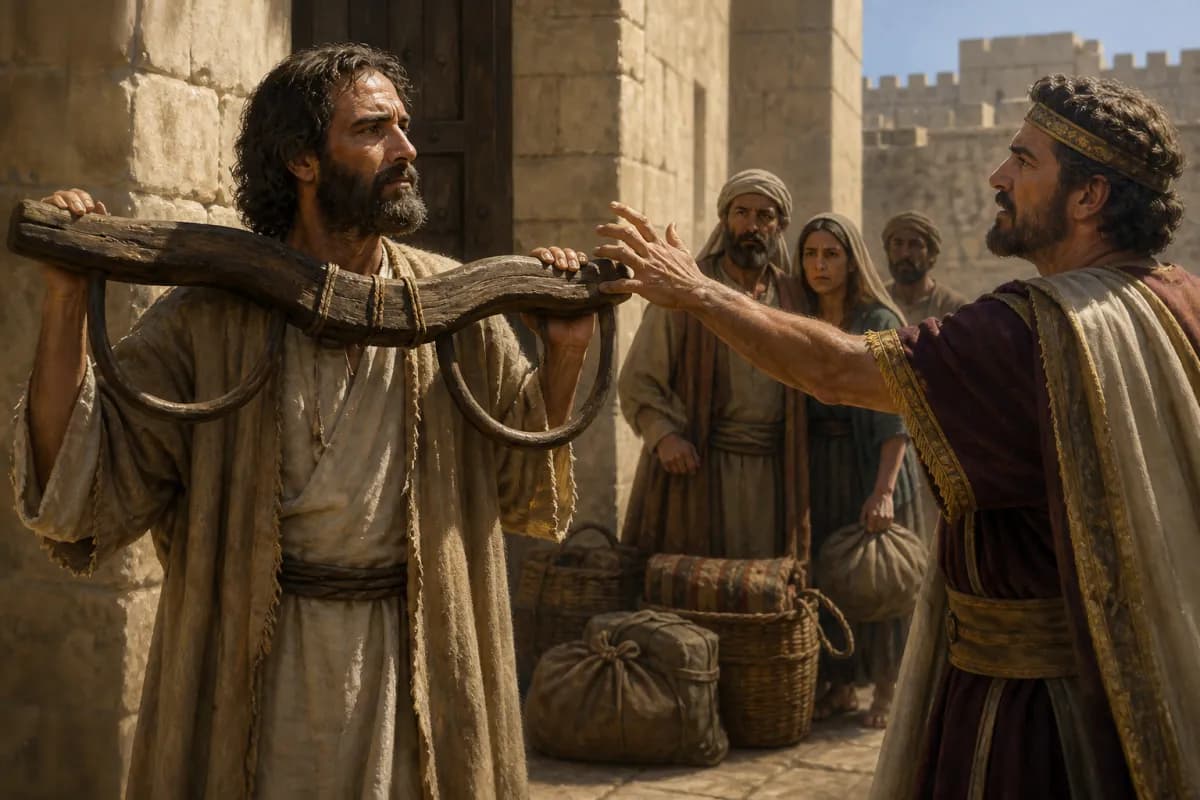
28:10Then Hananiah the prophet took the bar from off the prophet Jeremiah’s neck, and broke it.
28:11Hananiah spoke in the presence of all the people, saying, “The LORD says: ‘Even so I will break the yoke of Nebuchadnezzar king of Babylon from off the neck of all the nations within two full years.’” Then the prophet Jeremiah went his way.
28:12Then the LORD’s word came to Jeremiah, after Hananiah the prophet had broken the bar from off the neck of the prophet Jeremiah, saying,
28:13“Go, and tell Hananiah, saying, ‘The LORD says, “You have broken the bars of wood, but you have made in their place bars of iron.”
28:14For the LORD of Armies, the God of Israel says, “I have put a yoke of iron on the neck of all these nations, that they may serve Nebuchadnezzar king of Babylon; and they will serve him. I have also given him the animals of the field.”’”
28:15Then the prophet Jeremiah said to Hananiah the prophet, “Listen, Hananiah! The LORD has not sent you, but you make this people trust in a lie.
28:16Therefore the LORD says, ‘Behold, I will send you away from off the surface of the earth. This year you will die, because you have spoken rebellion against the LORD.’”
28:17So Hananiah the prophet died the same year in the seventh month.
Jeremiah 29
29:1Now these are the words of the letter that Jeremiah the prophet sent from Jerusalem to the residue of the elders of the captivity, and to the priests, to the prophets, and to all the people whom Nebuchadnezzar had carried away captive from Jerusalem to Babylon,
29:2(after Jeconiah the king, the queen mother, the eunuchs, the princes of Judah and Jerusalem, the craftsmen, and the smiths had departed from Jerusalem),
29:3by the hand of Elasah the son of Shaphan and Gemariah the son of Hilkiah, (whom Zedekiah king of Judah sent to Babylon to Nebuchadnezzar king of Babylon). It said:
29:4The LORD of Armies, the God of Israel, says to all the captives whom I have caused to be carried away captive from Jerusalem to Babylon:
29:5“Build houses and dwell in them. Plant gardens and eat their fruit.
29:6Take wives and father sons and daughters. Take wives for your sons, and give your daughters to husbands, that they may bear sons and daughters. Multiply there, and don’t be diminished.
29:7Seek the peace of the city where I have caused you to be carried away captive, and pray to the LORD for it; for in its peace you will have peace.”
29:8For the LORD of Armies, the God of Israel says: “Don’t let your prophets who are among you and your diviners deceive you. Don’t listen to your dreams which you cause to be dreamed.
29:9For they prophesy falsely to you in my name. I have not sent them,” says the LORD.
29:10For the LORD says, “After seventy years are accomplished for Babylon, I will visit you and perform my good word toward you, in causing you to return to this place.
29:11For I know the thoughts that I think toward you,” says the LORD, “thoughts of peace, and not of evil, to give you hope and a future.
29:12You shall call on me, and you shall go and pray to me, and I will listen to you.
29:13You shall seek me and find me, when you search for me with all your heart.
29:14I will be found by you,” says the LORD, “and I will turn again your captivity, and I will gather you from all the nations, and from all the places where I have driven you,” says the LORD. “I will bring you again to the place from where I caused you to be carried away captive.”
29:15Because you have said, “The LORD has raised us up prophets in Babylon,”
29:16the LORD says concerning the king who sits on David’s throne, and concerning all the people who dwell in this city, your brothers who haven’t gone with you into captivity,
29:17the LORD of Armies says: “Behold, I will send on them the sword, the famine, and the pestilence, and will make them like rotten figs that can’t be eaten, they are so bad.
29:18I will pursue after them with the sword, with the famine, and with the pestilence, and will deliver them to be tossed back and forth among all the kingdoms of the earth, to be an object of horror, an astonishment, a hissing, and a reproach among all the nations where I have driven them,
29:19because they have not listened to my words,” says the LORD, “with which I sent to them my servants the prophets, rising up early and sending them; but you would not hear,” says the LORD.
29:20Hear therefore the LORD’s word, all you captives whom I have sent away from Jerusalem to Babylon.
29:21The LORD of Armies, the God of Israel, says concerning Ahab the son of Kolaiah, and concerning Zedekiah the son of Maaseiah, who prophesy a lie to you in my name: “Behold, I will deliver them into the hand of Nebuchadnezzar king of Babylon; and he will kill them before your eyes.
29:22A curse will be taken up about them by all the captives of Judah who are in Babylon, saying, ‘The LORD make you like Zedekiah and like Ahab, whom the king of Babylon roasted in the fire;’
29:23because they have done foolish things in Israel, and have committed adultery with their neighbors’ wives, and have spoken words in my name falsely, which I didn’t command them. I am he who knows, and am witness,” says the LORD.
29:24Concerning Shemaiah the Nehelamite you shall speak, saying,
29:25“The LORD of Armies, the God of Israel, says, ‘Because you have sent letters in your own name to all the people who are at Jerusalem, and to Zephaniah the son of Maaseiah, the priest, and to all the priests, saying,
29:26“The LORD has made you priest in the place of Jehoiada the priest, that there may be officers in the LORD’s house, for every man who is crazy and makes himself a prophet, that you should put him in the stocks and in shackles.
29:27Now therefore, why have you not rebuked Jeremiah of Anathoth, who makes himself a prophet to you,
29:28because he has sent to us in Babylon, saying, The captivity is long. Build houses, and dwell in them. Plant gardens, and eat their fruit?”’”
29:29Zephaniah the priest read this letter in the hearing of Jeremiah the prophet.
29:30Then the LORD’s word came to Jeremiah, saying,
29:31“Send to all of the captives, saying, ‘The LORD says concerning Shemaiah the Nehelamite: “Because Shemaiah has prophesied to you, and I didn’t send him, and he has caused you to trust in a lie,”
29:32therefore the LORD says, “Behold, I will punish Shemaiah the Nehelamite and his offspring. He will not have a man to dwell among this people. He won’t see the good that I will do to my people,” says the LORD, “because he has spoken rebellion against the LORD.”’”
CONTEXTUAL OVERVIEW
Jeremiah’s temple address in chapter 26 places a hard conditional word before Judah: if the people will not listen and amend their ways, the temple will become like Shiloh and Jerusalem will become a curse among the nations. Priests, prophets, and people hear this as treason against their city, but Jeremiah refuses to soften the message in order to save himself.
Chapters 27–29 move the conflict into the era of Babylonian domination. A wooden yoke on Jeremiah’s neck dramatizes that Judah and surrounding nations must submit to Nebuchadnezzar for a season. The pressure is therefore spiritual as well as political: will God’s people receive an unwelcome word from Him, or choose prophets who make resistance sound faithful and captivity sound impossible?
HISTORICAL AND LITERARY CONTEXT
The chapters gather courtroom-like confrontation, symbolic action, and a letter sent to deportees in Babylon. The narrative remembers that Hezekiah did not execute Micah for announcing Zion’s ruin, which supplies a precedent for taking prophetic warning seriously rather than silencing it. Jeremiah’s opponents use the vocabulary of the Lord while contradicting the direction the Lord has given.
The letter in chapter 29 is addressed to people already carried away from Jerusalem. It does not promise an immediate escape. They are told to build houses, plant gardens, form families, and seek the welfare of Babylon because their life there will be long. God’s future of restoration is certain, but it is not permission to believe every urgent promise of relief.
SECTION-BY-SECTION ANALYSIS
- The temple court · Jeremiah 26:2Jeremiah’s threatened death reveals how deeply Judah resists a word that exposes its false confidence.
- The broken wooden yoke · Jeremiah 28:2Hananiah’s dramatic act offers a visible but false assurance, while Jeremiah’s iron yoke declares the unavoidable weight of Babylonian rule.
- Seek the welfare of the city · Jeremiah 29:7Exiles are commanded to live constructively and prayerfully in Babylon while awaiting God’s appointed restoration.
CHRIST IN THIS PASSAGE
Jeremiah’s refusal to change God’s word for an easier verdict points thematically to Jesus, who was rejected when His teaching and actions challenged false security around the temple. Jesus does not offer peace by pretending sin has no consequence. He bears judgment at the cross so that peace with God can be real, purchased, and received by faith.
The letter to the exiles also gives a lasting pattern for God’s people who await their final home. The New Testament calls Christians sojourners, yet sends them into the world for its good. Christ’s saving mission forms a people who pray, serve, and tell the truth where they live while looking for the city God will finally establish.
REFLECTION
Jeremiah asks whether we prefer a message because it is God’s word or because it leaves our plans untouched. When Scripture names a sin, a costly obedience, or a delayed hope, a soothing alternative can feel more spiritual than it is. Bring the particular promise or fear you are using to avoid obedience into the light of Christ.
If you are living in a season you did not choose, chapter 29 gives a concrete vocation: cultivate faithfulness where God has placed you, pray for your neighbors, and do not let a longing for escape make you useless in the present. Jesus meets His people in that waiting and keeps their hope anchored in His resurrection.
Original Hebrew Word Study
Jeremiah 28:15
שֶׁקֶר
sheqer · H8267
Usually translated: falsehood or deception
Sheqer means falsehood or deception. A comforting message becomes spiritually deadly when it promises peace without God’s word, repentance, or truth.
Follow the Scripture trail
The Word That Cannot Be Replaced by a Peaceful Lie in the larger story
The connection: Jeremiah exposes peace claims that deny God’s judgment and teaches exiles to wait faithfully for His restoration. Jesus is the rejected truth-teller who bears judgment to make peace with God, and He sends His waiting people to serve the world without surrendering their hope in His kingdom.
Respond to the passage
Identify one comforting message that lets you avoid a clear command of Christ. Ask Him for the courage to obey it, and choose one tangible way to seek the good of the people and place where He has put you this week.
- Why does Jeremiah refuse to celebrate Hananiah’s prediction even though he desires Judah’s restoration?
- What does the promise of Jeremiah 29 require of exiles before it promises restoration?
- Where might you be tempted to call an easier message “peace” when Christ is calling you to truth?
Prayer
Lord Jesus, keep me from preferring reassuring lies to Your faithful word. Teach me to wait under Your rule, seek my neighbors’ good, and trust the peace You secured through Your cross. Amen.