Passage Study
Freedom Revoked, the Scroll Burned, and the Word That Endures
Jeremiah 34:1–36:32
Jeremiah 34–36 exposes Jerusalem’s final refusal to obey while Babylon closes in. The people free enslaved Hebrews and then enslave them again; King Zedekiah receives a personal warning; and King Jehoiakim burns Jeremiah’s scroll. God’s word remains after the scroll burns, and the broken promise of release reveals Judah’s need for the liberating grace Christ secures.
- In this study
- 73 verses · 5 movements
Jeremiah 34
34:1The word which came to Jeremiah from the LORD, when Nebuchadnezzar king of Babylon, with all his army, all the kingdoms of the earth that were under his dominion, and all the peoples, were fighting against Jerusalem and against all its cities, saying:
34:2“The LORD, the God of Israel, says, ‘Go, and speak to Zedekiah king of Judah, and tell him, the LORD says, “Behold, I will give this city into the hand of the king of Babylon and he will burn it with fire.
34:3You won’t escape out of his hand, but will surely be taken and delivered into his hand. Your eyes will see the eyes of the king of Babylon, and he will speak with you mouth to mouth. You will go to Babylon.”’
34:4“Yet hear the LORD’s word, O Zedekiah king of Judah. The LORD says concerning you, ‘You won’t die by the sword.
34:5You will die in peace; and with the burnings of your fathers, the former kings who were before you, so they will make a burning for you. They will lament you, saying, “Ah Lord!” for I have spoken the word,’ says the LORD.”
34:6Then Jeremiah the prophet spoke all these words to Zedekiah king of Judah in Jerusalem,
34:7when the king of Babylon’s army was fighting against Jerusalem and against all the cities of Judah that were left, against Lachish and against Azekah; for these alone remained of the cities of Judah as fortified cities.
34:8The word came to Jeremiah from the LORD, after King Zedekiah had made a covenant with all the people who were at Jerusalem, to proclaim liberty to them,
34:9that every man should let his male servant, and every man his female servant, who is a Hebrew or a Hebrewess, go free, that no one should make bondservants of them, of a Jew his brother.
34:10All the princes and all the people obeyed who had entered into the covenant, that everyone should let his male servant and everyone his female servant go free, that no one should make bondservants of them any more. They obeyed and let them go,
34:11but afterwards they turned, and caused the servants and the handmaids whom they had let go free to return, and brought them into subjection for servants and for handmaids.
34:12Therefore the LORD’s word came to Jeremiah from the LORD, saying,
34:13“The LORD, the God of Israel, says: ‘I made a covenant with your fathers in the day that I brought them out of the land of Egypt, out of the house of bondage, saying:
34:14At the end of seven years, every man of you shall release his brother who is a Hebrew, who has been sold to you, and has served you six years. You shall let him go free from you. But your fathers didn’t listen to me, and didn’t incline their ear.
34:15You had now turned, and had done that which is right in my eyes, in every man proclaiming liberty to his neighbor. You had made a covenant before me in the house which is called by my name;
34:16but you turned and profaned my name, and every man caused his servant and every man his handmaid, whom you had let go free at their pleasure, to return. You brought them into subjection, to be to you for servants and for handmaids.’”
34:17Therefore the LORD says: “You have not listened to me, to proclaim liberty, every man to his brother, and every man to his neighbor. Behold, I proclaim to you a liberty,” says the LORD, “to the sword, to the pestilence, and to the famine. I will make you be tossed back and forth among all the kingdoms of the earth.
34:18I will give the men who have transgressed my covenant, who have not performed the words of the covenant which they made before me when they cut the calf in two and passed between its parts:
34:19the princes of Judah, the princes of Jerusalem, the eunuchs, the priests, and all the people of the land, who passed between the parts of the calf.
34:20I will even give them into the hand of their enemies and into the hand of those who seek their life. Their dead bodies will be food for the birds of the sky and for the animals of the earth.
34:21“I will give Zedekiah king of Judah and his princes into the hands of their enemies, into the hands of those who seek their life and into the hands of the king of Babylon’s army, who has gone away from you.
34:22Behold, I will command,” says the LORD, “and cause them to return to this city. They will fight against it, take it, and burn it with fire. I will make the cities of Judah a desolation, without inhabitant.”
Jeremiah 35
35:1The word which came to Jeremiah from the LORD in the days of Jehoiakim the son of Josiah, king of Judah, saying,
35:2“Go to the house of the Rechabites, and speak to them, and bring them into the LORD’s house, into one of the rooms, and give them wine to drink.”
35:3Then I took Jaazaniah the son of Jeremiah, the son of Habazziniah, with his brothers, all his sons, and the whole house of the Rechabites;
35:4and I brought them into the LORD’s house, into the room of the sons of Hanan the son of Igdaliah, the man of God, which was by the room of the princes, which was above the room of Maaseiah the son of Shallum, the keeper of the threshold.
35:5I set before the sons of the house of the Rechabites bowls full of wine, and cups; and I said to them, “Drink wine!”
35:6But they said, “We will drink no wine; for Jonadab the son of Rechab, our father, commanded us, saying, ‘You shall drink no wine, neither you nor your children, forever.
35:7You shall not build a house, sow seed, plant a vineyard, or have any; but all your days you shall dwell in tents, that you may live many days in the land in which you live as nomads.’
35:8We have obeyed the voice of Jonadab the son of Rechab, our father, in all that he commanded us, to drink no wine all our days, we, our wives, our sons, or our daughters;
35:9and not to build houses for ourselves to dwell in. We have no vineyard, field, or seed;
35:10but we have lived in tents, and have obeyed, and done according to all that Jonadab our father commanded us.
35:11But when Nebuchadnezzar king of Babylon came up into the land, we said, ‘Come! Let’s go to Jerusalem for fear of the army of the Chaldeans, and for fear of the army of the Syrians; so we will dwell at Jerusalem.’”
35:12Then the LORD’s word came to Jeremiah, saying,
35:13“The LORD of Armies, the God of Israel, says: ‘Go and tell the men of Judah and the inhabitants of Jerusalem, “Will you not receive instruction to listen to my words?” says the LORD.
35:14“The words of Jonadab the son of Rechab that he commanded his sons, not to drink wine, are performed; and to this day they drink none, for they obey their father’s commandment; but I have spoken to you, rising up early and speaking, and you have not listened to me.
35:15I have sent also to you all my servants the prophets, rising up early and sending them, saying, ‘Every one of you must return now from his evil way, amend your doings, and don’t go after other gods to serve them. Then you will dwell in the land which I have given to you and to your fathers;’ but you have not inclined your ear, nor listened to me.
35:16The sons of Jonadab the son of Rechab have performed the commandment of their father which he commanded them, but this people has not listened to me.”’
35:17“Therefore the LORD, the God of Armies, the God of Israel, says: ‘Behold, I will bring on Judah and on all the inhabitants of Jerusalem all the evil that I have pronounced against them, because I have spoken to them, but they have not heard; and I have called to them, but they have not answered.’”
35:18Jeremiah said to the house of the Rechabites, “The LORD of Armies, the God of Israel, says: ‘Because you have obeyed the commandment of Jonadab your father, and kept all his precepts, and done according to all that he commanded you,’
35:19therefore the LORD of Armies, the God of Israel, says: ‘Jonadab the son of Rechab will not lack a man to stand before me forever.’”
Jeremiah 36
36:1In the fourth year of Jehoiakim the son of Josiah, king of Judah, this word came to Jeremiah from the LORD, saying,
36:2“Take a scroll of a book, and write in it all the words that I have spoken to you against Israel, against Judah, and against all the nations, from the day I spoke to you, from the days of Josiah even to this day.
36:3It may be that the house of Judah will hear all the evil which I intend to do to them, that they may each return from his evil way; that I may forgive their iniquity and their sin.”
36:4Then Jeremiah called Baruch the son of Neriah; and Baruch wrote from the mouth of Jeremiah all the LORD’s words, which he had spoken to him, on a scroll of a book.
36:5Jeremiah commanded Baruch, saying, “I am restricted. I can’t go into the LORD’s house.
36:6Therefore you go, and read from the scroll which you have written from my mouth, the LORD’s words, in the ears of the people in the LORD’s house on the fast day. Also you shall read them in the ears of all Judah who come out of their cities.
36:7It may be they will present their supplication before the LORD, and will each return from his evil way; for the LORD has pronounced great anger and wrath against this people.”
36:8Baruch the son of Neriah did according to all that Jeremiah the prophet commanded him, reading in the book the LORD’s words in the LORD’s house.
36:9Now in the fifth year of Jehoiakim the son of Josiah, king of Judah, in the ninth month, all the people in Jerusalem and all the people who came from the cities of Judah to Jerusalem, proclaimed a fast before the LORD.
36:10Then Baruch read the words of Jeremiah from the book in the LORD’s house, in the room of Gemariah the son of Shaphan the scribe, in the upper court, at the entry of the new gate of the LORD’s house, in the ears of all the people.
36:11When Micaiah the son of Gemariah, the son of Shaphan, had heard out of the book all the LORD’s words,
36:12he went down into the king’s house, into the scribe’s room; and behold, all the princes were sitting there, Elishama the scribe, Delaiah the son of Shemaiah, Elnathan the son of Achbor, Gemariah the son of Shaphan, Zedekiah the son of Hananiah, and all the princes.
36:13Then Micaiah declared to them all the words that he had heard, when Baruch read the book in the ears of the people.
36:14Therefore all the princes sent Jehudi the son of Nethaniah, the son of Shelemiah, the son of Cushi, to Baruch, saying, “Take in your hand the scroll in which you have read in the ears of the people, and come.” So Baruch the son of Neriah took the scroll in his hand, and came to them.
36:15They said to him, “Sit down now, and read it in our hearing.” So Baruch read it in their hearing.
36:16Now when they had heard all the words, they turned in fear one toward another, and said to Baruch, “We will surely tell the king of all these words.”
36:17They asked Baruch, saying, “Tell us now, how did you write all these words at his mouth?”
36:18Then Baruch answered them, “He dictated all these words to me with his mouth, and I wrote them with ink in the book.”
36:19Then the princes said to Baruch, “You and Jeremiah go hide. Don’t let anyone know where you are.”
36:20They went in to the king into the court, but they had laid up the scroll in the room of Elishama the scribe. Then they told all the words in the hearing of the king.
36:21So the king sent Jehudi to get the scroll, and he took it out of the room of Elishama the scribe. Jehudi read it in the hearing of the king, and in the hearing of all the princes who stood beside the king.
36:22Now the king was sitting in the winter house in the ninth month, and there was a fire in the brazier burning before him.
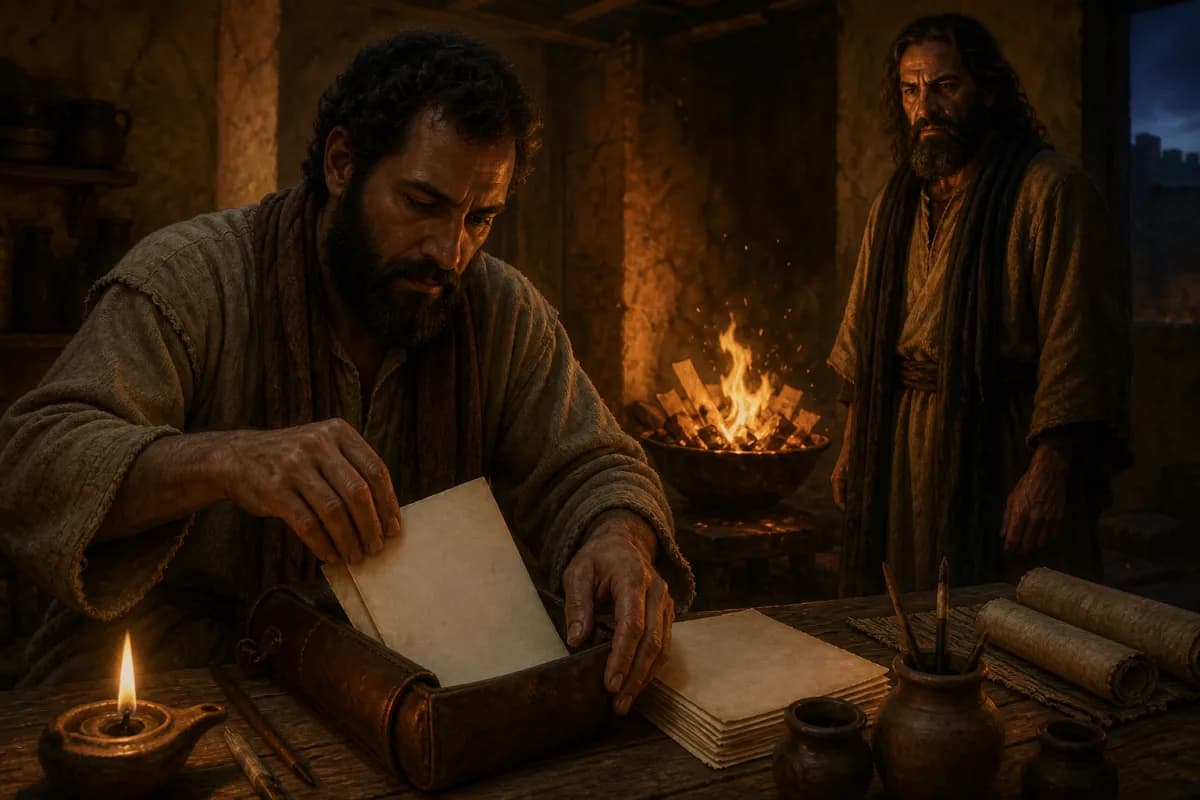
36:23When Jehudi had read three or four columns, the king cut it with the penknife, and cast it into the fire that was in the brazier, until all the scroll was consumed in the fire that was in the brazier.
36:24The king and his servants who heard all these words were not afraid, and didn’t tear their garments.
36:25Moreover Elnathan and Delaiah and Gemariah had made intercession to the king that he would not burn the scroll; but he would not listen to them.
36:26The king commanded Jerahmeel the king’s son, and Seraiah the son of Azriel, and Shelemiah the son of Abdeel, to arrest Baruch the scribe and Jeremiah the prophet; but the LORD hid them.
36:27Then the LORD’s word came to Jeremiah, after the king had burned the scroll, and the words which Baruch wrote at the mouth of Jeremiah, saying,
36:28“Take again another scroll, and write in it all the former words that were in the first scroll, which Jehoiakim the king of Judah has burned.
36:29Concerning Jehoiakim king of Judah you shall say, ‘The LORD says: “You have burned this scroll, saying, ‘Why have you written therein, saying, “The king of Babylon will certainly come and destroy this land, and will cause to cease from there man and animal”?’”
36:30Therefore the LORD says concerning Jehoiakim king of Judah: “He will have no one to sit on David’s throne. His dead body will be cast out in the day to the heat, and in the night to the frost.
36:31I will punish him, his offspring, and his servants for their iniquity. I will bring on them, on the inhabitants of Jerusalem, and on the men of Judah, all the evil that I have pronounced against them, but they didn’t listen.”’”
36:32Then Jeremiah took another scroll, and gave it to Baruch the scribe, the son of Neriah, who wrote therein from the mouth of Jeremiah all the words of the book which Jehoiakim king of Judah had burned in the fire; and many similar words were added to them.
CONTEXTUAL OVERVIEW
Jeremiah 34 opens while Babylonian forces are fighting against Jerusalem and the remaining fortified cities. King Zedekiah receives a personal word that he will not escape Babylon, yet he continues in a city whose leaders have made covenant promises they quickly abandon. The final crisis reveals that Judah’s danger is not only Babylon outside the walls; it is treachery against God and neighbor within them.
The freedom proclamation gives the section its sharpest moral focus. Judeans release enslaved Hebrew brothers and sisters, then seize them again. Their public covenant act is reversed as soon as it becomes costly, exposing a people willing to invoke the Lord’s name while withholding the mercy and justice His covenant requires.
HISTORICAL AND LITERARY CONTEXT
These chapters bring together royal oracles, a covenant lawsuit, the Rechabite household as a contrast, and the story of a written scroll. The law had required release in the seventh year for Hebrew servants. Jeremiah uses the leaders’ reversal to show that their sin has a definite social form: they are refusing the freedom God commanded while asking Him to preserve their freedom from Babylon.
The account of Jehoiakim occurs earlier than the siege setting of chapter 34, during the fourth and fifth years of his reign, but its placement intensifies the portrait of persistent refusal. Baruch reads Jeremiah’s dictated words publicly; officials react with fear and conceal the scroll; the king feeds it piece by piece into a fire. The king can destroy a copy, but he cannot cancel the Lord’s speech.
SECTION-BY-SECTION ANALYSIS
- Proclaim liberty · Jeremiah 34:8Jerusalem’s leaders promise a release commanded by God, then reveal their covenant faithlessness by taking the freed people back.
- The Rechabites · Jeremiah 35:2Their consistent obedience to a human ancestor throws Judah’s resistance to the Lord’s repeated speech into relief.
- The brazier in the winter house · Jeremiah 36:22Jehoiakim burns the written prophecy, but the rewritten scroll proves that human contempt cannot extinguish God’s word.
CHRIST IN THIS PASSAGE
The revoked release exposes why Israel needs more than a renewed public promise. Jesus announces good news to the poor and liberty to captives, then gives His life to free people from sin’s mastery. His liberation does not bypass justice; at the cross He bears sin’s judgment and creates a people called to treat others with the mercy they have received.
Jehoiakim’s burning of the scroll also anticipates the resistance Jesus encounters as the Word made flesh. Christ is rejected, but He is not silenced: His resurrection vindicates His authority and His gospel continues to call sinners to repentance. This is a thematic connection, while the immediate point in Jeremiah remains God’s enduring word to Judah’s king.
REFLECTION
This passage asks whether our promises of justice survive inconvenience. Look at a relationship, workplace responsibility, debt, or advantage where someone else depends on your integrity. Jesus’ grace does not excuse broken commitments; it gives forgiven people a new motive and power to keep faith with those they could otherwise exploit.
If God’s word has confronted a cherished plan, do not imitate Jehoiakim by cutting out the part you do not want to hear. Receive Christ’s correction as mercy. Read the warning, confess specifically, and let His enduring word reshape the decision before you.
Original Hebrew Word Study
Jeremiah 34:8
דְּרוֹר
deror · H1865
Usually translated: freedom or release
Deror means freedom or release. Judah’s brief promise to free its Hebrew slaves exposes a deeper covenant failure when the people reverse that release and return to oppression.
Follow the Scripture trail
Freedom Revoked, the Scroll Burned, and the Word That Endures in the larger story
The connection: Judah breaks a covenant of release and its king tries to destroy the word that exposes him. Jesus bears the judgment of covenant-breakers, frees people from sin, and establishes a community whose mercy and obedience display the enduring authority of His word.
Respond to the passage
Ask Christ to show you a promise, obligation, or person’s freedom that you have treated as reversible when it costs you. Confess it, take a repair step, and receive Scripture’s correction without editing it to protect yourself.
- Why does the reversal of slave release make Judah’s covenant failure so serious?
- How do the Rechabites sharpen the indictment against Judah?
- What does the rewritten scroll teach about the way to receive a difficult word from God?
Prayer
Lord Jesus, You have freed me at great cost. Forgive my broken promises and my resistance to Your word. Make me truthful, merciful, and ready to obey when Your correction unsettles me. Amen.