Passage Study
The Prophet in the Cistern and the City That Refused Rescue
Jeremiah 37:1–39:18
Jeremiah 37–39 follows Jerusalem through its last siege as its leaders seek a favorable word but reject the word God gives. Jeremiah is beaten, imprisoned, lowered into a muddy cistern, rescued by Ebed-melech, and finally released after Babylon takes the city. The rejected prophet foreshadows Christ’s suffering witness, while the city’s fall shows the deadly cost of refusing God’s offered way of life.
- In this study
- 67 verses · 5 movements
Jeremiah 37
37:1Zedekiah the son of Josiah reigned as king instead of Coniah the son of Jehoiakim, whom Nebuchadnezzar king of Babylon made king in the land of Judah.
37:2But neither he, nor his servants, nor the people of the land, listened to the LORD’s words, which he spoke by the prophet Jeremiah.
37:3Zedekiah the king sent Jehucal the son of Shelemiah and Zephaniah the son of Maaseiah, the priest, to the prophet Jeremiah, saying, “Pray now to the LORD our God for us.”
37:4Now Jeremiah came in and went out among the people, for they had not put him into prison.
37:5Pharaoh’s army had come out of Egypt; and when the Chaldeans who were besieging Jerusalem heard news of them, they withdrew from Jerusalem.
37:6Then the LORD’s word came to the prophet Jeremiah, saying,
37:7“The LORD, the God of Israel, says, ‘You shall tell the king of Judah, who sent you to me to inquire of me: “Behold, Pharaoh’s army, which has come out to help you, will return to Egypt into their own land.
37:8The Chaldeans will come again, and fight against this city. They will take it and burn it with fire.”’
37:9“The LORD says, ‘Don’t deceive yourselves, saying, “The Chaldeans will surely depart from us;” for they will not depart.
37:10For though you had struck the whole army of the Chaldeans who fight against you, and only wounded men remained among them, they would each rise up in his tent and burn this city with fire.’”
37:11When the army of the Chaldeans had withdrawn from Jerusalem for fear of Pharaoh’s army,
37:12then Jeremiah went out of Jerusalem to go into the land of Benjamin, to receive his portion there, in the middle of the people.
37:13When he was in Benjamin’s gate, a captain of the guard was there, whose name was Irijah, the son of Shelemiah, the son of Hananiah; and he seized Jeremiah the prophet, saying, “You are defecting to the Chaldeans!”
37:14Then Jeremiah said, “That is false! I am not defecting to the Chaldeans.” But he didn’t listen to him; so Irijah seized Jeremiah, and brought him to the princes.
37:15The princes were angry with Jeremiah, and struck him, and put him in prison in the house of Jonathan the scribe; for they had made that the prison.
37:16When Jeremiah had come into the dungeon house and into the cells, and Jeremiah had remained there many days,
37:17then Zedekiah the king sent and had him brought out. The king asked him secretly in his house, “Is there any word from the LORD?” Jeremiah said, “There is.” He also said, “You will be delivered into the hand of the king of Babylon.”
37:18Moreover Jeremiah said to King Zedekiah, “How have I sinned against you, against your servants, or against this people, that you have put me in prison?
37:19Now where are your prophets who prophesied to you, saying, ‘The king of Babylon will not come against you, nor against this land’?
37:20Now please hear, my lord the king: please let my supplication be presented before you, that you not cause me to return to the house of Jonathan the scribe, lest I die there.”
37:21Then Zedekiah the king commanded, and they committed Jeremiah into the court of the guard. They gave him daily a loaf of bread out of the bakers’ street, until all the bread in the city was gone. Thus Jeremiah remained in the court of the guard.
Jeremiah 38
38:1Shephatiah the son of Mattan, Gedaliah the son of Pashhur, Jucal the son of Shelemiah, and Pashhur the son of Malchijah heard the words that Jeremiah spoke to all the people, saying,
38:2“The LORD says, ‘He who remains in this city will die by the sword, by the famine, and by the pestilence, but he who goes out to the Chaldeans will live. He will escape with his life and he will live.’
38:3The LORD says, ‘This city will surely be given into the hand of the army of the king of Babylon, and he will take it.’”
38:4Then the princes said to the king, “Please let this man be put to death, because he weakens the hands of the men of war who remain in this city, and the hands of all the people, in speaking such words to them; for this man doesn’t seek the welfare of this people, but harm.”
38:5Zedekiah the king said, “Behold, he is in your hand; for the king can’t do anything to oppose you.”
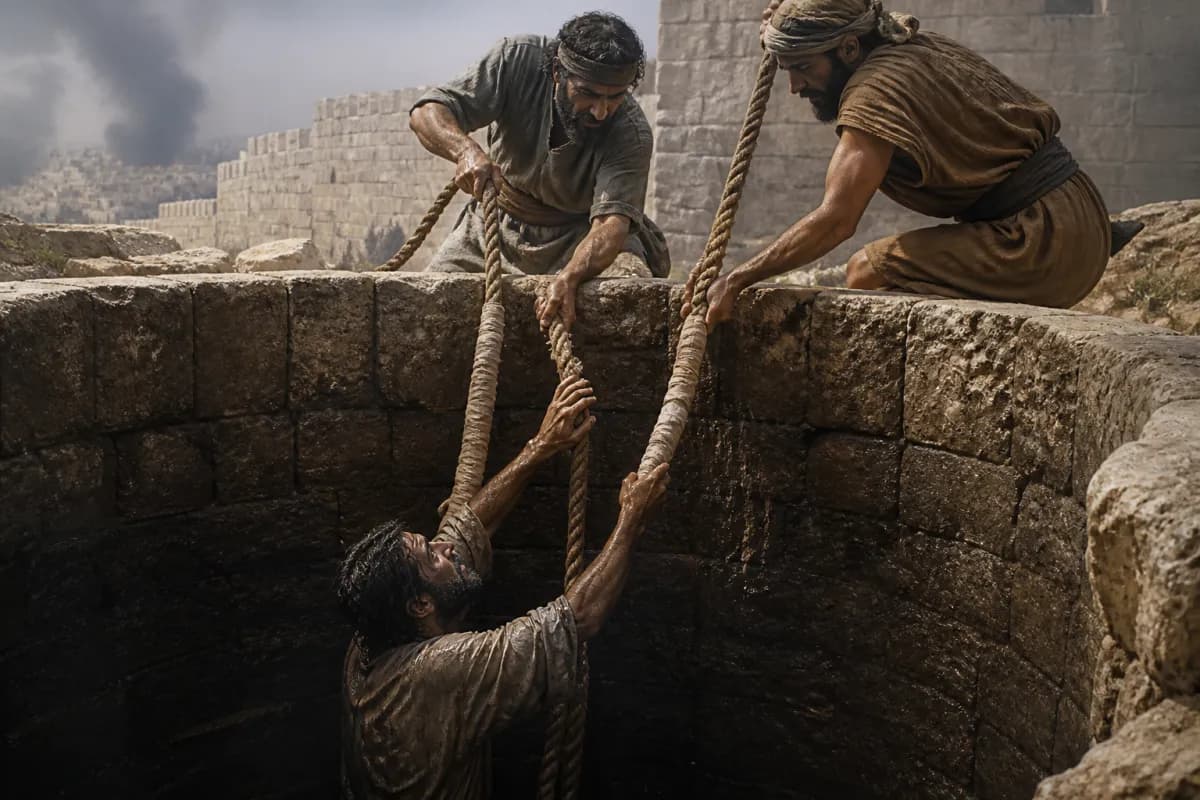
38:6Then they took Jeremiah and threw him into the dungeon of Malchijah the king’s son, that was in the court of the guard. They let down Jeremiah with cords. In the dungeon there was no water, but mire; and Jeremiah sank in the mire.
38:7Now when Ebedmelech the Ethiopian, a eunuch, who was in the king’s house, heard that they had put Jeremiah in the dungeon (the king was then sitting in Benjamin’s gate),
38:8Ebedmelech went out of the king’s house, and spoke to the king, saying,
38:9“My lord the king, these men have done evil in all that they have done to Jeremiah the prophet, whom they have cast into the dungeon. He is likely to die in the place where he is, because of the famine; for there is no more bread in the city.”
38:10Then the king commanded Ebedmelech the Ethiopian, saying, “Take from here thirty men with you, and take up Jeremiah the prophet out of the dungeon, before he dies.”
38:11So Ebedmelech took the men with him, and went into the house of the king under the treasury, and took from there rags and worn-out garments, and let them down by cords into the dungeon to Jeremiah.
38:12Ebedmelech the Ethiopian said to Jeremiah, “Now put these rags and worn-out garments under your armpits under the cords.” Jeremiah did so.
38:13So they lifted Jeremiah up with the cords, and took him up out of the dungeon; and Jeremiah remained in the court of the guard.
38:14Then Zedekiah the king sent and took Jeremiah the prophet to himself into the third entry that is in the LORD’s house. Then the king said to Jeremiah, “I will ask you something. Hide nothing from me.”
38:15Then Jeremiah said to Zedekiah, “If I declare it to you, will you not surely put me to death? If I give you counsel, you will not listen to me.”
38:16So Zedekiah the king swore secretly to Jeremiah, saying, “As the LORD lives, who made our souls, I will not put you to death, neither will I give you into the hand of these men who seek your life.”
38:17Then Jeremiah said to Zedekiah, “The LORD, the God of Armies, the God of Israel, says: ‘If you will go out to the king of Babylon’s princes, then your soul will live, and this city will not be burned with fire. You will live, along with your house.
38:18But if you will not go out to the king of Babylon’s princes, then this city will be given into the hand of the Chaldeans, and they will burn it with fire, and you won’t escape out of their hand.’”
38:19Zedekiah the king said to Jeremiah, “I am afraid of the Jews who have defected to the Chaldeans, lest they deliver me into their hand, and they mock me.”
38:20But Jeremiah said, “They won’t deliver you. Obey, I beg you, the LORD’s voice, in that which I speak to you; so it will be well with you, and your soul will live.
38:21But if you refuse to go out, this is the word that the LORD has shown me:
38:22‘Behold, all the women who are left in the king of Judah’s house will be brought out to the king of Babylon’s princes, and those women will say, “Your familiar friends have turned on you, and have prevailed over you. Your feet are sunk in the mire, they have turned away from you.”
38:23They will bring out all your wives and your children to the Chaldeans. You won’t escape out of their hand, but will be taken by the hand of the king of Babylon. You will cause this city to be burned with fire.’”
38:24Then Zedekiah said to Jeremiah, “Let no man know of these words, and you won’t die.
38:25But if the princes hear that I have talked with you, and they come to you, and tell you, ‘Declare to us now what you have said to the king; don’t hide it from us, and we will not put you to death; also tell us what the king said to you;’
38:26then you shall tell them, ‘I presented my supplication before the king, that he would not cause me to return to Jonathan’s house, to die there.’”
38:27Then all the princes came to Jeremiah, and asked him; and he told them according to all these words that the king had commanded. So they stopped speaking with him, for the matter was not perceived.
38:28So Jeremiah stayed in the court of the guard until the day that Jerusalem was taken.
Jeremiah 39
39:1In the ninth year of Zedekiah king of Judah, in the tenth month, Nebuchadnezzar king of Babylon and all his army came against Jerusalem, and besieged it.
39:2In the eleventh year of Zedekiah, in the fourth month, the ninth day of the month, a breach was made in the city.
39:3All the princes of the king of Babylon came in, and sat in the middle gate: Nergal Sharezer, Samgarnebo, Sarsechim the Rabsaris, Nergal Sharezer the Rabmag, with all the rest of the princes of the king of Babylon.
39:4When Zedekiah the king of Judah and all the men of war saw them, then they fled and went out of the city by night, by the way of the king’s garden, through the gate between the two walls; and he went out toward the Arabah.
39:5But the army of the Chaldeans pursued them, and overtook Zedekiah in the plains of Jericho. When they had taken him, they brought him up to Nebuchadnezzar king of Babylon to Riblah in the land of Hamath; and he pronounced judgment on him.
39:6Then the king of Babylon killed Zedekiah’s sons in Riblah before his eyes. The king of Babylon also killed all the nobles of Judah.
39:7Moreover he put out Zedekiah’s eyes and bound him in fetters, to carry him to Babylon.
39:8The Chaldeans burned the king’s house and the people’s houses with fire and broke down the walls of Jerusalem.
39:9Then Nebuzaradan the captain of the guard carried away captive into Babylon the rest of the people who remained in the city, the deserters also who fell away to him, and the rest of the people who remained.
39:10But Nebuzaradan the captain of the guard left of the poor of the people, who had nothing, in the land of Judah, and gave them vineyards and fields at the same time.
39:11Now Nebuchadnezzar king of Babylon commanded Nebuzaradan the captain of the guard concerning Jeremiah, saying,
39:12“Take him and take care of him. Do him no harm; but do to him even as he tells you.”
39:13So Nebuzaradan the captain of the guard, Nebushazban, Rabsaris, and Nergal Sharezer, Rabmag, and all the chief officers of the king of Babylon
39:14sent and took Jeremiah out of the court of the guard, and committed him to Gedaliah the son of Ahikam, the son of Shaphan, that he should bring him home. So he lived among the people.
39:15Now the LORD’s word came to Jeremiah while he was shut up in the court of the guard, saying,
39:16“Go, and speak to Ebedmelech the Ethiopian, saying, ‘The LORD of Armies, the God of Israel, says: “Behold, I will bring my words on this city for evil, and not for good; and they will be accomplished before you in that day.
39:17But I will deliver you in that day,” says the LORD; “and you will not be given into the hand of the men of whom you are afraid.
39:18For I will surely save you. You won’t fall by the sword, but you will escape with your life, because you have put your trust in me,” says the LORD.’”
CONTEXTUAL OVERVIEW
The last king of Judah wants Jeremiah’s prayer and information, but not Jeremiah’s obedience-demanding message. When Egypt’s army briefly interrupts Babylon’s siege, the city treats the reprieve as rescue. Jeremiah insists that Babylon will return and burn Jerusalem. The issue is now stark: accepting God’s judgment by surrendering will preserve life; refusing His word will multiply death.
Jeremiah’s treatment reveals how Jerusalem receives the God it claims to worship. He is accused of desertion when he is leaving for Benjamin, beaten, placed in a dungeon, and later lowered into an empty cistern where he sinks in mud. The city’s leaders are not simply disagreeing with a political analyst; they are attempting to silence the Lord’s messenger while catastrophe presses against their gates.
HISTORICAL AND LITERARY CONTEXT
These chapters narrate events around Babylon’s final campaign against Jerusalem in the early sixth century BCE. The siege, Egypt’s temporary movement, food shortage, breach of the city wall, and forced march toward exile form the historical frame. Jeremiah’s counsel to surrender is not pro-Babylonian enthusiasm; it is submission to the specific judgment God has announced after generations of warning.
The narrative repeatedly contrasts secret conversations with public decisions. Zedekiah privately asks Jeremiah for a word from the Lord yet fears his officials and the people. Ebed-melech, a Cushite court official, acts openly enough to rescue Jeremiah, while the princes use royal authority to leave him to die. The contrast identifies courage by response to God’s word, not rank or ethnic standing.
SECTION-BY-SECTION ANALYSIS
- Will you pray for us? · Jeremiah 37:17Zedekiah seeks religious help while continuing to resist the obedience for which Jeremiah’s prayer is meant to prepare him.
- The cistern · Jeremiah 37:21Jeremiah’s descent into mud makes the city’s rejection of God’s messenger physically visible.
- If you surrender, you will live · Jeremiah 38:2The saving path sounds humiliating, yet it is the Lord’s merciful way of preserving life amid unavoidable judgment.
CHRIST IN THIS PASSAGE
Jeremiah’s unjust arrest, isolation, and rejection by leaders create a strong thematic pattern for Jesus, who also speaks God’s truth under hostile judgment and is handed over by rulers who fear people more than God. Jeremiah does not die as an atoning substitute, so the comparison must stop short of identification. Jesus alone bears sin’s judgment in His death and rises to give life to those who trust Him.
Ebed-melech’s rescue is not a coded prediction of Christ, but it displays the kind of costly mercy God honors in the midst of national ruin. In Jesus’ mission, mercy toward the helpless and loyalty to God’s rejected servant belong together. His resurrection assures believers that human powers cannot finally bury the word and witness of God.
REFLECTION
Zedekiah shows the danger of wanting spiritual counsel only if it does not require a costly choice. Where has Christ already made the next faithful step clear—confession, reconciliation, truth-telling, relinquishing control—while fear keeps you asking for another answer? Bring that fear to Him and obey the word you have received.
Ebed-melech notices a man left to die and acts with practical care. Ask Jesus to make you attentive to someone being neglected, silenced, or harmed by a crowd’s convenience. Faithfulness may require using the influence and resources you have to draw that person out of the pit.
Original Hebrew Word Study
Jeremiah 38:6
בּוֹר
bor · H953
Usually translated: pit or cistern
Bor means pit or cistern. Jeremiah is lowered into an empty cistern and left to sink in mud, making his rejection a concrete picture of how Jerusalem treats the word of the Lord during its siege.
Follow the Scripture trail
The Prophet in the Cistern and the City That Refused Rescue in the larger story
The connection: Jerusalem rejects the prophet who tells the truth about judgment and life. Jesus is the greater rejected messenger who bears the judgment sinners deserve, rises victorious, and calls fearful people to trust His saving word rather than preserve themselves by compromise.
Respond to the passage
Name the costly obedience you have delayed because you fear other people’s reaction. Ask Jesus for courage to take that step, and look for one vulnerable person to whom you can offer Ebed-melech-like practical mercy.
- Why is Zedekiah’s request for prayer inadequate without obedience?
- What does Ebed-melech’s rescue reveal about courage in Jerusalem’s final days?
- How does the fall of the city confirm the seriousness of rejecting God’s word?
Prayer
Lord Jesus, forgive me for wanting Your help while avoiding Your commands. Give me courage to obey when fear is loud, and make me quick to protect and serve those whom others leave in the pit. Amen.