Passage Study
Jerusalem Falls, Yet God Leaves a Sign of Hope for David’s House
Jeremiah 52:1–52:34
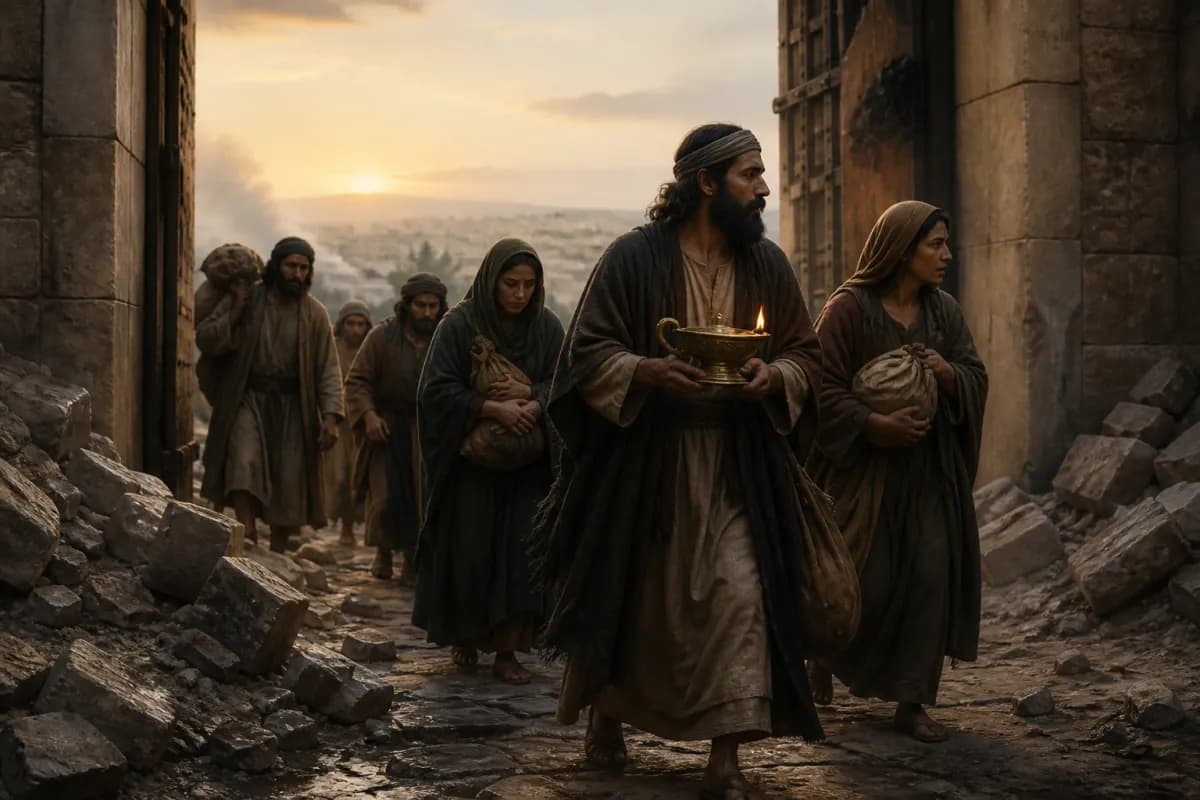
Jeremiah 52 recounts Jerusalem’s siege, Zedekiah’s capture, the temple’s destruction, the deportation of Judah, and the release of King Jehoiachin from prison. The chapter confirms that the covenant warnings spoken throughout Jeremiah were fulfilled with devastating precision. Its final mercy toward David’s imprisoned descendant does not undo the exile, but it keeps God’s promise alive and directs hope toward Jesus, the faithful Davidic King.
- In this study
- 34 verses · 5 movements
Jeremiah 52
52:1Zedekiah was twenty-one years old when he began to reign. He reigned eleven years in Jerusalem. His mother’s name was Hamutal the daughter of Jeremiah of Libnah.
52:2He did that which was evil in the LORD’s sight, according to all that Jehoiakim had done.
52:3For through the LORD’s anger this happened in Jerusalem and Judah, until he had cast them out from his presence. Zedekiah rebelled against the king of Babylon.
52:4In the ninth year of his reign, in the tenth month, in the tenth day of the month, Nebuchadnezzar king of Babylon came, he and all his army, against Jerusalem, and encamped against it; and they built forts against it round about.
52:5So the city was besieged to the eleventh year of King Zedekiah.
52:6In the fourth month, in the ninth day of the month, the famine was severe in the city, so that there was no bread for the people of the land.
52:7Then a breach was made in the city, and all the men of war fled, and went out of the city by night by the way of the gate between the two walls, which was by the king’s garden. Now the Chaldeans were against the city all around. The men of war went toward the Arabah,
52:8but the army of the Chaldeans pursued the king, and overtook Zedekiah in the plains of Jericho; and all his army was scattered from him.
52:9Then they took the king, and carried him up to the king of Babylon to Riblah in the land of Hamath; and he pronounced judgment on him.
52:10The king of Babylon killed the sons of Zedekiah before his eyes. He also killed all the princes of Judah in Riblah.
52:11He put out the eyes of Zedekiah; and the king of Babylon bound him in fetters, and carried him to Babylon, and put him in prison until the day of his death.
52:12Now in the fifth month, in the tenth day of the month, which was the nineteenth year of King Nebuchadnezzar, king of Babylon, Nebuzaradan the captain of the guard, who stood before the king of Babylon, came into Jerusalem.
52:13He burned the LORD’s house, and the king’s house; and all the houses of Jerusalem, even every great house, he burned with fire.
52:14All the army of the Chaldeans, who were with the captain of the guard, broke down all the walls of Jerusalem all around.
52:15Then Nebuzaradan the captain of the guard carried away captive of the poorest of the people, and the rest of the people who were left in the city, and those who fell away, who defected to the king of Babylon, and the rest of the multitude.
52:16But Nebuzaradan the captain of the guard left of the poorest of the land to be vineyard keepers and farmers.
52:17The Chaldeans broke the pillars of bronze that were in the LORD’s house and the bases and the bronze sea that were in the LORD’s house in pieces, and carried all of their bronze to Babylon.
52:18They also took away the pots, the shovels, the snuffers, the basins, the spoons, and all the vessels of bronze with which they ministered.
52:19The captain of the guard took away the cups, the fire pans, the basins, the pots, the lamp stands, the spoons, and the bowls; that which was of gold, as gold, and that which was of silver, as silver.
52:20They took the two pillars, the one sea, and the twelve bronze bulls that were under the bases, which King Solomon had made for the LORD’s house. The bronze of all these vessels was without weight.
52:21As for the pillars, the height of the one pillar was eighteen cubits; and a line of twelve cubits encircled it; and its thickness was four fingers. It was hollow.
52:22A capital of bronze was on it; and the height of the one capital was five cubits, with network and pomegranates on the capital all around, all of bronze. The second pillar also had the same, with pomegranates.
52:23There were ninety-six pomegranates on the sides; all the pomegranates were one hundred on the network all around.
52:24The captain of the guard took Seraiah the chief priest, and Zephaniah the second priest, and the three keepers of the threshold,
52:25and out of the city he took an officer who was set over the men of war; and seven men of those who saw the king’s face, who were found in the city; and the scribe of the captain of the army, who mustered the people of the land; and sixty men of the people of the land, who were found in the middle of the city.
52:26Nebuzaradan the captain of the guard took them, and brought them to the king of Babylon to Riblah.
52:27The king of Babylon struck them, and put them to death at Riblah in the land of Hamath. So Judah was carried away captive out of his land.
52:28This is the number of the people whom Nebuchadnezzar carried away captive: in the seventh year, three thousand twenty-three Jews;
52:29in the eighteenth year of Nebuchadnezzar, he carried away captive from Jerusalem eight hundred thirty-two persons;
52:30in the twenty-third year of Nebuchadnezzar, Nebuzaradan the captain of the guard carried away captive of the Jews seven hundred forty-five people. All the people numbered four thousand six hundred.
52:31In the thirty-seventh year of the captivity of Jehoiachin king of Judah, in the twelfth month, in the twenty-fifth day of the month, Evilmerodach king of Babylon, in the first year of his reign, lifted up the head of Jehoiachin king of Judah, and released him from prison.
52:32He spoke kindly to him, and set his throne above the throne of the kings who were with him in Babylon,
52:33and changed his prison garments. Jehoiachin ate bread before him continually all the days of his life.
52:34For his allowance, there was a continual allowance given him by the king of Babylon, every day a portion until the day of his death, all the days of his life.
CONTEXTUAL OVERVIEW
Jeremiah closes with a historical account rather than another sermon. The chapter lets the reader watch the warnings of the book become events: the city is surrounded, food fails, its walls are breached, its king is captured, and the temple is burned. The final record removes any possibility that Jeremiah’s words were empty threats or that Jerusalem’s sacred institutions guaranteed safety while its leaders persisted in rebellion.
The account reaches beyond the death of Zedekiah to the later release of Jehoiachin, a Davidic king held in Babylonian prison. This ending is deliberately restrained. Judah remains in exile, the temple is in ruins, and no political restoration is announced. Yet Jehoiachin’s changed status leaves the reader with a small but significant sign that the Davidic line has not disappeared from God’s purposes.
HISTORICAL AND LITERARY CONTEXT
Jeremiah 52 substantially parallels the conclusion of 2 Kings, functioning as the book’s historical epilogue. It dates Jerusalem’s final siege to Zedekiah’s reign and records the Babylonian destruction carried out under Nebuzaradan. The careful inventory of bronze pillars, basins, utensils, and temple furnishings underscores the scale of the loss: the house that had become a false refuge is stripped and burned.
The chapter also distinguishes several deportations, preserving the reality that exile involved actual families, officials, craftsmen, soldiers, and temple personnel removed from their land. The figures are presented as part of the book’s historical record, while comparisons with related accounts raise questions about how particular totals are counted. The theological point is clear in either case: Jeremiah’s threatened removal from the land has become a national catastrophe.
SECTION-BY-SECTION ANALYSIS
- The breached city · Jeremiah 52:7Jerusalem’s fall confirms that rebellion against the Lord cannot be secured by walls, temple rituals, or royal strategy.
- The burned temple · Jeremiah 52:13The destruction of the sanctuary judges false trust while showing that God’s presence and faithfulness are not controlled by its furnishings.
- Jehoiachin lifted up · Jeremiah 52:31The imprisoned Davidic king receives undeserved favor, a small historical sign that judgment has not canceled God’s covenant purposes.
CHRIST IN THIS PASSAGE
Jeremiah 52 makes the need for a faithful king unmistakable. Zedekiah rebels, flees, and loses both kingdom and sight; Jehoiachin survives only by mercy in exile. The chapter does not directly name Jesus, but its preservation of David’s line sustains the promise that God would raise a righteous Davidic ruler. Jesus is that promised King: unlike Zedekiah, He obeys the Father; unlike the failed kings of Judah, He establishes His reign through self-giving obedience unto death.
The ruined temple also prepares the way for Christ’s saving mission. Jesus speaks of His body as the true temple and, by His death and resurrection, opens access to God for sinners who cannot rely on a building or inherited privilege. The final table fellowship given to Jehoiachin is only a faint thematic echo of the grace Jesus gives: the true Son of David brings prisoners of sin into reconciled fellowship with God and promises a kingdom that exile and death cannot destroy.
REFLECTION
Jeremiah 52 is sobering for anyone who relies on a religious setting, family history, or outward association with God while resisting His word. Jerusalem had a temple, priests, and Davidic rulers, yet those gifts could not shield persistent rebellion. Jesus calls us to receive His mercy with repentance, not to use Christian language or belonging as a cover for self-rule.
The chapter also gives wounded believers a reason for durable hope. God does not minimize the ruins of Jerusalem, and faith need not deny the damage sin has done. But the lifted head of Jehoiachin says that God can preserve His promise through an exile that seems final. Entrust your losses to Christ, the risen Son of David, and follow Him in the next obedient act while you wait for His kingdom’s full restoration.
Original Hebrew Word Study
Jeremiah 52:27
גָּלָה
galah · H1540
Usually translated: to uncover, remove, or go into exile
Galah carries the sense of being removed into exile. Jerusalem’s fall is the severe covenant consequence Jeremiah warned of, while the final mercy shown to Jehoiachin leaves a small opening of hope.
Follow the Scripture trail
Jerusalem Falls, Yet God Leaves a Sign of Hope for David’s House in the larger story
The connection: Jerusalem’s destruction proves that God’s covenant warnings are true, while Jehoiachin’s release preserves a trace of Davidic hope after the throne has collapsed. Jesus is the faithful Son of David who bears judgment for His people, rises from death, and establishes the indestructible kingdom for which Jeremiah’s ending leaves the reader waiting.
Respond to the passage
Bring to Jesus any outward form of security you have treated as a substitute for obedience. Confess it plainly, trust His mercy for the ruins sin has made, and take one concrete step of faithfulness under His reign this week.
- How does Jeremiah 52 confirm the warnings given throughout the book?
- Why does the destruction of the temple expose false trust rather than signal God’s defeat?
- What hope does Jehoiachin’s release preserve without pretending that the exile is already over?
Prayer
Lord Jesus, faithful Son of David, forgive me for trusting outward signs while resisting Your word. Meet me in the consequences of sin, preserve my hope when life feels ruined, and lead me in the obedience of Your unshakable kingdom. Amen.