Passage Study
The Word Made Flesh and the First Disciples
John 1:1–1:51
John 1 presents Jesus as the eternal Word who became flesh, reveals the Father, and gives God’s children new life. John the Baptist bears witness to Him as the Lamb of God, and the first disciples begin to follow the One in whom heaven and earth meet.
- In this study
- 51 verses · 5 movements
John 1
1:1In the beginning was the Word, and the Word was with God, and the Word was God.
1:2The same was in the beginning with God.
1:3All things were made through him. Without him, nothing was made that has been made.
1:4In him was life, and the life was the light of men.
1:5The light shines in the darkness, and the darkness hasn’t overcome it.
1:6There came a man sent from God, whose name was John.
1:7The same came as a witness, that he might testify about the light, that all might believe through him.
1:8He was not the light, but was sent that he might testify about the light.
1:9The true light that enlightens everyone was coming into the world.
1:10He was in the world, and the world was made through him, and the world didn’t recognize him.
1:11He came to his own, and those who were his own didn’t receive him.
1:12But as many as received him, to them he gave the right to become God’s children, to those who believe in his name:
1:13who were born, not of blood, nor of the will of the flesh, nor of the will of man, but of God.
1:14The Word became flesh and lived among us. We saw his glory, such glory as of the only born Son of the Father, full of grace and truth.
1:15John testified about him. He cried out, saying, “This was he of whom I said, ‘He who comes after me has surpassed me, for he was before me.’”
1:16From his fullness we all received grace upon grace.
1:17For the law was given through Moses. Grace and truth were realized through Jesus Christ.
1:18No one has seen God at any time. The only born Son, who is in the bosom of the Father, has declared him.
1:19This is John’s testimony, when the Jews sent priests and Levites from Jerusalem to ask him, “Who are you?”
1:20He declared, and didn’t deny, but he declared, “I am not the Christ.”
1:21They asked him, “What then? Are you Elijah?” He said, “I am not.” “Are you the prophet?” He answered, “No.”
1:22They said therefore to him, “Who are you? Give us an answer to take back to those who sent us. What do you say about yourself?”
1:23He said, “I am the voice of one crying in the wilderness, ‘Make straight the way of the Lord,’ as Isaiah the prophet said.”
1:24The ones who had been sent were from the Pharisees.
1:25They asked him, “Why then do you baptize if you are not the Christ, nor Elijah, nor the prophet?”
1:26John answered them, “I baptize in water, but among you stands one whom you don’t know.
1:27He is the one who comes after me, who is preferred before me, whose sandal strap I’m not worthy to loosen.”
1:28These things were done in Bethany beyond the Jordan, where John was baptizing.
1:29The next day, he saw Jesus coming to him, and said, “Behold, the Lamb of God, who takes away the sin of the world!
1:30This is he of whom I said, ‘After me comes a man who is preferred before me, for he was before me.’
1:31I didn’t know him, but for this reason I came baptizing in water, that he would be revealed to Israel.”
1:32John testified, saying, “I have seen the Spirit descending like a dove out of heaven, and it remained on him.
1:33I didn’t recognize him, but he who sent me to baptize in water said to me, ‘On whomever you will see the Spirit descending and remaining on him is he who baptizes in the Holy Spirit.’
1:34I have seen and have testified that this is the Son of God.”
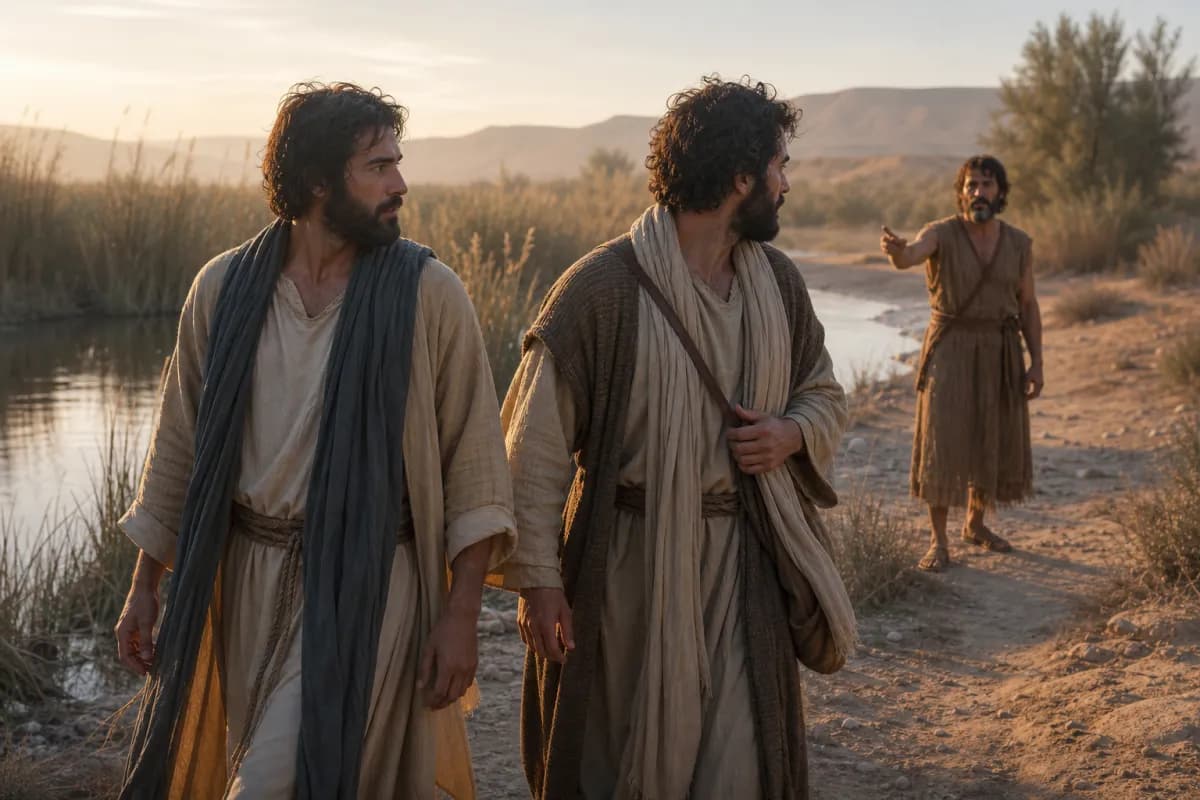
1:35Again, the next day, John was standing with two of his disciples,
1:36and he looked at Jesus as he walked, and said, “Behold, the Lamb of God!”
1:37The two disciples heard him speak, and they followed Jesus.
1:38Jesus turned and saw them following, and said to them, “What are you looking for?” They said to him, “Rabbi” (which is to say, being interpreted, Teacher), “where are you staying?”
1:39He said to them, “Come and see.” They came and saw where he was staying, and they stayed with him that day. It was about the tenth hour.
1:40One of the two who heard John and followed him was Andrew, Simon Peter’s brother.
1:41He first found his own brother, Simon, and said to him, “We have found the Messiah!” (which is, being interpreted, Christ ).
1:42He brought him to Jesus. Jesus looked at him and said, “You are Simon the son of Jonah. You shall be called Cephas” (which is by interpretation, Peter).
1:43On the next day, he was determined to go out into Galilee, and he found Philip. Jesus said to him, “Follow me.”
1:44Now Philip was from Bethsaida, the city of Andrew and Peter.
1:45Philip found Nathanael, and said to him, “We have found him of whom Moses in the law and also the prophets, wrote: Jesus of Nazareth, the son of Joseph.”
1:46Nathanael said to him, “Can any good thing come out of Nazareth?” Philip said to him, “Come and see.”
1:47Jesus saw Nathanael coming to him, and said about him, “Behold, an Israelite indeed, in whom is no deceit!”
1:48Nathanael said to him, “How do you know me?” Jesus answered him, “Before Philip called you, when you were under the fig tree, I saw you.”
1:49Nathanael answered him, “Rabbi, you are the Son of God! You are King of Israel!”
1:50Jesus answered him, “Because I told you, ‘I saw you underneath the fig tree,’ do you believe? You will see greater things than these!”
1:51He said to him, “Most certainly, I tell you all, hereafter you will see heaven opened, and the angels of God ascending and descending on the Son of Man.”
CONTEXTUAL OVERVIEW
John begins before Bethlehem. “In the beginning” places Jesus alongside creation, and the Word is both with God and truly God. The prologue moves from creation’s life and light to the tragedy that the world did not know its maker. Yet it gives the Gospel’s first promise: those who receive Him and trust His name are given the right to become God’s children.
The scenes after the prologue make that claim personal. John the Baptist refuses the titles crowds want to give him and directs attention to Jesus. Andrew, Simon, Philip, and Nathanael do not merely join a teacher’s circle; they begin following the Lamb, the Son of God, and the King of Israel. Their first steps of faith show how the Gospel calls people to come, see, and remain with Jesus.
HISTORICAL AND LITERARY CONTEXT
John’s Gospel unfolds through witnesses, signs, and encounters that disclose Jesus’ identity. John the Baptist is the first human witness in this opening unit, and his role is deliberately limited. He is not the light, the Messiah, or the center of the story. He is a voice preparing people to recognize the One already among them.
The prologue’s language of the Word “dwelling” among us echoes Israel’s tabernacle story, where God made His presence known among His redeemed people. John does not present Jesus as one more messenger who brings news from God. The Son makes the unseen Father known personally, then calls ordinary people into fellowship with Himself.
SECTION-BY-SECTION ANALYSIS
- John 1:1–18 · John 1:6The eternal Word enters human life to reveal the Father and give believing people a new identity as God’s children.
- John 1:19–34 · John 1:19John’s testimony directs attention to Jesus as the Lamb of God and the Son who gives the Spirit.
- John 1:35–51 · John 1:32The first disciples confess Jesus as Christ and King, while His promise identifies Him as the true meeting place of heaven and earth.
CHRIST IN THIS PASSAGE
Christ is explicit from the first sentence. Jesus is the eternal Word made flesh, the One through whom creation came to be and the One who uniquely makes the Father known. John the Baptist’s title, “Lamb of God,” directs His identity toward His saving mission: Jesus comes to deal with the world’s sin, not merely to offer religious instruction or spiritual inspiration.
Jesus’ promise to Nathanael recalls Jacob’s vision of a stairway joining earth and heaven. The connection is not a claim that Jesus is an object like Jacob’s ladder; Jesus declares that He is the living Son of Man through whom God comes near and people are brought into God’s presence. The incarnation is therefore not an idea detached from discipleship. The eternal Son calls people by name and forms them into witnesses of His glory.
REFLECTION
John the Baptist’s humility is a pattern for faithful witness. He knows he is not the Christ and gladly directs others to Jesus. Where have a role, achievement, church involvement, or spiritual knowledge become the center of your identity? Receive again the prologue’s gift: those who receive the Son are made children of God by grace.
The first disciples also show that faith often begins with a simple response to Christ’s invitation. Bring Him the question, doubt, or longing you have kept at a distance. Then take one concrete step of following: remain in His word, tell someone what you have seen of His grace, or invite another person to consider Jesus with you.
Original Greek Word Study
John 1:1
λόγος
logos · G3056
Usually translated: word, message, or self-expression
Logos means word or self-expression. John identifies Jesus as the eternal Word through whom all things came to be and who has now made God known in human flesh.
Follow the Scripture trail
The Word Made Flesh and the First Disciples in the larger story
The connection: The Word through whom creation came to be has entered His creation as the Lamb who takes away sin. Jesus makes the Father known and gathers disciples into the life of God, opening the way for sinners to become God’s children through faith in Him.
Respond to the passage
Receive Jesus as He reveals Himself: the eternal Son, the Lamb of God, and the One who brings people to the Father. Thank Him for making God known, confess one rival source of identity, and point one person toward Christ rather than toward yourself.
- Why does John begin with creation language before narrating Jesus’ public ministry?
- How do John the Baptist’s titles for Jesus prepare readers for the Gospel’s saving message?
- What does Jesus’ promise to Nathanael reveal about His identity and mission?
Prayer
Lord Jesus, eternal Word and Lamb of God, thank You for coming near and making the Father known. Give me the humility of a true witness, the faith to follow Your call, and the courage to point others to You. Amen.