Passage Study
The Resurrection and the Life Whose Hour Has Come
John 11:1–12:50
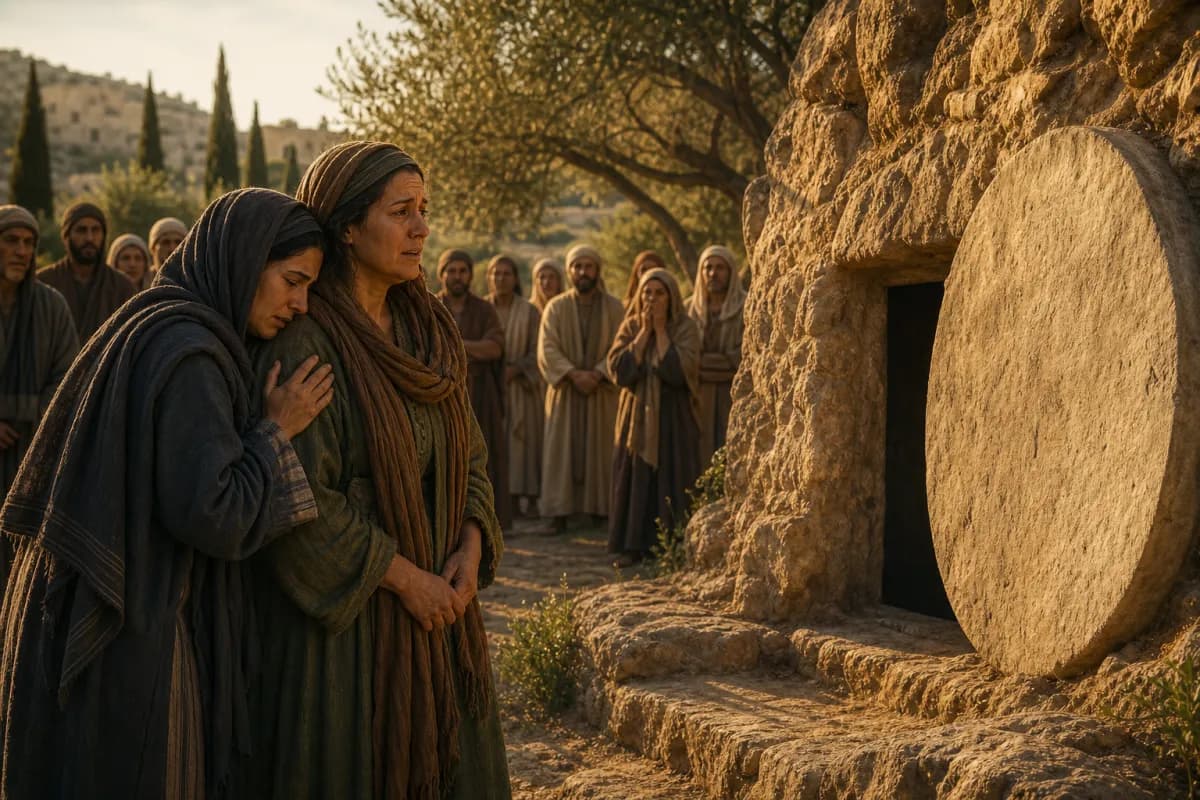
John 11–12 brings Jesus to Lazarus’s tomb, where He weeps, calls His friend out of death, and identifies Himself as the resurrection and the life. The sign intensifies the leaders’ plan to kill Him, while Mary anoints Him for burial, crowds hail Him as king, Greeks seek Him, and Jesus explains that His approaching death is the hour in which His glory will be seen and many will receive life.
- In this study
- 107 verses · 5 movements
John 11
11:1Now a certain man was sick, Lazarus from Bethany, of the village of Mary and her sister, Martha.
11:2It was that Mary who had anointed the Lord with ointment and wiped his feet with her hair, whose brother Lazarus was sick.
11:3The sisters therefore sent to him, saying, “Lord, behold, he for whom you have great affection is sick.”
11:4But when Jesus heard it, he said, “This sickness is not to death, but for the glory of God, that God’s Son may be glorified by it.”
11:5Now Jesus loved Martha, and her sister, and Lazarus.
11:6When therefore he heard that he was sick, he stayed two days in the place where he was.
11:7Then after this he said to the disciples, “Let’s go into Judea again.”
11:8The disciples asked him, “Rabbi, the Jews were just trying to stone you. Are you going there again?”
11:9Jesus answered, “Aren’t there twelve hours of daylight? If a man walks in the day, he doesn’t stumble, because he sees the light of this world.
11:10But if a man walks in the night, he stumbles, because the light isn’t in him.”
11:11He said these things, and after that, he said to them, “Our friend Lazarus has fallen asleep, but I am going so that I may awake him out of sleep.”
11:12The disciples therefore said, “Lord, if he has fallen asleep, he will recover.”
11:13Now Jesus had spoken of his death, but they thought that he spoke of taking rest in sleep.
11:14So Jesus said to them plainly then, “Lazarus is dead.
11:15I am glad for your sakes that I was not there, so that you may believe. Nevertheless, let’s go to him.”
11:16Thomas therefore, who is called Didymus, said to his fellow disciples, “Let’s also go, that we may die with him.”
11:17So when Jesus came, he found that he had been in the tomb four days already.
11:18Now Bethany was near Jerusalem, about fifteen stadia away.
11:19Many of the Jews had joined the women around Martha and Mary, to console them concerning their brother.
11:20Then when Martha heard that Jesus was coming, she went and met him, but Mary stayed in the house.
11:21Therefore Martha said to Jesus, “Lord, if you would have been here, my brother wouldn’t have died.
11:22Even now I know that whatever you ask of God, God will give you.”
11:23Jesus said to her, “Your brother will rise again.”
11:24Martha said to him, “I know that he will rise again in the resurrection at the last day.”
11:25Jesus said to her, “I am the resurrection and the life. He who believes in me will still live, even if he dies.
11:26Whoever lives and believes in me will never die. Do you believe this?”
11:27She said to him, “Yes, Lord. I have come to believe that you are the Christ, God’s Son, he who comes into the world.”
11:28When she had said this, she went away and called Mary, her sister, secretly, saying, “The Teacher is here and is calling you.”
11:29When she heard this, she arose quickly and went to him.
11:30Now Jesus had not yet come into the village, but was in the place where Martha met him.
11:31Then the Jews who were with her in the house and were consoling her, when they saw Mary, that she rose up quickly and went out, followed her, saying, “She is going to the tomb to weep there.”
11:32Therefore when Mary came to where Jesus was and saw him, she fell down at his feet, saying to him, “Lord, if you would have been here, my brother wouldn’t have died.”
11:33When Jesus therefore saw her weeping, and the Jews weeping who came with her, he groaned in the spirit and was troubled,
11:34and said, “Where have you laid him?” They told him, “Lord, come and see.”
11:35Jesus wept.
11:36The Jews therefore said, “See how much affection he had for him!”
11:37Some of them said, “Couldn’t this man, who opened the eyes of him who was blind, have also kept this man from dying?”
11:38Jesus therefore, again groaning in himself, came to the tomb. Now it was a cave, and a stone lay against it.
11:39Jesus said, “Take away the stone.” Martha, the sister of him who was dead, said to him, “Lord, by this time there is a stench, for he has been dead four days.”
11:40Jesus said to her, “Didn’t I tell you that if you believed, you would see God’s glory?”
11:41So they took away the stone from the place where the dead man was lying. Jesus lifted up his eyes and said, “Father, I thank you that you listened to me.
11:42I know that you always listen to me, but because of the multitude standing around I said this, that they may believe that you sent me.”
11:43When he had said this, he cried with a loud voice, “Lazarus, come out!”
11:44He who was dead came out, bound hand and foot with wrappings, and his face was wrapped around with a cloth. Jesus said to them, “Free him, and let him go.”
11:45Therefore many of the Jews who came to Mary and saw what Jesus did believed in him.
11:46But some of them went away to the Pharisees and told them the things which Jesus had done.
11:47The chief priests therefore and the Pharisees gathered a council, and said, “What are we doing? For this man does many signs.
11:48If we leave him alone like this, everyone will believe in him, and the Romans will come and take away both our place and our nation.”
11:49But a certain one of them, Caiaphas, being high priest that year, said to them, “You know nothing at all,
11:50nor do you consider that it is advantageous for us that one man should die for the people, and that the whole nation not perish.”
11:51Now he didn’t say this of himself, but being high priest that year, he prophesied that Jesus would die for the nation,
11:52and not for the nation only, but that he might also gather together into one the children of God who are scattered abroad.
11:53So from that day forward they took counsel that they might put him to death.
11:54Jesus therefore walked no more openly among the Jews, but departed from there into the country near the wilderness, to a city called Ephraim. He stayed there with his disciples.
11:55Now the Passover of the Jews was at hand. Many went up from the country to Jerusalem before the Passover, to purify themselves.
11:56Then they sought for Jesus and spoke with one another as they stood in the temple, “What do you think—that he isn’t coming to the feast at all?”
11:57Now the chief priests and the Pharisees had commanded that if anyone knew where he was, he should report it, that they might seize him.
John 12
12:1Then, six days before the Passover, Jesus came to Bethany, where Lazarus was, who had been dead, whom he raised from the dead.
12:2So they made him a supper there. Martha served, but Lazarus was one of those who sat at the table with him.
12:3Therefore Mary took a pound of ointment of pure nard, very precious, and anointed Jesus’ feet and wiped his feet with her hair. The house was filled with the fragrance of the ointment.
12:4Then Judas Iscariot, Simon’s son, one of his disciples, who would betray him, said,
12:5“Why wasn’t this ointment sold for three hundred denarii and given to the poor?”
12:6Now he said this, not because he cared for the poor, but because he was a thief, and having the money box, used to steal what was put into it.
12:7But Jesus said, “Leave her alone. She has kept this for the day of my burial.
12:8For you always have the poor with you, but you don’t always have me.”
12:9A large crowd therefore of the Jews learned that he was there; and they came, not for Jesus’ sake only, but that they might see Lazarus also, whom he had raised from the dead.
12:10But the chief priests conspired to put Lazarus to death also,
12:11because on account of him many of the Jews went away and believed in Jesus.
12:12On the next day a great multitude had come to the feast. When they heard that Jesus was coming to Jerusalem,
12:13they took the branches of the palm trees and went out to meet him, and cried out, “Hosanna! Blessed is he who comes in the name of the Lord, the King of Israel!”
12:14Jesus, having found a young donkey, sat on it. As it is written,
12:15“Don’t be afraid, daughter of Zion. Behold, your King comes, sitting on a donkey’s colt.”
12:16His disciples didn’t understand these things at first, but when Jesus was glorified, then they remembered that these things were written about him, and that they had done these things to him.
12:17The multitude therefore that was with him when he called Lazarus out of the tomb and raised him from the dead was testifying about it.
12:18For this cause also the multitude went and met him, because they heard that he had done this sign.
12:19The Pharisees therefore said among themselves, “See how you accomplish nothing. Behold, the world has gone after him.”
12:20Now there were certain Greeks among those who went up to worship at the feast.
12:21Therefore, these came to Philip, who was from Bethsaida of Galilee, and asked him, saying, “Sir, we want to see Jesus.”
12:22Philip came and told Andrew, and in turn, Andrew came with Philip, and they told Jesus.
12:23Jesus answered them, “The time has come for the Son of Man to be glorified.
12:24Most certainly I tell you, unless a grain of wheat falls into the earth and dies, it remains by itself alone. But if it dies, it bears much fruit.
12:25He who loves his life will lose it. He who hates his life in this world will keep it to eternal life.
12:26If anyone serves me, let him follow me. Where I am, there my servant will also be. If anyone serves me, the Father will honor him.
12:27“Now my soul is troubled. What shall I say? ‘Father, save me from this time’? But I came to this time for this cause.
12:28Father, glorify your name!” Then a voice came out of the sky, saying, “I have both glorified it and will glorify it again.”
12:29Therefore the multitude who stood by and heard it said that it had thundered. Others said, “An angel has spoken to him.”
12:30Jesus answered, “This voice hasn’t come for my sake, but for your sakes.
12:31Now is the judgment of this world. Now the prince of this world will be cast out.
12:32And I, if I am lifted up from the earth, will draw all people to myself.”
12:33But he said this, signifying by what kind of death he should die.
12:34The multitude answered him, “We have heard out of the law that the Christ remains forever. How do you say, ‘The Son of Man must be lifted up’ ? Who is this Son of Man?”
12:35Jesus therefore said to them, “Yet a little while the light is with you. Walk while you have the light, that darkness doesn’t overtake you. He who walks in the darkness doesn’t know where he is going.
12:36While you have the light, believe in the light, that you may become children of light.” Jesus said these things, and he departed and hid himself from them.
12:37But though he had done so many signs before them, yet they didn’t believe in him,
12:38that the word of Isaiah the prophet might be fulfilled, which he spoke: “Lord, who has believed our report? To whom has the arm of the Lord been revealed?”
12:39For this cause they couldn’t believe, for Isaiah said again:
12:40“He has blinded their eyes and he hardened their heart, lest they should see with their eyes, and perceive with their heart, and would turn, and I would heal them.”
12:41Isaiah said these things when he saw his glory, and spoke of him.
12:42Nevertheless, even many of the rulers believed in him, but because of the Pharisees they didn’t confess it, so that they wouldn’t be put out of the synagogue,
12:43for they loved men’s praise more than God’s praise.
12:44Jesus cried out and said, “Whoever believes in me, believes not in me, but in him who sent me.
12:45He who sees me sees him who sent me.
12:46I have come as a light into the world, that whoever believes in me may not remain in the darkness.
12:47If anyone listens to my sayings and doesn’t believe, I don’t judge him. For I came not to judge the world, but to save the world.
12:48He who rejects me, and doesn’t receive my sayings, has one who judges him. The word that I spoke will judge him in the last day.
12:49For I spoke not from myself, but the Father who sent me gave me a commandment, what I should say and what I should speak.
12:50I know that his commandment is eternal life. The things therefore which I speak, even as the Father has said to me, so I speak.”
CONTEXTUAL OVERVIEW
The death of Lazarus is not a detour from Jesus’ mission. Jesus says the illness will display God’s glory and the Son’s glorification, yet He also receives the sisters’ grief with tears. Bethany therefore holds both a real funeral and a revelation: Jesus does not stand outside human sorrow as a lecturer on eternal life; He comes to a tomb, groans at death’s devastation, and calls Lazarus by name.
The second half of the unit explains why this seventh sign cannot be separated from the cross. Lazarus’s resurrection gathers crowds, threatens the authorities, and leads Caiaphas to speak more truly than he knows about one man dying for the people. Mary’s costly anointing, the donkey procession, and the arrival of Greeks all turn the narrative toward Jesus’ “hour.” The life He gives Lazarus foreshadows, but does not replace, the death He will willingly undergo to gather God’s scattered children.
HISTORICAL AND LITERARY CONTEXT
John has arranged Jesus’ ministry around signs that reveal His identity and summon belief. The raising of Lazarus is the climactic public sign before the passion narrative. It takes place near Jerusalem, where the temple leadership has already sought to arrest Jesus. Thomas’s willingness to go with Jesus even if it means death shows that the disciples understand the danger, though they do not yet understand the saving purpose of the coming death.
The Passover setting in chapter 12 gives the events their covenantal weight. Jesus comes to Jerusalem as crowds recall Israel’s deliverance and sing from Psalm 118. Yet John also records that Jesus rides a donkey, an action later understood through Zechariah’s promise of Zion’s humble king. The mixed reactions—from Mary’s devotion and the Greeks’ request to the authorities’ plotting and some leaders’ fear of public confession—show that revelation creates a decision rather than neutral admiration.
SECTION-BY-SECTION ANALYSIS
- John 11:25–27 · John 11:30Jesus is not merely the announcer of a distant resurrection; He is its personal source, calling Martha to trust Him in the presence of death.
- John 11:49–52 · John 11:23Caiaphas seeks political preservation, but John identifies an unintended prophecy: Jesus will die to gather a people divided and scattered by sin.
- John 12:23–33 · John 11:4The grain of wheat and the lifting up of the Son interpret glory through self-giving death that bears life for many.
CHRIST IN THIS PASSAGE
Jesus’ claim to be the resurrection and the life is explicit. Lazarus’s return proves that death cannot finally resist His voice, but Lazarus will die again; the sign points beyond itself to the life Jesus secures through His own death and resurrection. His tears at the tomb protect the passage from sentimental triumphalism. The Son who has authority over death also enters the grief death has brought into the world.
The connection between Lazarus and the cross is direct in John’s narrative. The sign hastens the leaders’ plot, Caiaphas speaks of Jesus dying for the people, and Jesus calls His death the hour of His glory. The grain-of-wheat image is a strong explanation of His saving mission: by giving His life, the Son bears a harvest of people drawn to Him from Israel and the nations. His glory is not a display detached from suffering but the revelation of the Father’s love through the cross.
REFLECTION
Martha is invited to trust Jesus before Lazarus comes out of the tomb, and Mary’s tears are not rebuked. Bring bereavement, fear, and unresolved loss to the One who weeps with His friends and promises resurrection. Christian hope does not ask us to call death good; it rests in Jesus’ authority to raise those who belong to Him.
Mary’s anointing and the Greeks’ request expose two responses to Jesus’ hour: costly devotion and a desire truly to see Him. Ask whether you are seeking a Jesus who protects your plans or the crucified and risen King whose life bears fruit through self-giving love. Trust Him with the places where obedience feels like loss, and let His cross shape how you serve others.
Original Greek Word Study
John 11:40
δόξα
doxa · G1391
Usually translated: glory, honor, or radiant splendor
Doxa means glory. Lazarus’s raising displays the glory of God, while the approach of the cross reveals that Jesus’ hour of glory includes self-giving love rather than mere public triumph.
Follow the Scripture trail
The Resurrection and the Life Whose Hour Has Come in the larger story
The connection: The One who calls Lazarus from the grave goes willingly toward His own death. John presents this as the decisive hour in which the Son reveals the Father’s glory: His cross gathers a people from every nation, and His resurrection guarantees that death will not have the final word over those who believe in Him.
Respond to the passage
Bring a specific grief or fear of death to Jesus, naming it honestly as Martha and Mary did. Then consider one costly act of love that reflects the grain-of-wheat pattern of His mission—service, reconciliation, generosity, or faithful witness—and take it in confidence that His risen life bears lasting fruit.
- Why does John show Jesus both weeping at Lazarus’s tomb and commanding Lazarus to come out?
- How does Caiaphas’s counsel reveal more than he intended about Jesus’ death?
- What does Jesus mean when He calls His approaching death His hour of glory?
Prayer
Lord Jesus, resurrection and life, meet me in the grief I cannot solve. Thank You for going to the cross to gather sinners and for breaking death’s claim through Your resurrection. Teach me to trust Your life-giving power and follow You in costly love. Amen.