Passage Study
The King Whose Cross Reveals His Glory
John 18:1–19:42
John 18–19 follows Jesus from the garden through arrest, Jewish and Roman hearings, crucifixion, death, and burial. He is not swept along as a helpless victim: He identifies Himself before the arresting party, tells Pilate that His kingdom is not from this world, carries the cross, and declares His work finished. The irony of titles, robes, and inscriptions reveals that the condemned Jesus is the true King who gives Himself for His people.
- In this study
- 82 verses · 5 movements
John 18
18:1When Jesus had spoken these words, he went out with his disciples over the brook Kidron, where there was a garden, into which he and his disciples entered.
18:2Now Judas, who betrayed him, also knew the place, for Jesus often met there with his disciples.
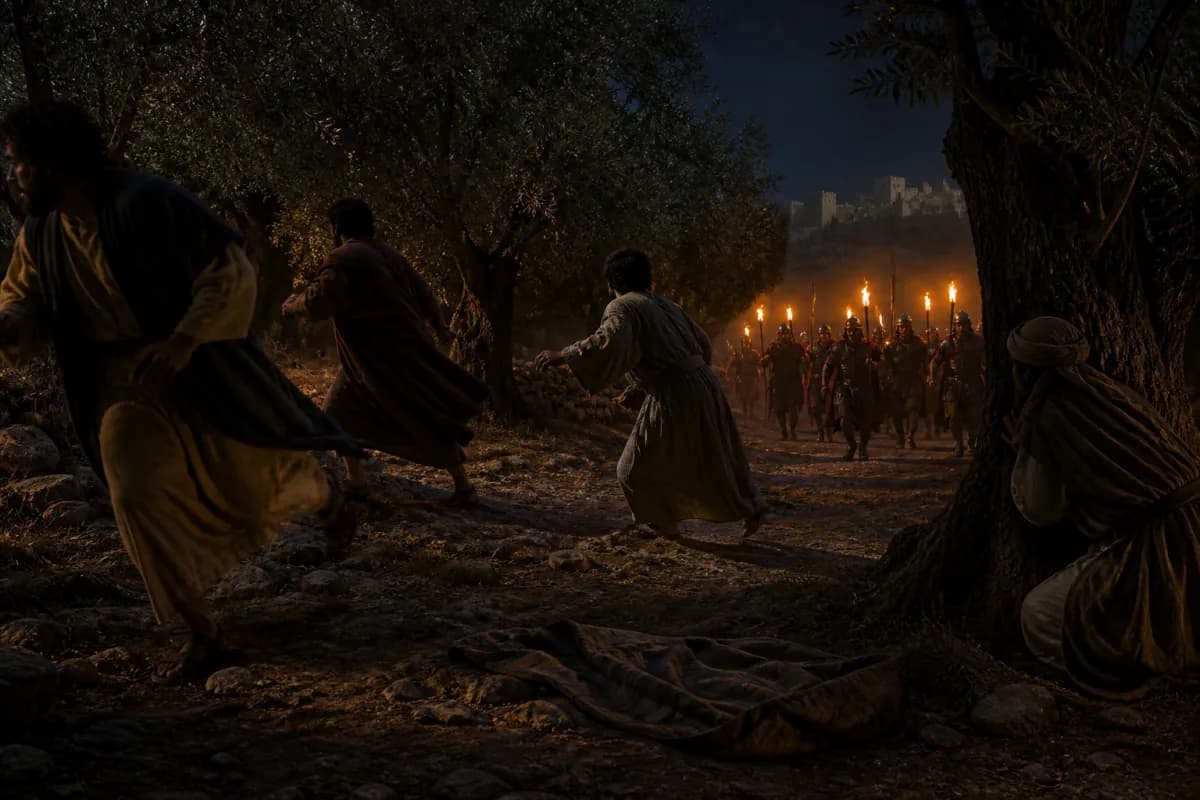
18:3Judas then, having taken a detachment of soldiers and officers from the chief priests and the Pharisees, came there with lanterns, torches, and weapons.
18:4Jesus therefore, knowing all the things that were happening to him, went out and said to them, “Who are you looking for?”
18:5They answered him, “Jesus of Nazareth.” Jesus said to them, “I am he.” Judas also, who betrayed him, was standing with them.
18:6When therefore he said to them, “I am he,” they went backward and fell to the ground.
18:7Again therefore he asked them, “Who are you looking for?” They said, “Jesus of Nazareth.”
18:8Jesus answered, “I told you that I am he. If therefore you seek me, let these go their way,”
18:9that the word might be fulfilled which he spoke, “Of those whom you have given me, I have lost none.”
18:10Simon Peter therefore, having a sword, drew it, struck the high priest’s servant, and cut off his right ear. The servant’s name was Malchus.
18:11Jesus therefore said to Peter, “Put the sword into its sheath. The cup which the Father has given me, shall I not surely drink it?”
18:12So the detachment, the commanding officer, and the officers of the Jews seized Jesus and bound him,
18:13and led him to Annas first, for he was father-in-law to Caiaphas, who was high priest that year.
18:14Now it was Caiaphas who advised the Jews that it was expedient that one man should perish for the people.
18:15Simon Peter followed Jesus, as did another disciple. Now that disciple was known to the high priest, and entered in with Jesus into the court of the high priest;
18:16but Peter was standing at the door outside. So the other disciple, who was known to the high priest, went out and spoke to her who kept the door, and brought in Peter.
18:17Then the maid who kept the door said to Peter, “Are you also one of this man’s disciples?” He said, “I am not.”
18:18Now the servants and the officers were standing there, having made a fire of coals, for it was cold. They were warming themselves. Peter was with them, standing and warming himself.
18:19The high priest therefore asked Jesus about his disciples and about his teaching.
18:20Jesus answered him, “I spoke openly to the world. I always taught in synagogues and in the temple, where the Jews always meet. I said nothing in secret.
18:21Why do you ask me? Ask those who have heard me what I said to them. Behold, they know the things which I said.”
18:22When he had said this, one of the officers standing by slapped Jesus with his hand, saying, “Do you answer the high priest like that?”
18:23Jesus answered him, “If I have spoken evil, testify of the evil; but if well, why do you beat me?”
18:24Annas sent him bound to Caiaphas, the high priest.
18:25Now Simon Peter was standing and warming himself. They said therefore to him, “You aren’t also one of his disciples, are you?” He denied it and said, “I am not.”
18:26One of the servants of the high priest, being a relative of him whose ear Peter had cut off, said, “Didn’t I see you in the garden with him?”
18:27Peter therefore denied it again, and immediately the rooster crowed.
18:28They led Jesus therefore from Caiaphas into the Praetorium. It was early, and they themselves didn’t enter into the Praetorium, that they might not be defiled, but might eat the Passover.
18:29Pilate therefore went out to them and said, “What accusation do you bring against this man?”
18:30They answered him, “If this man weren’t an evildoer, we wouldn’t have delivered him up to you.”
18:31Pilate therefore said to them, “Take him yourselves, and judge him according to your law.” Therefore the Jews said to him, “It is illegal for us to put anyone to death,”
18:32that the word of Jesus might be fulfilled, which he spoke, signifying by what kind of death he should die.
18:33Pilate therefore entered again into the Praetorium, called Jesus, and said to him, “Are you the King of the Jews?”
18:34Jesus answered him, “Do you say this by yourself, or did others tell you about me?”
18:35Pilate answered, “I’m not a Jew, am I? Your own nation and the chief priests delivered you to me. What have you done?”
18:36Jesus answered, “My Kingdom is not of this world. If my Kingdom were of this world, then my servants would fight, that I wouldn’t be delivered to the Jews. But now my Kingdom is not from here.”
18:37Pilate therefore said to him, “Are you a king then?” Jesus answered, “You say that I am a king. For this reason I have been born, and for this reason I have come into the world, that I should testify to the truth. Everyone who is of the truth listens to my voice.”
18:38Pilate said to him, “What is truth?” When he had said this, he went out again to the Jews, and said to them, “I find no basis for a charge against him.
18:39But you have a custom that I should release someone to you at the Passover. Therefore, do you want me to release to you the King of the Jews?”
18:40Then they all shouted again, saying, “Not this man, but Barabbas!” Now Barabbas was a robber.
John 19
19:1So Pilate then took Jesus and flogged him.
19:2The soldiers twisted thorns into a crown and put it on his head, and dressed him in a purple garment.
19:3They kept saying, “Hail, King of the Jews!” and they kept slapping him.
19:4Then Pilate went out again, and said to them, “Behold, I bring him out to you, that you may know that I find no basis for a charge against him.”
19:5Jesus therefore came out, wearing the crown of thorns and the purple garment. Pilate said to them, “Behold, the man!”
19:6When therefore the chief priests and the officers saw him, they shouted, saying, “Crucify! Crucify!” Pilate said to them, “Take him yourselves and crucify him, for I find no basis for a charge against him.”
19:7The Jews answered him, “We have a law, and by our law he ought to die, because he made himself the Son of God.”
19:8When therefore Pilate heard this saying, he was more afraid.
19:9He entered into the Praetorium again, and said to Jesus, “Where are you from?” But Jesus gave him no answer.
19:10Pilate therefore said to him, “Aren’t you speaking to me? Don’t you know that I have power to release you and have power to crucify you?”
19:11Jesus answered, “You would have no power at all against me, unless it were given to you from above. Therefore he who delivered me to you has greater sin.”
19:12At this, Pilate was seeking to release him, but the Jews cried out, saying, “If you release this man, you aren’t Caesar’s friend! Everyone who makes himself a king speaks against Caesar!”
19:13When Pilate therefore heard these words, he brought Jesus out and sat down on the judgment seat at a place called “The Pavement”, but in Hebrew, “Gabbatha.”
19:14Now it was the Preparation Day of the Passover, at about the sixth hour. He said to the Jews, “Behold, your King!”
19:15They cried out, “Away with him! Away with him! Crucify him!” Pilate said to them, “Shall I crucify your King?” The chief priests answered, “We have no king but Caesar!”
19:16So then he delivered him to them to be crucified. So they took Jesus and led him away.
19:17He went out, bearing his cross, to the place called “The Place of a Skull”, which is called in Hebrew, “Golgotha”,
19:18where they crucified him, and with him two others, on either side one, and Jesus in the middle.
19:19Pilate wrote a title also, and put it on the cross. There was written, “JESUS OF NAZARETH, THE KING OF THE JEWS.”
19:20Therefore many of the Jews read this title, for the place where Jesus was crucified was near the city; and it was written in Hebrew, in Latin, and in Greek.
19:21The chief priests of the Jews therefore said to Pilate, “Don’t write, ‘The King of the Jews,’ but, ‘he said, “I am King of the Jews.”’”
19:22Pilate answered, “What I have written, I have written.”
19:23Then the soldiers, when they had crucified Jesus, took his garments and made four parts, to every soldier a part; and also the tunic. Now the tunic was without seam, woven from the top throughout.
19:24Then they said to one another, “Let’s not tear it, but cast lots for it to decide whose it will be,” that the Scripture might be fulfilled, which says, “They parted my garments among them. They cast lots for my clothing.” Therefore the soldiers did these things.
19:25But standing by Jesus’ cross were his mother, his mother’s sister, Mary the wife of Clopas, and Mary Magdalene.
19:26Therefore when Jesus saw his mother, and the disciple whom he loved standing there, he said to his mother, “Woman, behold, your son!”
19:27Then he said to the disciple, “Behold, your mother!” From that hour, the disciple took her to his own home.
19:28After this, Jesus, seeing that all things were now finished, that the Scripture might be fulfilled, said, “I am thirsty!”
19:29Now a vessel full of vinegar was set there; so they put a sponge full of the vinegar on hyssop, and held it at his mouth.
19:30When Jesus therefore had received the vinegar, he said, “It is finished!” Then he bowed his head and gave up his spirit.
19:31Therefore the Jews, because it was the Preparation Day, so that the bodies wouldn’t remain on the cross on the Sabbath (for that Sabbath was a special one), asked of Pilate that their legs might be broken and that they might be taken away.
19:32Therefore the soldiers came and broke the legs of the first and of the other who was crucified with him;
19:33but when they came to Jesus and saw that he was already dead, they didn’t break his legs.
19:34However, one of the soldiers pierced his side with a spear, and immediately blood and water came out.
19:35He who has seen has testified, and his testimony is true. He knows that he tells the truth, that you may believe.
19:36For these things happened that the Scripture might be fulfilled, “A bone of him will not be broken.”
19:37Again another Scripture says, “They will look on him whom they pierced.”
19:38After these things, Joseph of Arimathaea, being a disciple of Jesus, but secretly for fear of the Jews, asked of Pilate that he might take away Jesus’ body. Pilate gave him permission. He came therefore and took away his body.
19:39Nicodemus, who at first came to Jesus by night, also came bringing a mixture of myrrh and aloes, about a hundred Roman pounds.
19:40So they took Jesus’ body, and bound it in linen cloths with the spices, as the custom of the Jews is to bury.
19:41Now in the place where he was crucified there was a garden. In the garden was a new tomb in which no man had ever yet been laid.
19:42Then, because of the Jews’ Preparation Day (for the tomb was near at hand), they laid Jesus there.
CONTEXTUAL OVERVIEW
John’s passion narrative begins in a garden, where Jesus goes willingly to meet those coming for Him. When He answers “I am he,” the arresting group draws back and falls to the ground; yet He then permits His arrest and insists that His disciples be allowed to go. The scene presents neither escape nor resignation. The Son who has spoken of His hour freely gives Himself in obedience to the Father, preserving those entrusted to Him even as the path to the cross opens.
The narrative keeps asking what kind of king Jesus is. Soldiers mock Him with a crown of thorns and purple robe, Pilate displays Him as “the man,” and the inscription above the cross calls Him King of the Jews. These actions are intended as ridicule or political management, but John’s irony exposes their truth. Jesus’ kingdom does not arise from the world’s weapons, yet His reign is real, and the cross is where the King completes the work the Father gave Him.
HISTORICAL AND LITERARY CONTEXT
Jesus’ trial moves between Jewish authorities and Pilate, the Roman governor. The leaders’ concern that Jesus claims kingship places the case within Rome’s political categories, while their demand for crucifixion reveals a deeper rejection of the Messiah before them. John does not simplify guilt into one group’s sin: Peter denies Jesus, the temple leadership seeks His death, Pilate knowingly compromises justice, soldiers carry out the execution, and crowds choose Barabbas. The cross exposes universal human resistance to God’s true King.
Crucifixion was a public Roman execution designed to shame and warn. John includes details other Gospels do not foreground: the seamless tunic, the care of Jesus’ mother, the hyssop branch, the flow from His pierced side, and the mixture of myrrh and aloes used by Joseph and Nicodemus. These details show that the death is bodily and public, while Scripture-shaped allusions help readers see it as the culmination of the Father’s saving purpose rather than an interruption of it.
Did you know?
A stone bearing Pontius Pilate’s name survived as reused building material in a theater staircase at Caesarea. Its Latin inscription identifies him as prefect of Judea and refers to a building honoring Emperor Tiberius.
Why it matters: Pilate’s surviving public inscription places the governor in the imperial world that frames Jesus’ trial.
SECTION-BY-SECTION ANALYSIS
- John 18:4–9 · John 18:1Jesus meets His captors knowingly and protects His disciples, showing that His arrest occurs within His deliberate obedience to the Father.
- John 18:33–38 · John 18:36Jesus’ kingdom is not sourced in the world’s systems of force, yet His kingship is true and His mission bears witness to God’s truth.
- John 19:28–30 · John 18:2Jesus’ thirst, final act, and declaration of completion show that His embodied death fulfills the saving work entrusted to Him.
CHRIST IN THIS PASSAGE
John portrays Jesus as the King who gives Himself rather than taking power by violence. His refusal of Peter’s sword, His testimony before Pilate, and His movement toward crucifixion all belong together. The kingdom is not from this world in source and character, but it enters this world through the crucified King who exposes false authority and bears the cost of reconciliation.
Jesus’ words, “It is finished,” announce the completion of the work described throughout John: He has revealed the Father, loved His own to the end, and given His life so that those who believe may have life. The Passover and righteous-sufferer echoes are strong canonical connections, yet John’s central claim is clear on its own terms: the cross is the Son’s voluntary, saving obedience. The resurrection will vindicate this finished work, but it does not make the cross an unfortunate prelude.
REFLECTION
Peter’s sword and Peter’s denial show two opposite ways of failing under pressure: trying to secure Jesus’ cause by force and trying to preserve oneself through concealment. Bring both impulses to the crucified King. He does not need our panic or coercion; He calls us to truthful witness shaped by His self-giving love.
Pilate recognizes enough of Jesus’ innocence to be uneasy, yet yields to the crowd’s demand. Where has fear of consequences trained you to call compromise practical wisdom? Stand beneath the cross and receive the King whose work is finished. Let His mercy free you to speak and act with courage, humility, and concern for people who are being treated unjustly.
Original Greek Word Study
John 18:36
βασιλεία
basileia · G932
Usually translated: kingdom, reign, or royal rule
Basileia means kingdom or royal reign. Jesus is truly King, yet His kingdom does not arise from the world’s systems of force; the cross reveals its truth and character.
Follow the Scripture trail
The King Whose Cross Reveals His Glory in the larger story
The connection: Jesus is enthroned in John’s paradoxical way at the cross: rejected by human authorities but obedient to the Father, mocked as king yet truly reigning. By giving His life as the Passover-shaped sacrifice and righteous servant, He completes the work that reconciles sinners to God and opens the way to resurrection life.
Respond to the passage
Name one place where fear tempts you either to grasp control like Peter or to conceal allegiance like Peter at the fire. Receive the forgiveness secured by Jesus’ finished work, and choose one truthful, non-coercive act that bears witness to His kingship in that situation.
- How does John show that Jesus’ arrest is voluntary while still portraying real injustice?
- What does Jesus mean when He says His kingdom is not from this world?
- Why does John treat Jesus’ final declaration as completion rather than defeat?
Prayer
King Jesus, thank You for facing the cross in faithful obedience and completing the work I could never do. Forgive my fear, my compromise, and my desire to control. Make me a truthful witness whose life reflects the mercy of Your kingdom. Amen.