Passage Study
The Wedding at Cana: Jesus Reveals His Glory
John 2:1–2:11
At Cana, Jesus turns water held in jars for purification into abundant, excellent wine. His first sign reveals His glory and leads His disciples to believe, showing that in Him God brings the deep cleansing and promised joy His people cannot supply for themselves.
- In this study
- 11 verses · 5 movements
John 2
2:1The third day, there was a wedding in Cana of Galilee. Jesus’ mother was there.
2:2Jesus also was invited, with his disciples, to the wedding.
2:3When the wine ran out, Jesus’ mother said to him, “They have no wine.”
2:4Jesus said to her, “Woman, what does that have to do with you and me? My hour has not yet come.”
2:5His mother said to the servants, “Whatever he says to you, do it.”
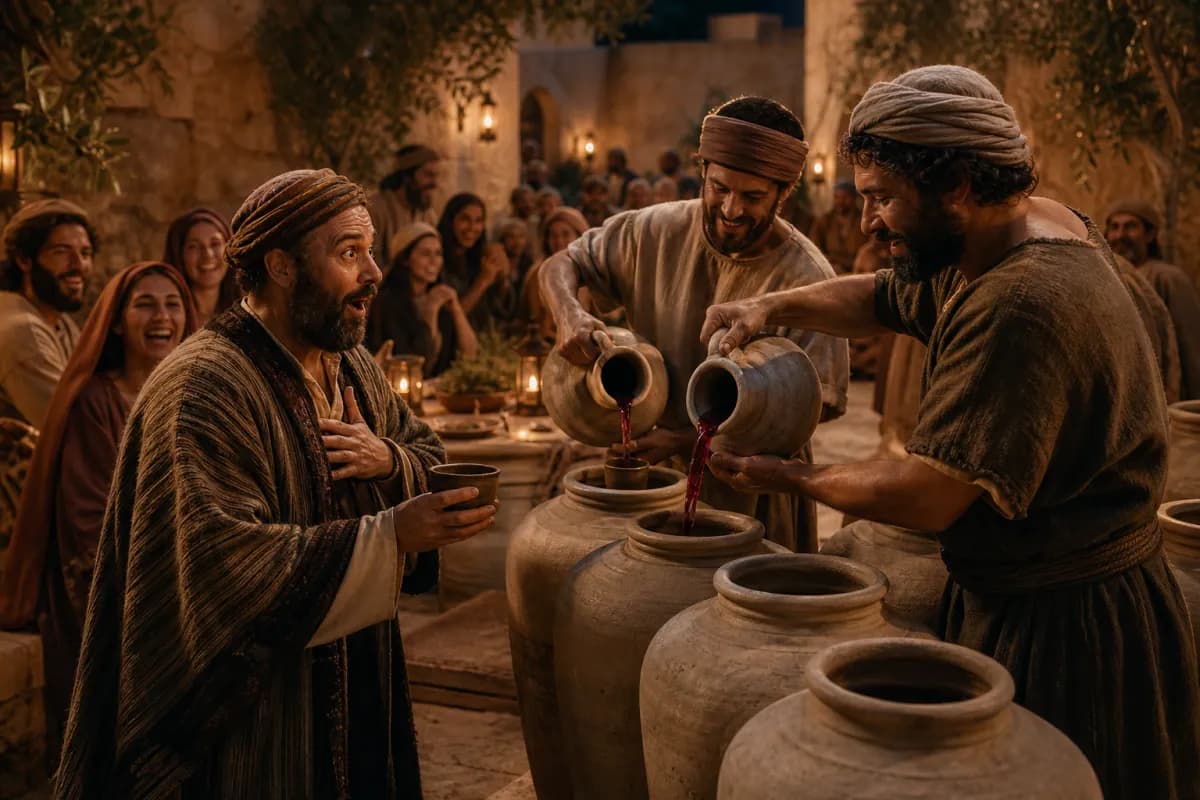
2:6Now there were six water pots of stone set there after the Jews’ way of purifying, containing two or three metretes apiece.
2:7Jesus said to them, “Fill the water pots with water.” So they filled them up to the brim.
2:8He said to them, “Now draw some out, and take it to the ruler of the feast.” So they took it.
2:9When the ruler of the feast tasted the water now become wine, and didn’t know where it came from (but the servants who had drawn the water knew), the ruler of the feast called the bridegroom
2:10and said to him, “Everyone serves the good wine first, and when the guests have drunk freely, then that which is worse. You have kept the good wine until now!”
2:11This beginning of his signs Jesus did in Cana of Galilee, and revealed his glory; and his disciples believed in him.
CONTEXTUAL OVERVIEW
The wedding at Cana follows the first disciples’ encounter with Jesus. John moves immediately from their confessions to an ordinary village celebration, where a household embarrassment becomes the setting for Jesus’ first sign. The scene is about more than rescuing a wedding from social shame: it reveals who Jesus is and what His arrival means.
John calls this event the beginning of Jesus’ signs. A sign is an act that points beyond itself. The wine is real, the need is real, and the servants truly carry water and draw what has become wine. Yet John directs readers beyond the marvel to Jesus’ glory and to the faith His glory awakens in His disciples.
HISTORICAL AND LITERARY CONTEXT
A wedding feast was a shared family and community celebration, and wine was part of its hospitality and joy. Running out would have brought real embarrassment to the household. John does not make the host’s failure the moral center of the story; he uses the lack to show Jesus supplying what the family cannot provide.
The six stone jars are identified as vessels used for Jewish rites of purification. Jesus does not mock purification or Israel’s worship. He fills those jars to the brim and transforms their water into wine, placing the sign within John’s larger testimony that God’s promised renewal, cleansing, and joy arrive in the person of His Son.
Did you know?
Archaeologists uncovered a cave workshop on Jerusalem’s Mount Scopus where craftspeople produced chalk-stone vessels during the first century CE. The industry supplied storage and tableware associated with Jewish purity observance.
Why it matters: The workshop provides material evidence for the kind of stone-vessel culture John mentions at Cana.
Mount Scopus chalk-vessel production complex — Israel Antiquities Authority
SECTION-BY-SECTION ANALYSIS
- The lack · John 2:1The household cannot solve its own need, and Jesus’ provision begins with a problem openly brought into His presence.
- The jars · John 2:7Vessels associated with purification are filled completely, locating the sign within Israel’s worshiping hope for cleansing and renewal.
- The sign · John 2:11The disciples are led from seeing Jesus’ act to believing in Him; the purpose is faith in His revealed glory.
CHRIST IN THIS PASSAGE
Jesus reveals His glory through generosity, not display for its own sake. John’s later references to Jesus’ hour show that His glory reaches its climax in His death, resurrection, and return to the Father. Cana does not explain every detail of that hour, but it begins the Gospel’s pattern: the Son’s signs unveil a glory that will finally be seen in self-giving love.
Wedding and wine imagery also form a strong biblical theme of restored joy. The connection must be held carefully: John does not say that every jar, measure, or gesture is a separate prediction. He does show that Jesus brings the fulfillment to which God’s promises of cleansing and feast-like joy have been moving. The One who supplies the wine is the Bridegroom who gives Himself to gather a redeemed people.
REFLECTION
Cana invites honest dependence. The servants do not create the wine, and the family’s need is not solved by anxiety or appearance management. Bring the ordinary lack you are tempted to hide—joy that has thinned, a relationship under strain, fear of public failure—to Jesus. His provision may not follow your timetable, but His presence is not indifferent to human need.
The disciples’ response is the center of the passage: they believe in Him. Christian faith receives Jesus for more than temporary relief. It trusts the One whose glory is generous, whose cleansing reaches the heart, and whose final joy is secured through His saving work. Ask where you have been seeking joy apart from the Giver, then return to Christ with gratitude and obedience.
Original Greek Word Study
John 2:11
σημεῖον
semeion · G4592
Usually translated: sign, distinguishing mark, or revealing act
Semeion names a sign that directs attention beyond the act itself. Cana is not presented as spectacle for its own sake: Jesus’ first sign reveals His glory and leads His disciples to believe in Him.
Follow the Scripture trail
The Wedding at Cana: Jesus Reveals His Glory in the larger story
The connection: At Cana, Jesus begins revealing the glory that will lead to the cross and resurrection. He is the Bridegroom who brings God’s cleansing and lasting joy, gathering a people who believe in Him and will one day share the Lamb’s final wedding feast.
Respond to the passage
Bring one ordinary lack to Jesus without hiding it behind appearances. Thank Him that His glory is seen in generous grace, then choose one act of obedience that shows you are seeking joy in Christ rather than in a substitute that cannot satisfy.
- Why does John call Cana a sign rather than merely a miracle?
- How do the purification jars shape the meaning of Jesus’ provision?
- What does the disciples’ belief teach about the goal of Jesus’ signs?
Prayer
Lord Jesus, thank You for revealing Your glory in generous grace. Meet me in the places where joy or strength has run low, cleanse what I cannot cleanse, and teach me to trust You as the true source of lasting joy. Amen.