Passage Study
The Risen Lord Who Sends and Restores His Disciples
John 20:1–21:25
John 20–21 announces that Jesus has risen bodily from the tomb and meets Mary Magdalene, the gathered disciples, Thomas, and seven disciples by the sea. He gives peace, sends them as the Father sent Him, grants the Spirit, calls Thomas from doubt to worship, and restores Peter after his denial by entrusting him with the care of His sheep. The Gospel closes by naming its purpose: these signs are written so readers may believe Jesus is the Messiah, God’s Son, and have life in His name.
- In this study
- 56 verses · 5 movements
John 20
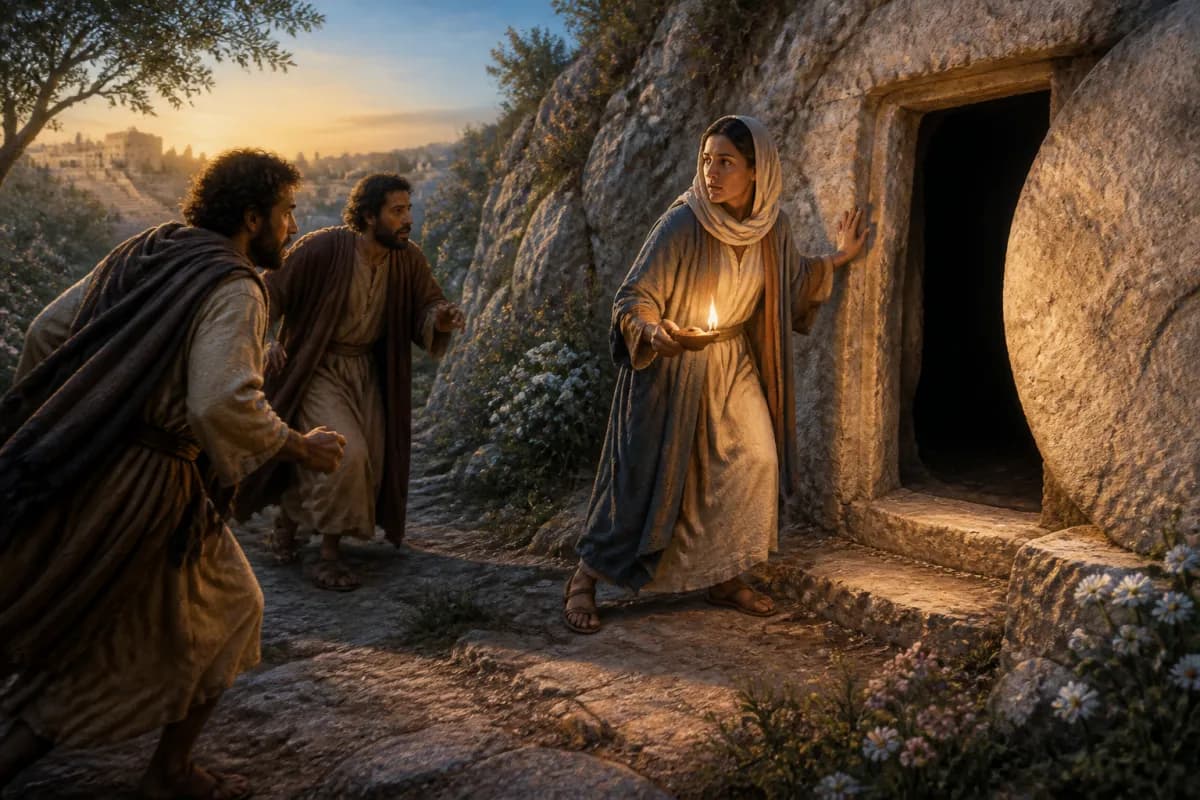
20:1Now on the first day of the week, Mary Magdalene went early, while it was still dark, to the tomb, and saw that the stone had been taken away from the tomb.
20:2Therefore she ran and came to Simon Peter and to the other disciple whom Jesus loved, and said to them, “They have taken away the Lord out of the tomb, and we don’t know where they have laid him!”
20:3Therefore Peter and the other disciple went out, and they went toward the tomb.
20:4They both ran together. The other disciple outran Peter and came to the tomb first.
20:5Stooping and looking in, he saw the linen cloths lying there; yet he didn’t enter in.
20:6Then Simon Peter came, following him, and entered into the tomb. He saw the linen cloths lying,
20:7and the cloth that had been on his head, not lying with the linen cloths, but rolled up in a place by itself.
20:8So then the other disciple who came first to the tomb also entered in, and he saw and believed.
20:9For as yet they didn’t know the Scripture, that he must rise from the dead.
20:10So the disciples went away again to their own homes.
20:11But Mary was standing outside at the tomb weeping. So as she wept, she stooped and looked into the tomb,
20:12and she saw two angels in white sitting, one at the head and one at the feet, where the body of Jesus had lain.
20:13They asked her, “Woman, why are you weeping?” She said to them, “Because they have taken away my Lord, and I don’t know where they have laid him.”
20:14When she had said this, she turned around and saw Jesus standing, and didn’t know that it was Jesus.
20:15Jesus said to her, “Woman, why are you weeping? Who are you looking for?” She, supposing him to be the gardener, said to him, “Sir, if you have carried him away, tell me where you have laid him, and I will take him away.”
20:16Jesus said to her, “Mary.” She turned and said to him, “Rabboni!” which is to say, “Teacher!”
20:17Jesus said to her, “Don’t hold me, for I haven’t yet ascended to my Father; but go to my brothers and tell them, ‘I am ascending to my Father and your Father, to my God and your God.’”
20:18Mary Magdalene came and told the disciples that she had seen the Lord, and that he had said these things to her.
20:19When therefore it was evening on that day, the first day of the week, and when the doors were locked where the disciples were assembled, for fear of the Jews, Jesus came and stood in the middle and said to them, “Peace be to you.”
20:20When he had said this, he showed them his hands and his side. The disciples therefore were glad when they saw the Lord.
20:21Jesus therefore said to them again, “Peace be to you. As the Father has sent me, even so I send you.”
20:22When he had said this, he breathed on them, and said to them, “Receive the Holy Spirit!
20:23If you forgive anyone’s sins, they have been forgiven them. If you retain anyone’s sins, they have been retained.”
20:24But Thomas, one of the twelve, called Didymus, wasn’t with them when Jesus came.
20:25The other disciples therefore said to him, “We have seen the Lord!” But he said to them, “Unless I see in his hands the print of the nails, put my finger into the print of the nails, and put my hand into his side, I will not believe.”
20:26After eight days, again his disciples were inside and Thomas was with them. Jesus came, the doors being locked, and stood in the middle, and said, “Peace be to you.”
20:27Then he said to Thomas, “Reach here your finger, and see my hands. Reach here your hand, and put it into my side. Don’t be unbelieving, but believing.”
20:28Thomas answered him, “My Lord and my God!”
20:29Jesus said to him, “Because you have seen me, you have believed. Blessed are those who have not seen and have believed.”
20:30Therefore Jesus did many other signs in the presence of his disciples, which are not written in this book;
20:31but these are written that you may believe that Jesus is the Christ, the Son of God, and that believing you may have life in his name.
John 21
21:1After these things, Jesus revealed himself again to the disciples at the sea of Tiberias. He revealed himself this way.
21:2Simon Peter, Thomas called Didymus, Nathanael of Cana in Galilee, and the sons of Zebedee, and two others of his disciples were together.
21:3Simon Peter said to them, “I’m going fishing.” They told him, “We are also coming with you.” They immediately went out and entered into the boat. That night, they caught nothing.
21:4But when day had already come, Jesus stood on the beach; yet the disciples didn’t know that it was Jesus.
21:5Jesus therefore said to them, “Children, have you anything to eat?” They answered him, “No.”
21:6He said to them, “Cast the net on the right side of the boat, and you will find some.” They cast it therefore, and now they weren’t able to draw it in for the multitude of fish.
21:7That disciple therefore whom Jesus loved said to Peter, “It’s the Lord!” So when Simon Peter heard that it was the Lord, he wrapped his coat around himself (for he was naked), and threw himself into the sea.
21:8But the other disciples came in the little boat (for they were not far from the land, but about two hundred cubits away), dragging the net full of fish.
21:9So when they got out on the land, they saw a fire of coals there, with fish and bread laid on it.
21:10Jesus said to them, “Bring some of the fish which you have just caught.”
21:11Simon Peter went up, and drew the net to land, full of one hundred fifty-three great fish. Even though there were so many, the net wasn’t torn.
21:12Jesus said to them, “Come and eat breakfast!” None of the disciples dared inquire of him, “Who are you?” knowing that it was the Lord.
21:13Then Jesus came and took the bread, gave it to them, and the fish likewise.
21:14This is now the third time that Jesus was revealed to his disciples after he had risen from the dead.
21:15So when they had eaten their breakfast, Jesus said to Simon Peter, “Simon, son of Jonah, do you love me more than these?” He said to him, “Yes, Lord; you know that I have affection for you.” He said to him, “Feed my lambs.”
21:16He said to him again a second time, “Simon, son of Jonah, do you love me?” He said to him, “Yes, Lord; you know that I have affection for you.” He said to him, “Tend my sheep.”
21:17He said to him the third time, “Simon, son of Jonah, do you have affection for me?” Peter was grieved because he asked him the third time, “Do you have affection for me?” He said to him, “Lord, you know everything. You know that I have affection for you.” Jesus said to him, “Feed my sheep.
21:18Most certainly I tell you, when you were young, you dressed yourself and walked where you wanted to. But when you are old, you will stretch out your hands, and another will dress you and carry you where you don’t want to go.”
21:19Now he said this, signifying by what kind of death he would glorify God. When he had said this, he said to him, “Follow me.”
21:20Then Peter, turning around, saw a disciple following. This was the disciple whom Jesus loved, the one who had also leaned on Jesus’ chest at the supper and asked, “Lord, who is going to betray you?”
21:21Peter, seeing him, said to Jesus, “Lord, what about this man?”
21:22Jesus said to him, “If I desire that he stay until I come, what is that to you? You follow me.”
21:23This saying therefore went out among the brothers that this disciple wouldn’t die. Yet Jesus didn’t say to him that he wouldn’t die, but, “If I desire that he stay until I come, what is that to you?”
21:24This is the disciple who testifies about these things, and wrote these things. We know that his witness is true.
21:25There are also many other things which Jesus did, which if they would all be written, I suppose that even the world itself wouldn’t have room for the books that would be written.
CONTEXTUAL OVERVIEW
John’s resurrection account begins before dawn with Mary Magdalene coming to a tomb she expects to find occupied. The removed stone creates confusion, and Peter and the beloved disciple run to investigate. The linen cloths are left behind, but the decisive turn comes when the risen Jesus speaks Mary’s name. Grief becomes recognition, and the woman who had stood outside the tomb is sent to tell the disciples that Jesus is ascending to His Father and their Father.
The risen Jesus does more than prove that death has been reversed. He creates a sent people. In the locked room He brings peace to fearful disciples, shows His wounds, breathes the Spirit, and commissions them as the Father sent Him. By the sea, He meets disciples who have returned to fishing, provides a meal, and restores Peter through three searching questions that answer Peter’s three denials. Resurrection life therefore includes witness, forgiveness, calling, and costly pastoral care under the living Lord.
HISTORICAL AND LITERARY CONTEXT
John has repeatedly prepared readers for Jesus’ death and resurrection, but the disciples’ first responses show that prior teaching does not make the empty tomb easy to interpret. Mary assumes a body has been moved; Thomas refuses to rely on the others’ testimony; and the disciples gather behind locked doors. John neither suppresses their confusion nor leaves them there. The risen Jesus is recognizable and bodily present, bearing the wounds of crucifixion, while His appearances create the faith and mission the narrative has anticipated.
Chapter 21 functions as an epilogue after the purpose statement in 20:30–31. It returns readers to the Sea of Tiberias and a familiar fishing scene, where the risen Jesus turns an empty night into an abundant catch and serves breakfast on the shore. The setting recalls earlier calling and provision, but the central focus is Peter. Jesus’ restoration does not minimize his failure; it turns forgiveness into a renewed commission to feed and tend Christ’s sheep.
Did you know?
Peter’s denial and his breakfast with the risen Jesus share a small sensory detail: both scenes take place beside a charcoal fire, in John 18:18 and 21:9.
Why it matters: Read the two scenes together: a familiar setting of failure becomes a place of welcome before Jesus entrusts Peter with caring for His sheep.
SECTION-BY-SECTION ANALYSIS
- John 20:11–18 · John 20:1Jesus’ personal call of Mary transforms her from a grieving witness at the tomb into the first messenger of His resurrection and ascent.
- John 20:24–31 · John 20:31Thomas’s confession names the risen Jesus as Lord and God, while John states that faith in this Messiah and Son brings life.
- John 21:15–19 · John 20:2Peter’s restoration is personal and vocational: the risen Jesus forgives the disciple who denied Him and entrusts him with the care of Christ’s flock.
CHRIST IN THIS PASSAGE
The resurrection is central and bodily in these chapters. Jesus is not remembered as an inspiring teacher; He shows His wounded hands and side, speaks to named people, eats with His disciples, and directs their work. Thomas’s confession gathers John’s Gospel into worship: the crucified and risen Jesus is “my Lord and my God.” The signs were written so that this faith may lead to life in His name.
Jesus’ saving mission continues through the commission He gives. As the Father sent Him, He sends His disciples with the Spirit and the message of forgiveness. This does not make them replacements for Christ; they testify to the One who has conquered death and remains the Good Shepherd. Peter’s restoration shows the grace of the risen Lord: the disciple’s failure is faced truthfully, forgiven through Christ’s prior saving work, and redirected into serving people Jesus calls His own.
REFLECTION
Mary’s tears, Thomas’s reluctance, and Peter’s shame each meet Jesus in a particular way. Bring your own uncertainty to the risen Lord rather than treating doubt, grief, or failure as reasons to stay away. He does not commend unbelief, but He gives the testimony of His wounds and His word so that trust may become worship.
The final command to Peter is not “explain your past” but “follow me.” If you belong to Jesus, your worst failure need not be the final definition of your life. Receive His forgiveness, listen for the concrete people and responsibilities He has placed before you, and serve them as someone sent by the living Lord rather than as someone trying to earn a second chance.
Original Greek Word Study
John 21:15
ἀγαπάω
agapao · G25
Usually translated: to love with committed care
Agapao means to love with committed care. Jesus’ repeated question restores Peter through love and then entrusts him with the care of His sheep, turning failure into renewed service.
Follow the Scripture trail
The Risen Lord Who Sends and Restores His Disciples in the larger story
The connection: The Father raises the crucified Son, vindicating His finished saving work and defeating death’s final claim. The risen Jesus sends witnesses with the Spirit, forms a people who believe through their word, and restores fallen disciples for service until they see the glory He promised them.
Respond to the passage
Tell the risen Jesus the place where grief, doubt, or past failure still speaks most loudly. Read John’s purpose statement as a personal invitation to believe in His name, then take one concrete step of obedient witness or care for someone He has placed in your life.
- Why does John emphasize Jesus’ wounds in the resurrection appearances?
- How does Thomas’s confession answer the Gospel’s central question about Jesus?
- What does Peter’s restoration teach about grace and continued service after failure?
Prayer
Risen Lord Jesus, I confess that You are my Lord and my God. Meet me in grief, doubt, and failure with the peace of Your resurrection. Send me in the power of Your Spirit to bear witness, love Your people, and follow You faithfully. Amen.