Passage Study
The Son Gives New Birth and Living Water
John 3:1–4:54
John 3–4 brings Jesus into searching conversations with Nicodemus and a Samaritan woman. He teaches that no one enters God’s kingdom without birth from above by the Spirit, announces God’s love in giving the Son, offers living water that becomes eternal life, exposes false worship, and heals an official’s son by His word. Life comes through believing the Son, not through status, ancestry, location, or sight.
- In this study
- 90 verses · 5 movements
John 3
3:1Now there was a man of the Pharisees named Nicodemus, a ruler of the Jews.
3:2He came to Jesus by night and said to him, “Rabbi, we know that you are a teacher come from God, for no one can do these signs that you do, unless God is with him.”
3:3Jesus answered him, “Most certainly I tell you, unless one is born anew, he can’t see God’s Kingdom.”
3:4Nicodemus said to him, “How can a man be born when he is old? Can he enter a second time into his mother’s womb and be born?”
3:5Jesus answered, “Most certainly I tell you, unless one is born of water and Spirit, he can’t enter into God’s Kingdom.
3:6That which is born of the flesh is flesh. That which is born of the Spirit is spirit.
3:7Don’t marvel that I said to you, ‘You must be born anew.’
3:8The wind blows where it wants to, and you hear its sound, but don’t know where it comes from and where it is going. So is everyone who is born of the Spirit.”
3:9Nicodemus answered him, “How can these things be?”
3:10Jesus answered him, “Are you the teacher of Israel, and don’t understand these things?
3:11Most certainly I tell you, we speak that which we know and testify of that which we have seen, and you don’t receive our witness.
3:12If I told you earthly things and you don’t believe, how will you believe if I tell you heavenly things?
3:13No one has ascended into heaven but he who descended out of heaven, the Son of Man, who is in heaven.
3:14As Moses lifted up the serpent in the wilderness, even so must the Son of Man be lifted up,
3:15that whoever believes in him should not perish, but have eternal life.
3:16For God so loved the world, that he gave his only born Son, that whoever believes in him should not perish, but have eternal life.
3:17For God didn’t send his Son into the world to judge the world, but that the world should be saved through him.
3:18He who believes in him is not judged. He who doesn’t believe has been judged already, because he has not believed in the name of the only born Son of God.
3:19This is the judgment, that the light has come into the world, and men loved the darkness rather than the light, for their works were evil.
3:20For everyone who does evil hates the light and doesn’t come to the light, lest his works would be exposed.
3:21But he who does the truth comes to the light, that his works may be revealed, that they have been done in God.”
3:22After these things, Jesus came with his disciples into the land of Judea. He stayed there with them and baptized.
3:23John also was baptizing in Enon near Salim, because there was much water there. They came and were baptized;
3:24for John was not yet thrown into prison.
3:25Therefore a dispute arose on the part of John’s disciples with some Jews about purification.
3:26They came to John and said to him, “Rabbi, he who was with you beyond the Jordan, to whom you have testified, behold, he baptizes, and everyone is coming to him.”
3:27John answered, “A man can receive nothing unless it has been given him from heaven.
3:28You yourselves testify that I said, ‘I am not the Christ,’ but, ‘I have been sent before him.’
3:29He who has the bride is the bridegroom; but the friend of the bridegroom, who stands and hears him, rejoices greatly because of the bridegroom’s voice. Therefore my joy is made full.
3:30He must increase, but I must decrease.
3:31“He who comes from above is above all. He who is from the earth belongs to the earth and speaks of the earth. He who comes from heaven is above all.
3:32What he has seen and heard, of that he testifies; and no one receives his witness.
3:33He who has received his witness has set his seal to this, that God is true.
3:34For he whom God has sent speaks the words of God; for God gives the Spirit without measure.
3:35The Father loves the Son, and has given all things into his hand.
3:36One who believes in the Son has eternal life, but one who disobeys the Son won’t see life, but the wrath of God remains on him.”
John 4
4:1Therefore when the Lord knew that the Pharisees had heard that Jesus was making and baptizing more disciples than John
4:2(although Jesus himself didn’t baptize, but his disciples),
4:3he left Judea and departed into Galilee.
4:4He needed to pass through Samaria.
4:5So he came to a city of Samaria called Sychar, near the parcel of ground that Jacob gave to his son Joseph.
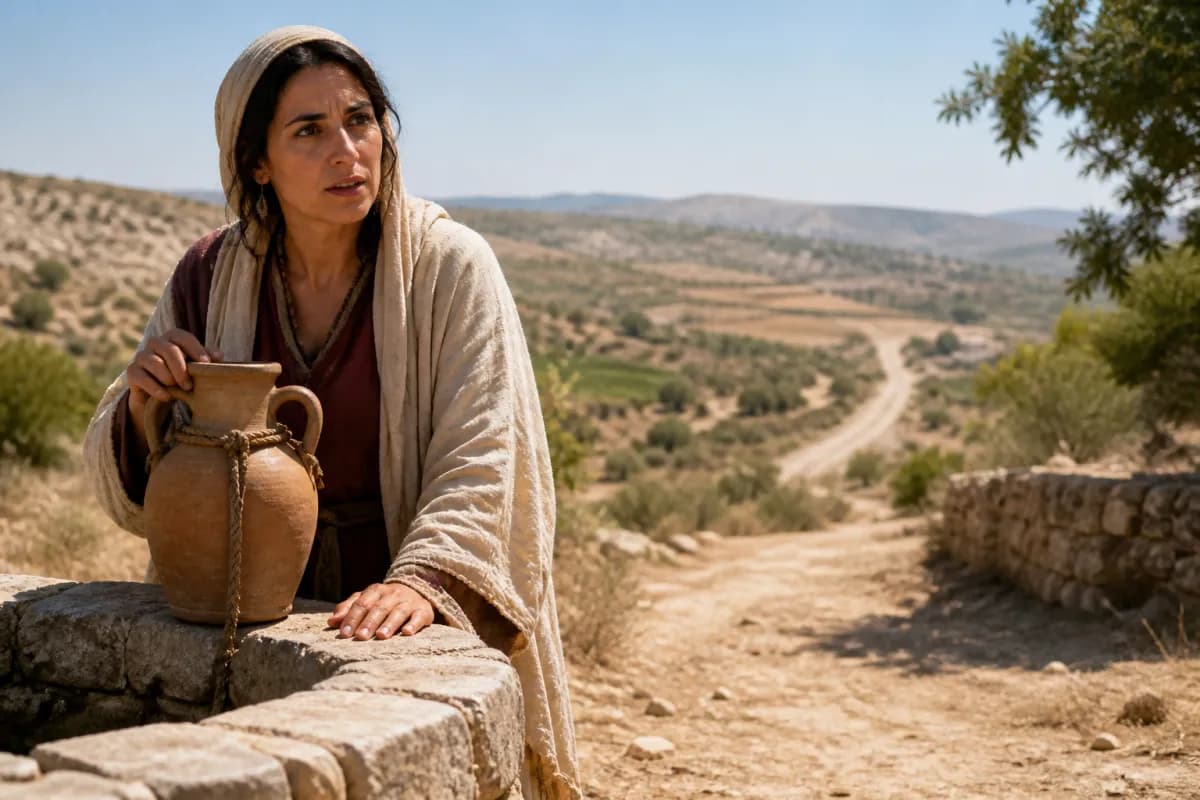
4:6Jacob’s well was there. Jesus therefore, being tired from his journey, sat down by the well. It was about the sixth hour.
4:7A woman of Samaria came to draw water. Jesus said to her, “Give me a drink.”
4:8For his disciples had gone away into the city to buy food.
4:9The Samaritan woman therefore said to him, “How is it that you, being a Jew, ask for a drink from me, a Samaritan woman?” (For Jews have no dealings with Samaritans.)
4:10Jesus answered her, “If you knew the gift of God, and who it is who says to you, ‘Give me a drink,’ you would have asked him, and he would have given you living water.”
4:11The woman said to him, “Sir, you have nothing to draw with, and the well is deep. So where do you get that living water?
4:12Are you greater than our father Jacob, who gave us the well and drank from it himself, as did his children and his livestock?”
4:13Jesus answered her, “Everyone who drinks of this water will thirst again,
4:14but whoever drinks of the water that I will give him will never thirst again; but the water that I will give him will become in him a well of water springing up to eternal life.”
4:15The woman said to him, “Sir, give me this water, so that I don’t get thirsty, neither come all the way here to draw.”
4:16Jesus said to her, “Go, call your husband, and come here.”
4:17The woman answered, “I have no husband.” Jesus said to her, “You said well, ‘I have no husband,’
4:18for you have had five husbands; and he whom you now have is not your husband. This you have said truly.”
4:19The woman said to him, “Sir, I perceive that you are a prophet.
4:20Our fathers worshiped in this mountain, and you Jews say that in Jerusalem is the place where people ought to worship.”
4:21Jesus said to her, “Woman, believe me, the hour is coming when neither in this mountain nor in Jerusalem will you worship the Father.
4:22You worship that which you don’t know. We worship that which we know; for salvation is from the Jews.
4:23But the hour comes, and now is, when the true worshipers will worship the Father in spirit and truth, for the Father seeks such to be his worshipers.
4:24God is spirit, and those who worship him must worship in spirit and truth.”
4:25The woman said to him, “I know that Messiah is coming, he who is called Christ. When he has come, he will declare to us all things.”
4:26Jesus said to her, “I am he, the one who speaks to you.”
4:27Just then, his disciples came. They marveled that he was speaking with a woman; yet no one said, “What are you looking for?” or, “Why do you speak with her?”
4:28So the woman left her water pot, went away into the city, and said to the people,
4:29“Come, see a man who told me everything that I have done. Can this be the Christ?”
4:30They went out of the city, and were coming to him.
4:31In the meanwhile, the disciples urged him, saying, “Rabbi, eat.”
4:32But he said to them, “I have food to eat that you don’t know about.”
4:33The disciples therefore said to one another, “Has anyone brought him something to eat?”
4:34Jesus said to them, “My food is to do the will of him who sent me and to accomplish his work.
4:35Don’t you say, ‘There are yet four months until the harvest’? Behold, I tell you, lift up your eyes and look at the fields, that they are white for harvest already.
4:36He who reaps receives wages and gathers fruit to eternal life, that both he who sows and he who reaps may rejoice together.
4:37For in this the saying is true, ‘One sows, and another reaps.’
4:38I sent you to reap that for which you haven’t labored. Others have labored, and you have entered into their labor.”
4:39From that city many of the Samaritans believed in him because of the word of the woman, who testified, “He told me everything that I have done.”
4:40So when the Samaritans came to him, they begged him to stay with them. He stayed there two days.
4:41Many more believed because of his word.
4:42They said to the woman, “Now we believe, not because of your speaking; for we have heard for ourselves, and know that this is indeed the Christ, the Savior of the world.”
4:43After the two days he went out from there and went into Galilee.
4:44For Jesus himself testified that a prophet has no honor in his own country.
4:45So when he came into Galilee, the Galileans received him, having seen all the things that he did in Jerusalem at the feast, for they also went to the feast.
4:46Jesus came therefore again to Cana of Galilee, where he made the water into wine. There was a certain nobleman whose son was sick at Capernaum.
4:47When he heard that Jesus had come out of Judea into Galilee, he went to him and begged him that he would come down and heal his son, for he was at the point of death.
4:48Jesus therefore said to him, “Unless you see signs and wonders, you will in no way believe.”
4:49The nobleman said to him, “Sir, come down before my child dies.”
4:50Jesus said to him, “Go your way. Your son lives.” The man believed the word that Jesus spoke to him, and he went his way.
4:51As he was going down, his servants met him and reported, saying “Your child lives!”
4:52So he inquired of them the hour when he began to get better. They said therefore to him, “Yesterday at the seventh hour, the fever left him.”
4:53So the father knew that it was at that hour in which Jesus said to him, “Your son lives.” He believed, as did his whole house.
4:54This is again the second sign that Jesus did, having come out of Judea into Galilee.
CONTEXTUAL OVERVIEW
John places two very different people before Jesus: Nicodemus, a Pharisee and teacher of Israel who comes by night, and an unnamed Samaritan woman drawing water at midday. Neither encounter lets social position settle the question of life with God. Nicodemus has learning but misunderstands birth from above; the woman’s history is exposed, yet she becomes a witness to her town.
Water, birth, worship, and testimony hold the unit together. Jesus speaks of water and Spirit, then asks a thirsty woman for a drink and offers her living water. He moves worship from the Samaritan mountain and Jerusalem temple toward worship in Spirit and truth. He finally honors the royal official’s trust in His word, showing that life-giving faith rests on Jesus rather than on visible proof.
HISTORICAL AND LITERARY CONTEXT
Nicodemus’s address, “Rabbi,” acknowledges Jesus as a teacher from God because of His signs. Jesus redirects the conversation from signs to the Spirit’s sovereign work. The Greek word anothen can mean “again” or “from above,” and John lets Nicodemus hear the first sense while Jesus explains the second: the required birth comes from God, through water and Spirit, rather than from human origin or religious accomplishment.
The Samaritan setting matters because Jewish and Samaritan communities disputed covenant identity and the proper place of worship. Jesus does not ignore that division; He tells the woman that salvation is from the Jews. Yet He also announces an hour when worship will be defined by the Father’s seeking of people who worship in Spirit and truth. The arrival of Samaritan believers previews the breadth of the Son’s saving mission.
SECTION-BY-SECTION ANALYSIS
- John 3:1–21 · John 3:23New birth comes from above through the Spirit, and eternal life comes through trusting the Son lifted up for the world’s rescue.
- John 3:22–36 · John 3:24John rejoices as the bridegroom receives His people and insists that the Son’s authority and life-giving word surpass every human witness.
- John 4:1–54 · John 4:1Jesus gives living water, creates worshipers across a historic divide, and calls people to rely on His word even before they see the outcome.
CHRIST IN THIS PASSAGE
Jesus identifies His saving mission in plain terms: the Son of Man will be lifted up so that believers have eternal life, and the Father gives the Son because He loves the world. The serpent comparison is a strong biblical pattern. As dying Israelites looked in trust to God’s provided means of healing, sinners receive life by believing in the crucified Son; John’s Gospel will show that His lifting up includes His death and exaltation.
Jesus is also the giver of the Spirit’s life and the source of living water. His conversation with the Samaritan woman does not erase Israel’s story or turn her into a generic symbol of thirst. It shows the Messiah crossing a real boundary, exposing sin truthfully, and creating worshipers whom the Father seeks. The Samaritans call Him “the Savior of the world,” a fitting confession of the mission John has been unfolding.
REFLECTION
Nicodemus warns against treating spiritual knowledge as the same thing as new life. The Samaritan woman warns against looking for a lasting drink in relationships, reputation, or a particular place. Bring your actual thirst and your actual shame to Jesus. He already knows them, and He invites people into worship of the Father through the life He gives.
The official gives a practical picture of faith: he hears Jesus’ word, goes home, and learns that the healing occurred at the hour Jesus spoke. Where do you need to obey Christ’s word before you can see the result? Trust the Son who was given for the world, and speak honestly about Him to someone who may be closer to faith than you assume.
Original Greek Word Study
John 3:3
ἄνωθεν
anothen · G509
Usually translated: from above or again
Anothen can mean from above or again. Jesus speaks of a birth that comes from God, not a second natural birth, and Nicodemus’s confusion draws out the Spirit’s life-giving work.
Follow the Scripture trail
The Son Gives New Birth and Living Water in the larger story
The connection: The Father sends His Son into a world unable to give itself new birth. Lifted up at the cross, Jesus gives eternal life to believers; through His Spirit He gives living water and gathers worshipers from divided peoples into the Father’s family.
Respond to the passage
Stop hiding behind knowledge, background, or a preferred religious setting. Tell Jesus where you are thirsty and where you resist the light. Trust His word in one unresolved situation, and ask Him to make your ordinary testimony a truthful invitation for another person to meet the Savior.
- What does Jesus correct in Nicodemus’s understanding of new birth?
- How does the lifted serpent clarify John 3:14–16?
- What changes in the Samaritan woman after Jesus speaks truthfully about her life?
Prayer
Father, give me the new life I cannot produce. Lord Jesus, lifted up for the world, satisfy my thirst with Your living water and make me a truthful witness to Your saving grace. Amen.