Passage Study
The Son Gives Life and Is the Bread from Heaven
John 5:1–6:71
John 5–6 presents Jesus as the Son who gives life, exercises the Father’s judgment, and feeds a hungry crowd as the true bread from heaven. He heals a man at Bethesda on the Sabbath, answers hostility by naming His unity with the Father, feeds five thousand, walks on the sea, and calls people beyond perishable food to believe in Him. His flesh and blood language points to the saving gift of His life.
- In this study
- 118 verses · 5 movements
John 5
5:1After these things, there was a feast of the Jews, and Jesus went up to Jerusalem.
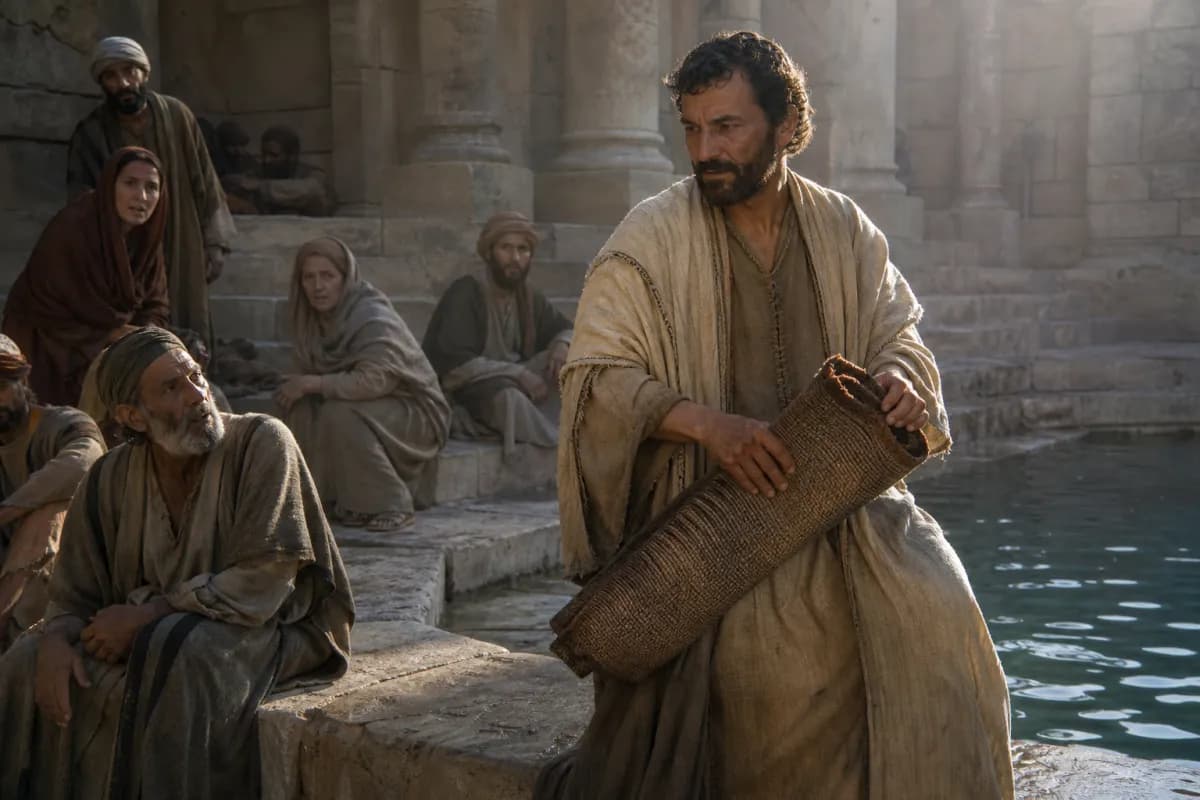
5:2Now in Jerusalem by the sheep gate, there is a pool, which is called in Hebrew, “Bethesda”, having five porches.
5:3In these lay a great multitude of those who were sick, blind, lame, or paralyzed, waiting for the moving of the water;
5:4for an angel went down at certain times into the pool and stirred up the water. Whoever stepped in first after the stirring of the water was healed of whatever disease he had.
5:5A certain man was there who had been sick for thirty-eight years.
5:6When Jesus saw him lying there, and knew that he had been sick for a long time, he asked him, “Do you want to be made well?”
5:7The sick man answered him, “Sir, I have no one to put me into the pool when the water is stirred up, but while I’m coming, another steps down before me.”
5:8Jesus said to him, “Arise, take up your mat, and walk.”
5:9Immediately, the man was made well, and took up his mat and walked. Now that day was a Sabbath.
5:10So the Jews said to him who was cured, “It is the Sabbath. It is not lawful for you to carry the mat.”
5:11He answered them, “He who made me well said to me, ‘Take up your mat and walk.’ ”
5:12Then they asked him, “Who is the man who said to you, ‘Take up your mat and walk’ ?”
5:13But he who was healed didn’t know who it was, for Jesus had withdrawn, a crowd being in the place.
5:14Afterward Jesus found him in the temple and said to him, “Behold, you are made well. Sin no more, so that nothing worse happens to you.”
5:15The man went away, and told the Jews that it was Jesus who had made him well.
5:16For this cause the Jews persecuted Jesus and sought to kill him, because he did these things on the Sabbath.
5:17But Jesus answered them, “My Father is still working, so I am working, too.”
5:18For this cause therefore the Jews sought all the more to kill him, because he not only broke the Sabbath, but also called God his own Father, making himself equal with God.
5:19Jesus therefore answered them, “Most certainly, I tell you, the Son can do nothing of himself, but what he sees the Father doing. For whatever things he does, these the Son also does likewise.
5:20For the Father has affection for the Son, and shows him all things that he himself does. He will show him greater works than these, that you may marvel.
5:21For as the Father raises the dead and gives them life, even so the Son also gives life to whom he desires.
5:22For the Father judges no one, but he has given all judgment to the Son,
5:23that all may honor the Son, even as they honor the Father. He who doesn’t honor the Son doesn’t honor the Father who sent him.
5:24“Most certainly I tell you, he who hears my word and believes him who sent me has eternal life, and doesn’t come into judgment, but has passed out of death into life.
5:25Most certainly I tell you, the hour comes, and now is, when the dead will hear the Son of God’s voice; and those who hear will live.
5:26For as the Father has life in himself, even so he gave to the Son also to have life in himself.
5:27He also gave him authority to execute judgment, because he is a son of man.
5:28Don’t marvel at this, for the hour comes in which all who are in the tombs will hear his voice
5:29and will come out; those who have done good, to the resurrection of life; and those who have done evil, to the resurrection of judgment.
5:30I can of myself do nothing. As I hear, I judge; and my judgment is righteous, because I don’t seek my own will, but the will of my Father who sent me.
5:31“If I testify about myself, my witness is not valid.
5:32It is another who testifies about me. I know that the testimony which he testifies about me is true.
5:33You have sent to John, and he has testified to the truth.
5:34But the testimony which I receive is not from man. However, I say these things that you may be saved.
5:35He was the burning and shining lamp, and you were willing to rejoice for a while in his light.
5:36But the testimony which I have is greater than that of John; for the works which the Father gave me to accomplish, the very works that I do, testify about me, that the Father has sent me.
5:37The Father himself, who sent me, has testified about me. You have neither heard his voice at any time, nor seen his form.
5:38You don’t have his word living in you, because you don’t believe him whom he sent.
5:39“You search the Scriptures, because you think that in them you have eternal life; and these are they which testify about me.
5:40Yet you will not come to me, that you may have life.
5:41I don’t receive glory from men.
5:42But I know you, that you don’t have God’s love in yourselves.
5:43I have come in my Father’s name, and you don’t receive me. If another comes in his own name, you will receive him.
5:44How can you believe, who receive glory from one another, and you don’t seek the glory that comes from the only God?
5:45“Don’t think that I will accuse you to the Father. There is one who accuses you, even Moses, on whom you have set your hope.
5:46For if you believed Moses, you would believe me; for he wrote about me.
5:47But if you don’t believe his writings, how will you believe my words?”
John 6
6:1After these things, Jesus went away to the other side of the sea of Galilee, which is also called the Sea of Tiberias.
6:2A great multitude followed him, because they saw his signs which he did on those who were sick.
6:3Jesus went up into the mountain, and he sat there with his disciples.
6:4Now the Passover, the feast of the Jews, was at hand.
6:5Jesus therefore, lifting up his eyes and seeing that a great multitude was coming to him, said to Philip, “Where are we to buy bread, that these may eat?”
6:6He said this to test him, for he himself knew what he would do.
6:7Philip answered him, “Two hundred denarii worth of bread is not sufficient for them, that every one of them may receive a little.”
6:8One of his disciples, Andrew, Simon Peter’s brother, said to him,
6:9“There is a boy here who has five barley loaves and two fish, but what are these among so many?”
6:10Jesus said, “Have the people sit down.” Now there was much grass in that place. So the men sat down, in number about five thousand.
6:11Jesus took the loaves, and having given thanks, he distributed to the disciples, and the disciples to those who were sitting down, likewise also of the fish as much as they desired.
6:12When they were filled, he said to his disciples, “Gather up the broken pieces which are left over, that nothing be lost.”
6:13So they gathered them up, and filled twelve baskets with broken pieces from the five barley loaves, which were left over by those who had eaten.
6:14When therefore the people saw the sign which Jesus did, they said, “This is truly the prophet who comes into the world.”
6:15Jesus therefore, perceiving that they were about to come and take him by force to make him king, withdrew again to the mountain by himself.
6:16When evening came, his disciples went down to the sea.
6:17They entered into the boat, and were going over the sea to Capernaum. It was now dark, and Jesus had not come to them.
6:18The sea was tossed by a great wind blowing.
6:19When therefore they had rowed about twenty-five or thirty stadia, they saw Jesus walking on the sea and drawing near to the boat; and they were afraid.
6:20But he said to them, “It is I. Don’t be afraid.”
6:21They were willing therefore to receive him into the boat. Immediately the boat was at the land where they were going.
6:22On the next day, the multitude that stood on the other side of the sea saw that there was no other boat there, except the one in which his disciples had embarked, and that Jesus hadn’t entered with his disciples into the boat, but his disciples had gone away alone.
6:23However, boats from Tiberias came near to the place where they ate the bread after the Lord had given thanks.
6:24When the multitude therefore saw that Jesus wasn’t there, nor his disciples, they themselves got into the boats and came to Capernaum, seeking Jesus.
6:25When they found him on the other side of the sea, they asked him, “Rabbi, when did you come here?”
6:26Jesus answered them, “Most certainly I tell you, you seek me, not because you saw signs, but because you ate of the loaves and were filled.
6:27Don’t work for the food which perishes, but for the food which remains to eternal life, which the Son of Man will give to you. For God the Father has sealed him.”
6:28They said therefore to him, “What must we do, that we may work the works of God?”
6:29Jesus answered them, “This is the work of God, that you believe in him whom he has sent.”
6:30They said therefore to him, “What then do you do for a sign, that we may see and believe you? What work do you do?
6:31Our fathers ate the manna in the wilderness. As it is written, ‘He gave them bread out of heaven to eat.’”
6:32Jesus therefore said to them, “Most certainly, I tell you, it wasn’t Moses who gave you the bread out of heaven, but my Father gives you the true bread out of heaven.
6:33For the bread of God is that which comes down out of heaven and gives life to the world.”
6:34They said therefore to him, “Lord, always give us this bread.”
6:35Jesus said to them, “I am the bread of life. Whoever comes to me will not be hungry, and whoever believes in me will never be thirsty.
6:36But I told you that you have seen me, and yet you don’t believe.
6:37All those whom the Father gives me will come to me. He who comes to me I will in no way throw out.
6:38For I have come down from heaven, not to do my own will, but the will of him who sent me.
6:39This is the will of my Father who sent me, that of all he has given to me I should lose nothing, but should raise him up at the last day.
6:40This is the will of the one who sent me, that everyone who sees the Son and believes in him should have eternal life; and I will raise him up at the last day.”
6:41The Jews therefore murmured concerning him, because he said, “I am the bread which came down out of heaven.”
6:42They said, “Isn’t this Jesus, the son of Joseph, whose father and mother we know? How then does he say, ‘I have come down out of heaven’?”
6:43Therefore Jesus answered them, “Don’t murmur among yourselves.
6:44No one can come to me unless the Father who sent me draws him; and I will raise him up in the last day.
6:45It is written in the prophets, ‘They will all be taught by God.’ Therefore everyone who hears from the Father and has learned, comes to me.
6:46Not that anyone has seen the Father, except he who is from God. He has seen the Father.
6:47Most certainly, I tell you, he who believes in me has eternal life.
6:48I am the bread of life.
6:49Your fathers ate the manna in the wilderness and they died.
6:50This is the bread which comes down out of heaven, that anyone may eat of it and not die.
6:51I am the living bread which came down out of heaven. If anyone eats of this bread, he will live forever. Yes, the bread which I will give for the life of the world is my flesh.”
6:52The Jews therefore contended with one another, saying, “How can this man give us his flesh to eat?”
6:53Jesus therefore said to them, “Most certainly I tell you, unless you eat the flesh of the Son of Man and drink his blood, you don’t have life in yourselves.
6:54He who eats my flesh and drinks my blood has eternal life, and I will raise him up at the last day.
6:55For my flesh is food indeed, and my blood is drink indeed.
6:56He who eats my flesh and drinks my blood lives in me, and I in him.
6:57As the living Father sent me, and I live because of the Father, so he who feeds on me will also live because of me.
6:58This is the bread which came down out of heaven—not as our fathers ate the manna and died. He who eats this bread will live forever.”
6:59He said these things in the synagogue, as he taught in Capernaum.
6:60Therefore many of his disciples, when they heard this, said, “This is a hard saying! Who can listen to it?”
6:61But Jesus knowing in himself that his disciples murmured at this, said to them, “Does this cause you to stumble?
6:62Then what if you would see the Son of Man ascending to where he was before?
6:63It is the spirit who gives life. The flesh profits nothing. The words that I speak to you are spirit, and are life.
6:64But there are some of you who don’t believe.” For Jesus knew from the beginning who they were who didn’t believe, and who it was who would betray him.
6:65He said, “For this cause I have said to you that no one can come to me, unless it is given to him by my Father.”
6:66At this, many of his disciples went back and walked no more with him.
6:67Jesus said therefore to the twelve, “You don’t also want to go away, do you?”
6:68Simon Peter answered him, “Lord, to whom would we go? You have the words of eternal life.
6:69We have come to believe and know that you are the Christ, the Son of the living God.”
6:70Jesus answered them, “Didn’t I choose you, the twelve, and one of you is a devil?”
6:71Now he spoke of Judas, the son of Simon Iscariot, for it was he who would betray him, being one of the twelve.
CONTEXTUAL OVERVIEW
John 5 begins beside a pool with a man who has been ill for thirty-eight years; John 6 opens on a mountain with a crowd seeking Jesus because they have seen His signs. Both chapters expose a desire for help that must become faith in the Son. The healed man later reports Jesus to the authorities, and the fed crowd later pursues Him for more bread. Jesus does not dismiss bodily need, but He refuses to let healing or food become the final object of desire.
Sabbath and Passover provide the setting for Jesus’ claims. At Bethesda He heals on the Sabbath and calls God His own Father, provoking charges of blasphemy. Near Passover He feeds the crowd in the wilderness, and people want to make Him king by force. Jesus withdraws and later explains that Moses did not give the true bread from heaven; the Father gives it now in His Son.
HISTORICAL AND LITERARY CONTEXT
John names Bethesda in Jerusalem and its five porticoes, locating the healing in a concrete place near the Sheep Gate. The man’s condition and long wait make Jesus’ command, “Stand up, take your mat and walk,” striking. The resulting dispute is not about whether healing is good; it centers on Jesus’ act on the Sabbath and His claim that the Father’s work and His own work are inseparable.
John 6 is shaped by Israel’s wilderness memory. The crowd recalls manna after Jesus multiplies loaves and fish, but Jesus redirects their memory from Moses to the Father. The language of eating His flesh and drinking His blood is deliberately shocking in a setting where blood had strong covenantal significance. Within the discourse Jesus identifies His gift as His flesh “for the life of the world,” keeping the focus on His self-giving life rather than on a miraculous food supply.
SECTION-BY-SECTION ANALYSIS
- John 5:1–18 · John 5:36Jesus’ word restores the long-disabled man, and the Sabbath controversy reveals that His work belongs to the Father’s continuing life-giving action.
- John 5:19–47 · John 5:33The Son gives life and judges with the Father’s authority, while Scripture’s true witness summons people to come to Him for life.
- John 6:1–71 · John 6:33Bread, sea, and wilderness memories lead to Jesus’ declaration that His self-giving life is the true nourishment God supplies to the world.
CHRIST IN THIS PASSAGE
Jesus speaks here with extraordinary directness about His identity. The Son gives life, receives the same honor as the Father, and will judge the dead. These are not claims John leaves us to infer from a sign alone. The healing at Bethesda displays the authority Jesus explains in words: the Father’s life-giving work is active in the Son.
The bread discourse turns that authority toward the cross. Jesus does not promise that followers will never hunger physically; the crowd has already eaten and returns hungry. He gives His flesh for the life of the world, a direct declaration that His saving mission involves self-giving death. The manna comparison is a strong canonical pattern: Israel ate and died, but the Son who comes down from heaven gives eternal life to those who receive Him by faith.
REFLECTION
The man by the pool and the bread-seeking crowd expose two different ways need can remain centered on ourselves. One waits without power; the other wants Jesus’ benefits without His words. Bring your real bodily, emotional, and material needs to Christ, but ask Him to make you want Him more than the immediate relief you seek.
When Jesus’ teaching becomes costly or difficult, Peter’s answer gives a faithful prayer: “Lord, to whom can we go?” Name one competing source of security that cannot give eternal life. Turn to the Son, receive His self-giving mercy, and remain with His words even where obedience costs comfort or approval.
Original Greek Word Study
John 6:35
ζωή
zoe · G2222
Usually translated: life
Zoe means life, especially the life that comes from God. Jesus is the bread of life because trusting Him brings the lasting life that neither signs nor ordinary bread can supply.
Follow the Scripture trail
The Son Gives Life and Is the Bread from Heaven in the larger story
The connection: The Son who raises the helpless man and feeds the crowd is the Father’s life-giving gift. His flesh is given for the world’s life at the cross, so eternal life rests on receiving the crucified and risen Jesus rather than on religious achievement, signs, or perishable bread.
Respond to the passage
Tell Jesus where you have pursued a gift from Him while avoiding His claims over your life. Thank Him for giving His life for the world, trust His words where they are hard, and choose one act of obedience that shows you want the Giver more than a temporary benefit.
- Why does Jesus connect His Sabbath healing with the Father’s work?
- What witnesses does Jesus name in John 5, and why do they matter?
- How does Peter’s response differ from the crowd’s pursuit of bread?
Prayer
Lord Jesus, bread of life, forgive me for seeking Your gifts while resisting Your word. Thank You for giving Your flesh for the life of the world. Keep me near You when Your truth is costly, and feed my faith with Your grace. Amen.