Passage Study
Jerusalem Sits Alone and Confesses Her Rebellion
Lamentations 1:1–1:22
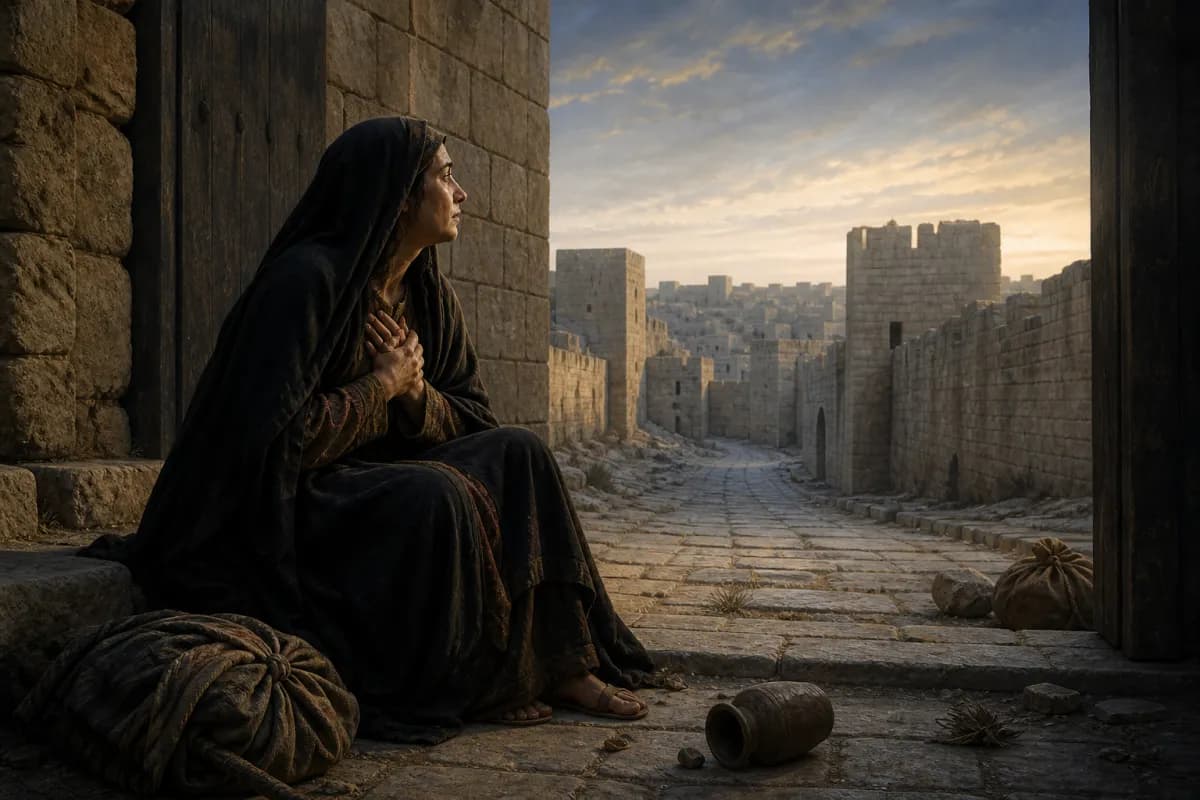
Lamentations 1 gives voice to Jerusalem after the Babylonian catastrophe. The once-crowded city sits like a widow; former friends have become enemies; priests groan and children have gone into captivity. The poem refuses easy explanations: Zion’s suffering is terrible, and Zion also confesses that the Lord is righteous because she rebelled. Her appeal for God to see her affliction teaches grieving sinners to bring both sorrow and guilt before Him.
- In this study
- 22 verses · 5 movements
Lamentations 1
1:1How the city sits solitary, that was full of people! She has become as a widow, who was great among the nations! She who was a princess among the provinces has become a slave!
1:2She weeps bitterly in the night. Her tears are on her cheeks. Among all her lovers she has no one to comfort her. All her friends have dealt treacherously with her. They have become her enemies.
1:3Judah has gone into captivity because of affliction and because of great servitude. She dwells among the nations. She finds no rest. All her persecutors overtook her in her distress.
1:4The roads to Zion mourn, because no one comes to the solemn assembly. All her gates are desolate. Her priests sigh. Her virgins are afflicted, and she herself is in bitterness.
1:5Her adversaries have become the head. Her enemies prosper; for the LORD has afflicted her for the multitude of her transgressions. Her young children have gone into captivity before the adversary.
1:6All majesty has departed from the daughter of Zion. Her princes have become like deer that find no pasture. They have gone without strength before the pursuer.
1:7Jerusalem remembers in the days of her affliction and of her miseries all her pleasant things that were from the days of old; when her people fell into the hand of the adversary, and no one helped her. The adversaries saw her. They mocked at her desolations.
1:8Jerusalem has grievously sinned. Therefore she has become unclean. All who honored her despise her, because they have seen her nakedness. Yes, she sighs and turns backward.
1:9Her filthiness was in her skirts. She didn’t remember her latter end. Therefore she has come down astoundingly. She has no comforter. “See, LORD, my affliction; for the enemy has magnified himself.”
1:10The adversary has spread out his hand on all her pleasant things; for she has seen that the nations have entered into her sanctuary, concerning whom you commanded that they should not enter into your assembly.
1:11All her people sigh. They seek bread. They have given their pleasant things for food to refresh their soul. “Look, LORD, and see, for I have become despised.”
1:12“Is it nothing to you, all you who pass by? Look, and see if there is any sorrow like my sorrow, which is brought on me, with which the LORD has afflicted me in the day of his fierce anger.
1:13“From on high has he sent fire into my bones, and it prevails against them. He has spread a net for my feet. He has turned me back. He has made me desolate and I faint all day long.
1:14“The yoke of my transgressions is bound by his hand. They are knit together. They have come up on my neck. He made my strength fail. The Lord has delivered me into their hands, against whom I am not able to stand.
1:15“The Lord has set at nothing all my mighty men within me. He has called a solemn assembly against me to crush my young men. The Lord has trodden the virgin daughter of Judah as in a wine press.
1:16“For these things I weep. My eye, my eye runs down with water, because the comforter who should refresh my soul is far from me. My children are desolate, because the enemy has prevailed.”
1:17Zion spreads out her hands. There is no one to comfort her. The LORD has commanded concerning Jacob, that those who are around him should be his adversaries. Jerusalem is among them as an unclean thing.
1:18“The LORD is righteous, for I have rebelled against his commandment. Please hear all you peoples, and see my sorrow. My virgins and my young men have gone into captivity.
1:19“I called for my lovers, but they deceived me. My priests and my elders gave up the spirit in the city, while they sought food for themselves to refresh their souls.
1:20“Look, LORD; for I am in distress. My heart is troubled. My heart turns over within me, for I have grievously rebelled. Abroad, the sword bereaves. At home, it is like death.
1:21“They have heard that I sigh. There is no one to comfort me. All my enemies have heard of my trouble. They are glad that you have done it. You will bring the day that you have proclaimed, and they will be like me.
1:22“Let all their wickedness come before you. Do to them as you have done to me for all my transgressions. For my sighs are many, and my heart is faint.
CONTEXTUAL OVERVIEW
The opening word, “How,” is a cry of stunned grief. Jerusalem was once full of people and treated as a princess among provinces; now she sits alone, like a widow, paying tribute. The poem does not let the reader look at an anonymous ruined city. It gives the city a voice: she weeps at night, has no comforter, remembers days of old, and stretches out empty hands toward a God she fears has judged her.
Lamentations 1 holds two truths together without softening either. Enemy armies have brought exile, hunger, mockery, and isolation; the suffering is not imaginary or deserved in a simplistic personal sense. Yet Jerusalem says, “The Lord is in the right, for I have rebelled against his word.” The chapter forms grief that neither denies evil done to the city nor hides the covenant rebellion that brought divine judgment.
HISTORICAL AND LITERARY CONTEXT
The poem mourns Jerusalem after its destruction by Babylon in the early sixth century BCE. Its images of ruined gates, scattered priests, captive children, and foreign domination fit the aftermath of siege and exile described in Kings and Jeremiah. Jewish and Christian tradition has associated Lamentations with Jeremiah, while many scholars understand the book as a shaped collection of laments arising from the disaster; the precise authorship is debated.
Chapter 1 is an alphabetic acrostic in Hebrew, a disciplined poetic form for disorder that cannot be controlled. The speaker moves between an observer describing Zion and Zion herself speaking in the first person. That alternation matters: readers are asked both to witness another’s devastation and to hear the city’s own confession and plea. No human comforter appears; the repeated absence makes Zion’s address to the Lord all the more urgent.
SECTION-BY-SECTION ANALYSIS
- Lamentations 1:1–11 · Lamentations 1:1The deserted city, mourning roads, and captive children show how completely Jerusalem’s former public life has collapsed.
- Lamentations 1:12–19 · Lamentations 1:12Zion names incomparable sorrow while acknowledging that rebellion against the Lord’s word has brought righteous judgment.
- Lamentations 1:20–22 · Lamentations 1:5The city brings both inner anguish and the enemy’s wickedness before the Lord instead of pretending the loss is settled.
CHRIST IN THIS PASSAGE
Jesus weeps over Jerusalem and foretells its later destruction because the city does not recognize the time of God’s visitation. That is a strong thematic and historical echo, not a claim that Lamentations directly predicts every detail of the first-century fall. Both poems make clear that covenant privilege cannot protect a people who refuse the Lord. Jesus’ tears show that divine judgment is never presented as cold indifference to human suffering.
The deeper gospel connection is found in the righteous sufferer. Jerusalem confesses rebellion; Jesus has no rebellion to confess. Yet He goes outside the city to bear sin’s curse and abandonment so that guilty people can be reconciled to God. Lamentations gives sinners words to admit that the Lord is right; Christ’s cross gives those sinners the mercy and cleansing they cannot produce for themselves.
REFLECTION
This poem refuses two harmful responses to tragedy. It does not call pain unreal, and it does not let guilt be renamed innocence. When grief involves our own sin, we may say with Jerusalem that the Lord is righteous without deciding that every loss is a simple equation. Bring the actual names of what has been lost—relationship, home, health, trust, livelihood—before God rather than hiding behind religious phrases.
Come to Jesus with the particular rebellion that needs confession and the particular wound that still has no human comforter. He does not demand a polished conclusion before you pray. Ask Him to make you truthful about sin, tender toward sufferers, and confident that the One who bore judgment for us hears cries that end in tears.
Original Hebrew Word Study
Lamentations 1:1
אֵיכָה
ekhah · H349
Usually translated: how?
Ekhah is the stunned cry “how?” The opening word does not explain away Jerusalem’s ruin; it gives grief its first honest question as the once-crowded city sits alone.
Follow the Scripture trail
Jerusalem Sits Alone and Confesses Her Rebellion in the larger story
The connection: Jerusalem’s empty streets testify that rebellion against the Lord brings real judgment, yet the poem’s appeal to God leaves room for mercy. Jesus weeps over sinful Jerusalem and then bears the judgment sinners deserve, opening reconciliation with God for all who confess their need and trust Him.
Respond to the passage
Tell Jesus one loss you have been tempted to minimize and one sin you have been tempted to excuse. Receive His mercy, and choose one concrete act of honest prayer or reconciliation instead of carrying the burden alone.
- Why does the chapter give Jerusalem both a public description and a first-person voice?
- How does Zion’s confession that the Lord is righteous differ from pretending that the city’s suffering does not matter?
- How do Jesus’ tears over Jerusalem shape the way you speak of judgment and grief together?
Prayer
Lord Jesus, You wept over a city that would not receive You and bore the judgment our rebellion deserves. Teach me to tell the truth about my sin and my sorrow, to bring both before You, and to rest in Your mercy. Amen.