Passage Study
Hope Recalled in the Darkness of God’s Discipline
Lamentations 3:1–3:66
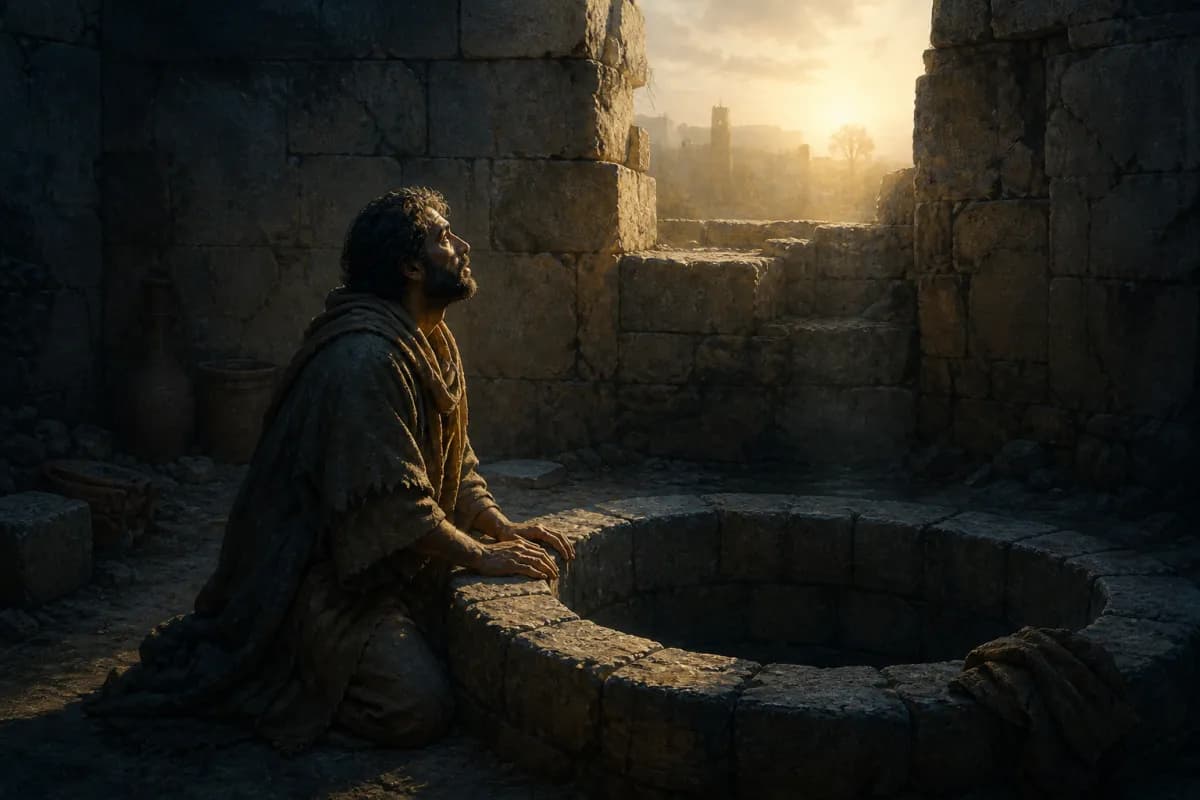
Lamentations 3 follows an afflicted man who feels pursued, shut in, mocked, and crushed beneath God’s rod. At the poem’s center he deliberately recalls the Lord’s steadfast love, mercy, and faithfulness, learning to wait quietly for God’s salvation. The chapter joins confession, protest, and hope: God does not afflict from His heart, hears the cry from the pit, and draws near to redeem the life of the one who calls.
- In this study
- 66 verses · 5 movements
Lamentations 3
3:1I am the man who has seen affliction by the rod of his wrath.
3:2He has led me and caused me to walk in darkness, and not in light.
3:3Surely he turns his hand against me again and again all day long.
3:4He has made my flesh and my skin old. He has broken my bones.
3:5He has built against me, and surrounded me with bitterness and hardship.
3:6He has made me dwell in dark places, as those who have been long dead.
3:7He has walled me about, so that I can’t go out. He has made my chain heavy.
3:8Yes, when I cry, and call for help, he shuts out my prayer.
3:9He has walled up my ways with cut stone. He has made my paths crooked.
3:10He is to me as a bear lying in wait, as a lion in hiding.
3:11He has turned away my path, and pulled me in pieces. He has made me desolate.
3:12He has bent his bow, and set me as a mark for the arrow.
3:13He has caused the shafts of his quiver to enter into my kidneys.
3:14I have become a derision to all my people, and their song all day long.
3:15He has filled me with bitterness. He has stuffed me with wormwood.
3:16He has also broken my teeth with gravel. He has covered me with ashes.
3:17You have removed my soul far away from peace. I forgot prosperity.
3:18I said, “My strength has perished, along with my expectation from the LORD.”
3:19Remember my affliction and my misery, the wormwood and the bitterness.
3:20My soul still remembers them, and is bowed down within me.
3:21This I recall to my mind; therefore I have hope.
3:22It is because of the LORD’s loving kindnesses that we are not consumed, because his mercies don’t fail.
3:23They are new every morning. Great is your faithfulness.
3:24“The LORD is my portion,” says my soul. “Therefore I will hope in him.”
3:25The LORD is good to those who wait for him, to the soul who seeks him.
3:26It is good that a man should hope and quietly wait for the salvation of the LORD.
3:27It is good for a man that he bear the yoke in his youth.
3:28Let him sit alone and keep silence, because he has laid it on him.
3:29Let him put his mouth in the dust, if it is so that there may be hope.
3:30Let him give his cheek to him who strikes him. Let him be filled full of reproach.
3:31For the Lord will not cast off forever.
3:32For though he causes grief, yet he will have compassion according to the multitude of his loving kindnesses.
3:33For he does not afflict willingly, nor grieve the children of men.
3:34To crush under foot all the prisoners of the earth,
3:35to turn away the right of a man before the face of the Most High,
3:36to subvert a man in his cause, the Lord doesn’t approve.
3:37Who is he who says, and it comes to pass, when the Lord doesn’t command it?
3:38Doesn’t evil and good come out of the mouth of the Most High?
3:39Why should a living man complain, a man for the punishment of his sins?
3:40Let us search and try our ways, and turn again to the LORD.
3:41Let’s lift up our heart with our hands to God in the heavens.
3:42“We have transgressed and have rebelled. You have not pardoned.
3:43“You have covered us with anger and pursued us. You have killed. You have not pitied.
3:44You have covered yourself with a cloud, so that no prayer can pass through.
3:45You have made us an off-scouring and refuse in the middle of the peoples.
3:46“All our enemies have opened their mouth wide against us.
3:47Terror and the pit have come on us, devastation and destruction.”
3:48My eye runs down with streams of water, for the destruction of the daughter of my people.
3:49My eye pours down and doesn’t cease, without any intermission,
3:50until the LORD looks down, and sees from heaven.
3:51My eye affects my soul, because of all the daughters of my city.
3:52They have chased me relentlessly like a bird, those who are my enemies without cause.
3:53They have cut off my life in the dungeon, and have cast a stone on me.
3:54Waters flowed over my head. I said, “I am cut off.”
3:55I called on your name, LORD, out of the lowest dungeon.
3:56You heard my voice: “Don’t hide your ear from my sighing, and my cry.”
3:57You came near in the day that I called on you. You said, “Don’t be afraid.”
3:58Lord, you have pleaded the causes of my soul. You have redeemed my life.
3:59LORD, you have seen my wrong. Judge my cause.
3:60You have seen all their vengeance and all their plans against me.
3:61You have heard their reproach, LORD, and all their plans against me,
3:62the lips of those that rose up against me, and their plots against me all day long.
3:63You see their sitting down and their rising up. I am their song.
3:64You will pay them back, LORD, according to the work of their hands.
3:65You will give them hardness of heart, your curse to them.
3:66You will pursue them in anger, and destroy them from under the heavens of the LORD.
CONTEXTUAL OVERVIEW
The third poem narrows the book’s grief into the voice of “the man who has seen affliction.” He describes darkness, broken bones, besieging walls, chains, blocked prayers, and the terror of being hunted like prey. The intensity is personal, but the speaker’s language gathers the experience of a wounded community. He is not offered distance from God as a solution; his agony is precisely that he experiences God’s hand as heavy and hidden.
At verse 21, the poem turns because the speaker chooses to call something to mind. He does not deny wormwood, bitterness, or a bowed-down soul. He remembers that the Lord’s steadfast love has not ceased, that mercies are new every morning, and that the Lord is his portion. Hope in this chapter is not optimism built from changed circumstances; it is a deliberate return to God’s covenant character while circumstances remain dark.
HISTORICAL AND LITERARY CONTEXT
Lamentations 3 is the central and longest poem in the book, with a highly ordered alphabetic pattern in Hebrew. Its first-person voice has often been connected with Jeremiah, but the text does not name the speaker, and certainty about authorship is not possible. What is clear is its pastoral function: it gives a faithful sufferer language for pain that is neither self-pity nor unbelief.
The chapter moves through complaint, confession, instruction, prayer, and appeal for justice. It says that people should search and test their ways and return to the Lord, yet it also says that the Lord does not willingly afflict or grieve anyone. Those statements are not contradictory. Divine discipline is morally serious, while God takes no cruel pleasure in human misery; His compassion remains the ground on which the afflicted person waits.
SECTION-BY-SECTION ANALYSIS
- Lamentations 3:1–20 · Lamentations 3:1The afflicted man uses concrete images of darkness, walls, gravel, and a pit to speak honestly of suffering under God’s hand.
- Lamentations 3:21–39 · Lamentations 3:32Remembered steadfast love and new mercies become the basis for patient hope while judgment and grief have not yet disappeared.
- Lamentations 3:40–66 · Lamentations 3:18Confession, a cry from the pit, and confidence that the Lord has drawn near shape the passage’s appeal for justice.
CHRIST IN THIS PASSAGE
The afflicted speaker’s cry from darkness and a pit finds a careful canonical echo in Jesus’ suffering. Jesus enters rejection, mockery, and death without sin, and His cry from the cross shows that God’s Son has not stood at a safe distance from human anguish. Lamentations 3 does not directly predict every moment of the passion, but its movement from affliction to the Lord’s nearness prepares readers to see why the crucified and risen Christ is a trustworthy refuge for the crushed.
The chapter’s hope rests in God’s steadfast love, mercy, and redemption of life. In Jesus, that mercy becomes saving action: He bears sin, rises from death, and gives the Spirit to people who cannot cleanse their own hearts. Because Christ has passed through death and lives, waiting on the Lord is not resignation to darkness. It is trust that the God who says “Do not fear” will complete His redemptive purpose.
REFLECTION
When despair has made God seem silent, borrow the speaker’s honest words rather than pretending you are untouched. Name the wall, the grief, the memory, or the fear that has closed around you. Then practice verse 21: deliberately call to mind one specific mercy of God in Christ—His forgiveness, His cross, His resurrection, His promise to be with His people—and let that truth answer the lie that suffering has made God absent.
Lamentations 3 also joins hope to self-examination. Ask Jesus to show you any sin that needs confession without using the search for sin to accuse yourself for every wound. In a season of waiting, take one small action of faith: pray a psalm aloud, ask a mature believer to sit with you, or serve someone else from the mercy you are learning to receive.
Original Hebrew Word Study
Lamentations 3:22
חֶסֶד
hesed · H2617
Usually translated: steadfast covenant love
Hesed is steadfast covenant love. In the center of the book’s grief, hope rests in God’s faithful love and mercy, which have not been exhausted by the judgment His people deserved.
Follow the Scripture trail
Hope Recalled in the Darkness of God’s Discipline in the larger story
The connection: The man in Lamentations remembers the Lord’s mercy while still surrounded by grief and cries from the pit for God to draw near. Jesus enters suffering without sin, bears death itself, and rises to secure the mercy, redemption, and final hope for which this poem waits.
Respond to the passage
Write down one bitter circumstance you need to bring into the light and one mercy of Jesus you will deliberately call to mind today. Ask Him for help to wait faithfully, confess what is truly yours to confess, and receive care from His people.
- What changes in the speaker’s reasoning at verse 21, even before his circumstances change?
- How does the chapter distinguish patient waiting from denial or passive fatalism?
- Why does Christ’s own suffering make the promise “Do not fear” meaningful to an afflicted believer?
Prayer
Faithful Lord, when grief closes around me, bring Your mercies to mind. Lord Jesus, You entered suffering and conquered death; draw near to me, cleanse what needs confession, and teach me to wait for Your salvation with honest hope. Amen.