Passage Study
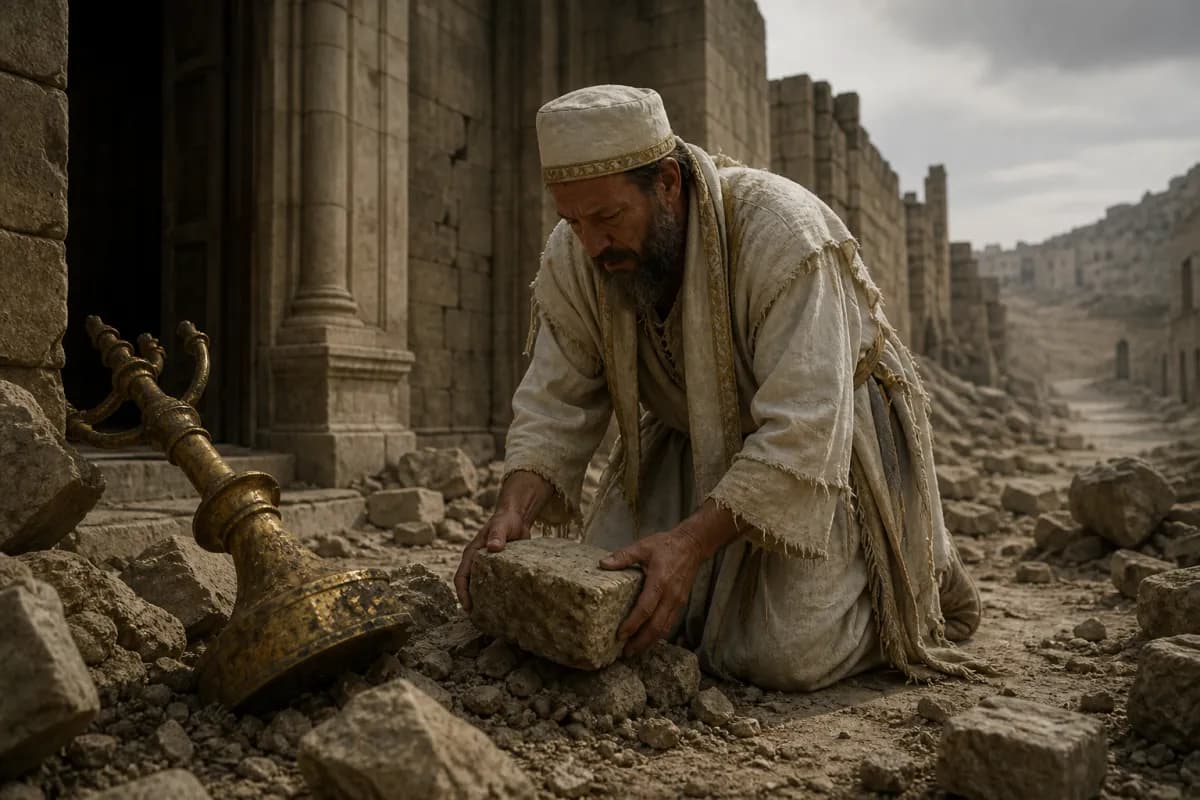
Gold Grown Dim and Zion’s False Hopes Exposed
Lamentations 4:1–4:22
Lamentations 4 mourns Jerusalem’s collapse through devastating reversals: gold grows dim, precious children are treated like clay jars, compassionate women cook their own children, nobles become unrecognizable, and priests wander bloodstained through the streets. The poem says Zion’s punishment is complete but exposes the sins of prophets and priests and the city’s futile hope in foreign rescue. Even Edom, which rejoices over Zion, will not escape God’s judgment.
- In this study
- 22 verses · 5 movements
Lamentations 4
4:1How the gold has become dim! The most pure gold has changed! The stones of the sanctuary are poured out at the head of every street.
4:2The precious sons of Zion, comparable to fine gold, how they are esteemed as earthen pitchers, the work of the hands of the potter!
4:3Even the jackals offer their breast. They nurse their young ones. But the daughter of my people has become cruel, like the ostriches in the wilderness.
4:4The tongue of the nursing child clings to the roof of his mouth for thirst. The young children ask for bread, and no one breaks it for them.
4:5Those who ate delicacies are desolate in the streets. Those who were brought up in purple embrace dunghills.
4:6For the iniquity of the daughter of my people is greater than the sin of Sodom, which was overthrown as in a moment. No hands were laid on her.
4:7Her nobles were purer than snow. They were whiter than milk. They were more ruddy in body than rubies. Their polishing was like sapphire.
4:8Their appearance is blacker than a coal. They are not known in the streets. Their skin clings to their bones. It is withered. It has become like wood.
4:9Those who are killed with the sword are better than those who are killed with hunger; for these pine away, stricken through, for lack of the fruits of the field.
4:10The hands of the pitiful women have boiled their own children. They were their food in the destruction of the daughter of my people.
4:11The LORD has accomplished his wrath. He has poured out his fierce anger. He has kindled a fire in Zion, which has devoured its foundations.
4:12The kings of the earth didn’t believe, neither did all the inhabitants of the world, that the adversary and the enemy would enter into the gates of Jerusalem.
4:13It is because of the sins of her prophets and the iniquities of her priests, that have shed the blood of the just in the middle of her.
4:14They wander as blind men in the streets. They are polluted with blood, So that men can’t touch their garments.
4:15“Go away!” they cried to them. “Unclean! Go away! Go away! Don’t touch! When they fled away and wandered, men said among the nations, “They can’t live here any more.”
4:16The LORD’s anger has scattered them. He will not pay attention to them any more. They didn’t respect the persons of the priests. They didn’t favor the elders.
4:17Our eyes still fail, looking in vain for our help. In our watching we have watched for a nation that could not save.
4:18They hunt our steps, so that we can’t go in our streets. Our end is near. Our days are fulfilled, for our end has come.
4:19Our pursuers were swifter than the eagles of the sky. They chased us on the mountains. They set an ambush for us in the wilderness.
4:20The breath of our nostrils, the anointed of the LORD, was taken in their pits; of whom we said, under his shadow we will live among the nations.
4:21Rejoice and be glad, daughter of Edom, who dwells in the land of Uz. The cup will pass through to you also. You will be drunken, and will make yourself naked.
4:22The punishment of your iniquity is accomplished, daughter of Zion. He will no more carry you away into captivity. He will visit your iniquity, daughter of Edom. He will uncover your sins.
CONTEXTUAL OVERVIEW
“How the gold has grown dim” opens the fourth poem with a picture of lost glory. Sacred stones lie scattered; Zion’s precious children, once valued like fine gold, are regarded as earthen pots. The poem refuses the language of mere political defeat. Jerusalem’s collapse has desecrated what was precious, exposed the vulnerability of the innocent, and made the city’s former honor unrecognizable.
The chapter’s hardest images belong to siege: infants’ tongues cling to their mouths, children beg for food, and women once called compassionate cook their own children. Lamentations does not make these scenes useful illustrations for a moral lesson. It records the appalling end toward which starvation and abandonment have driven the city, then asks why leaders and hopes that should have protected the people proved so empty.
HISTORICAL AND LITERARY CONTEXT
Like the preceding poems, chapter 4 is an alphabetic lament shaped around Jerusalem’s fall. It remembers the city under siege and then after its capture, using comparisons between former abundance and present ruin. The poem is rooted in covenant warnings about famine and bloodshed, but it also addresses named moral failures within the city: prophets and priests shed the blood of the righteous, and the people look to a nation that cannot save them.
The final address to daughter Edom reflects Edom’s hostility toward Jerusalem’s fall, a hostility remembered elsewhere in the Old Testament. The poem does not ask readers to take revenge. It declares that the God who has exposed Zion’s guilt will also call hostile nations to account. Judgment belongs to the Lord, including judgment on those who celebrate another people’s devastation.
SECTION-BY-SECTION ANALYSIS
- Lamentations 4:1–11 · Lamentations 4:1Gold, sacred stones, children, princes, and food all become images of a city whose former honor has been overturned by siege and wrath.
- Lamentations 4:12–16 · Lamentations 4:13The fall that seemed unimaginable is linked to leaders who shed righteous blood and leave the people morally and publicly defiled.
- Lamentations 4:17–22 · Lamentations 4:21Jerusalem’s watch for foreign rescue fails, while Edom’s celebration is answered by the promise that God will expose its guilt as well.
CHRIST IN THIS PASSAGE
The capture of “the Lord’s anointed” king exposes the collapse of Judah’s remaining royal hope. The passage does not identify that king with Jesus, and its immediate referent belongs to Jerusalem’s final days. Yet the failure of David’s earthly line sharpens the canonical longing for the faithful Davidic King God promised. Jesus is that King, but unlike Jerusalem’s last king He is not captured because He cannot save; He gives Himself to save through His death and resurrection.
Lamentations also condemns leaders who shed righteous blood. Jesus, the truly righteous One, is condemned by corrupt leadership and killed, yet God turns that injustice into the means of atonement without calling evil good. Through His cross He bears the curse that brings ruin and opens a kingdom that cannot be destroyed. The poem’s warning against trusting nations, status, or failing leaders directs faith toward Christ alone.
REFLECTION
Chapter 4 is for moments when what once seemed solid has proved fragile: a trusted institution fails, leaders disappoint, provision disappears, or public honor collapses. Do not call broken gold bright. Bring the actual reversal to Jesus, who sees both the structural sins that harm communities and the individual grief of people caught in their consequences.
Examine where you have been watching for a rescue that cannot save—political power, reputation, wealth, a leader, or your own ability to manage a crisis. Christ does not promise that every visible loss will be restored quickly. He does promise a kingdom that outlasts every failed throne and a righteous judgment that will expose evil without abandoning those who belong to Him.
Original Hebrew Word Study
Lamentations 4:1
זָהָב
zahav · H2091
Usually translated: gold
Zahav means gold. The poem mourns that gold has lost its brightness, an image for a city and people once honored yet now visibly ruined by sin and siege.
Follow the Scripture trail
Gold Grown Dim and Zion’s False Hopes Exposed in the larger story
The connection: The dimmed gold of Zion and the capture of its anointed king reveal that sacred status, political alliances, and fallen leaders cannot save. Jesus is the faithful Davidic King who is handed over by unjust leaders, bears the curse of sin, rises in victory, and establishes the kingdom that earthly collapse cannot overturn.
Respond to the passage
Identify one human rescue you have been watching for as though it could carry the weight of salvation. Bring that dependence to Jesus, and take one faithful action shaped by His enduring kingdom rather than by fear of losing status or control.
- Why does the poem begin with gold, stones, and precious children rather than with military strategy?
- What does the failure of prophets, priests, and foreign help reveal about misplaced trust?
- How does Jesus’ resurrection answer the collapse of earthly kingship without erasing the pain Lamentations records?
Prayer
King Jesus, forgive me for looking to fragile powers as though they could save. See the places where what was precious has been dimmed, judge evil rightly, and anchor me in Your kingdom that cannot be shaken. Amen.