Passage Study
Restore Us to Yourself, O Lord
Lamentations 5:1–5:22
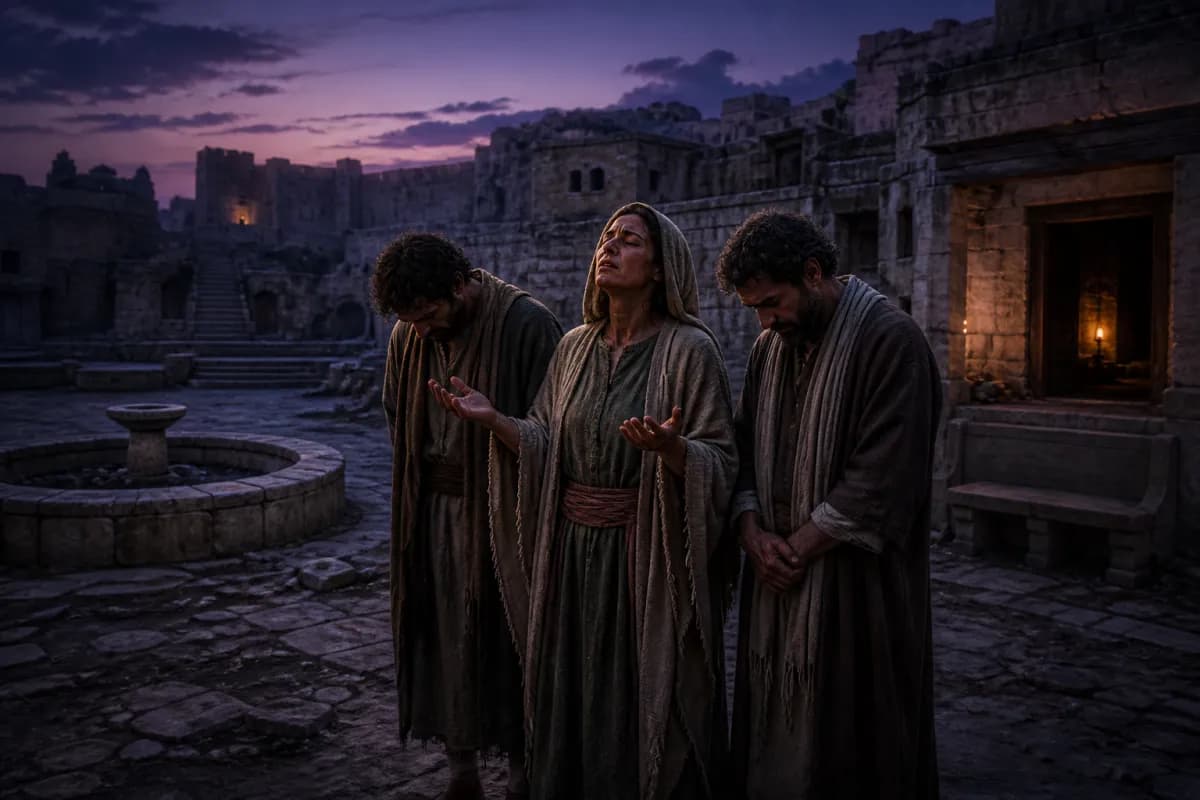
Lamentations 5 turns the book’s grief into a communal prayer. The survivors ask the Lord to remember their disgrace: inheritance given to strangers, children made fatherless, water and wood purchased at a price, exhausted labor, violated women, dishonored elders, and joy turned to mourning. They confess that they have sinned and ask God to restore them to Himself. The unresolved final question keeps the community waiting on His mercy.
- In this study
- 22 verses · 5 movements
Lamentations 5
5:1Remember, LORD, what has come on us. Look, and see our reproach.
5:2Our inheritance has been turned over to strangers, our houses to aliens.
5:3We are orphans and fatherless. Our mothers are as widows.
5:4We must pay for water to drink. Our wood is sold to us.
5:5Our pursuers are on our necks. We are weary, and have no rest.
5:6We have given our hands to the Egyptians, and to the Assyrians, to be satisfied with bread.
5:7Our fathers sinned, and are no more. We have borne their iniquities.
5:8Servants rule over us. There is no one to deliver us out of their hand.
5:9We get our bread at the peril of our lives, because of the sword in the wilderness.
5:10Our skin is black like an oven, because of the burning heat of famine.
5:11They ravished the women in Zion, the virgins in the cities of Judah.
5:12Princes were hanged up by their hands. The faces of elders were not honored.
5:13The young men carry millstones. The children stumbled under loads of wood.
5:14The elders have ceased from the gate, and the young men from their music.
5:15The joy of our heart has ceased. Our dance is turned into mourning.
5:16The crown has fallen from our head. Woe to us, for we have sinned!
5:17For this our heart is faint. For these things our eyes are dim:
5:18for the mountain of Zion, which is desolate. The foxes walk on it.
5:19You, LORD, remain forever. Your throne is from generation to generation.
5:20Why do you forget us forever, and forsake us for so long a time?
5:21Turn us to yourself, LORD, and we will be turned. Renew our days as of old.
5:22But you have utterly rejected us. You are very angry against us.
CONTEXTUAL OVERVIEW
The fifth and final poem is a direct communal prayer. Unlike the earlier alphabetic laments, it is not an acrostic, though it still contains twenty-two verses. The loosened form fits a people whose ordered world has been shattered. “Remember, O Lord, what has befallen us” does not suggest that God has forgotten information. It is a covenant plea asking Him to look, act, and show mercy toward a people who have no other defender.
The prayer names social humiliation in concrete terms. Houses and inheritance belong to strangers; orphans lack fathers; water and firewood must be bought; women are violated; princes are hung up; elders no longer sit at the gate; young men no longer make music. The final chapter gathers the city’s losses into a shared voice so that suffering is neither privatized nor hidden from God.
HISTORICAL AND LITERARY CONTEXT
Lamentations 5 arises from the aftermath of Jerusalem’s fall, when survivors faced displacement, labor under foreign control, food scarcity, and the collapse of ordinary civic life. The gate was the place where elders exercised public judgment and community decisions were made; its emptiness therefore signals more than sadness. It marks the disappearance of ordered communal life.
The prayer confesses, “We have transgressed and rebelled,” and acknowledges the long history of sin that has reached the present generation. At the same time, it does not treat inherited consequences as an excuse for personal guilt or as a denial of present suffering. The people speak as a covenant community needing God to turn them back. Their hope rests finally on the Lord’s throne, which endures when Jerusalem’s throne, gates, and homes have fallen.
SECTION-BY-SECTION ANALYSIS
- Lamentations 5:1–10 · Lamentations 5:1The community asks God to remember concrete losses of land, family, safety, labor, and food after the city’s fall.
- Lamentations 5:11–18 · Lamentations 5:14Violence, dishonor, silenced elders, ended music, and foxes on Mount Zion portray a whole social order laid waste.
- Lamentations 5:19–22 · Lamentations 5:19The Lord’s enduring throne grounds the plea that He Himself would turn His people back and restore them.
CHRIST IN THIS PASSAGE
The plea “Restore us to yourself” reaches a need that cannot be met by rebuilding streets or returning exiles alone. Jesus comes to reconcile sinners to God, bearing sin’s estrangement through His death and creating a people who are brought near by His blood. This is the gospel answer to the prayer’s deepest request: restoration begins with God’s initiative, not with a ruined people repairing their own relationship to Him.
The final unresolved question should not be answered glibly. Lamentations leaves survivors waiting, while the resurrection of Jesus gives the church a fuller basis for hope: God has not finally rejected those He redeems. Christ identifies with the afflicted, promises His presence, and will bring the New Jerusalem where mourning, loss, and curse are gone. That future does not silence lament now; it gives prayer a promised horizon.
REFLECTION
Use this chapter when loss has touched more than one part of life and you do not know how to pray. Name what has changed in your household, work, body, neighborhood, church, or sense of safety. The community’s prayer does not hide structural harm or personal grief. It places them before the Lord whose throne remains when every familiar support has been shaken.
Pray the chapter’s central request through Jesus: “Restore us to yourself.” Confess what needs confession, ask Him to renew a concrete relationship or practice of worship, and let His resurrection keep you from interpreting a long delay as final rejection. If someone nearby is carrying public or private disgrace, join them in patient prayer and practical care rather than asking them to recover alone.
Original Hebrew Word Study
Lamentations 5:21
שׁוּב
shuv · H7725
Usually translated: to return or restore
Shuv means to return or restore. The final prayer asks the Lord to turn His people back to Himself, acknowledging that true restoration begins with God’s merciful initiative.
Follow the Scripture trail
Restore Us to Yourself, O Lord in the larger story
The connection: Lamentations ends with a people unable to restore themselves, pleading that the enthroned Lord would turn them back. Jesus fulfills that deepest hope by reconciling sinners to God through His death, gathering them into His people, and promising the New Jerusalem where exile, grief, and curse will be no more.
Respond to the passage
Pray the sentence “Restore me to Yourself, Lord Jesus” over one broken area of life, then name one practical need you can share with a trusted believer. Let Christ’s resurrection teach you to wait with honest grief and durable hope.
- Why does the final poem list ordinary losses such as water, wood, work, elders, and music?
- How does the Lord’s everlasting throne change the community’s ability to pray in verses 19–22?
- What does Jesus’ reconciling work add to the plea, “Restore us to yourself”?
Prayer
Enthroned Lord, remember the places where grief has emptied our homes and communities. Lord Jesus, restore us to the Father through Your mercy, renew our worship, and keep us hopeful for the city where You will wipe away every tear. Amen.