Passage Study
The Kingdom Received, Resisted, and Revealed in Parables
Matthew 11:1–13:52
Matthew 11–13:52 records sharply different responses to Jesus. John asks from prison, cities refuse to repent, religious leaders oppose Sabbath mercy and call His works demonic, His family seeks Him, and crowds hear kingdom parables. Yet Jesus invites weary people to take His yoke, identifies His true family as those who do the Father’s will, explains the mixed reception of His word, and reveals a kingdom that grows, judges evil, and is worth every costly exchange.
- In this study
- 132 verses · 5 movements
Matthew 11
11:1When Jesus had finished directing his twelve disciples, he departed from there to teach and preach in their cities.
11:2Now when John heard in the prison the works of Christ, he sent two of his disciples
11:3and said to him, “Are you he who comes, or should we look for another?”
11:4Jesus answered them, “Go and tell John the things which you hear and see:
11:5the blind receive their sight, the lame walk, the lepers are cleansed, the deaf hear, the dead are raised up, and the poor have good news preached to them.
11:6Blessed is he who finds no occasion for stumbling in me.”
11:7As these went their way, Jesus began to say to the multitudes concerning John, “What did you go out into the wilderness to see? A reed shaken by the wind?
11:8But what did you go out to see? A man in soft clothing? Behold, those who wear soft clothing are in kings’ houses.
11:9But why did you go out? To see a prophet? Yes, I tell you, and much more than a prophet.
11:10For this is he, of whom it is written, ‘Behold, I send my messenger before your face, who will prepare your way before you.’
11:11Most certainly I tell you, among those who are born of women there has not arisen anyone greater than John the Baptizer; yet he who is least in the Kingdom of Heaven is greater than he.
11:12From the days of John the Baptizer until now, the Kingdom of Heaven suffers violence, and the violent take it by force.
11:13For all the prophets and the law prophesied until John.
11:14If you are willing to receive it, this is Elijah, who is to come.
11:15He who has ears to hear, let him hear.
11:16“But to what shall I compare this generation? It is like children sitting in the marketplaces, who call to their companions
11:17and say, ‘We played the flute for you, and you didn’t dance. We mourned for you, and you didn’t lament.’
11:18For John came neither eating nor drinking, and they say, ‘He has a demon.’
11:19The Son of Man came eating and drinking, and they say, ‘Behold, a gluttonous man and a drunkard, a friend of tax collectors and sinners!’ But wisdom is justified by her children.”
11:20Then he began to denounce the cities in which most of his mighty works had been done, because they didn’t repent.
11:21“Woe to you, Chorazin! Woe to you, Bethsaida! For if the mighty works had been done in Tyre and Sidon which were done in you, they would have repented long ago in sackcloth and ashes.
11:22But I tell you, it will be more tolerable for Tyre and Sidon on the day of judgment than for you.
11:23You, Capernaum, who are exalted to heaven, you will go down to Hades. For if the mighty works had been done in Sodom which were done in you, it would have remained until today.
11:24But I tell you that it will be more tolerable for the land of Sodom on the day of judgment, than for you.”
11:25At that time, Jesus answered, “I thank you, Father, Lord of heaven and earth, that you hid these things from the wise and understanding, and revealed them to infants.
11:26Yes, Father, for so it was well-pleasing in your sight.
11:27All things have been delivered to me by my Father. No one knows the Son, except the Father; neither does anyone know the Father, except the Son and he to whom the Son desires to reveal him.
11:28“Come to me, all you who labor and are heavily burdened, and I will give you rest.
11:29Take my yoke upon you and learn from me, for I am gentle and humble in heart; and you will find rest for your souls.
11:30For my yoke is easy, and my burden is light.”
Matthew 12
12:1At that time, Jesus went on the Sabbath day through the grain fields. His disciples were hungry and began to pluck heads of grain and to eat.
12:2But the Pharisees, when they saw it, said to him, “Behold, your disciples do what is not lawful to do on the Sabbath.”
12:3But he said to them, “Haven’t you read what David did when he was hungry, and those who were with him:
12:4how he entered into God’s house and ate the show bread, which was not lawful for him to eat, nor for those who were with him, but only for the priests?
12:5Or have you not read in the law that on the Sabbath day the priests in the temple profane the Sabbath and are guiltless?
12:6But I tell you that one greater than the temple is here.
12:7But if you had known what this means, ‘I desire mercy, and not sacrifice,’ you wouldn’t have condemned the guiltless.
12:8For the Son of Man is Lord of the Sabbath.”
12:9He departed from there and went into their synagogue.
12:10And behold, there was a man with a withered hand. They asked him, “Is it lawful to heal on the Sabbath day?” so that they might accuse him.
12:11He said to them, “What man is there among you who has one sheep, and if this one falls into a pit on the Sabbath day, won’t he grab on to it and lift it out?
12:12Of how much more value then is a man than a sheep! Therefore it is lawful to do good on the Sabbath day.”
12:13Then he told the man, “Stretch out your hand.” He stretched it out; and it was restored whole, just like the other.
12:14But the Pharisees went out and conspired against him, how they might destroy him.
12:15Jesus, perceiving that, withdrew from there. Great multitudes followed him; and he healed them all,
12:16and commanded them that they should not make him known,
12:17that it might be fulfilled which was spoken through Isaiah the prophet, saying,
12:18“Behold, my servant whom I have chosen, my beloved in whom my soul is well pleased. I will put my Spirit on him. He will proclaim justice to the nations.
12:19He will not strive, nor shout, neither will anyone hear his voice in the streets.
12:20He won’t break a bruised reed. He won’t quench a smoking flax, until he leads justice to victory.
12:21In his name, the nations will hope.”
12:22Then one possessed by a demon, blind and mute, was brought to him; and he healed him, so that the blind and mute man both spoke and saw.
12:23All the multitudes were amazed, and said, “Can this be the son of David?”
12:24But when the Pharisees heard it, they said, “This man does not cast out demons except by Beelzebul, the prince of the demons.”
12:25Knowing their thoughts, Jesus said to them, “Every kingdom divided against itself is brought to desolation, and every city or house divided against itself will not stand.
12:26If Satan casts out Satan, he is divided against himself. How then will his kingdom stand?
12:27If I by Beelzebul cast out demons, by whom do your children cast them out? Therefore they will be your judges.
12:28But if I by the Spirit of God cast out demons, then God’s Kingdom has come upon you.
12:29Or how can one enter into the house of the strong man and plunder his goods, unless he first bind the strong man? Then he will plunder his house.
12:30“He who is not with me is against me, and he who doesn’t gather with me, scatters.
12:31Therefore I tell you, every sin and blasphemy will be forgiven men, but the blasphemy against the Spirit will not be forgiven men.
12:32Whoever speaks a word against the Son of Man, it will be forgiven him; but whoever speaks against the Holy Spirit, it will not be forgiven him, either in this age, or in that which is to come.
12:33“Either make the tree good and its fruit good, or make the tree corrupt and its fruit corrupt; for the tree is known by its fruit.
12:34You offspring of vipers, how can you, being evil, speak good things? For out of the abundance of the heart, the mouth speaks.
12:35The good man out of his good treasure brings out good things, and the evil man out of his evil treasure brings out evil things.
12:36I tell you that every idle word that men speak, they will give account of it in the day of judgment.
12:37For by your words you will be justified, and by your words you will be condemned.”
12:38Then certain of the scribes and Pharisees answered, “Teacher, we want to see a sign from you.”
12:39But he answered them, “An evil and adulterous generation seeks after a sign, but no sign will be given to it but the sign of Jonah the prophet.
12:40For as Jonah was three days and three nights in the belly of the huge fish, so will the Son of Man be three days and three nights in the heart of the earth.
12:41The men of Nineveh will stand up in the judgment with this generation and will condemn it, for they repented at the preaching of Jonah; and behold, someone greater than Jonah is here.
12:42The Queen of the South will rise up in the judgment with this generation and will condemn it, for she came from the ends of the earth to hear the wisdom of Solomon; and behold, someone greater than Solomon is here.
12:43“When an unclean spirit has gone out of a man, he passes through waterless places seeking rest, and doesn’t find it.
12:44Then he says, ‘I will return into my house from which I came;’ and when he has come back, he finds it empty, swept, and put in order.
12:45Then he goes and takes with himself seven other spirits more evil than he is, and they enter in and dwell there. The last state of that man becomes worse than the first. Even so will it be also to this evil generation.”
12:46While he was yet speaking to the multitudes, behold, his mother and his brothers stood outside, seeking to speak to him.
12:47One said to him, “Behold, your mother and your brothers stand outside, seeking to speak to you.”
12:48But he answered him who spoke to him, “Who is my mother? Who are my brothers?”
12:49He stretched out his hand toward his disciples, and said, “Behold, my mother and my brothers!
12:50For whoever does the will of my Father who is in heaven, he is my brother, and sister, and mother.”
Matthew 13
13:1On that day Jesus went out of the house and sat by the seaside.
13:2Great multitudes gathered to him, so that he entered into a boat and sat; and all the multitude stood on the beach.
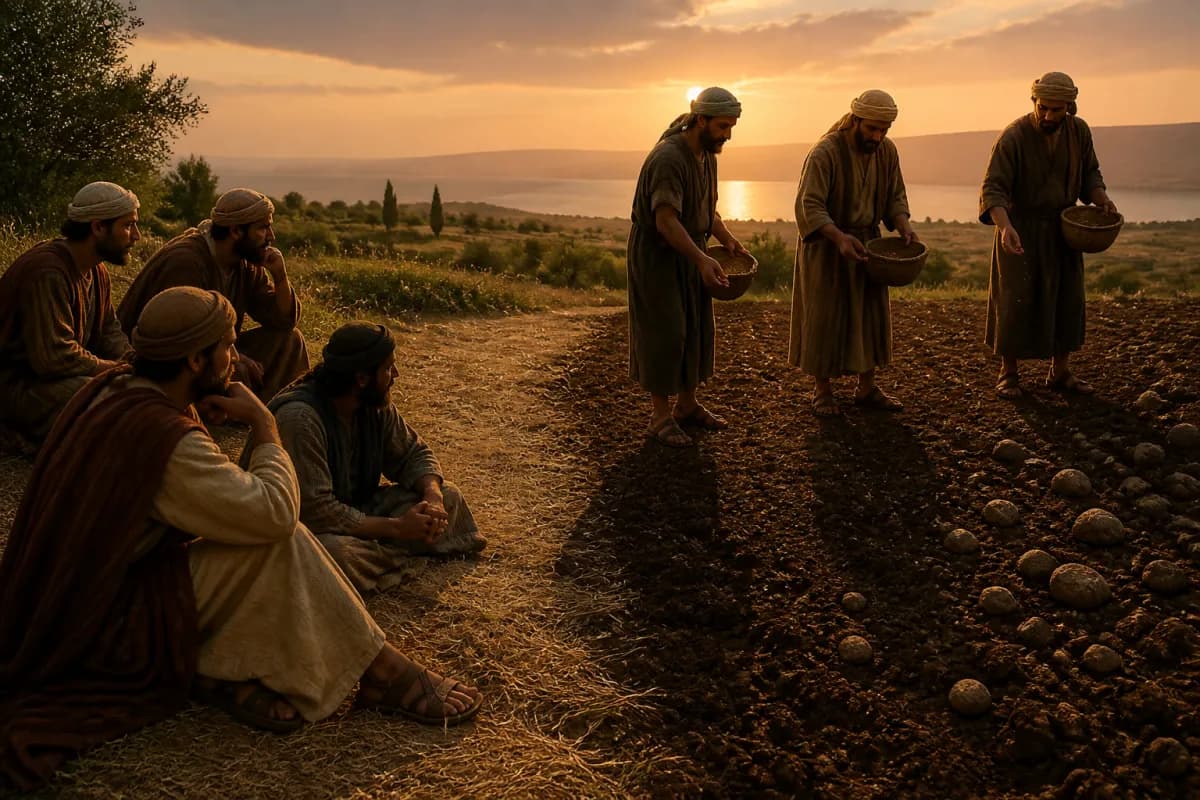
13:3He spoke to them many things in parables, saying, “Behold, a farmer went out to sow.
13:4As he sowed, some seeds fell by the roadside, and the birds came and devoured them.
13:5Others fell on rocky ground, where they didn’t have much soil, and immediately they sprang up, because they had no depth of earth.
13:6When the sun had risen, they were scorched. Because they had no root, they withered away.
13:7Others fell among thorns. The thorns grew up and choked them.
13:8Others fell on good soil and yielded fruit: some one hundred times as much, some sixty, and some thirty.
13:9He who has ears to hear, let him hear.”
13:10The disciples came, and said to him, “Why do you speak to them in parables?”
13:11He answered them, “To you it is given to know the mysteries of the Kingdom of Heaven, but it is not given to them.
13:12For whoever has, to him will be given, and he will have abundance; but whoever doesn’t have, from him will be taken away even that which he has.
13:13Therefore I speak to them in parables, because seeing they don’t see, and hearing, they don’t hear, neither do they understand.
13:14In them the prophecy of Isaiah is fulfilled, which says, ‘By hearing you will hear, and will in no way understand; Seeing you will see, and will in no way perceive;
13:15for this people’s heart has grown callous, their ears are dull of hearing, and they have closed their eyes; or else perhaps they might perceive with their eyes, hear with their ears, understand with their heart, and would turn again, and I would heal them.’
13:16“But blessed are your eyes, for they see; and your ears, for they hear.
13:17For most certainly I tell you that many prophets and righteous men desired to see the things which you see, and didn’t see them; and to hear the things which you hear, and didn’t hear them.
13:18“Hear, then, the parable of the farmer.
13:19When anyone hears the word of the Kingdom and doesn’t understand it, the evil one comes and snatches away that which has been sown in his heart. This is what was sown by the roadside.
13:20What was sown on the rocky places, this is he who hears the word and immediately with joy receives it;
13:21yet he has no root in himself, but endures for a while. When oppression or persecution arises because of the word, immediately he stumbles.
13:22What was sown among the thorns, this is he who hears the word, but the cares of this age and the deceitfulness of riches choke the word, and he becomes unfruitful.
13:23What was sown on the good ground, this is he who hears the word and understands it, who most certainly bears fruit and produces, some one hundred times as much, some sixty, and some thirty.”
13:24He set another parable before them, saying, “The Kingdom of Heaven is like a man who sowed good seed in his field,
13:25but while people slept, his enemy came and sowed darnel weeds also among the wheat, and went away.
13:26But when the blade sprang up and produced grain, then the darnel weeds appeared also.
13:27The servants of the householder came and said to him, ‘Sir, didn’t you sow good seed in your field? Where did these darnel weeds come from?’
13:28“He said to them, ‘An enemy has done this.’ “The servants asked him, ‘Do you want us to go and gather them up?’
13:29“But he said, ‘No, lest perhaps while you gather up the darnel weeds, you root up the wheat with them.
13:30Let both grow together until the harvest, and in the harvest time I will tell the reapers, “First, gather up the darnel weeds, and bind them in bundles to burn them; but gather the wheat into my barn.”’”
13:31He set another parable before them, saying, “The Kingdom of Heaven is like a grain of mustard seed which a man took, and sowed in his field,
13:32which indeed is smaller than all seeds. But when it is grown, it is greater than the herbs and becomes a tree, so that the birds of the air come and lodge in its branches.”
13:33He spoke another parable to them. “The Kingdom of Heaven is like yeast which a woman took and hid in three measures of meal, until it was all leavened.”
13:34Jesus spoke all these things in parables to the multitudes; and without a parable, he didn’t speak to them,
13:35that it might be fulfilled which was spoken through the prophet, saying, “I will open my mouth in parables; I will utter things hidden from the foundation of the world.”
13:36Then Jesus sent the multitudes away, and went into the house. His disciples came to him, saying, “Explain to us the parable of the darnel weeds of the field.”
13:37He answered them, “He who sows the good seed is the Son of Man,
13:38the field is the world, the good seeds are the children of the Kingdom, and the darnel weeds are the children of the evil one.
13:39The enemy who sowed them is the devil. The harvest is the end of the age, and the reapers are angels.
13:40As therefore the darnel weeds are gathered up and burned with fire; so will it be at the end of this age.
13:41The Son of Man will send out his angels, and they will gather out of his Kingdom all things that cause stumbling and those who do iniquity,
13:42and will cast them into the furnace of fire. There will be weeping and gnashing of teeth.
13:43Then the righteous will shine like the sun in the Kingdom of their Father. He who has ears to hear, let him hear.
13:44“Again, the Kingdom of Heaven is like treasure hidden in the field, which a man found and hid. In his joy, he goes and sells all that he has and buys that field.
13:45“Again, the Kingdom of Heaven is like a man who is a merchant seeking fine pearls,
13:46who having found one pearl of great price, he went and sold all that he had and bought it.
13:47“Again, the Kingdom of Heaven is like a dragnet that was cast into the sea and gathered some fish of every kind,
13:48which, when it was filled, fishermen drew up on the beach. They sat down and gathered the good into containers, but the bad they threw away.
13:49So it will be in the end of the world. The angels will come and separate the wicked from among the righteous,
13:50and will cast them into the furnace of fire. There will be weeping and gnashing of teeth.”
13:51Jesus said to them, “Have you understood all these things?” They answered him, “Yes, Lord.”
13:52He said to them, “Therefore every scribe who has been made a disciple in the Kingdom of Heaven is like a man who is a householder, who brings out of his treasure new and old things.”
CONTEXTUAL OVERVIEW
Matthew 11 begins with John the Baptist in prison asking whether Jesus is the expected one. Jesus answers by pointing to the blind seeing, the lame walking, lepers cleansed, the deaf hearing, the dead raised, the poor receiving good news, and the warning not to stumble over Him. The answer does not promise John an immediate release. It directs him to the messianic works already occurring and asks him to trust God’s way of fulfilling promise.
These chapters repeatedly show that proximity to Jesus does not guarantee repentance. Chorazin, Bethsaida, and Capernaum have seen mighty works yet remain unresponsive. Pharisees object when Jesus’ hungry disciples pluck grain and when He heals on the Sabbath; later they attribute His deliverance ministry to the ruler of demons. In this setting, Jesus’ invitation to weary people and His parables of hearing become urgent accounts of how the kingdom may be received or resisted.
HISTORICAL AND LITERARY CONTEXT
The Sabbath controversies concern God’s gift of rest and the law’s faithful observance, not a dispute over whether God’s commands matter. Jesus appeals to David’s need, priestly service, and Hosea’s call for mercy, then claims authority as “Lord of the sabbath.” His healing of a man with a withered hand places restoration of a person before a narrow reading that protects rules while withholding mercy.
In chapter 13 Jesus begins teaching crowds from a boat and uses parables—short comparisons drawn from sowing, fields, yeast, fishing, and household work. These spoken comparisons do not mean visible illustrations are being shown on the page. Jesus explains that parables reveal the kingdom’s mystery to receptive disciples while exposing hardened hearing. The chapter itself supplies interpretations for the sower and weeds, so readers should follow those explanations rather than assign secret meanings to every detail.
SECTION-BY-SECTION ANALYSIS
- Matthew 11:1–30 · Matthew 11:1Jesus answers John’s question with messianic deeds, confronts unreceptive cities, and invites weary people to learn from Him.
- Matthew 12:1–50 · Matthew 12:1Sabbath mercy, deliverance from demons, and Jesus’ true family expose opposition that sees God’s work yet refuses to submit to Him.
- Matthew 13:1–52 · Matthew 11:12The parables explain why the kingdom meets mixed reception now while promising its quiet growth, priceless worth, and final judgment.
CHRIST IN THIS PASSAGE
Jesus identifies His own works as the signs foretold for God’s saving reign, calls Himself Lord of the Sabbath, offers rest to weary people, and speaks of the Son of Man sending angels at the end of the age. These are not disconnected titles. The one who brings sight, cleansing, good news, mercy, and rest is the King through whom God’s kingdom has come near.
The invitation of 11:28–30 is especially direct: weary and burdened people are called to Jesus Himself. He will later carry the burden of sin at the cross and rise in victory, making reconciliation with God possible. The parables also keep the saving mission in view: the word of the kingdom is sown broadly, disciples are formed as Jesus’ true family, and the final harvest warns that His mercy must be received before judgment comes.
REFLECTION
John’s prison question gives believers room to bring disappointed expectations to Jesus without pretending they do not exist. Jesus does not shame John; He directs him to the works that testify to God’s faithfulness. When circumstances seem to contradict hope, look again at the crucified and risen Christ, whose saving mission was accomplished through suffering rather than escape from it.
The parables ask what kind of hearing is taking place in you. Is the word quickly crowded out by anxiety, wealth, or a desire to avoid costly obedience? Is there a mercy you resist because it challenges your control? Come under Jesus’ gentle yoke, make room for His word, and value His kingdom above the possession or approval you are most afraid to lose.
Original Greek Word Study
Matthew 13:3
παραβολή
parabole · G3850
Usually translated: parable, comparison, or illustrative saying
Parabole means parable or comparison. Jesus’ stories both reveal and test the heart: the kingdom is pictured in everyday scenes, yet its meaning is received by those willing to hear.
Follow the Scripture trail
The Kingdom Received, Resisted, and Revealed in Parables in the larger story
The connection: Matthew 11–13:52 reveals Jesus as the promised one whose works bring God’s saving restoration, the Lord who offers rest, and the Son of Man who will judge at the harvest. His parables explain the kingdom’s mixed reception while His invitation calls weary sinners to receive Him before the final separation.
Respond to the passage
Bring your unanswered question or burden honestly to Jesus, then identify what is choking or resisting His word in you. Place that competing loyalty before the King and take one step that gives His kingdom first place.
- Why does Jesus answer John’s question by naming what people are seeing and hearing?
- How do the Sabbath controversies reveal the difference between mercy and hardened religion?
- What do the parables of the soils, weeds, and treasure teach about receiving the kingdom?
Prayer
Lord Jesus, I come to You with my weariness and unanswered questions. Give me ears to receive Your word, free me from hardened religion and divided loyalty, and teach me to treasure Your kingdom above all else. Amen.