Passage Study
The Beloved Son Brings the Kingdom Near
Matthew 3:1–4:25
Matthew 3–4 begins Jesus’ public ministry with John’s call to repentance, Jesus’ baptism and Spirit-anointing, His victory over the devil’s temptations, and His first call to disciples. The Father identifies Him as the beloved Son, and Jesus proves that identity through obedient dependence on God’s word. He announces the kingdom near, heals the afflicted, and summons ordinary workers to join His mission of gathering people.
- In this study
- 42 verses · 5 movements
Matthew 3
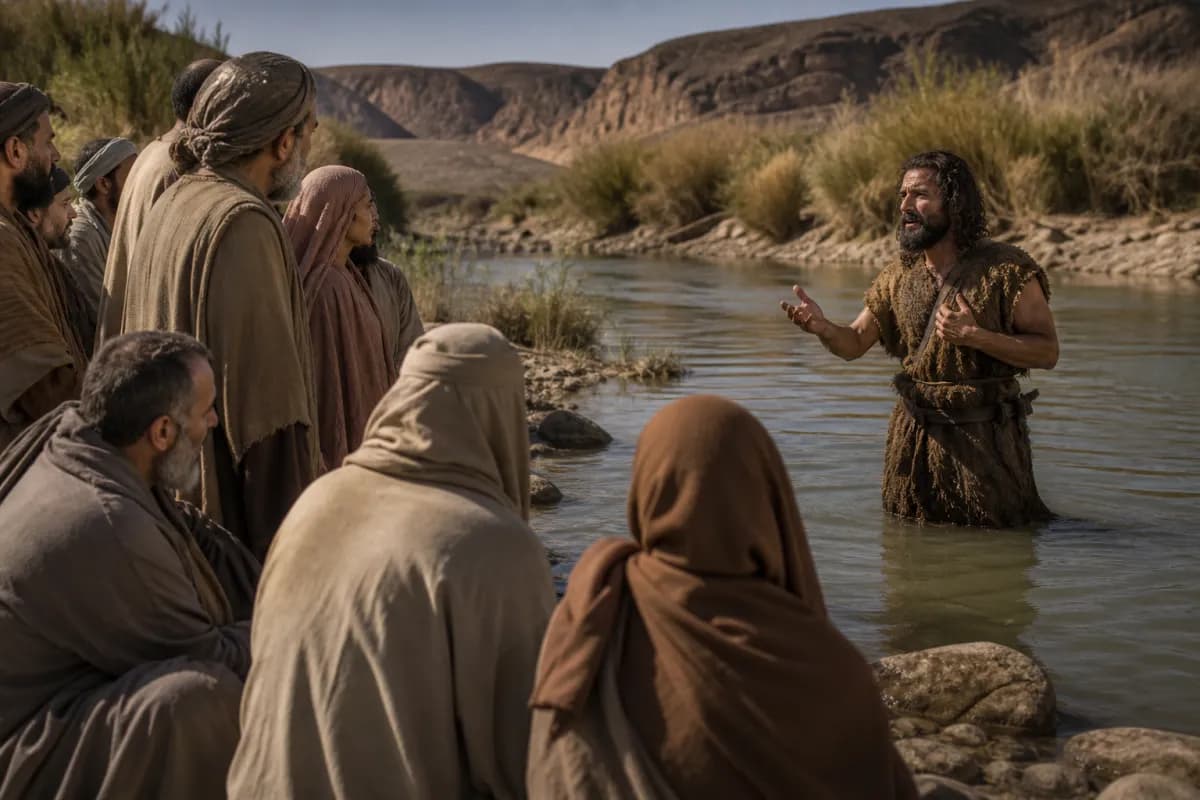
3:1In those days, John the Baptizer came, preaching in the wilderness of Judea, saying,
3:2“Repent, for the Kingdom of Heaven is at hand!”
3:3For this is he who was spoken of by Isaiah the prophet, saying, “The voice of one crying in the wilderness, make the way of the Lord ready! Make his paths straight!”
3:4Now John himself wore clothing made of camel’s hair with a leather belt around his waist. His food was locusts and wild honey.
3:5Then people from Jerusalem, all of Judea, and all the region around the Jordan went out to him.
3:6They were baptized by him in the Jordan, confessing their sins.
3:7But when he saw many of the Pharisees and Sadducees coming for his baptism, he said to them, “You offspring of vipers, who warned you to flee from the wrath to come?
3:8Therefore produce fruit worthy of repentance!
3:9Don’t think to yourselves, ‘We have Abraham for our father,’ for I tell you that God is able to raise up children to Abraham from these stones.
3:10Even now the ax lies at the root of the trees. Therefore every tree that doesn’t produce good fruit is cut down, and cast into the fire.
3:11“I indeed baptize you in water for repentance, but he who comes after me is mightier than I, whose sandals I am not worthy to carry. He will baptize you in the Holy Spirit.
3:12His winnowing fork is in his hand, and he will thoroughly cleanse his threshing floor. He will gather his wheat into the barn, but the chaff he will burn up with unquenchable fire.”
3:13Then Jesus came from Galilee to the Jordan to John, to be baptized by him.
3:14But John would have hindered him, saying, “I need to be baptized by you, and you come to me?”
3:15But Jesus, answering, said to him, “Allow it now, for this is the fitting way for us to fulfill all righteousness.” Then he allowed him.
3:16Jesus, when he was baptized, went up directly from the water: and behold, the heavens were opened to him. He saw the Spirit of God descending as a dove, and coming on him.
3:17Behold, a voice out of the heavens said, “This is my beloved Son, with whom I am well pleased.”
Matthew 4
4:1Then Jesus was led up by the Spirit into the wilderness to be tempted by the devil.
4:2When he had fasted forty days and forty nights, he was hungry afterward.
4:3The tempter came and said to him, “If you are the Son of God, command that these stones become bread.”
4:4But he answered, “It is written, ‘Man shall not live by bread alone, but by every word that proceeds out of God’s mouth.’”
4:5Then the devil took him into the holy city. He set him on the pinnacle of the temple,
4:6and said to him, “If you are the Son of God, throw yourself down, for it is written, ‘He will command his angels concerning you,’ and, ‘On their hands they will bear you up, so that you don’t dash your foot against a stone.’”
4:7Jesus said to him, “Again, it is written, ‘You shall not test the Lord, your God.’”
4:8Again, the devil took him to an exceedingly high mountain, and showed him all the kingdoms of the world and their glory.
4:9He said to him, “I will give you all of these things, if you will fall down and worship me.”
4:10Then Jesus said to him, “Get behind me, Satan! For it is written, ‘You shall worship the Lord your God, and you shall serve him only.’”
4:11Then the devil left him, and behold, angels came and served him.
4:12Now when Jesus heard that John was delivered up, he withdrew into Galilee.
4:13Leaving Nazareth, he came and lived in Capernaum, which is by the sea, in the region of Zebulun and Naphtali,
4:14that it might be fulfilled which was spoken through Isaiah the prophet, saying,
4:15“The land of Zebulun and the land of Naphtali, toward the sea, beyond the Jordan, Galilee of the Gentiles,
4:16the people who sat in darkness saw a great light; to those who sat in the region and shadow of death, to them light has dawned.”
4:17From that time, Jesus began to preach, and to say, “Repent! For the Kingdom of Heaven is at hand.”
4:18Walking by the sea of Galilee, he saw two brothers: Simon, who is called Peter, and Andrew, his brother, casting a net into the sea; for they were fishermen.
4:19He said to them, “Come after me, and I will make you fishers for men.”
4:20They immediately left their nets and followed him.
4:21Going on from there, he saw two other brothers, James the son of Zebedee, and John his brother, in the boat with Zebedee their father, mending their nets. He called them.
4:22They immediately left the boat and their father, and followed him.
4:23Jesus went about in all Galilee, teaching in their synagogues, preaching the Good News of the Kingdom, and healing every disease and every sickness among the people.
4:24The report about him went out into all Syria. They brought to him all who were sick, afflicted with various diseases and torments, possessed with demons, epileptics, and paralytics; and he healed them.
4:25Great multitudes from Galilee, Decapolis, Jerusalem, Judea, and from beyond the Jordan followed him.
CONTEXTUAL OVERVIEW
Matthew 3 opens in the wilderness with John the Baptist, not in Jerusalem’s temple courts. His message is direct: repent, because heaven’s kingdom has drawn near. The supplied word note on metanoeo rightly keeps repentance concrete: this is a turn from sin toward God, shown by fruit rather than inherited status. John’s warning to Pharisees and Sadducees prevents baptism from becoming a religious shield against the judgment it announces.
Jesus then enters the same water without sharing the crowd’s need for repentance. John initially resists, but Jesus speaks of fulfilling all righteousness. The heaven-opened scene identifies Him as the Son on whom the Spirit rests and the Father delights. Matthew does not present baptism as a magical display; it inaugurates the Son’s obedient public vocation and leads immediately into testing.
HISTORICAL AND LITERARY CONTEXT
John’s clothing and wilderness setting recall Elijah, while his call for fruit-bearing repentance addresses Israel’s covenant life. Matthew explicitly connects him with Isaiah’s voice preparing the Lord’s way. His baptism in the Jordan is therefore a public summons to readiness for God’s approaching reign, not a substitute for the deeper cleansing and Spirit-work John says the coming one will bring.
The chapters move from the Jordan to wilderness, then to Galilee. That sequence echoes Israel’s own journey without collapsing Jesus into Israel. Where Israel repeatedly failed in wilderness testing, Jesus answers the devil with Scripture and remains faithful to the Father. His relocation to Capernaum then fulfills Isaiah’s hope that light would rise in a region associated with darkness and Gentile proximity.
SECTION-BY-SECTION ANALYSIS
- Matthew 3:1–12 · Matthew 3:8John demands repentance that bears fruit because ancestry and outward ritual cannot replace a turned life before God.
- Matthew 3:13–17 · Matthew 3:16At Jesus’ baptism the Father names Him beloved Son and the Spirit descends, marking His righteous mission.
- Matthew 4:1–25 · Matthew 4:23Jesus defeats wilderness temptations by obedient trust, then calls disciples and displays the kingdom in preaching and healing.
CHRIST IN THIS PASSAGE
Jesus is explicitly God’s beloved Son and the Spirit-anointed King whose baptism and temptation reveal the character of His rule. He does not exploit sonship for comfort, spectacle, or domination. His obedience in the wilderness qualifies Him as the faithful Son Israel failed to be and anticipates the deeper obedience by which He gives Himself for sinners.
John says the coming one will baptize with the Holy Spirit and fire, while Jesus announces the kingdom and calls people into it. His healings display mercy toward damaged bodies, and His preaching confronts sin. Together they show His saving mission: He brings God’s reign near by defeating the devil’s false rule, calling for repentance, and forming a people who follow Him.
REFLECTION
Repentance in these chapters is not religious regret that leaves the same loyalties intact. Ask where you are relying on heritage, Christian language, public association, or a past decision while resisting the fruit John calls for. Jesus receives those who turn to Him, and His obedience supplies hope for people whose own testing has exposed compromise.
The devil’s questions still appeal to familiar hungers: use God for immediate relief, demand proof on your terms, or gain influence by giving ultimate loyalty elsewhere. Answer them as Jesus does, with trustful submission to the Father. Then hear His call to leave what prevents faithfulness and participate in His mission of gathering people to the King.
Original Greek Word Study
Matthew 3:2
μετανοέω
metanoeo · G3340
Usually translated: to repent or turn in mind and life
Metanoeo means to repent, a turn of mind and life toward God. John’s call prepares for the kingdom by demanding more than religious interest: people must turn from sin to welcome the coming King.
Follow the Scripture trail
The Beloved Son Brings the Kingdom Near in the larger story
The connection: Jesus enters the waters with the people He came to save, receives the Father’s declaration, and succeeds where Israel failed in the wilderness. As the beloved Son, He brings the kingdom through obedient dependence, confronts evil, and calls disciples into the saving reign of God.
Respond to the passage
Turn from one specific allegiance that keeps you from bearing the fruit of repentance. Trust the beloved Son who resisted temptation for you, and take one concrete step of obedience in the place where He is calling you to follow.
- Why does John refuse to treat Abrahamic ancestry as sufficient before God?
- What does each wilderness temptation ask Jesus to do with His identity as Son?
- How do Jesus’ preaching, healing, and calling of disciples belong together in Matthew 4?
Prayer
Father, turn me from empty religious confidence and make repentance visible in my life. Lord Jesus, faithful Son, strengthen me to resist temptation through Your word and to follow You in Your mission. Amen.