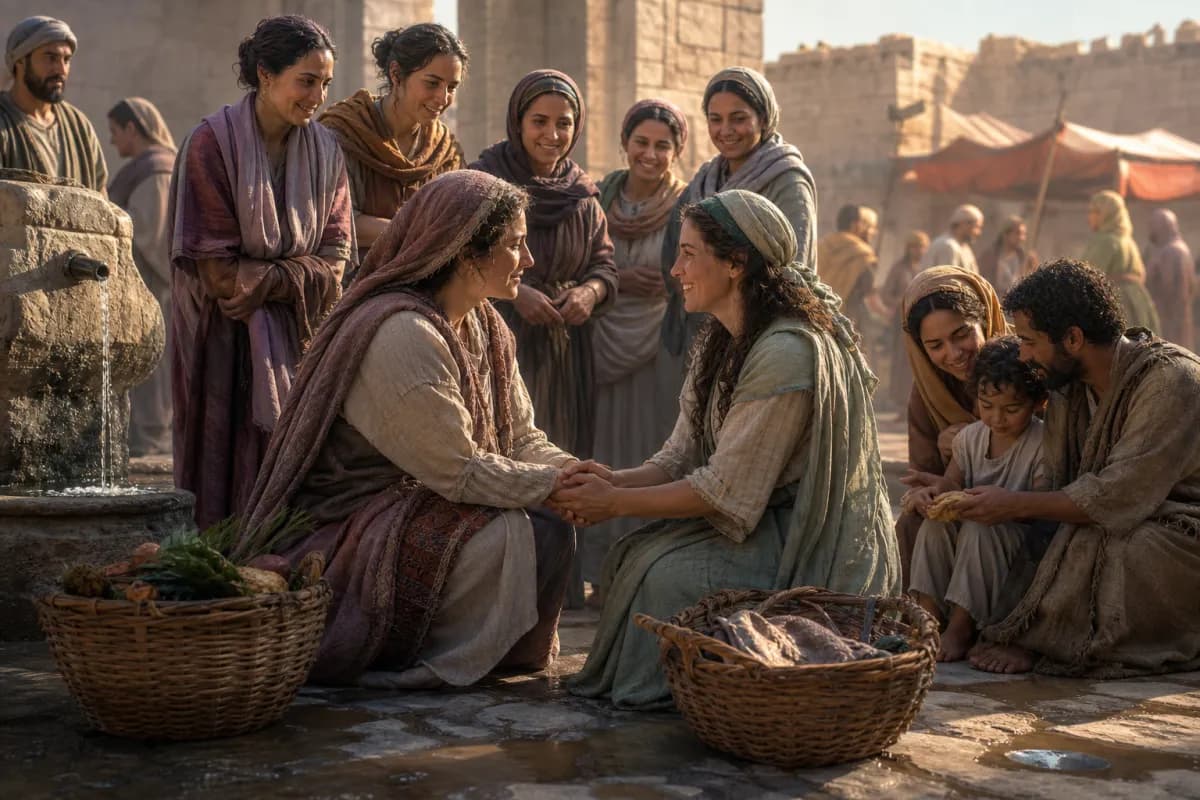
Passage Study
Steadfast Joy, Guarded Hearts, and Contentment in Christ
Philippians 4:1–4:23
Philippians 4:1–4:23 brings Paul’s letter to its practical climax: two coworkers must be reconciled, the church must rejoice and pray instead of yielding to anxiety, and its thinking and practices must be shaped by what is true and honorable. Paul testifies that he has learned contentment in need and abundance through Christ’s strength, then thanks the Philippians for their long-running financial partnership in the gospel.
- In this study
- 23 verses · 5 movements
Philippians 4
4:1Therefore, my brothers, beloved and longed for, my joy and crown, stand firm in the Lord in this way, my beloved.
4:2I exhort Euodia, and I exhort Syntyche, to think the same way in the Lord.
4:3Yes, I beg you also, true partner, help these women, for they labored with me in the Good News with Clement also, and the rest of my fellow workers, whose names are in the book of life.
4:4Rejoice in the Lord always! Again I will say, “Rejoice!”
4:5Let your gentleness be known to all men. The Lord is at hand.
4:6In nothing be anxious, but in everything, by prayer and petition with thanksgiving, let your requests be made known to God.
4:7And the peace of God, which surpasses all understanding, will guard your hearts and your thoughts in Christ Jesus.
4:8Finally, brothers, whatever things are true, whatever things are honorable, whatever things are just, whatever things are pure, whatever things are lovely, whatever things are of good report: if there is any virtue and if there is anything worthy of praise, think about these things.
4:9Do the things which you learned, received, heard, and saw in me, and the God of peace will be with you.
4:10But I rejoice in the Lord greatly that now at length you have revived your thought for me; in which you did indeed take thought, but you lacked opportunity.
4:11Not that I speak because of lack, for I have learned in whatever state I am, to be content in it.
4:12I know how to be humbled, and I also know how to abound. In any and all circumstances I have learned the secret both to be filled and to be hungry, both to abound and to be in need.
4:13I can do all things through Christ who strengthens me.
4:14However you did well that you shared in my affliction.
4:15You yourselves also know, you Philippians, that in the beginning of the Good News, when I departed from Macedonia, no assembly shared with me in the matter of giving and receiving but you only.
4:16For even in Thessalonica you sent once and again to my need.
4:17Not that I seek for the gift, but I seek for the fruit that increases to your account.
4:18But I have all things and abound. I am filled, having received from Epaphroditus the things that came from you, a sweet-smelling fragrance, an acceptable and well-pleasing sacrifice to God.
4:19My God will supply every need of yours according to his riches in glory in Christ Jesus.
4:20Now to our God and Father be the glory forever and ever! Amen.
4:21Greet every saint in Christ Jesus. The brothers who are with me greet you.
4:22All the saints greet you, especially those who are of Caesar’s household.
4:23The grace of the Lord Jesus Christ be with you all. Amen.
CONTEXTUAL OVERVIEW
Paul’s final exhortations begin with named people. Euodia and Syntyche have labored with him in the gospel alongside Clement and other coworkers, yet they need help to agree in the Lord. Their disagreement matters because the whole church has been told to stand firm in one spirit and adopt Christ’s mind. Paul therefore asks a trusted companion to help them rather than treating conflict as a private inconvenience or erasing their prior service.
The chapter then moves from relational strain to anxiety, thought, material need, and generosity. Its commands are neither detached slogans nor promises of effortless calm. Paul writes from imprisonment to people who know conflict and pressure. The peace of God guards hearts and minds as believers make requests known to God with thanksgiving, and contentment is learned in hunger and plenty through the strength Christ supplies.
HISTORICAL AND LITERARY CONTEXT
The final thanks recalls the Philippians’ material support from the beginning of their relationship. They shared with Paul in giving and receiving when he left Macedonia, and they sent help more than once when he was in Thessalonica. Paul does not write as a fundraiser. He says he seeks the fruit that increases to their account and receives their gift as a fragrant offering acceptable to God. Their generosity is gospel fellowship with spiritual consequence.
Paul’s “the Lord is near” can naturally carry both the Lord’s present nearness and the expectation of His return; the brief phrase does not require choosing one against the other. In either case it explains the command for gentleness and prayer. The command to think about what is true, honorable, just, pure, pleasing, commendable, excellent, and worthy of praise is followed by a command to practice what the Philippians received and observed in Paul. Christian thought is meant to become embodied conduct under the God of peace.
Did you know?
Paul’s thank-you includes the language of a business receipt: in Philippians 4:18, his acknowledgment of their gift uses a term used for payment received in full.
Why it matters: Paul moves from the marketplace to worship in the same verse, calling their gift a fragrant offering to God. Practical generosity can be an act of worship.
SECTION-BY-SECTION ANALYSIS
- Philippians 4:1–9 · Philippians 4:15Reconciliation, joy, gentleness, prayer, disciplined thought, and practiced obedience belong together in a church standing firm in the Lord.
- Philippians 4:10–13 · Philippians 4:13Paul’s contentment is learned in actual hunger and abundance through Christ’s strength for faithful endurance.
- Philippians 4:14–23 · Philippians 4:17The Philippians’ practical gift shares Paul’s distress, becomes worship to God, and supplies fruit in their gospel partnership.
CHRIST IN THIS PASSAGE
Every promise and command in this conclusion is located in the Lord Jesus. Euodia and Syntyche are to agree in the Lord; their hearts and minds are guarded in Christ Jesus; Paul’s strength comes through Christ; and God supplies needs according to His riches in glory in Christ Jesus. The Savior’s mission has created a people whose reconciliation, prayer, and sharing are not self-help techniques but responses to belonging to Him.
Paul’s contentment is inseparable from the risen Christ who strengthens him in prison, hunger, and abundance. The chapter’s final mention of Caesar’s household also extends the first chapter’s witness: the Lord’s gospel is reaching places that chains appeared to close off. Christ’s saving reign turns a suffering apostle’s needs and a congregation’s gift into occasions for worship, endurance, and mission.
REFLECTION
Bring a named anxiety to God as Paul directs: make the request specific, give thanks for God’s mercies already received, and refuse to rehearse the fear as though it were the only truth. If a conflict with another Christian is feeding that anxiety, seek help to agree in the Lord rather than letting resentment harden under spiritual language.
Paul’s learned contentment tests both scarcity and comfort. In your present condition, ask what faithfulness requires rather than asking Christ to guarantee a preferred outcome. Receive His strength for the actual hunger, abundance, limitation, or opportunity before you, and share a concrete resource with gospel work as the Philippians did.
Original Greek Word Study
Philippians 4:11
αὐτάρκης
autarkes · G842
Usually translated: content, sufficient, or self-sufficient
Autarkes means content or sufficient. Paul’s contentment is not independence from God; it is learned confidence that Christ strengthens him in abundance and need alike.
Follow the Scripture trail
Steadfast Joy, Guarded Hearts, and Contentment in Christ in the larger story
The connection: The risen Lord who gave Himself for His people continues to strengthen them in real need and gather witnesses even in Caesar’s household. His gospel creates a reconciled community whose prayer, peace, contentment, and generous partnership testify that their security is found in Christ rather than in circumstances.
Respond to the passage
Write down one anxious request and bring it to God with thanksgiving today. If it is connected to a strained relationship, pursue reconciliation in the Lord; if it is connected to material concern, ask Christ for contentment and give one concrete gift that joins His gospel work.
- Why does Paul place Euodia and Syntyche’s disagreement beside his call to stand firm in the Lord?
- How does the setting of Philippians 4:10–13 correct common uses of “I can do all things”?
- What does Paul’s description of the Philippians’ gift show about gospel partnership and worship?
Prayer
Lord Jesus, guard my heart and mind as I bring my needs to You. Teach me Your peace in conflict, Your strength in lack and abundance, and Your generosity in sharing what You have given. Make my life a thankful offering for Your gospel. Amen.