Passage Study
The Fear of the Lord against the Enticement of Sinners
Proverbs 1:1–1:33
Proverbs 1 opens Solomon’s collection by naming its purpose: to form people who can receive wisdom, righteousness, justice, and sound judgment. Its first command is to fear the Lord, and its first warning concerns companions who invite a son into violent gain. Wisdom then cries in the public streets. The chapter directs readers to Jesus, in whom God gives wisdom and who calls sinners away from the path of death into life with Him.
- In this study
- 33 verses · 5 movements
Proverbs 1
1:1The proverbs of Solomon, the son of David, king of Israel:
1:2to know wisdom and instruction; to discern the words of understanding;
1:3to receive instruction in wise dealing, in righteousness, justice, and equity;
1:4to give prudence to the simple, knowledge and discretion to the young man—
1:5that the wise man may hear, and increase in learning; that the man of understanding may attain to sound counsel;
1:6to understand a proverb and parables, the words and riddles of the wise.
1:7The fear of the LORD is the beginning of knowledge, but the foolish despise wisdom and instruction.
1:8My son, listen to your father’s instruction, and don’t forsake your mother’s teaching;
1:9for they will be a garland to grace your head, and chains around your neck.
1:10My son, if sinners entice you, don’t consent.
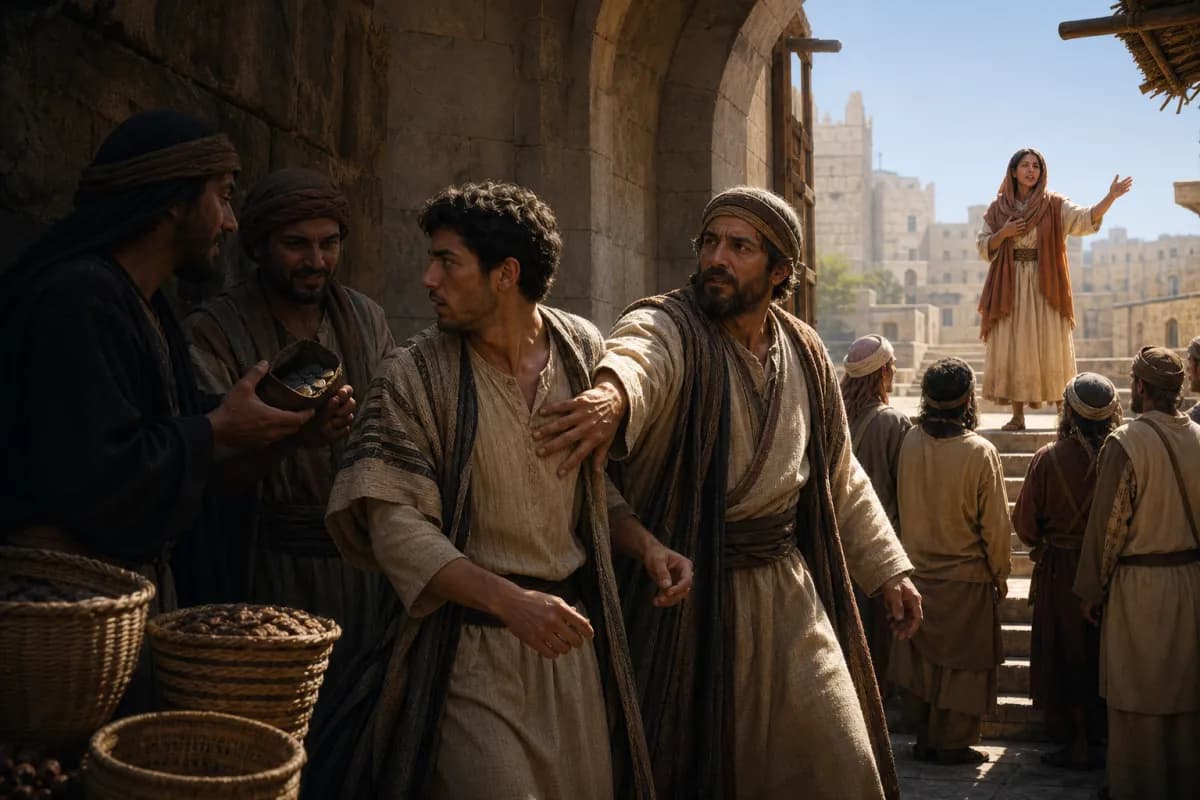
1:11If they say, “Come with us. Let’s lie in wait for blood. Let’s lurk secretly for the innocent without cause.
1:12Let’s swallow them up alive like Sheol, and whole, like those who go down into the pit.
1:13We’ll find all valuable wealth. We’ll fill our houses with plunder.
1:14You shall cast your lot among us. We’ll all have one purse”—
1:15my son, don’t walk on the path with them. Keep your foot from their path,
1:16for their feet run to evil. They hurry to shed blood.
1:17For the net is spread in vain in the sight of any bird;
1:18but these lay in wait for their own blood. They lurk secretly for their own lives.
1:19So are the ways of everyone who is greedy for gain. It takes away the life of its owners.
1:20Wisdom calls aloud in the street. She utters her voice in the public squares.
1:21She calls at the head of noisy places. At the entrance of the city gates, she utters her words:
1:22“How long, you simple ones, will you love simplicity? How long will mockers delight themselves in mockery, and fools hate knowledge?
1:23Turn at my reproof. Behold, I will pour out my spirit on you. I will make known my words to you.
1:24Because I have called, and you have refused; I have stretched out my hand, and no one has paid attention;
1:25but you have ignored all my counsel, and wanted none of my reproof;
1:26I also will laugh at your disaster. I will mock when calamity overtakes you,
1:27when calamity overtakes you like a storm, when your disaster comes on like a whirlwind, when distress and anguish come on you.
1:28Then they will call on me, but I will not answer. They will seek me diligently, but they will not find me,
1:29because they hated knowledge, and didn’t choose the fear of the LORD.
1:30They wanted none of my counsel. They despised all my reproof.
1:31Therefore they will eat of the fruit of their own way, and be filled with their own schemes.
1:32For the backsliding of the simple will kill them. The careless ease of fools will destroy them.
1:33But whoever listens to me will dwell securely, and will be at ease, without fear of harm.”
CONTEXTUAL OVERVIEW
The opening verses do not offer clever tricks for getting ahead. They describe wisdom as moral formation: learning prudence, righteousness, justice, and equity. The first governing claim is that “the fear of the Lord is the beginning of knowledge.” The supplied word note on yirah helps here: this fear is reverent awe before the Lord, not mere panic. Fools reject the instruction that could give them life because they reject the God who gives it.
The chapter immediately tests that fear in a concrete setting. A father warns his son not to join men who promise quick profit through ambushing the innocent. Their invitation sounds communal—“come with us”—but their shared purse is built on blood. Proverbs 1 therefore treats companions, money, and violence as spiritual matters: the road a person chooses reveals whom he fears.
HISTORICAL AND LITERARY CONTEXT
Proverbs 1 begins a collection associated with Solomon and is shaped as parental instruction to a son. The father and mother are not competing sources of authority; their teaching is presented together as a graceful garland and necklace. The chapter uses short exhortation and then personifies wisdom as a woman crying at gates, crossroads, and busy streets. “Wisdom” is a literary voice, not a claim that a visible woman is standing in every city square.
The public setting matters. The violent group plots secretly, but wisdom speaks where ordinary people gather and where decisions become visible. The chapter does not say every calamity proves a particular hidden sin. It does say that a settled refusal of correction has consequences, because those who love destructive paths eventually meet the fruit of those paths.
SECTION-BY-SECTION ANALYSIS
- Verses 1–7 · Proverbs 1:7The fear of the Lord is the beginning, not an optional religious addition, to knowledge that forms justice and discretion.
- Verses 10–19 · Proverbs 1:14The gang’s promise of one purse exposes how greed can make violence sound like friendship.
- Verses 20–33 · Proverbs 1:20Wisdom’s public cry makes refusal responsible; the listener is called to turn at her reproof rather than blame wisdom for speaking too plainly.
CHRIST IN THIS PASSAGE
Proverbs 1 does not identify Wisdom’s street cry as a direct appearance of Jesus. Its strong canonical connection is thematic: Christ is called the wisdom of God, and He calls people out of darkness, greed, and destruction. Jesus does not merely supply better advice; through His cross and resurrection He rescues those whose sinful desires have led them into death and forms a people who learn His way.
The chapter’s warning about violent gain also exposes a need that instruction alone cannot cure. Christ forgives the guilty, breaks the power of sin, and teaches His disciples a different fellowship—one marked by love of neighbor rather than taking life or property from the weak. His saving mission makes reverent fear of God the beginning of a restored life, not a strategy for self-protection.
REFLECTION
Proverbs 1 asks whose invitation is shaping your steps. A friendship, online group, business opportunity, or private habit can promise belonging while training the heart to ignore who gets hurt. Bring that influence into the light before Jesus. Reverence for the Lord may require refusing a profitable path when it depends on deceit, exploitation, or contempt for another person.
This chapter also gives the church a pattern for correction. Wisdom speaks openly and specifically; she does not flatter folly. Receive a trusted warning as mercy, and offer warnings with the aim of restoring life. Jesus welcomes people who turn to Him, even after they have walked the road Proverbs 1 exposes.
Original Hebrew Word Study
Proverbs 1:7
יִרְאָה
yirah · H3374
Usually translated: fear, reverence, or awe
Yirah means reverent awe. Wisdom begins by seeing the Lord rightly, while fools reject the instruction that could give them life.
Follow the Scripture trail
The Fear of the Lord against the Enticement of Sinners in the larger story
The connection: Proverbs 1 begins with reverent fear of the Lord and exposes the death-dealing fellowship of greed and violence. Jesus, the wisdom of God, saves sinners from that path through His death and resurrection and gathers them into a community shaped by love and truth.
Respond to the passage
Name one invitation or influence that makes disobedience sound normal. Bring it before Jesus, refuse its next concrete step if it harms another person, and ask a mature Christian to help you walk in the fear of the Lord.
- What does Proverbs 1 mean by the fear of the Lord, and why does it call that the beginning of knowledge?
- How does the invitation of the violent group make evil sound attractive?
- Where do you need Christ’s wisdom to choose a life-giving path rather than a profitable but destructive one?
Prayer
Lord Jesus, You are the wisdom of God. Turn my heart from every invitation that feeds on another person’s harm, teach me to receive correction, and make me faithful in the fear of the Lord. Amen.