Passage Study
Honest Scales and Open Hands Before the Lord
Proverbs 11:1–11:31
Proverbs 11 contrasts the upright and the wicked in commerce, speech, community, generosity, and death. The chapter begins with dishonest scales and ends with the righteous finding life, showing that integrity before God is never merely private. Jesus gives sinners a righteousness they do not possess and makes His people free to deal honestly and give generously.
- In this study
- 31 verses · 5 movements
Proverbs 11
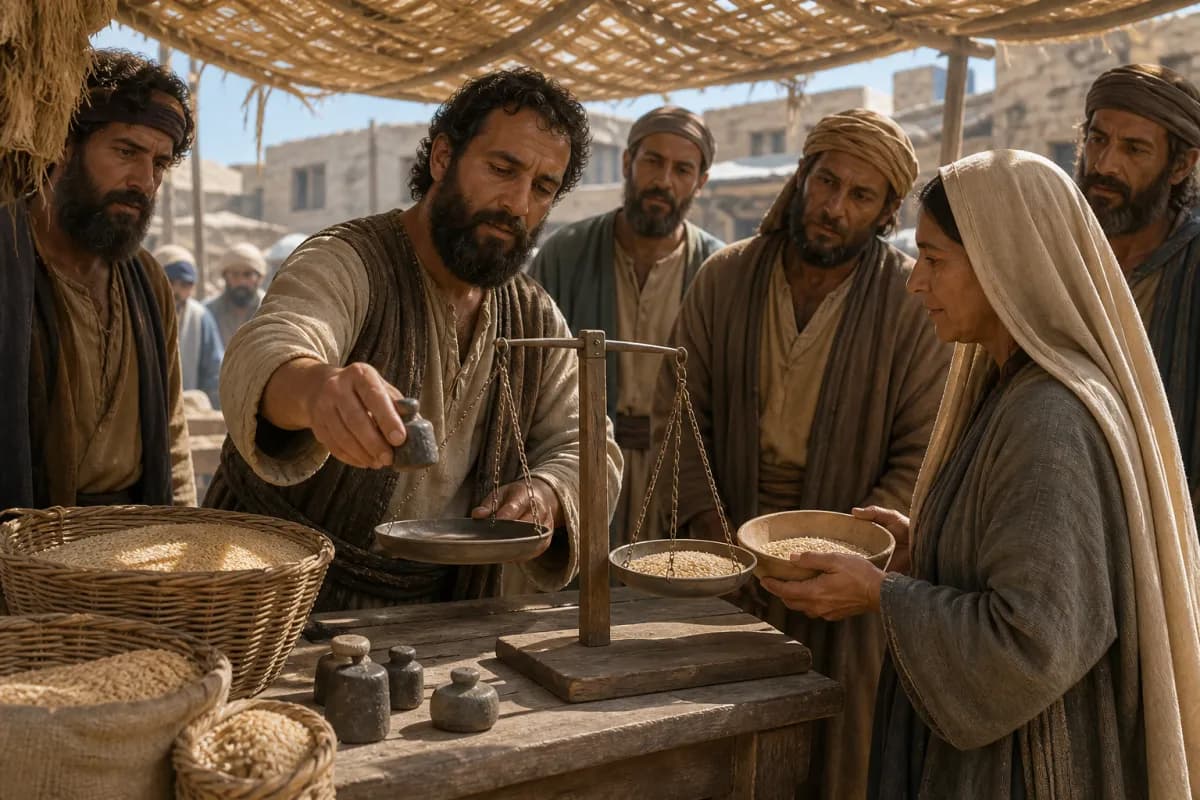
11:1A false balance is an abomination to the LORD, but accurate weights are his delight.
11:2When pride comes, then comes shame, but with humility comes wisdom.
11:3The integrity of the upright shall guide them, but the perverseness of the treacherous shall destroy them.
11:4Riches don’t profit in the day of wrath, but righteousness delivers from death.
11:5The righteousness of the blameless will direct his way, but the wicked shall fall by his own wickedness.
11:6The righteousness of the upright shall deliver them, but the unfaithful will be trapped by evil desires.
11:7When a wicked man dies, hope perishes, and expectation of power comes to nothing.
11:8A righteous person is delivered out of trouble, and the wicked takes his place.
11:9With his mouth the godless man destroys his neighbor, but the righteous will be delivered through knowledge.
11:10When it goes well with the righteous, the city rejoices. When the wicked perish, there is shouting.
11:11By the blessing of the upright, the city is exalted, but it is overthrown by the mouth of the wicked.
11:12One who despises his neighbor is void of wisdom, but a man of understanding holds his peace.
11:13One who brings gossip betrays a confidence, but one who is of a trustworthy spirit is one who keeps a secret.
11:14Where there is no wise guidance, the nation falls, but in the multitude of counselors there is victory.
11:15He who is collateral for a stranger will suffer for it, but he who refuses pledges of collateral is secure.
11:16A gracious woman obtains honor, but violent men obtain riches.
11:17The merciful man does good to his own soul, but he who is cruel troubles his own flesh.
11:18Wicked people earn deceitful wages, but one who sows righteousness reaps a sure reward.
11:19He who is truly righteous gets life. He who pursues evil gets death.
11:20Those who are perverse in heart are an abomination to the LORD, but those whose ways are blameless are his delight.
11:21Most certainly, the evil man will not be unpunished, but the offspring of the righteous will be delivered.
11:22Like a gold ring in a pig’s snout, is a beautiful woman who lacks discretion.
11:23The desire of the righteous is only good. The expectation of the wicked is wrath.
11:24There is one who scatters, and increases yet more. There is one who withholds more than is appropriate, but gains poverty.
11:25The liberal soul shall be made fat. He who waters shall be watered also himself.
11:26People curse someone who withholds grain, but blessing will be on the head of him who sells it.
11:27He who diligently seeks good seeks favor, but he who searches after evil, it shall come to him.
11:28He who trusts in his riches will fall, but the righteous shall flourish as the green leaf.
11:29He who troubles his own house shall inherit the wind. The foolish shall be servant to the wise of heart.
11:30The fruit of the righteous is a tree of life. He who is wise wins souls.
11:31Behold, the righteous shall be repaid in the earth, how much more the wicked and the sinner!
CONTEXTUAL OVERVIEW
Proverbs 11 is a collection of short contrasts, but its concerns repeatedly meet at the public life of a neighbor. A false balance in verse 1, a talebearer in verse 13, a generous person in verses 24–26, and a person who troubles a household in verse 29 all show that wisdom becomes visible in how people handle goods, confidences, and influence.
The chapter refuses to separate worship from ordinary transactions. The Lord delights in a just weight, while pride, crooked speech, confidence in riches, and withholding grain each damage the life God intends for His creatures. The righteous are not described as self-made winners; their path is marked by integrity, mercy, and dependence on the Lord.
HISTORICAL AND LITERARY CONTEXT
Proverbs 10–22:16 consists largely of two-line sayings associated with Solomon. Proverbs 11 does not narrate a single event, so its arrangement should not be treated as a chronological argument. Its recurring words—righteous, wicked, wealth, life, city, and neighbor—nevertheless give the sayings a coherent moral horizon.
Weights and measures mattered in ancient market exchange because a merchant could quietly profit by using a deceptive stone on the scale. The opening proverb therefore addresses a real economic temptation rather than an abstract symbol. Its concern expands through the chapter: the person who is faithful with a measure must also be faithful with a confidence, a harvest, and the power to bless or burden a community.
SECTION-BY-SECTION ANALYSIS
- Verses 1–11 · Proverbs 11:2Just measures and humble integrity serve a city, while deceit and pride finally undo their practitioners.
- Verses 12–23 · Proverbs 11:8Speech, confidential trust, and mercy reveal whether someone treats a neighbor as a person to honor or use.
- Verses 24–31 · Proverbs 11:19Generosity and trust in God lead toward life; hoarding and trust in wealth cannot survive God’s judgment.
CHRIST IN THIS PASSAGE
Proverbs 11 is not a direct prophecy of Jesus. Its strongest connection is ethical and saving: the chapter exposes the false measures, proud self-reliance, and loveless withholding that disqualify every sinner from claiming righteousness before God. Jesus alone lives with complete truthfulness and mercy, then bears judgment for the dishonest and greedy who come to Him in faith.
The chapter’s life-giving generosity also finds a clear gospel echo in Christ’s self-giving love. His grace does not endorse injustice or make wealth ultimate; it reconciles people to God and begins to remake their dealings with neighbors. Those who have received mercy can open their hands, tell the truth, and use material goods as servants rather than saviors.
REFLECTION
Let the false balance ask a concrete question: where might you gain by making the terms unclear, hiding a cost, exaggerating a result, or withholding what another person reasonably needs? Bring that practice into the light before Jesus. Faithful repentance may require a corrected invoice, a candid conversation, or a private confidence kept rather than repeated.
Then notice the chapter’s repeated attention to blessing a city and feeding others. Ask Christ to free you from fear-driven hoarding so that your money, words, and influence make room for your neighbor’s good. Generosity is not a way to secure salvation; it is a fitting response to the Savior who has been generous with us.
Original Hebrew Word Study
Proverbs 11:4
צְדָקָה
tsedaqah · H6666
Usually translated: righteousness or justice
Tsedaqah is righteous conduct. Wealth cannot rescue in the day of judgment, but righteousness leads away from death.
Follow the Scripture trail
Honest Scales and Open Hands Before the Lord in the larger story
The connection: Proverbs 11 places commerce, speech, wealth, and mercy beneath God’s judgment. Jesus bears the judgment deserved by dishonest and self-serving sinners and, through His grace, forms a people whose integrity and generosity point toward His kingdom.
Respond to the passage
Name one financial, relational, or conversational situation where you are tempted to use a false measure. Confess it to Christ, make the needed repair, and take one deliberate step this week to use what you have for a neighbor’s good.
- Why does Proverbs 11 begin its teaching about righteousness with a marketplace scale?
- How do the sayings connect private integrity with the health of a city?
- What makes generosity different from an attempt to purchase God’s favor?
Prayer
Lord Jesus, forgive my hidden dishonesty and fearful self-protection. Give me truthful words, just dealings, and open hands, because Your mercy has welcomed me. Amen.