Passage Study
Agur’s Humility Before God’s Word and the Creator’s Order
Proverbs 30:1–30:33
Proverbs 30 records Agur’s confession of creaturely limits, his confidence in God’s tested word, and his prayers for integrity and daily bread. Its numbered sayings observe small creatures, human arrogance, and created patterns that expose false self-sufficiency. Jesus reveals the Father perfectly, feeds His people with grace, and teaches them humble dependence on God rather than wealth, lies, or self-exaltation.
- In this study
- 33 verses · 5 movements
Proverbs 30
30:1The words of Agur the son of Jakeh, the revelation: the man says to Ithiel, to Ithiel and Ucal:
30:2“Surely I am the most ignorant man, and don’t have a man’s understanding.
30:3I have not learned wisdom, neither do I have the knowledge of the Holy One.
30:4Who has ascended up into heaven, and descended? Who has gathered the wind in his fists? Who has bound the waters in his garment? Who has established all the ends of the earth? What is his name, and what is his son’s name, if you know?
30:5“Every word of God is flawless. He is a shield to those who take refuge in him.
30:6Don’t you add to his words, lest he reprove you, and you be found a liar.
30:7“Two things I have asked of you. Don’t deny me before I die.
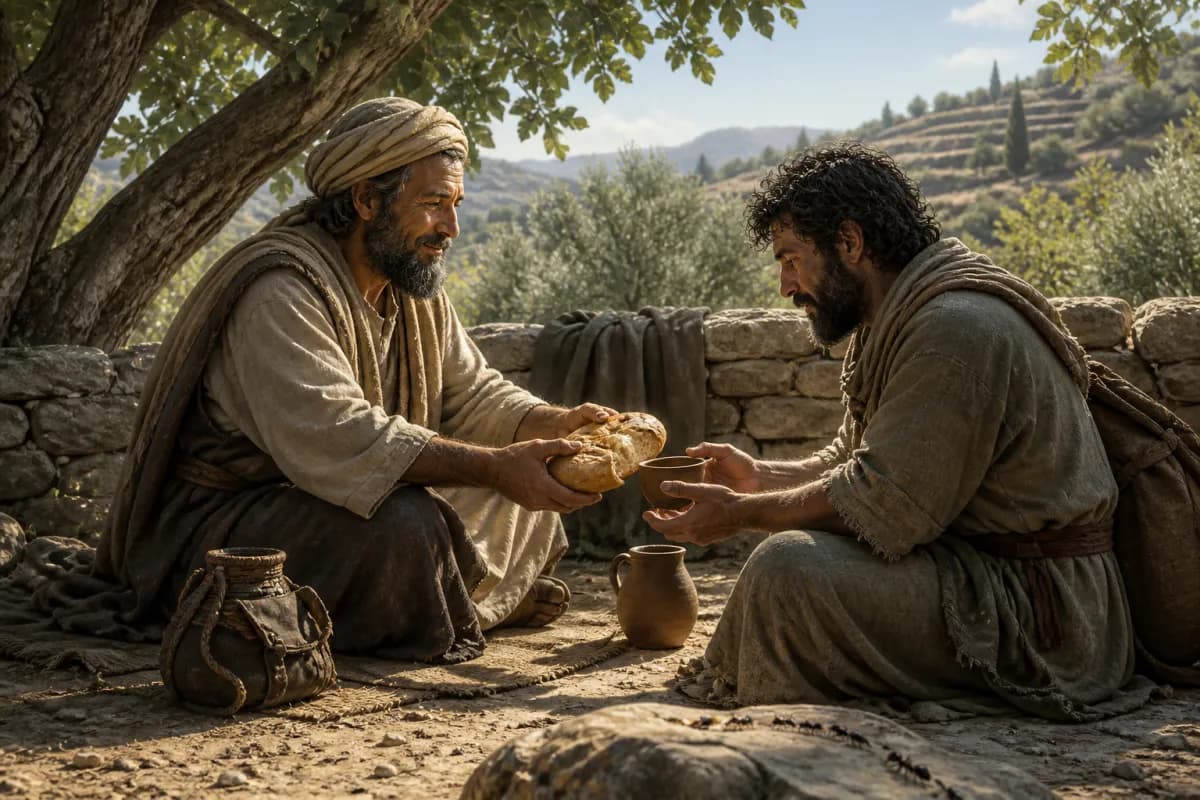
30:8Remove far from me falsehood and lies. Give me neither poverty nor riches. Feed me with the food that is needful for me,
30:9lest I be full, deny you, and say, ‘Who is the LORD?’ or lest I be poor, and steal, and so dishonor the name of my God.
30:10“Don’t slander a servant to his master, lest he curse you, and you be held guilty.
30:11There is a generation that curses their father, and doesn’t bless their mother.
30:12There is a generation that is pure in their own eyes, yet are not washed from their filthiness.
30:13There is a generation, oh how lofty are their eyes! Their eyelids are lifted up.
30:14There is a generation whose teeth are like swords, and their jaws like knives, to devour the poor from the earth, and the needy from among men.
30:15“The leech has two daughters: ‘Give, give.’ “There are three things that are never satisfied; four that don’t say, ‘Enough!’:
30:16Sheol, the barren womb, the earth that is not satisfied with water, and the fire that doesn’t say, ‘Enough!’
30:17“The eye that mocks at his father, and scorns obedience to his mother, the ravens of the valley shall pick it out, the young eagles shall eat it.
30:18“There are three things which are too amazing for me, four which I don’t understand:
30:19The way of an eagle in the air, the way of a serpent on a rock, the way of a ship in the middle of the sea, and the way of a man with a maiden.
30:20“So is the way of an adulterous woman: She eats and wipes her mouth, and says, ‘I have done nothing wrong.’
30:21“For three things the earth trembles, and under four, it can’t bear up:
30:22For a servant when he is king, a fool when he is filled with food,
30:23for an unloved woman when she is married, and a servant who is heir to her mistress.
30:24“There are four things which are little on the earth, but they are exceedingly wise:
30:25The ants are not a strong people, yet they provide their food in the summer.
30:26The hyraxes are but a feeble folk, yet make they their houses in the rocks.
30:27The locusts have no king, yet they advance in ranks.
30:28You can catch a lizard with your hands, yet it is in kings’ palaces.
30:29“There are three things which are stately in their march, four which are stately in going:
30:30The lion, which is mightiest among animals, and doesn’t turn away for any;
30:31the greyhound; the male goat; and the king against whom there is no rising up.
30:32“If you have done foolishly in lifting up yourself, or if you have thought evil, put your hand over your mouth.
30:33For as the churning of milk produces butter, and the wringing of the nose produces blood, so the forcing of wrath produces strife.”
CONTEXTUAL OVERVIEW
Proverbs 30 begins unlike the surrounding royal and parental sayings. Agur speaks as someone overwhelmed by the knowledge of God: he does not claim mastery, asks who has ascended and gathered the wind, and confesses that every word of God proves true. The response to this humility is neither despair nor speculation. It is refuge in God’s word and a prayer for a truthful, sufficient life.
The chapter’s observations are concrete: ants prepare food, rock badgers find refuge, locusts move in ranks, and a lizard reaches kings’ palaces. Agur does not turn animals into secret symbols. He asks the reader to see that small, dependent creatures can act wisely within God’s order while proud human beings imagine themselves self-made and pure.
HISTORICAL AND LITERARY CONTEXT
Proverbs 30 is attributed in its heading to Agur son of Jakeh. The identities and setting of Agur and the addressees Ithiel and Ucal are uncertain, so the text does not permit a detailed reconstruction. What is clear is the literary shift: a first-person confession leads into numerical sayings—“three things ... four”—that train attentive observation and memorable moral judgment.
Verse 8 asks neither for poverty nor riches, but for the food needed. In an agrarian world, both extremes could bring pressure toward sin: poverty might tempt theft and profaning God’s name, while wealth might entice denial of dependence. The prayer is not a promise of material comfort; it is a request for integrity under God’s provision.
SECTION-BY-SECTION ANALYSIS
- Verses 1–6 · Proverbs 30:5Human limits before the Creator lead Agur to trust God’s tested word and refuse to add to it.
- Verses 7–14 · Proverbs 30:8A prayer for daily provision exposes lies, greed, proud self-cleansing, and the exploitation of the poor.
- Verses 15–33 · Proverbs 30:3Created patterns reveal both insatiable desire and humble wisdom, ending with a warning against deliberately producing anger.
CHRIST IN THIS PASSAGE
Proverbs 30 does not directly predict Jesus, but Agur’s questions about the One who has ascended and gathered the wind prepare the reader to receive God’s self-revelation with humility. The New Testament explicitly identifies Jesus as the One who has come from heaven and makes the Father known. This is a canonical fulfillment, not a claim that Agur understood every detail of the incarnation.
Agur’s prayer for neither falsehood nor excess also finds a clear gospel horizon in Jesus. He teaches disciples to ask the Father for daily bread, exposes the deceitfulness of riches, and gives Himself as the true bread who meets the deeper hunger of sinners. His saving mission creates people who can receive provision gratefully without making it their god.
REFLECTION
Pray Agur’s two requests with concrete honesty. Name the lie you are tempted to tell or believe, and name the kind of wealth or lack that most tempts you to forget God. Ask Jesus for enough faithfulness for today rather than control over every future outcome.
Notice one way you are “pressing anger” in a relationship: rehearsing an insult, sending a sharp message, or drawing others into resentment. Take refuge in God’s tested word, stop supplying the pressure, and seek peace through a truthful conversation when it is possible.
Original Hebrew Word Study
Proverbs 30:5
אִמְרָה
imrah · H565
Usually translated: saying, word, or promise
Imrah means a tested saying or word. Every word of God proves true, making Him a shield for those who take refuge in Him.
Follow the Scripture trail
Agur’s Humility Before God’s Word and the Creator’s Order in the larger story
The connection: Agur’s wisdom begins by lowering human pride before the Creator and trusting His tested word. Jesus comes from the Father to reveal Him, gives His life for needy sinners, and teaches them to seek daily provision and truthful dependence in God’s kingdom.
Respond to the passage
Pray for freedom from one specific falsehood and for grateful sufficiency in one area of financial anxiety or desire. Receive today’s provision from Jesus, then refuse one action that would gain security through deception or exploitation.
- What does Agur’s confession teach about the limits of human wisdom?
- Why does he ask for neither poverty nor riches?
- How do the small creatures correct proud self-sufficiency?
Prayer
Lord Jesus, You reveal the Father and meet the hunger of sinners. Remove falsehood from me, give me grateful contentment, and teach me to trust Your word and daily care. Amen.