Passage Study
A King’s Justice and a Household of Fearful Strength
Proverbs 31:1–31:31
Proverbs 31 joins the counsel given to King Lemuel with a portrait of a capable wife whose strength, generosity, work, and fear of the Lord bless her household and community. The chapter warns rulers against appetites that pervert judgment and honors the woman whose wisdom becomes visible in faithful action. Jesus is the righteous King who defends the vulnerable and gathers a people whose service reflects His self-giving love.
- In this study
- 31 verses · 5 movements
Proverbs 31
31:1The words of King Lemuel—the revelation which his mother taught him:
31:2“Oh, my son! Oh, son of my womb! Oh, son of my vows!
31:3Don’t give your strength to women, nor your ways to that which destroys kings.
31:4It is not for kings, Lemuel, it is not for kings to drink wine, nor for princes to say, ‘Where is strong drink?’
31:5lest they drink, and forget the law, and pervert the justice due to anyone who is afflicted.
31:6Give strong drink to him who is ready to perish, and wine to the bitter in soul.
31:7Let him drink, and forget his poverty, and remember his misery no more.
31:8Open your mouth for the mute, in the cause of all who are left desolate.
31:9Open your mouth, judge righteously, and serve justice to the poor and needy.”
31:10Who can find a worthy woman? For her value is far above rubies.
31:11The heart of her husband trusts in her. He shall have no lack of gain.
31:12She does him good, and not harm, all the days of her life.
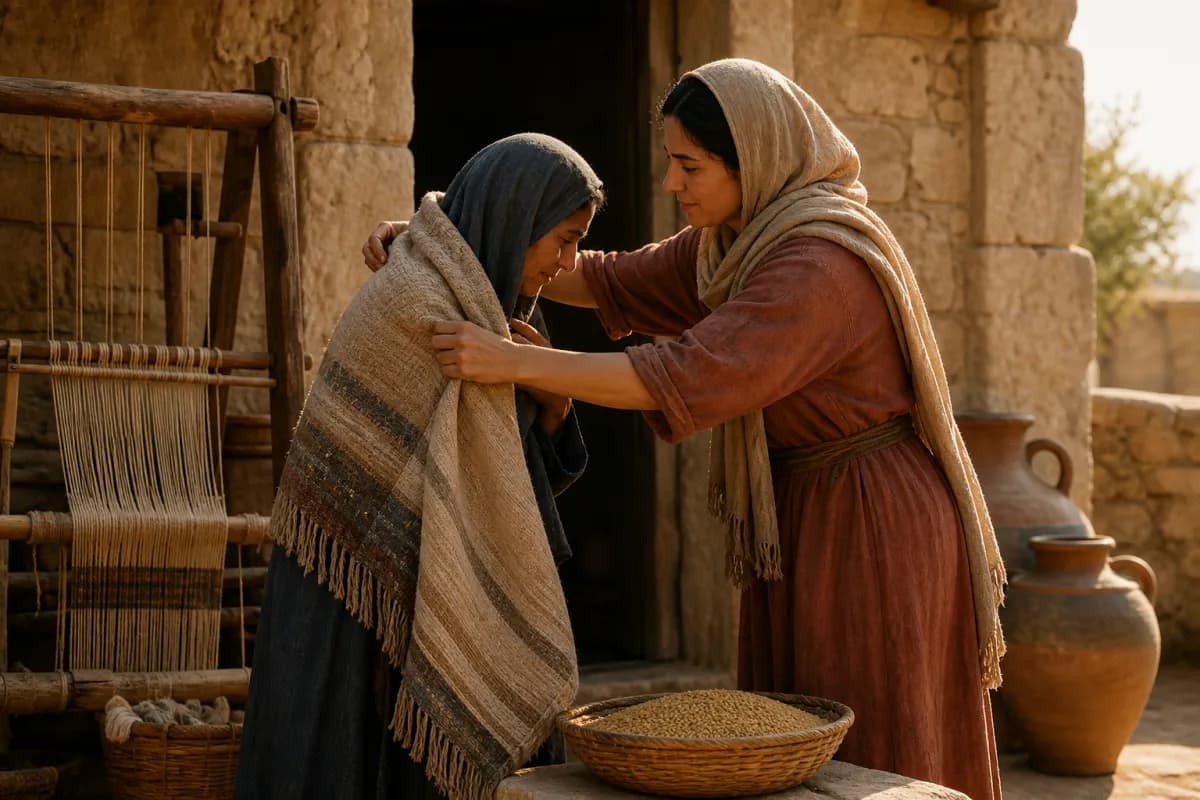
31:13She seeks wool and flax, and works eagerly with her hands.
31:14She is like the merchant ships. She brings her bread from afar.
31:15She rises also while it is yet night, gives food to her household, and portions for her servant girls.
31:16She considers a field, and buys it. With the fruit of her hands, she plants a vineyard.
31:17She arms her waist with strength, and makes her arms strong.
31:18She perceives that her merchandise is profitable. Her lamp doesn’t go out by night.
31:19She lays her hands to the distaff, and her hands hold the spindle.
31:20She opens her arms to the poor; yes, she extends her hands to the needy.
31:21She is not afraid of the snow for her household, for all her household are clothed with scarlet.
31:22She makes for herself carpets of tapestry. Her clothing is fine linen and purple.
31:23Her husband is respected in the gates, when he sits among the elders of the land.
31:24She makes linen garments and sells them, and delivers sashes to the merchant.
31:25Strength and dignity are her clothing. She laughs at the time to come.
31:26She opens her mouth with wisdom. Kind instruction is on her tongue.
31:27She looks well to the ways of her household, and doesn’t eat the bread of idleness.
31:28Her children rise up and call her blessed. Her husband also praises her:
31:29“Many women do noble things, but you excel them all.”
31:30Charm is deceitful, and beauty is vain; but a woman who fears the LORD, she shall be praised.
31:31Give her of the fruit of her hands! Let her works praise her in the gates!
CONTEXTUAL OVERVIEW
Proverbs 31 begins at the royal court and ends at the city gate. King Lemuel receives his mother’s warning not to spend his strength on destructive sexual pursuits or let wine cloud his judgment. He is told to open his mouth for those who cannot speak for themselves and to judge righteously for the poor and needy. Royal wisdom is measured by protection of the vulnerable, not privilege.
Verses 10–31 then portray a capable wife in an acrostic poem. Her value is not reduced to domestic productivity or physical appearance. She buys a field, trades profitably, gives to the poor, speaks with wisdom, prepares her household, and is praised for fearing the Lord. The poem honors a whole life of prudent, generous strength expressed through the ordinary responsibilities before her.
HISTORICAL AND LITERARY CONTEXT
Proverbs 31:1 names “the words of King Lemuel,” but Lemuel’s historical identity is not certain. The text presents his mother as a wisdom teacher whose instruction concerns a king’s public responsibility. Her words stand in continuity with Proverbs’ wider concern that rulers must reject greed, heed wisdom, and judge justly.
The poem about the capable wife is arranged alphabetically in Hebrew, a literary form that gives a sense of completeness rather than a checklist for one person to perform. Its household world includes servants, merchants, land, textiles, and city elders. The woman is an active economic and moral agent, and the poem calls her husband and children to recognize and praise her rather than take her labor for granted.
SECTION-BY-SECTION ANALYSIS
- Verses 1–9 · Proverbs 31:9A king must govern his appetites so that he can defend the poor and judge the vulnerable with righteousness.
- Verses 10–20 · Proverbs 31:8The capable wife exercises trustworthy skill, economic initiative, and open-handed generosity for her household and the poor.
- Verses 21–31 · Proverbs 31:30Fear of the Lord, wise speech, and enduring faithfulness deserve public praise beyond charm or appearance.
CHRIST IN THIS PASSAGE
Proverbs 31 does not directly predict Jesus, but Lemuel’s charge to defend the poor and needy gives a strong canonical line to the righteous reign of Christ. Jesus never allows appetite, wealth, or status to distort His judgment. He announces good news to the poor, welcomes those pushed aside, and will judge the world in righteousness. His kingship fulfills the moral horizon toward which Lemuel’s instruction points.
The capable wife is not an allegory of Christ or a burdening standard by which every woman earns approval. The poem displays wisdom’s fruitful work in a particular household and community. Jesus saves both women and men by grace, then forms His people into a serving body whose labor, generosity, truthful speech, and fear of the Lord reflect His self-giving love.
REFLECTION
If you hold influence, ask whether your habits make it easier or harder to hear the needs of people with less voice. Let King Jesus expose any appetite, distraction, or self-protection that bends your judgment. Use your speech this week to advocate concretely for someone who may be overlooked.
Honor faithful work that ordinarily goes unseen in your home, church, or workplace. Rather than using Proverbs 31 to compare yourself or someone else to an impossible ideal, thank God for specific acts of wisdom and generosity and ask Him to grow the fear of the Lord that gives them lasting weight.
Original Hebrew Word Study
Proverbs 31:10
חַיִל
chayil · H2428
Usually translated: strength, ability, or noble character
Chayil carries the sense of strength and capable excellence. The woman of valor is praised for wise, industrious, God-fearing faithfulness that blesses her household and community.
Follow the Scripture trail
A King’s Justice and a Household of Fearful Strength in the larger story
The connection: Proverbs 31 sets just rule and faithful household wisdom under the fear of the Lord. Jesus is the righteous King who gives His life for the vulnerable and, by grace, forms a people whose work, generosity, speech, and service honor God in public and private life.
Respond to the passage
Ask Jesus to show you one person whose need you have been able to ignore. Use your voice or resources to serve that person, and publicly honor one faithful act of wisdom in your household, church, or work.
- Why does Lemuel’s mother connect a ruler’s appetites to justice for the poor?
- What kinds of strength are visible in the capable wife’s life?
- Why does the poem end with fear of the Lord rather than charm or beauty?
Prayer
Lord Jesus, righteous King, rule my desires and make me attentive to those with little voice. Form in me the generous, wise, and faithful service that comes from fearing You and resting in Your grace. Amen.