Passage Study
Wise Boundaries, Honest Work, and Faithful Desire
Proverbs 6:1–6:35
Proverbs 6 gathers four urgent fatherly warnings: do not become trapped by a reckless pledge, learn foresight from the ant, recognize the destructive habits of a crooked person, and flee a neighbor’s wife. These are not disconnected rules. They show that wisdom protects covenant faithfulness in money, work, speech, and desire. Christ forgives the tangled sinner and forms His people to live freely and truthfully before God.
- In this study
- 35 verses · 5 movements
Proverbs 6
6:1My son, if you have become collateral for your neighbor, if you have struck your hands in pledge for a stranger,
6:2you are trapped by the words of your mouth; you are ensnared with the words of your mouth.
6:3Do this now, my son, and deliver yourself, since you have come into the hand of your neighbor. Go, humble yourself. Press your plea with your neighbor.
6:4Give no sleep to your eyes, nor slumber to your eyelids.
6:5Free yourself, like a gazelle from the hand of the hunter, like a bird from the snare of the fowler.
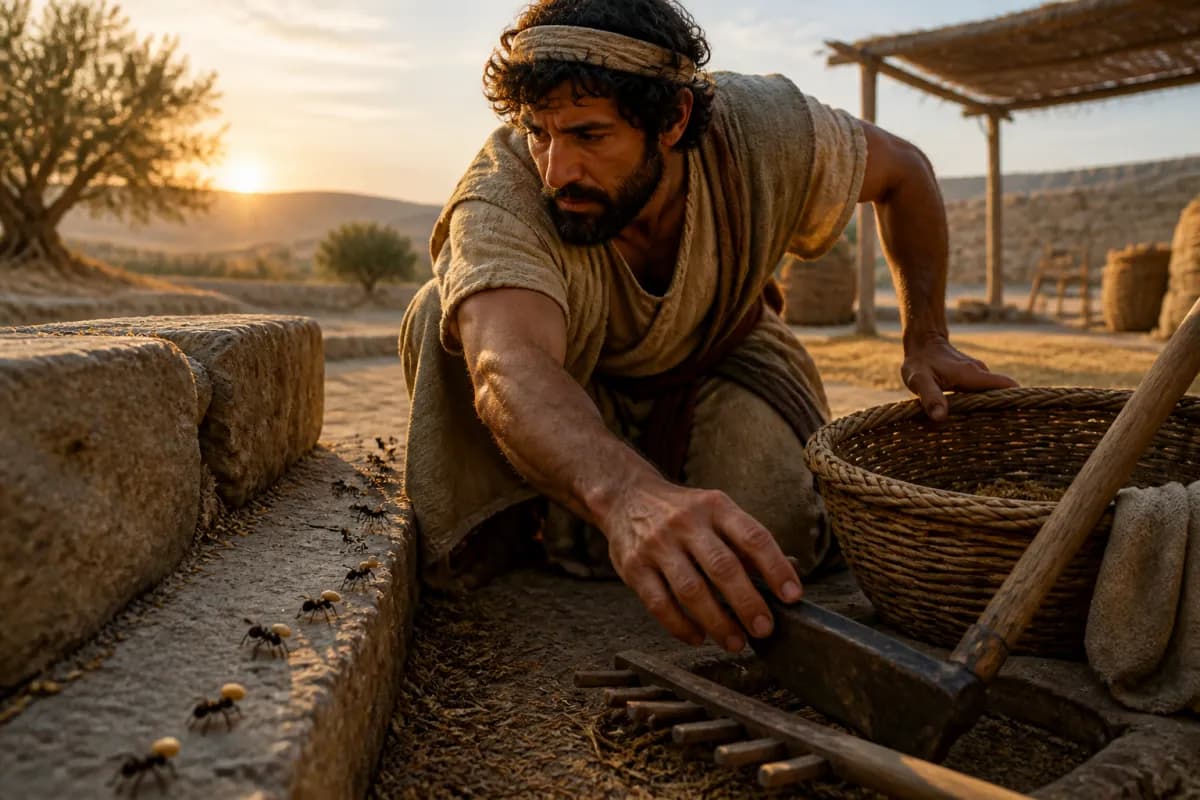
6:6Go to the ant, you sluggard. Consider her ways, and be wise;
6:7which having no chief, overseer, or ruler,
6:8provides her bread in the summer, and gathers her food in the harvest.
6:9How long will you sleep, sluggard? When will you arise out of your sleep?
6:10A little sleep, a little slumber, a little folding of the hands to sleep—
6:11so your poverty will come as a robber, and your scarcity as an armed man.
6:12A worthless person, a man of iniquity, is he who walks with a perverse mouth,
6:13who winks with his eyes, who signals with his feet, who motions with his fingers,
6:14in whose heart is perverseness, who devises evil continually, who always sows discord.
6:15Therefore his calamity will come suddenly. He will be broken suddenly, and that without remedy.
6:16There are six things which the LORD hates; yes, seven which are an abomination to him:
6:17arrogant eyes, a lying tongue, hands that shed innocent blood,
6:18a heart that devises wicked schemes, feet that are swift in running to mischief,
6:19a false witness who utters lies, and he who sows discord among brothers.
6:20My son, keep your father’s commandment, and don’t forsake your mother’s teaching.
6:21Bind them continually on your heart. Tie them around your neck.
6:22When you walk, it will lead you. When you sleep, it will watch over you. When you awake, it will talk with you.
6:23For the commandment is a lamp, and the law is light. Reproofs of instruction are the way of life,
6:24to keep you from the immoral woman, from the flattery of the wayward wife’s tongue.
6:25Don’t lust after her beauty in your heart, neither let her captivate you with her eyelids.
6:26For a prostitute reduces you to a piece of bread. The adulteress hunts for your precious life.
6:27Can a man scoop fire into his lap, and his clothes not be burned?
6:28Or can one walk on hot coals, and his feet not be scorched?
6:29So is he who goes in to his neighbor’s wife. Whoever touches her will not be unpunished.
6:30Men don’t despise a thief if he steals to satisfy himself when he is hungry,
6:31but if he is found, he shall restore seven times. He shall give all the wealth of his house.
6:32He who commits adultery with a woman is void of understanding. He who does it destroys his own soul.
6:33He will get wounds and dishonor. His reproach will not be wiped away.
6:34For jealousy arouses the fury of the husband. He won’t spare in the day of vengeance.
6:35He won’t regard any ransom, neither will he rest content, though you give many gifts.
CONTEXTUAL OVERVIEW
Proverbs 6 addresses ordinary pressures that can quietly master a life: guaranteeing another person’s debt, postponing necessary work, using speech and body language to deceive, and entertaining sexual temptation. The chapter does not treat wisdom as private intelligence. It asks whether a person’s promises, schedule, dealings with neighbors, and desires are ordered before the Lord.
The supplied word note calls the lazy person an atsel, a sluggard. The ant is not praised for creating a displayed picture for the reader; Proverbs uses the ant’s seasonal preparation as a verbal comparison. The point is concrete: sleep that repeatedly postpones responsibility can leave a person exposed to want.
HISTORICAL AND LITERARY CONTEXT
This chapter belongs to the father-to-son instructions of Proverbs 1–9, though verses 16–19 take the compact numerical form often found in wisdom teaching. The opening case concerns becoming surety for a stranger—putting oneself under obligation for another person’s debt. Proverbs does not condemn every generous act or every lawful financial agreement; it warns against a pledge made without sober judgment and urges immediate, humble action when someone is caught by one.
The final section echoes Proverbs 5. A mother’s and father’s command is to be kept close because the warning concerns a neighbor’s wife, a real breach of marriage and neighbor-love. The comparison with fire in one’s lap and walking on hot coals insists that adultery cannot be handled as harmless secrecy.
SECTION-BY-SECTION ANALYSIS
- Verses 1–5 · Proverbs 6:1A reckless pledge is met with prompt humility, not with prideful delay.
- Verses 6–19 · Proverbs 6:6The ant, the sluggard, and the discord-maker reveal how small habits of delay or deceit can become ruin.
- Verses 20–35 · Proverbs 6:3Keeping parental instruction near equips the son to flee adultery before its secrecy turns into public devastation.
CHRIST IN THIS PASSAGE
Proverbs 6 is not a direct prediction of Jesus. Its clearest connection is thematic: it exposes the self-rule that binds people through foolish promises, neglect, deception, and sexual sin. Jesus calls His disciples to truthfulness, purity, and love of neighbor, and His saving death provides forgiveness for people whose choices have already harmed others.
The chapter’s list of what the Lord hates also keeps grace from becoming permission to continue in evil. Christ reconciles sinners to God so that they may be remade in His likeness. A believer turns from a concealed affair, dishonest dealing, or conflict-making not to purchase mercy, but because the crucified and risen Lord is freeing them to walk in the light.
REFLECTION
Read this chapter where its warnings land. If you have made a financial commitment you cannot responsibly carry, seek counsel and pursue an honest conversation now. If delay has become a pattern, name one neglected task and complete its next faithful step today. Wisdom begins to work before the pressure becomes a crisis.
The final warning asks for more than private resolve. Bring sexual secrecy and conflict-producing speech into the light before Jesus. A spouse, pastor, counselor, or trusted mature believer may need to know the truth. Christ receives repentant sinners and gives courage to repair what can be repaired without pretending that sin has no cost.
Original Hebrew Word Study
Proverbs 6:6
עָצֵל
atsel · H6102
Usually translated: sluggard or lazy person
Atsel names the habitually lazy person. The ant becomes a teacher because wisdom recognizes that ordinary diligence prepares for the future.
Follow the Scripture trail
Wise Boundaries, Honest Work, and Faithful Desire in the larger story
The connection: Proverbs 6 reveals how sin entangles people through their own words, desires, and schemes. Jesus bears the guilt of those who repent and, by His Spirit, trains a redeemed people to practice truthful promises, faithful work, peaceable speech, and sexual holiness.
Respond to the passage
Identify the one area in Proverbs 6 where you are most tempted to delay, conceal, or manipulate. Bring it honestly to Jesus, take the next concrete step toward truth, and ask someone trustworthy to help you keep that step.
- Why does the father urge immediate humility when a rash pledge has trapped the son?
- What does the ant comparison expose about the repeated phrase “a little sleep”?
- How do the chapter’s warnings about discord and adultery both concern love of neighbor?
Prayer
Lord Jesus, forgive the ways I have used words, time, or desire without wisdom. Make me truthful in my commitments, diligent in my work, peaceable in my speech, and faithful in my relationships. Amen.