Passage Study
Psalm 18: The Rock Who Draws His King from Deep Waters
Psalms 18:1–18:50
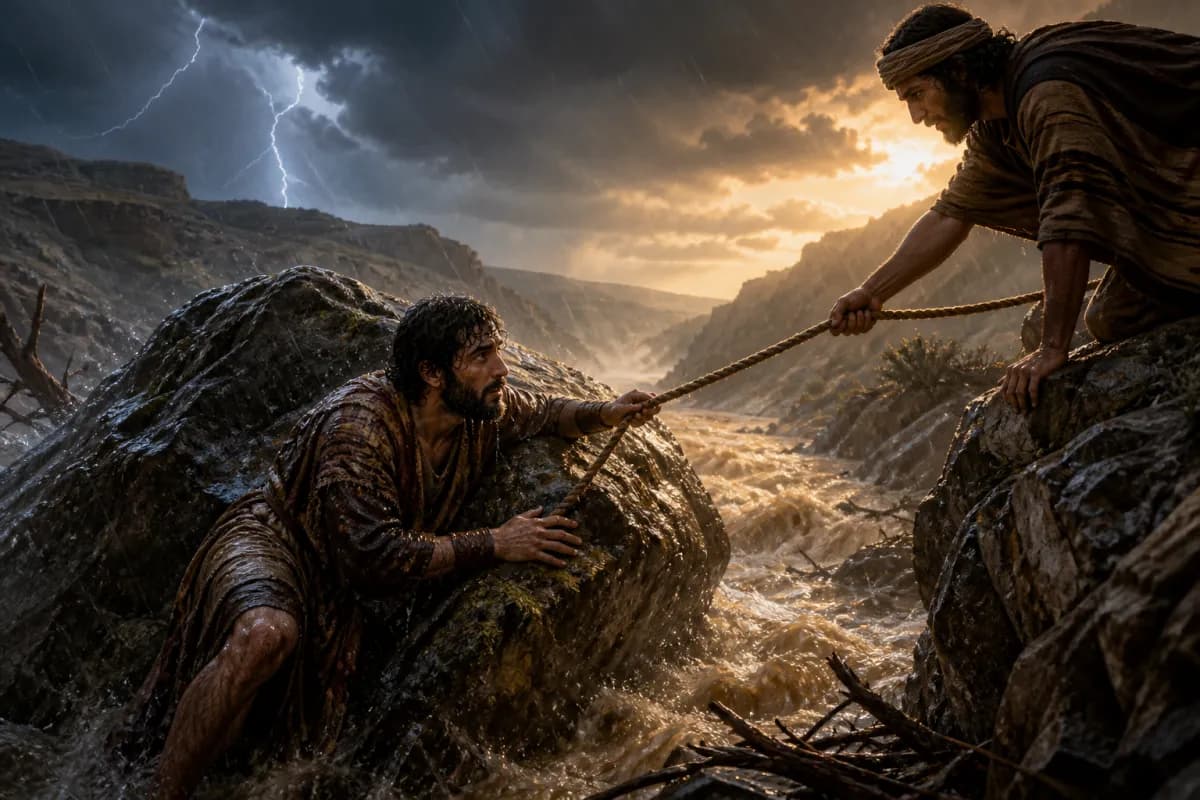
Psalm 18 is David’s great song of deliverance after the Lord rescued him from Saul and other enemies. The Lord hears David’s cry, comes in storm-like majesty, draws him from overwhelming waters, trains him for conflict, and establishes his king. Its Davidic hope reaches its climax in Jesus, the risen King whose deliverance secures mercy for people from the nations.
- In this study
- 50 verses · 5 movements
Psalms 18
18:1I love you, LORD, my strength.
18:2The LORD is my rock, my fortress, and my deliverer; my God, my rock, in whom I take refuge; my shield, and the horn of my salvation, my high tower.
18:3I call on the LORD, who is worthy to be praised; and I am saved from my enemies.
18:4The cords of death surrounded me. The floods of ungodliness made me afraid.
18:5The cords of Sheol were around me. The snares of death came on me.
18:6In my distress I called on the LORD, and cried to my God. He heard my voice out of his temple. My cry before him came into his ears.
18:7Then the earth shook and trembled. The foundations also of the mountains quaked and were shaken, because he was angry.
18:8Smoke went out of his nostrils. Consuming fire came out of his mouth. Coals were kindled by it.
18:9He bowed the heavens also, and came down. Thick darkness was under his feet.
18:10He rode on a cherub, and flew. Yes, he soared on the wings of the wind.
18:11He made darkness his hiding place, his pavilion around him, darkness of waters, thick clouds of the skies.
18:12At the brightness before him his thick clouds passed, hailstones and coals of fire.
18:13The LORD also thundered in the sky. The Most High uttered his voice: hailstones and coals of fire.
18:14He sent out his arrows, and scattered them. He routed them with great lightning bolts.
18:15Then the channels of waters appeared. The foundations of the world were laid bare at your rebuke, LORD, at the blast of the breath of your nostrils.
18:16He sent from on high. He took me. He drew me out of many waters.
18:17He delivered me from my strong enemy, from those who hated me; for they were too mighty for me.
18:18They came on me in the day of my calamity, but the LORD was my support.
18:19He brought me out also into a large place. He delivered me, because he delighted in me.
18:20The LORD has rewarded me according to my righteousness. According to the cleanness of my hands, he has recompensed me.
18:21For I have kept the ways of the LORD, and have not wickedly departed from my God.
18:22For all his ordinances were before me. I didn’t put away his statutes from me.
18:23I was also blameless with him. I kept myself from my iniquity.
18:24Therefore the LORD has rewarded me according to my righteousness, according to the cleanness of my hands in his eyesight.
18:25With the merciful you will show yourself merciful. With the perfect man, you will show yourself perfect.
18:26With the pure, you will show yourself pure. With the crooked you will show yourself shrewd.
18:27For you will save the afflicted people, but the arrogant eyes you will bring down.
18:28For you will light my lamp, LORD. My God will light up my darkness.
18:29For by you, I advance through a troop. By my God, I leap over a wall.
18:30As for God, his way is perfect. The LORD’s word is tried. He is a shield to all those who take refuge in him.
18:31For who is God, except the LORD? Who is a rock, besides our God,
18:32the God who arms me with strength, and makes my way perfect?
18:33He makes my feet like deer’s feet, and sets me on my high places.
18:34He teaches my hands to war, so that my arms bend a bow of bronze.
18:35You have also given me the shield of your salvation. Your right hand sustains me. Your gentleness has made me great.
18:36You have enlarged my steps under me, My feet have not slipped.
18:37I will pursue my enemies, and overtake them. I won’t turn away until they are consumed.
18:38I will strike them through, so that they will not be able to rise. They shall fall under my feet.
18:39For you have armed me with strength to the battle. You have subdued under me those who rose up against me.
18:40You have also made my enemies turn their backs to me, that I might cut off those who hate me.
18:41They cried, but there was no one to save; even to the LORD, but he didn’t answer them.
18:42Then I beat them small as the dust before the wind. I cast them out as the mire of the streets.
18:43You have delivered me from the strivings of the people. You have made me the head of the nations. A people whom I have not known shall serve me.
18:44As soon as they hear of me they shall obey me. The foreigners shall submit themselves to me.
18:45The foreigners shall fade away, and shall come trembling out of their strongholds.
18:46The LORD lives! Blessed be my rock. Exalted be the God of my salvation,
18:47even the God who executes vengeance for me, and subdues peoples under me.
18:48He rescues me from my enemies. Yes, you lift me up above those who rise up against me. You deliver me from the violent man.
18:49Therefore I will give thanks to you, LORD, among the nations, and will sing praises to your name.
18:50He gives great deliverance to his king, and shows loving kindness to his anointed, to David and to his offspring, forever more.
CONTEXTUAL OVERVIEW
Psalm 18’s heading joins the song to the Lord’s rescue of David from Saul and other enemies. David begins by piling up names for God: rock, fortress, deliverer, shield, horn of salvation, and stronghold. The accumulation matters because the danger was not imaginary; he had found the Lord sufficient in many kinds of threat.
The center of the poem turns David’s cry into a cosmic scene. The earth shakes, smoke rises, storm clouds gather, and the Lord thunders from heaven before drawing David “out of mighty waters.” These are poetic images of divine intervention, not a claim that every rescue occurred through a literal storm. They make the point that the God who rules creation acted for His endangered servant.
HISTORICAL AND LITERARY CONTEXT
Psalm 18 is virtually identical to 2 Samuel 22, where it concludes the narrative of David’s reign. That placement interprets David’s military success as the Lord’s rescue rather than self-made achievement. The song is royal thanksgiving, but its language of refuge makes it usable by God’s people whenever they are overwhelmed and need deliverance.
The supplied note on tsur, “rock,” highlights the poem’s controlling metaphor. A rock is stable refuge in terrain where pursuers, ravines, and floods can kill. David’s righteousness language in the middle of the psalm must be heard in the covenant setting of his deliverance from particular enemies; it does not erase the serious sins the Samuel narrative records.
SECTION-BY-SECTION ANALYSIS
- Verses 1–19 · Psalms 18:6David cries from deathly distress, and the Creator comes in storm-like majesty to draw him from overwhelming waters.
- Verses 20–30 · Psalms 18:30The rescued king testifies that the Lord’s way is perfect and His word is a shield for those who take refuge in Him.
- Verses 31–50 · Psalms 18:50God equips David for victory and extends steadfast love to His anointed king and his descendants.
CHRIST IN THIS PASSAGE
Psalm 18 belongs to the Davidic story and ends with the promise of steadfast love to David’s offspring forever. Jesus is that greater Son of David. He faced death itself, entrusted Himself to the Father, and was raised in the decisive deliverance no hostile ruler could prevent. The psalm’s storm imagery is poetic rather than a direct prediction of Easter, but its royal hope reaches its true horizon in the risen Messiah.
Paul quotes Psalm 18’s final praise among the nations to describe the Messiah’s mission of bringing Jew and Gentile into one worshiping people. Jesus saves by more than giving His followers a strategy for victory; through His death and resurrection, He rescues them from sin and death and makes the nations praise the God of David.
REFLECTION
Psalm 18 gives you permission to name danger in full: the cords, torrents, enemies, and waters that feel stronger than you. Then follow David’s movement—call on the Lord before trying to manufacture strength. The rock image does not promise that Christians will never face overwhelming circumstances; it declares where refuge is found when they do.
Thank Jesus for one past rescue without turning it into a claim that you earned it. In a present struggle, ask Him to make His perfect way and proven word your shield. Let deliverance enlarge your worship so that, like David, you speak of God’s mercy beyond your own survival.
Original Hebrew Word Study
Psalm 18:2
צוּר
tsur · H6697
Usually translated: rock or secure refuge
Tsur means rock. David piles up images of safety because God has proved Himself an immovable refuge in every danger.
Follow the Scripture trail
Psalm 18: The Rock Who Draws His King from Deep Waters in the larger story
The connection: Psalm 18 celebrates God’s rescue of David and His enduring mercy to David’s offspring. Jesus, the risen Son of David, fulfills that royal hope and draws people from every nation into praise through His victory over sin and death.
Respond to the passage
Name the waters that feel too strong for you, and call on Jesus as your rock rather than treating self-reliance as rescue. Thank Him for a specific mercy already given, and let that remembrance lead you to worship and witness.
- Why does David use so many images of refuge at the beginning of the psalm?
- What does the storm-like description of God’s coming communicate about David’s rescue?
- How does the promise to David’s descendants lead Psalm 18 toward Jesus and the nations?
Prayer
Lord Jesus, my rock and deliverer, hear me when fear feels stronger than I am. Draw me from the waters that overwhelm me, train my heart to trust Your proven word, and make my rescue a reason to praise You before others. Amen.