Passage Study
Psalm 23: The Shepherd Who Brings His People Home
Psalms 23:1–23:6
Psalm 23 confesses the Lord as the shepherd whose care supplies, restores, guides, protects, and finally welcomes His servant into His house. The psalm does not deny dark valleys or hostile enemies; it names God’s presence within them. Jesus explicitly calls Himself the good shepherd who lays down His life for the sheep, making this trust a hope grounded in His saving care.
- In this study
- 6 verses · 5 movements
Psalms 23
23:1The LORD is my shepherd; I shall lack nothing.
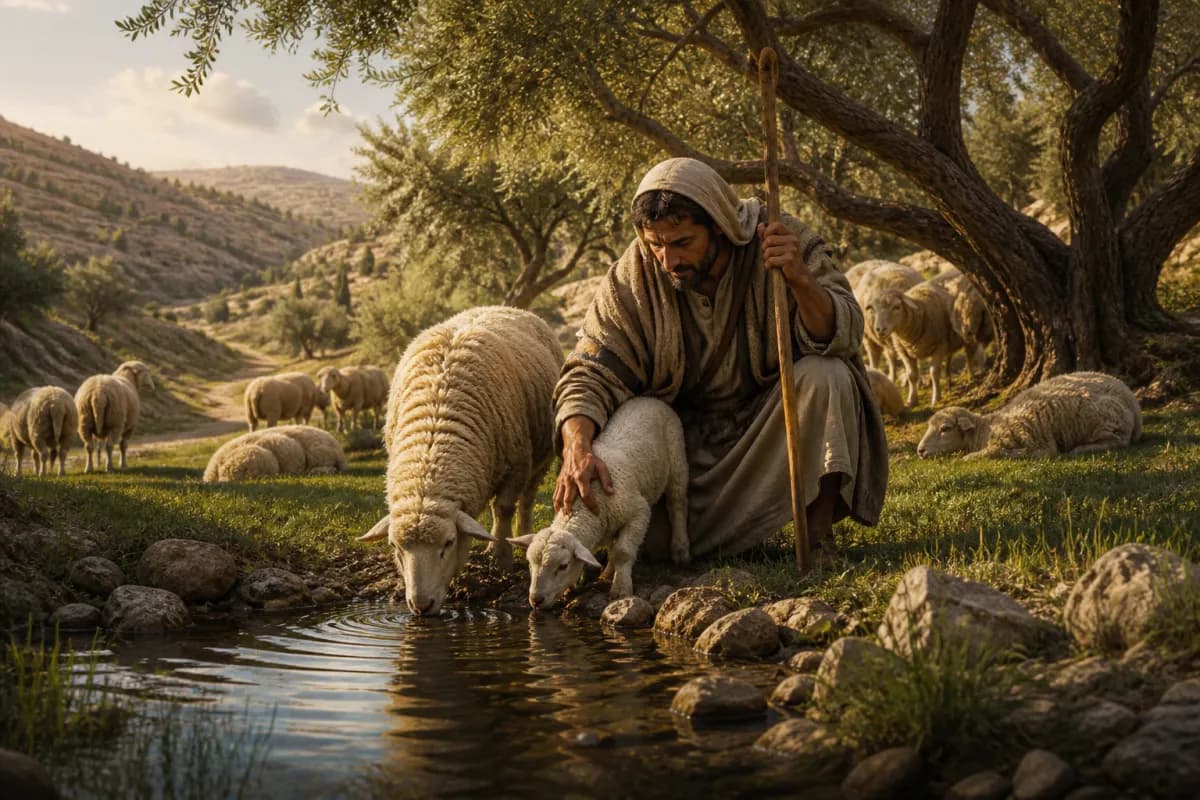
23:2He makes me lie down in green pastures. He leads me beside still waters.
23:3He restores my soul. He guides me in the paths of righteousness for his name’s sake.
23:4Even though I walk through the valley of the shadow of death, I will fear no evil, for you are with me. Your rod and your staff, they comfort me.
23:5You prepare a table before me in the presence of my enemies. You anoint my head with oil. My cup runs over.
23:6Surely goodness and loving kindness shall follow me all the days of my life, and I will dwell in the LORD’s house forever.
CONTEXTUAL OVERVIEW
Psalm 23 begins with a possessive confession: “The Lord is my shepherd.” The singer does not describe an abstract principle of providence. He entrusts himself to Israel’s covenant God as a sheep entrusts itself to the one who finds pasture, water, and a safe path. Because the Lord shepherds him, he says he will not lack what God knows is necessary for life with Him.
The psalm moves through changing terrain. Green pastures and still waters give way to the darkest valley, then to a table set while enemies remain nearby, and finally to the Lord’s house. Its confidence is therefore tested confidence. The shepherd does not promise a route without danger; His rod, staff, and presence keep fear from having the last word.
HISTORICAL AND LITERARY CONTEXT
This is a Davidic psalm, and its images draw on ordinary pastoral life while also using royal and worship language. Shepherding was a familiar picture for responsible leadership in Israel, yet Psalm 23 makes the Lord Himself the shepherd. The shift keeps David, Israel’s king and former shepherd, in the place of a dependent sheep.
The final image changes from field to host’s table and house. Anointing the head and filling the cup describe generous welcome, while “goodness and mercy” translate God’s active kindness and covenant faithfulness. The poetry is not a promise of uninterrupted comfort or wealth; it is a confession that the Lord’s care reaches every part of the servant’s journey.
SECTION-BY-SECTION ANALYSIS
- Verses 1–3 · Psalms 23:3The shepherd supplies rest, renewal, and paths that display the faithfulness of His own name.
- Verse 4 · Psalms 23:4The darkest valley is faced through the Shepherd’s presence and guidance, not through denial that danger exists.
- Verses 5–6 · Psalms 23:5The table, oil, full cup, and house portray a secure welcome that hostile circumstances cannot overturn.
CHRIST IN THIS PASSAGE
Psalm 23 is not an allegory in which every sheepfold detail predicts Jesus, but its central shepherd image has a strong canonical fulfillment. Jesus identifies Himself as the good shepherd and says that He lays down His life for the sheep. He brings people who are lost and exposed into the costly safety of His saving care.
The psalm’s destination is fellowship in the Lord’s house. Through His death and resurrection, Jesus opens access to the Father and promises that none of His sheep can be finally taken from His hand. His mission does not remove every dark valley from a Christian’s life, but it secures the Shepherd’s presence now and life with God beyond death.
REFLECTION
Psalm 23 gives words for seasons when provision feels thin or the road feels frightening. Name the valley honestly before the Lord. Then answer fear with the psalm’s actual ground of confidence: “you are with me.” The believer’s safety rests in Christ’s faithful care, even when the next turn in the path is hidden.
The table before enemies also keeps resentment from becoming a master. Bring the people or pressures that threaten your peace to Jesus, and receive the welcome He has secured. Let His care make you a calmer presence for someone walking through a dark valley beside you.
Original Hebrew Word Study
Psalm 23:1
רָעָה
raah · H7462
Usually translated: to shepherd or tend
Raah means to shepherd. The Lord’s care is personal, guiding, protecting, and providing for His people as a good shepherd does his flock.
Follow the Scripture trail
Psalm 23: The Shepherd Who Brings His People Home in the larger story
The connection: The Lord’s shepherd care in Psalm 23 finds a strong fulfillment in Jesus, the good shepherd. By laying down His life and rising again, He rescues wandering people, keeps them in His hand, and leads them toward unbroken fellowship with God.
Respond to the passage
Tell Jesus where the valley feels darkest, then entrust one concrete fear to His shepherding care. Look for a person who is carrying grief or pressure and offer the steady presence Psalm 23 describes.
- Which part of the psalm speaks most directly to your present terrain: need, weariness, danger, opposition, or longing for home?
- Why does verse 4 rest its confidence on the Shepherd’s presence rather than on a quick escape from the valley?
- How does Jesus laying down His life deepen the meaning of “The Lord is my shepherd”?
Prayer
Lord Jesus, my good Shepherd, lead me where I cannot guide myself. Restore what fear and weariness have drained, keep me near in the dark valley, and teach me to rest in the welcome You secured through Your death and resurrection. Amen.