Passage Study
Psalm 48: Walk About Zion and Remember the City of God
Psalms 48:1–48:14
Psalm 48 celebrates Mount Zion because the Lord is known there as a secure fortress. Enemy kings panic before the city, worshipers meditate on God’s steadfast love in His temple, and parents are told to tell the next generation that this God will guide His people forever. In Christ, Zion’s hope reaches the heavenly city and a people secured by God’s presence.
- In this study
- 14 verses · 5 movements
Psalms 48
48:1Great is the LORD, and greatly to be praised, in the city of our God, in his holy mountain.
48:2Beautiful in elevation, the joy of the whole earth, is Mount Zion, on the north sides, the city of the great King.
48:3God has shown himself in her citadels as a refuge.
48:4For, behold, the kings assembled themselves, they passed by together.
48:5They saw it, then they were amazed. They were dismayed. They hurried away.
48:6Trembling took hold of them there, pain, as of a woman in travail.
48:7With the east wind, you break the ships of Tarshish.
48:8As we have heard, so we have seen, in the city of the LORD of Armies, in the city of our God. God will establish it forever. Selah.
48:9We have thought about your loving kindness, God, in the middle of your temple.
48:10As is your name, God, so is your praise to the ends of the earth. Your right hand is full of righteousness.
48:11Let Mount Zion be glad! Let the daughters of Judah rejoice because of your judgments.
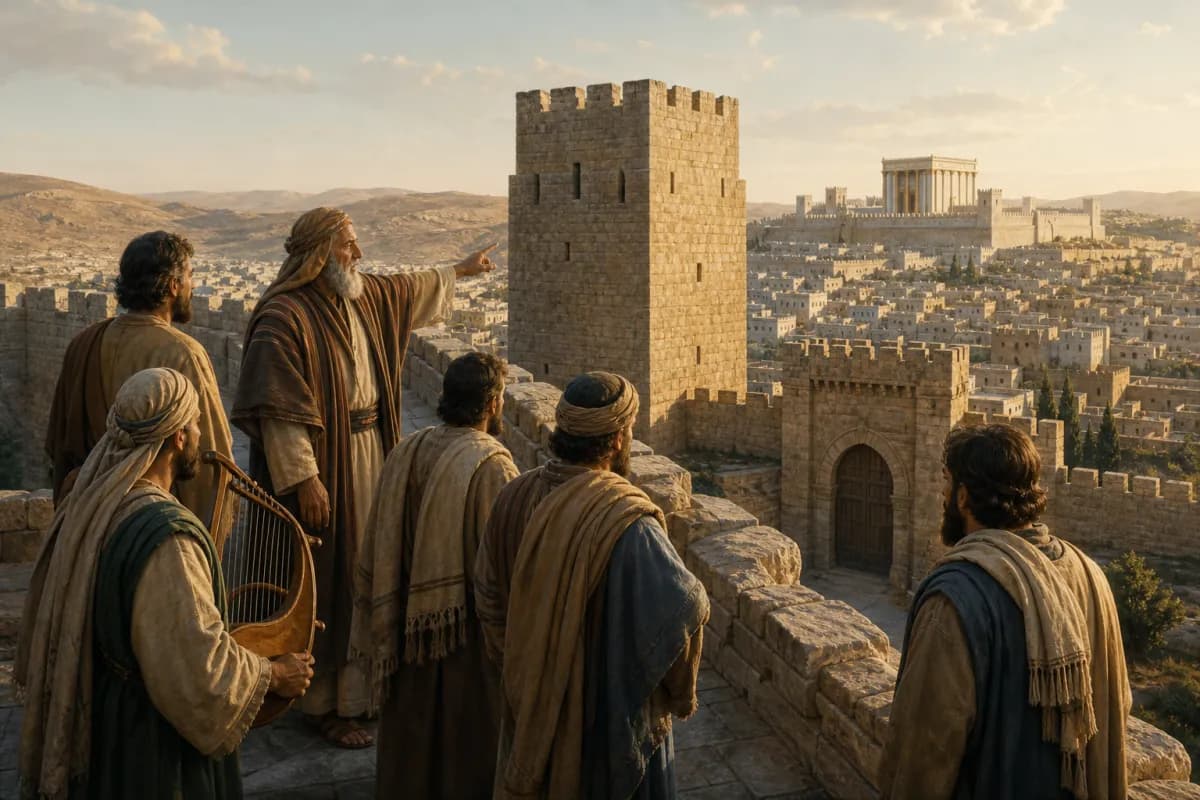
48:12Walk about Zion, and go around her. Number its towers.
48:13Notice her bulwarks. Consider her palaces, that you may tell it to the next generation.
48:14For this God is our God forever and ever. He will be our guide even to death.
CONTEXTUAL OVERVIEW
Psalm 48 sings of Zion, the mountain-city where the Lord made His dwelling known to Israel. The supplied note on tsiyyon identifies more than a place on a map: Zion is the theological center of God’s kingship and temple presence in Israel’s worship. Its beauty and elevation matter because “God is in her citadels,” known as her sure defense.
The song never asks readers to trust masonry by itself. Kings assemble against the city, see it, and are thrown into panic; sailors’ ships are shattered by an east wind. Zion is secure because the God of hosts establishes it, and worshipers respond by meditating on His steadfast love within His temple.
HISTORICAL AND LITERARY CONTEXT
Psalm 48 is a Zion hymn associated with the sons of Korah. It celebrates Jerusalem as the city of the great King and likely belongs in a worship setting where pilgrims could see its towers and walls. The particular military crisis behind the kings’ flight is not named, so the poem should not be reduced to an unverified historical reconstruction.
Zion’s significance comes from God’s covenant choice and temple presence, not an automatic guarantee that Jerusalem can never face judgment. Later prophets confront the false security of people who claimed the temple while practicing injustice. Psalm 48’s confidence is therefore covenantal: God’s name, love, and righteous rule are the refuge being celebrated.
SECTION-BY-SECTION ANALYSIS
- Verses 1–3 · Psalms 48:2Zion’s joy and security arise from the Lord’s known presence as fortress within the city.
- Verses 4–8 · Psalms 48:1Hostile kings panic and flee, confirming that God Himself establishes His city.
- Verses 9–14 · Psalms 48:13Temple worship recalls God’s steadfast love and commissions one generation to tell the next of His lasting guidance.
CHRIST IN THIS PASSAGE
Psalm 48 celebrates earthly Zion as the place of God’s dwelling with His covenant people. The New Testament does not erase that history; it brings it to its goal in Jesus, who is God present among His people and who opens access to the Father through His death. The connection is a strong temple-and-presence pattern rather than a claim that every tower secretly describes Christ.
Hebrews speaks of believers coming to Mount Zion, the city of the living God, while Revelation ends with the holy city where God dwells permanently with His redeemed people. Jesus secures that future by reconciling sinners to God. Thus the psalm’s final promise of divine guidance becomes lasting hope for a church whose ultimate security is God’s presence, not a particular earthly wall.
REFLECTION
Psalm 48 asks what you are counting as your citadel. It may be a neighborhood, savings, institution, or reputation that feels as solid as a tower. Thank God for real provisions, but meditate on His steadfast love until you can distinguish a good gift from the only sure defense.
Take the final command seriously in your home or church. Tell someone younger one concrete way God has guided you, including the part where His faithfulness was seen only in retrospect. Center that story on Jesus’ reconciliation and presence, so that you pass on more than nostalgia for a place or a past season.
Original Hebrew Word Study
Psalm 48:2
צִיּוֹן
tsiyyon · H6726
Usually translated: Zion
Tsiyyon is Zion, the city associated with God’s dwelling and kingship. The psalm celebrates it because God Himself is known there as a secure refuge.
Follow the Scripture trail
Psalm 48: Walk About Zion and Remember the City of God in the larger story
The connection: Psalm 48 praises Zion because God made Himself known there as Israel’s secure defense and guide. Jesus fulfills the temple-presence pattern by bringing sinners to God, and He leads His people toward the heavenly Zion where God will dwell with them forever.
Respond to the passage
Identify the visible structure you have been treating as your final security, and thank Jesus for it without confusing it with Him. Share one story of His faithful guidance with a younger believer or family member this week.
- Why does Psalm 48 celebrate Zion’s walls only after naming God as the city’s true fortress?
- How does the psalm’s concern for the next generation shape the purpose of remembering God’s past faithfulness?
- How do Hebrews and Revelation deepen Zion’s hope without dismissing the psalm’s original temple setting?
Prayer
Lord Jesus, You bring me into the presence of the living God. Keep me from trusting walls I can see more than Your steadfast love, guide me through every season, and make me faithful to tell the next generation of Your saving mercy. Amen.