Passage Study
The Majestic Lord and Humanity’s Entrusted Vocation
Psalms 8:1–8:9
Psalm 8 marvels that the majestic Creator notices frail human beings and gives them a dignified vocation beneath His rule. It directs readers to Jesus, the true human ruler who entered suffering, was crowned with glory, and restores the human calling to reflect God’s wise care in the world.
- In this study
- 9 verses · 5 movements
Psalms 8
8:1LORD, our Lord, how majestic is your name in all the earth! You have set your glory above the heavens!
8:2From the lips of babes and infants you have established strength, because of your adversaries, that you might silence the enemy and the avenger.
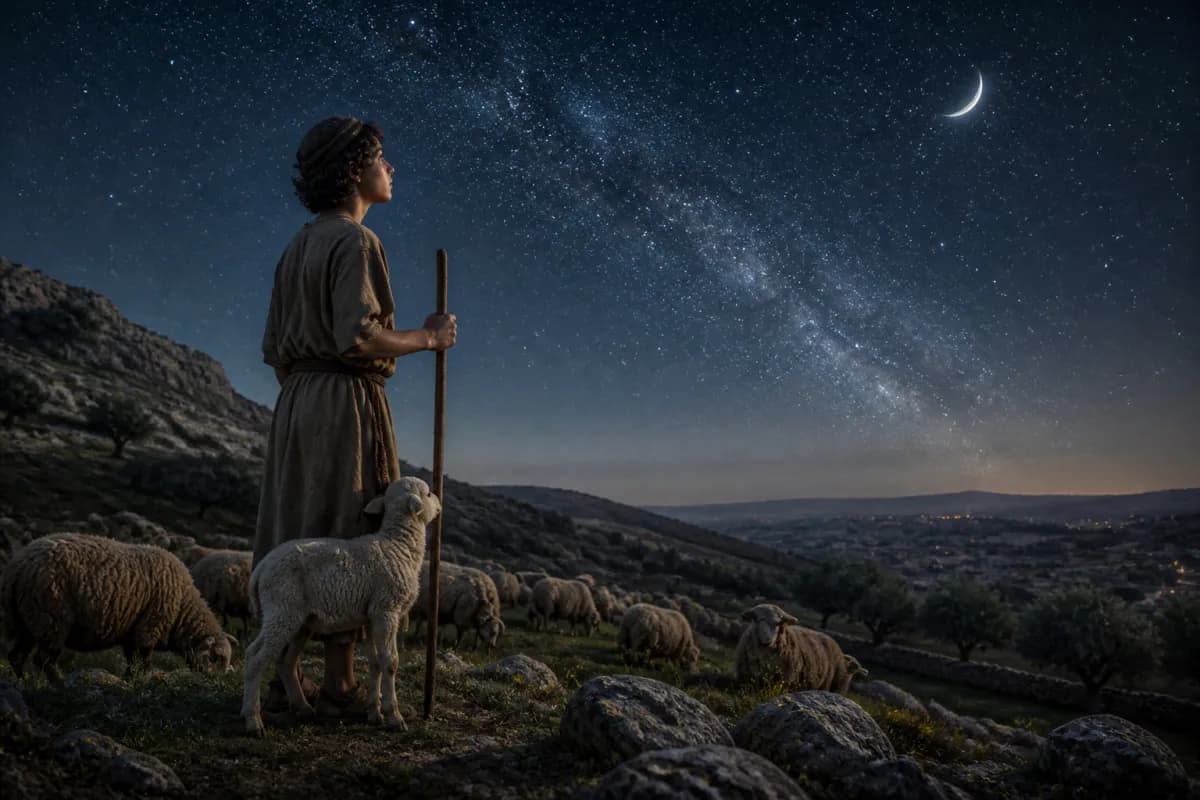
8:3When I consider your heavens, the work of your fingers, the moon and the stars, which you have ordained,
8:4what is man, that you think of him? What is the son of man, that you care for him?
8:5For you have made him a little lower than the angels, and crowned him with glory and honor.
8:6You make him ruler over the works of your hands. You have put all things under his feet:
8:7All sheep and cattle, yes, and the animals of the field,
8:8the birds of the sky, the fish of the sea, and whatever passes through the paths of the seas.
8:9LORD, our Lord, how majestic is your name in all the earth!
CONTEXTUAL OVERVIEW
Psalm 8 begins and ends with the same confession: the Lord’s name is majestic in all the earth. Between those lines, the singer looks at moon and stars and feels the disproportion between the vast heavens and mortal humanity. The question “what are human beings?” is not cynical; it opens into astonishment at God’s remembering care.
The psalm holds humility and dignity together. Humans are not the center of creation or rivals to the Creator, yet God crowns them with honor and entrusts them with rule over the works of His hands. This vocation comes under worship, because the psalm never allows human dignity to eclipse the Lord’s majesty.
HISTORICAL AND LITERARY CONTEXT
Psalm 8 is a hymn of praise whose meditation on humanity echoes the creation commission in Genesis. Its reference to infants and nursing children contrasts apparent weakness with God’s established strength, while its catalog of sheep, oxen, birds, fish, and sea paths reflects the created order entrusted to human care.
The phrase translated a little lower than God can also be rendered a little lower than heavenly beings. The psalm’s main point does not depend on settling that translation: God has granted human beings a remarkable, derivative dignity and responsibility within His world.
SECTION-BY-SECTION ANALYSIS
- Out of the mouths of babes · Psalms 8:2God establishes strength through those regarded as weak, overturning the confidence of His adversaries.
- What are human beings? · Psalms 8:4The psalmist’s wonder rises from the gap between the vast heavens and God’s attentive care for mortal people.
- You have given them dominion · Psalms 8:6Human rule over creatures is a delegated responsibility that remains under the Creator’s authority.
CHRIST IN THIS PASSAGE
Psalm 8 is rooted in humanity’s creation vocation, and the New Testament applies its language to Jesus as the representative human being. Hebrews especially sees Him made lower for a time, suffering death, and then crowned with glory and honor. This is a strong, explicit apostolic application that shows how Jesus fulfills the human calling where sin has disordered it.
Jesus’ saving mission restores more than private spirituality. By His incarnation, obedient death, resurrection, and reign, He begins the renewal of people made in God’s image and of the creation subjected to frustration. Christians therefore honor human dignity and exercise stewardship with hope, awaiting the day when everything is visibly placed under Christ’s feet.
REFLECTION
Psalm 8 corrects both self-contempt and self-importance. You are a creature, not God; your life is brief and dependent. Yet you are remembered by the Creator and called to bear His image in the places He has given you. Jesus makes that calling secure by receiving the lowly and restoring the ruined.
Consider one sphere of delegated care—your body, work, home, land, money, or influence. Ask whether you are using it as an owner or as a servant of the majestic Lord. Let Christ’s humble kingship reshape one practical choice this week.
Original Hebrew Word Study
Psalm 8:5
כָּבוֹד
kavod · H3519
Usually translated: glory, weight, or honor
Kavod carries the sense of weighty honor. God crowns human beings with glory and responsibility beneath His immeasurable majesty.
Follow the Scripture trail
The Majestic Lord and Humanity’s Entrusted Vocation in the larger story
The connection: Psalm 8 recalls the dignity and responsibility given to humanity in creation. Jesus, the true image of God and obedient human Son, bears suffering, is crowned with glory, and begins the restoration of humanity and creation under God’s majestic rule.
Respond to the passage
Receive your life as a gift from the Creator rather than a project of self-rule. Ask Jesus to show you one entrusted responsibility that needs His humble, life-giving care, and act as His servant there this week.
- Why does the psalm surround its meditation on humanity with praise for the Lord’s majestic name?
- How does the weakness of infants challenge ordinary ideas about strength?
- How does Hebrews help us see Jesus as the fulfillment of humanity’s vocation in Psalm 8?
Prayer
Majestic Lord Jesus, thank You for remembering frail people and for taking our humanity to Yourself. Teach me to receive my life and responsibilities from Your hand and to serve Your world with humble care. Amen.