Passage Study
Welcome One Another as Christ Welcomed You
Romans 14:1–15:13
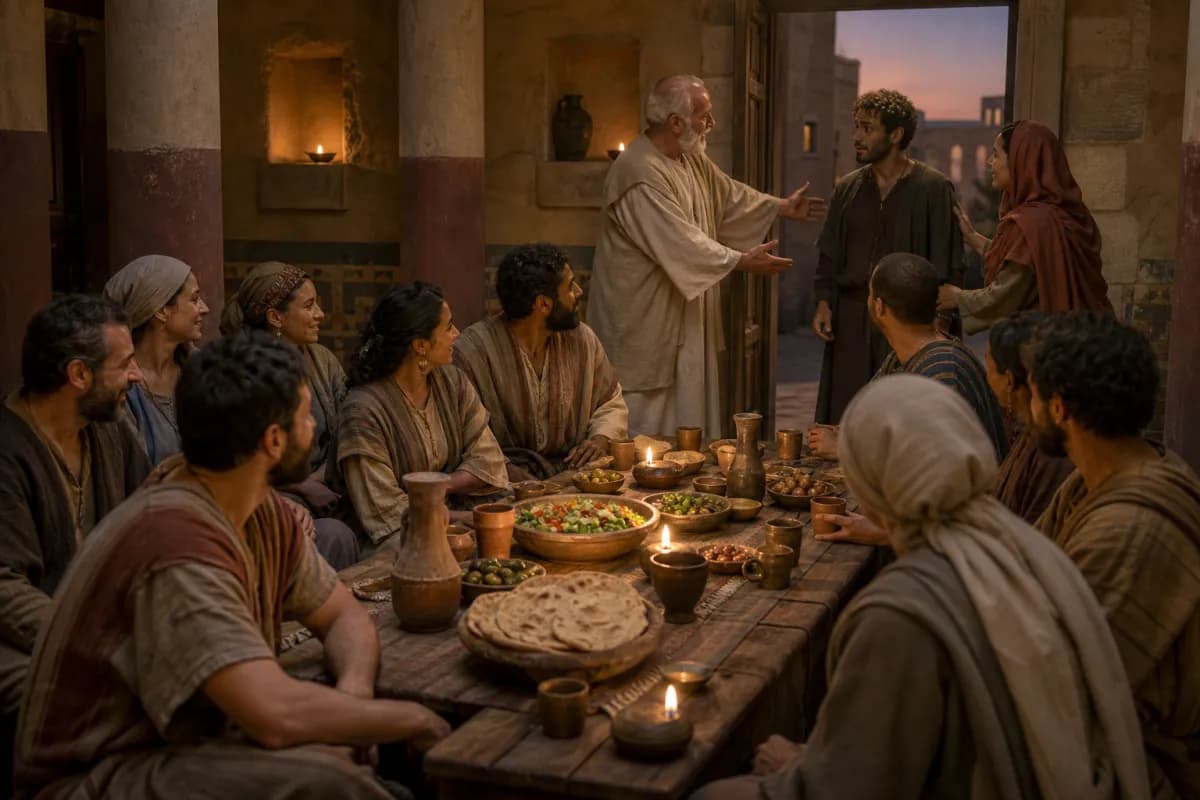
Romans 14:1–15:13 teaches a divided church how to live together when believers hold different convictions about food, days, and practices not required for salvation. The strong must not despise the weak, the weak must not judge the strong, and neither may wound a brother or sister for whom Christ died. Jesus’ self-giving welcome becomes the measure of unity as Jewish and Gentile believers glorify God with one voice.
- In this study
- 39 verses · 5 movements
Romans 14
14:1Now accept one who is weak in faith, but not for disputes over opinions.
14:2One man has faith to eat all things, but he who is weak eats only vegetables.
14:3Don’t let him who eats despise him who doesn’t eat. Don’t let him who doesn’t eat judge him who eats, for God has accepted him.
14:4Who are you who judge another’s servant? To his own lord he stands or falls. Yes, he will be made to stand, for God has power to make him stand.
14:5One man esteems one day as more important. Another esteems every day alike. Let each man be fully assured in his own mind.
14:6He who observes the day, observes it to the Lord; and he who does not observe the day, to the Lord he does not observe it. He who eats, eats to the Lord, for he gives God thanks. He who doesn’t eat, to the Lord he doesn’t eat, and gives God thanks.
14:7For none of us lives to himself, and none dies to himself.
14:8For if we live, we live to the Lord. Or if we die, we die to the Lord. If therefore we live or die, we are the Lord’s.
14:9For to this end Christ died, rose, and lived again, that he might be Lord of both the dead and the living.
14:10But you, why do you judge your brother? Or you again, why do you despise your brother? For we will all stand before the judgment seat of Christ.
14:11For it is written, “‘As I live,’ says the Lord, ‘to me every knee will bow. Every tongue will confess to God.’”
14:12So then each one of us will give account of himself to God.
14:13Therefore let’s not judge one another any more, but judge this rather, that no man put a stumbling block in his brother’s way, or an occasion for falling.
14:14I know and am persuaded in the Lord Jesus that nothing is unclean of itself; except that to him who considers anything to be unclean, to him it is unclean.
14:15Yet if because of food your brother is grieved, you walk no longer in love. Don’t destroy with your food him for whom Christ died.
14:16Then don’t let your good be slandered,
14:17for God’s Kingdom is not eating and drinking, but righteousness, peace, and joy in the Holy Spirit.
14:18For he who serves Christ in these things is acceptable to God and approved by men.
14:19So then, let’s follow after things which make for peace, and things by which we may build one another up.
14:20Don’t overthrow God’s work for food’s sake. All things indeed are clean, however it is evil for that man who creates a stumbling block by eating.
14:21It is good to not eat meat, drink wine, nor do anything by which your brother stumbles, is offended, or is made weak.
14:22Do you have faith? Have it to yourself before God. Happy is he who doesn’t judge himself in that which he approves.
14:23But he who doubts is condemned if he eats, because it isn’t of faith; and whatever is not of faith is sin.
14:24Now to him who is able to establish you according to my Good News and the preaching of Jesus Christ, according to the revelation of the mystery which has been kept secret through long ages,
14:25but now is revealed, and by the Scriptures of the prophets, according to the commandment of the eternal God, is made known for obedience of faith to all the nations;
14:26to the only wise God, through Jesus Christ, to whom be the glory forever! Amen.
Romans 15
15:1Now we who are strong ought to bear the weaknesses of the weak, and not to please ourselves.
15:2Let each one of us please his neighbor for that which is good, to be building him up.
15:3For even Christ didn’t please himself. But, as it is written, “The reproaches of those who reproached you fell on me.”
15:4For whatever things were written before were written for our learning, that through perseverance and through encouragement of the Scriptures we might have hope.
15:5Now the God of perseverance and of encouragement grant you to be of the same mind with one another according to Christ Jesus,
15:6that with one accord you may with one mouth glorify the God and Father of our Lord Jesus Christ.
15:7Therefore accept one another, even as Christ also accepted you, to the glory of God.
15:8Now I say that Christ has been made a servant of the circumcision for the truth of God, that he might confirm the promises given to the fathers,
15:9and that the Gentiles might glorify God for his mercy. As it is written, “Therefore I will give praise to you among the Gentiles and sing to your name.”
15:10Again he says, “Rejoice, you Gentiles, with his people.”
15:11Again, “Praise the Lord, all you Gentiles! Let all the peoples praise him.”
15:12Again, Isaiah says, “There will be the root of Jesse, he who arises to rule over the Gentiles; in him the Gentiles will hope.”
15:13Now may the God of hope fill you with all joy and peace in believing, that you may abound in hope in the power of the Holy Spirit.
CONTEXTUAL OVERVIEW
Romans 14 deals with real friction in the Roman churches. Some believers eat everything; others eat only vegetables. Some observe one day as special; others regard every day alike. Paul does not settle the issue by declaring every conviction equally true, nor does he allow food and calendar practices to become tests of belonging. The one who eats and the one who abstains both claim to give thanks to the Lord, so the church must learn to recognize the Lord’s ownership of each believer.
The passage’s repeated danger is relational destruction. A person may be technically free to eat, yet use that freedom in a way that grieves, stumbles, or destroys a brother or sister. Paul’s concern grows from meals to the whole church: righteousness, peace, and joy in the Holy Spirit matter more than winning a disputed practice. By 15:5–13, the issue has become united worship across Jew and Gentile in the hope supplied by Christ.
HISTORICAL AND LITERARY CONTEXT
The exact causes of the food and day disputes are not specified in Romans 14, so the text should not be made to settle every modern disagreement. The likely setting includes Jewish and Gentile Christians negotiating practices connected with Torah, marketplace food, and shared meals. Paul’s language of “clean” food and faith before God shows that conscience before the Lord matters; his refusal to make dietary freedom the final measure of maturity protects fellowship purchased by Christ.
Romans 14–15 follows the exhortations to love neighbors and precedes Paul’s missionary plans. Unity is therefore missional, not merely comfortable. A congregation that tears itself apart over meals cannot embody the good news that the crucified Messiah has welcomed diverse sinners. Paul roots their shared life in the Scriptures, citing Psalm 69, the Law, the Psalms, Isaiah, and the promise that the root of Jesse will give the nations hope.
SECTION-BY-SECTION ANALYSIS
- Romans 14:1–12 · Romans 14:9The church receives believers with disputed scruples because every servant belongs to the Lord who died and rose to rule the living and the dead.
- Romans 14:13–23 · Romans 14:15Christian freedom is governed by love that refuses to place a stumbling block before a sibling for whom Christ died.
- Romans 15:1–13 · Romans 15:9Christ’s self-giving welcome creates patient unity and fulfills the promise that Jews and Gentiles will praise God together in hope.
CHRIST IN THIS PASSAGE
Jesus is not a decorative example added after an argument about meals. Paul says Christ died and lived again to be Lord of all, so every believer’s conscience and life are accountable to Him. He also says that the person endangered by unloving conduct is one “for whom Christ died.” The cross gives the other believer a value that personal preference cannot dismiss.
Romans 15 makes Christ’s mission explicit. He became a servant to the circumcised to confirm God’s promises and so that Gentiles might glorify God for mercy. This is a strong canonical connection, not a generic appeal to diversity: Israel’s Messiah fulfills covenant promises and brings the nations into worship. His refusal to please Himself sets the pattern for the strong, whose maturity is shown by bearing burdens rather than demanding their rights.
REFLECTION
Identify a disputed practice that tempts you toward contempt or judgment—food, alcohol, entertainment, a church calendar, political custom, or a personal discipline. Romans does not ask you to abandon every conviction. It asks you to hold convictions before the Lord without recruiting them as the boundary of Christ’s welcome or using freedom to pressure another person against conscience.
Before the next shared meal, gathering, or online disagreement, ask the question Romans 14 makes unavoidable: will this action build peace and mutual upbuilding for a person Christ died to save? Ask Christ to make you strong in the way He is strong—patient, self-giving, and eager for Jews and Gentiles, the weak and the strong, to glorify God with one voice.
Original Greek Word Study
Romans 14:1
προσλαμβάνω
proslambano · G4355
Usually translated: to welcome or receive
Proslambano means to welcome or receive. Paul calls the church to receive believers with differing scruples rather than making secondary practices a test of belonging in Christ.
Follow the Scripture trail
Welcome One Another as Christ Welcomed You in the larger story
The connection: Christ died and rose as Lord of every believer, then fulfilled Israel’s promises so the nations might glorify God for mercy. His cross establishes the welcome that the church must embody: people with different histories and scruples belong together because He has received them.
Respond to the passage
Bring a disputed conviction honestly before the Lord, then examine whether you have used it to despise, judge, or pressure another Christian. For the sake of the person Christ died for, choose one act that builds peace—listen without winning, make room at your table, or refrain from a freedom that would wound another conscience.
- Why does Paul connect disagreements about food and days with Christ’s death and resurrection?
- What changes when freedom is evaluated by its effect on someone for whom Christ died?
- How does Romans 15 connect unity in the church with God’s promises to Israel and the nations?
Prayer
Lord Jesus, You welcomed me by mercy and gave Yourself for Your people. Free me from contempt and judgment, make me patient with those whose practices differ from mine, and unite Your church in the hope that brings the nations to praise God. Amen.