Passage Study
The Gospel’s Mission Creates a Family That Serves and Sends
Romans 15:14–16:27
Romans 15:14–16:27 reveals Paul’s gospel mission and the wide family formed by it. He writes as a priestly servant of Christ Jesus among the Gentiles, plans to travel through Rome toward Spain after delivering aid to Jerusalem, commends Phoebe, greets a network of co-workers, warns against divisive teachers, and ends by praising the God who strengthens His church through the revelation of Jesus Christ.
- In this study
- 45 verses · 5 movements
Romans 15
15:14I myself am also persuaded about you, my brothers, that you yourselves are full of goodness, filled with all knowledge, able also to admonish others.
15:15But I write the more boldly to you in part as reminding you, because of the grace that was given to me by God,
15:16that I should be a servant of Christ Jesus to the Gentiles, serving as a priest of the Good News of God, that the offering up of the Gentiles might be made acceptable, sanctified by the Holy Spirit.
15:17I have therefore my boasting in Christ Jesus in things pertaining to God.
15:18For I will not dare to speak of any things except those which Christ worked through me for the obedience of the Gentiles, by word and deed,
15:19in the power of signs and wonders, in the power of God’s Spirit; so that from Jerusalem and around as far as to Illyricum, I have fully preached the Good News of Christ;
15:20yes, making it my aim to preach the Good News, not where Christ was already named, that I might not build on another’s foundation.
15:21But, as it is written, “They will see, to whom no news of him came. They who haven’t heard will understand.”
15:22Therefore also I was hindered these many times from coming to you,
15:23but now, no longer having any place in these regions, and having these many years a longing to come to you,
15:24whenever I travel to Spain, I will come to you. For I hope to see you on my journey, and to be helped on my way there by you, if first I may enjoy your company for a while.
15:25But now, I say, I am going to Jerusalem, serving the saints.
15:26For it has been the good pleasure of Macedonia and Achaia to make a certain contribution for the poor among the saints who are at Jerusalem.
15:27Yes, it has been their good pleasure, and they are their debtors. For if the Gentiles have been made partakers of their spiritual things, they owe it to them also to serve them in material things.
15:28When therefore I have accomplished this, and have sealed to them this fruit, I will go on by way of you to Spain.
15:29I know that when I come to you, I will come in the fullness of the blessing of the Good News of Christ.
15:30Now I beg you, brothers, by our Lord Jesus Christ and by the love of the Spirit, that you strive together with me in your prayers to God for me,
15:31that I may be delivered from those who are disobedient in Judea, and that my service which I have for Jerusalem may be acceptable to the saints,
15:32that I may come to you in joy through the will of God, and together with you, find rest.
15:33Now the God of peace be with you all. Amen.
Romans 16
16:1I commend to you Phoebe, our sister, who is a servant of the assembly that is at Cenchreae,
16:2that you receive her in the Lord in a way worthy of the saints, and that you assist her in whatever matter she may need from you, for she herself also has been a helper of many, and of my own self.
16:3Greet Prisca and Aquila, my fellow workers in Christ Jesus,
16:4who risked their own necks for my life, to whom not only I give thanks, but also all the assemblies of the Gentiles.
16:5Greet the assembly that is in their house. Greet Epaenetus, my beloved, who is the first fruits of Achaia to Christ.
16:6Greet Mary, who labored much for us.
16:7Greet Andronicus and Junia, my relatives and my fellow prisoners, who are notable among the apostles, who were also in Christ before me.
16:8Greet Amplias, my beloved in the Lord.
16:9Greet Urbanus, our fellow worker in Christ, and Stachys, my beloved.
16:10Greet Apelles, the approved in Christ. Greet those who are of the household of Aristobulus.
16:11Greet Herodion, my kinsman. Greet them of the household of Narcissus, who are in the Lord.
16:12Greet Tryphaena and Tryphosa, who labor in the Lord. Greet Persis, the beloved, who labored much in the Lord.
16:13Greet Rufus, the chosen in the Lord, and his mother and mine.
16:14Greet Asyncritus, Phlegon, Hermes, Patrobas, Hermas, and the brothers who are with them.
16:15Greet Philologus and Julia, Nereus and his sister, and Olympas, and all the saints who are with them.
16:16Greet one another with a holy kiss. The assemblies of Christ greet you.
16:17Now I beg you, brothers, look out for those who are causing the divisions and occasions of stumbling, contrary to the doctrine which you learned, and turn away from them.
16:18For those who are such don’t serve our Lord Jesus Christ, but their own belly; and by their smooth and flattering speech they deceive the hearts of the innocent.
16:19For your obedience has become known to all. I rejoice therefore over you. But I desire to have you wise in that which is good, but innocent in that which is evil.
16:20And the God of peace will quickly crush Satan under your feet. The grace of our Lord Jesus Christ be with you.
16:21Timothy, my fellow worker, greets you, as do Lucius, Jason, and Sosipater, my relatives.
16:22I, Tertius, who write the letter, greet you in the Lord.
16:23Gaius, my host and host of the whole assembly, greets you. Erastus, the treasurer of the city, greets you, as does Quartus, the brother.
16:24The grace of our Lord Jesus Christ be with you all! Amen.
CONTEXTUAL OVERVIEW
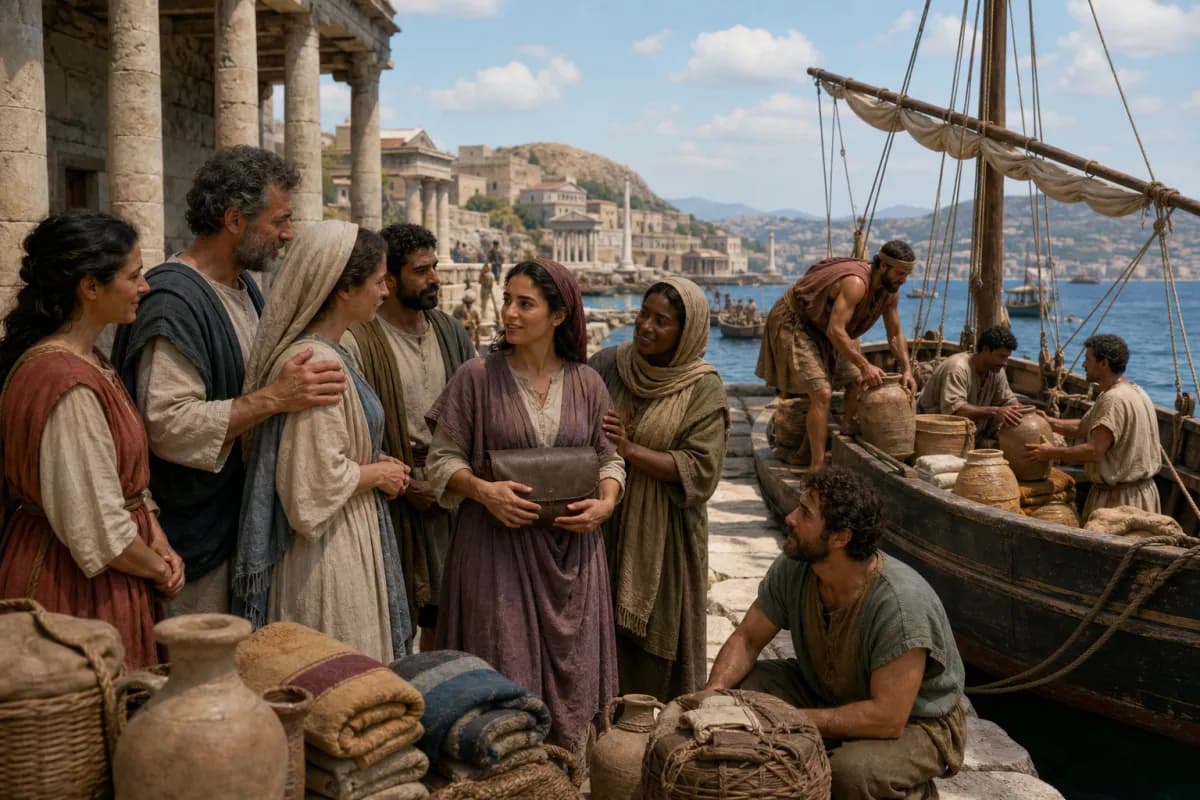
The final section of Romans does more than attach travel notes to a theological letter. It shows what the gospel Paul has explained actually creates: a mission moving from Jerusalem through the eastern Mediterranean toward Spain, a practical collection joining Gentile churches to poor believers in Jerusalem, a trusted sister carrying a letter, house churches, married couples, former prisoners, laborers, relatives, and leaders whose names deserve public honor.
Paul’s journey is constrained by unfinished work and present obligations. He has proclaimed Christ from Jerusalem around to Illyricum, hopes to visit Rome on his way to Spain, and must first take the Gentiles’ contribution to Jerusalem. His plans are bold but not self-directed. He asks the Romans to strive with him in prayer, knowing that his delivery and his future visit depend on the will of God.
HISTORICAL AND LITERARY CONTEXT
Paul calls himself a servant of Christ Jesus to the Gentiles, using priestly language for presenting the nations as an acceptable offering sanctified by the Holy Spirit. He does not claim personal achievement as the source of his work; he speaks only of what Christ has accomplished through him in word and deed. The missionary advance is therefore an extension of Christ’s reign, carried out through apostolic preaching and the Spirit’s power.
Romans 16 names people rather than treating the church as an idea. Phoebe is commended as a sister and servant of the church at Cenchreae, and Priscilla and Aquila are remembered for risking their necks for Paul. The greetings also show churches meeting in households and believers linked across social boundaries. The list does not give biographies for every name, so the passage invites honor for known labor rather than speculation about details it does not supply.
SECTION-BY-SECTION ANALYSIS
- Romans 15:14–33 · Romans 15:19Paul’s priestly Gentile mission, his Spainward hope, and the Jerusalem collection reveal a gospel that joins proclamation, partnership, and material care.
- Romans 16:1–16 · Romans 15:20Phoebe and the named believers show that the Roman churches are a concrete family of servants, hosts, co-workers, and households.
- Romans 16:17–27 · Romans 15:33The church must resist divisive teaching while trusting the God of peace to strengthen it through the gospel made known among all nations.
CHRIST IN THIS PASSAGE
Paul’s entire mission is defined by Christ Jesus. He is a servant of Christ, he speaks only of what Christ accomplished through him, and he will not build on another person’s foundation where Christ has already been named. The Gentile mission is therefore not an imperial expansion project or a personal career. It is the risen Lord gathering people who had not heard His name into holy worship through the Spirit.
The closing doxology names the saving center again: God strengthens the church through the gospel and the revelation of Jesus Christ. The mystery once hidden is now disclosed to all nations for the obedience of faith. Paul’s warning about division belongs here because false teaching can detach a church from the apostolic gospel of Christ. The God of peace will finally defeat Satan, echoing the promise that evil will not have the last word over Christ’s people.
REFLECTION
Romans 16 corrects the instinct to treat mission as the work of a few visible leaders. Paul’s gospel mission depends on a sending church, a collection, a letter carrier, open homes, co-workers who risked much, and believers whose faithful labor may be remembered only by name. Consider your own place in that family. You may preach, give, host, carry encouragement, pray, protect sound teaching, or make a missionary’s work possible through practical care.
Take Paul’s warning seriously without becoming suspicious of everyone. Measure teaching by the apostolic gospel centered on Jesus Christ, and resist people who feed ego, faction, or fascination with novelty. Ask the God of peace to strengthen your church in the obedience of faith, and make one concrete contribution to the mission of the gospel beyond your immediate circle.
Original Greek Word Study
Romans 15:16
λειτουργός
leitourgos · G3011
Usually translated: minister, servant, or public worker
Leitourgos means minister or servant. Paul describes his Gentile mission in priestly terms, showing that gospel ministry gathers the nations as an offering made holy by the Spirit.
Follow the Scripture trail
The Gospel’s Mission Creates a Family That Serves and Sends in the larger story
The connection: The risen Christ sends the gospel to peoples who have not heard His name and forms them into one serving family. Through Spirit-empowered proclamation, shared resources, faithful households, and the apostolic message, God reveals His Son to the nations and brings them into the obedience of faith.
Respond to the passage
Thank Jesus for the believers whose hidden labor made your own faith possible. Identify one practical way to participate in His mission now—support a worker, open your home, strengthen a local church, carry a need, or pray specifically for an unreached people—and test your commitments by the gospel that centers on Christ rather than personal influence.
- Why does Paul describe his Gentile ministry in priestly terms?
- What does the Jerusalem collection reveal about the relationship between Gentile and Jewish believers?
- How do Paul’s greetings reshape the way you think about mission and church service?
Prayer
God of peace, strengthen Your church through the gospel of Jesus Christ. Make me a faithful servant in Your family, guard me from divisive teaching, and use my gifts, resources, home, and prayers to make Your Son known among the nations. Amen.