Passage Study
God’s Mercy Keeps His Promise and Gathers the Nations
Romans 9:1–11:36
Romans 9–11 faces the painful question raised by widespread Jewish unbelief: has God’s word failed? Paul answers no. God’s mercy has always distinguished the children of promise from merely physical descent, Christ is the goal of the law for righteousness to everyone who believes, and Israel’s present stumbling has opened a mission to the nations without canceling God’s covenant faithfulness.
- In this study
- 90 verses · 5 movements
Romans 9
9:1I tell the truth in Christ. I am not lying, my conscience testifying with me in the Holy Spirit
9:2that I have great sorrow and unceasing pain in my heart.
9:3For I could wish that I myself were accursed from Christ for my brothers’ sake, my relatives according to the flesh
9:4who are Israelites; whose is the adoption, the glory, the covenants, the giving of the law, the service, and the promises;
9:5of whom are the fathers, and from whom is Christ as concerning the flesh, who is over all, God, blessed forever. Amen.
9:6But it is not as though the word of God has come to nothing. For they are not all Israel that are of Israel.
9:7Neither, because they are Abraham’s offspring, are they all children. But, “your offspring will be accounted as from Isaac.”
9:8That is, it is not the children of the flesh who are children of God, but the children of the promise are counted as heirs.
9:9For this is a word of promise: “At the appointed time I will come, and Sarah will have a son.”
9:10Not only so, but Rebekah also conceived by one, by our father Isaac.
9:11For being not yet born, neither having done anything good or bad, that the purpose of God according to election might stand, not of works, but of him who calls,
9:12it was said to her, “The elder will serve the younger.”
9:13Even as it is written, “Jacob I loved, but Esau I hated.”
9:14What shall we say then? Is there unrighteousness with God? May it never be!
9:15For he said to Moses, “I will have mercy on whom I have mercy, and I will have compassion on whom I have compassion.”
9:16So then it is not of him who wills, nor of him who runs, but of God who has mercy.
9:17For the Scripture says to Pharaoh, “For this very purpose I caused you to be raised up, that I might show in you my power, and that my name might be proclaimed in all the earth.”
9:18So then, he has mercy on whom he desires, and he hardens whom he desires.
9:19You will say then to me, “Why does he still find fault? For who withstands his will?”
9:20But indeed, O man, who are you to reply against God? Will the thing formed ask him who formed it, “Why did you make me like this?”
9:21Or hasn’t the potter a right over the clay, from the same lump to make one part a vessel for honor, and another for dishonor?
9:22What if God, willing to show his wrath and to make his power known, endured with much patience vessels of wrath prepared for destruction,
9:23and that he might make known the riches of his glory on vessels of mercy, which he prepared beforehand for glory—
9:24us, whom he also called, not from the Jews only, but also from the Gentiles?
9:25As he says also in Hosea, “I will call them ‘my people,’ which were not my people; and her ‘beloved,’ who was not beloved.”
9:26“It will be that in the place where it was said to them, ‘You are not my people,’ there they will be called ‘children of the living God.’”
9:27Isaiah cries concerning Israel, “If the number of the children of Israel are as the sand of the sea, it is the remnant who will be saved;
9:28for he will finish the work and cut it short in righteousness, because the Lord will make a short work upon the earth.”
9:29As Isaiah has said before, “Unless the Lord of Armies had left us a seed, we would have become like Sodom, and would have been made like Gomorrah.”
9:30What shall we say then? That the Gentiles, who didn’t follow after righteousness, attained to righteousness, even the righteousness which is of faith;
9:31but Israel, following after a law of righteousness, didn’t arrive at the law of righteousness.
9:32Why? Because they didn’t seek it by faith, but as it were by works of the law. They stumbled over the stumbling stone,
9:33even as it is written, “Behold, I lay in Zion a stumbling stone and a rock of offense; and no one who believes in him will be disappointed.”
Romans 10
10:1Brothers, my heart’s desire and my prayer to God is for Israel, that they may be saved.
10:2For I testify about them that they have a zeal for God, but not according to knowledge.
10:3For being ignorant of God’s righteousness, and seeking to establish their own righteousness, they didn’t subject themselves to the righteousness of God.
10:4For Christ is the fulfillment of the law for righteousness to everyone who believes.
10:5For Moses writes about the righteousness of the law, “The one who does them will live by them.”
10:6But the righteousness which is of faith says this, “Don’t say in your heart, ‘Who will ascend into heaven?’ (that is, to bring Christ down);
10:7or, ‘Who will descend into the abyss?’ (that is, to bring Christ up from the dead.)”
10:8But what does it say? “The word is near you, in your mouth and in your heart;” that is, the word of faith which we preach:
10:9that if you will confess with your mouth that Jesus is Lord and believe in your heart that God raised him from the dead, you will be saved.
10:10For with the heart one believes resulting in righteousness; and with the mouth confession is made resulting in salvation.
10:11For the Scripture says, “Whoever believes in him will not be disappointed.”
10:12For there is no distinction between Jew and Greek; for the same Lord is Lord of all, and is rich to all who call on him.
10:13For, “Whoever will call on the name of the Lord will be saved.”
10:14How then will they call on him in whom they have not believed? How will they believe in him whom they have not heard? How will they hear without a preacher?
10:15And how will they preach unless they are sent? As it is written: “How beautiful are the feet of those who preach the Good News of peace, who bring glad tidings of good things!”
10:16But they didn’t all listen to the glad news. For Isaiah says, “Lord, who has believed our report?”
10:17So faith comes by hearing, and hearing by the word of God.
10:18But I say, didn’t they hear? Yes, most certainly, “Their sound went out into all the earth, their words to the ends of the world.”
10:19But I ask, didn’t Israel know? First Moses says, “I will provoke you to jealousy with that which is no nation. I will make you angry with a nation void of understanding.”
10:20Isaiah is very bold and says, “I was found by those who didn’t seek me. I was revealed to those who didn’t ask for me.”
10:21But about Israel he says, “All day long I stretched out my hands to a disobedient and contrary people.”
Romans 11
11:1I ask then, did God reject his people? May it never be! For I also am an Israelite, a descendant of Abraham, of the tribe of Benjamin.
11:2God didn’t reject his people, whom he foreknew. Or don’t you know what the Scripture says about Elijah? How he pleads with God against Israel:
11:3“Lord, they have killed your prophets. They have broken down your altars. I am left alone, and they seek my life.”
11:4But how does God answer him? “I have reserved for myself seven thousand men who have not bowed the knee to Baal.”
11:5Even so too at this present time also there is a remnant according to the election of grace.
11:6And if by grace, then it is no longer of works; otherwise grace is no longer grace. But if it is of works, it is no longer grace; otherwise work is no longer work.
11:7What then? That which Israel seeks for, that he didn’t obtain, but the chosen ones obtained it, and the rest were hardened.
11:8According as it is written, “God gave them a spirit of stupor, eyes that they should not see, and ears that they should not hear, to this very day.”
11:9David says, “Let their table be made a snare, a trap, a stumbling block, and a retribution to them.
11:10Let their eyes be darkened, that they may not see. Always keep their backs bent.”
11:11I ask then, did they stumble that they might fall? May it never be! But by their fall salvation has come to the Gentiles, to provoke them to jealousy.
11:12Now if their fall is the riches of the world, and their loss the riches of the Gentiles, how much more their fullness!
11:13For I speak to you who are Gentiles. Since then as I am an apostle to Gentiles, I glorify my ministry,
11:14if by any means I may provoke to jealousy those who are my flesh, and may save some of them.
11:15For if the rejection of them is the reconciling of the world, what would their acceptance be, but life from the dead?
11:16If the first fruit is holy, so is the lump. If the root is holy, so are the branches.
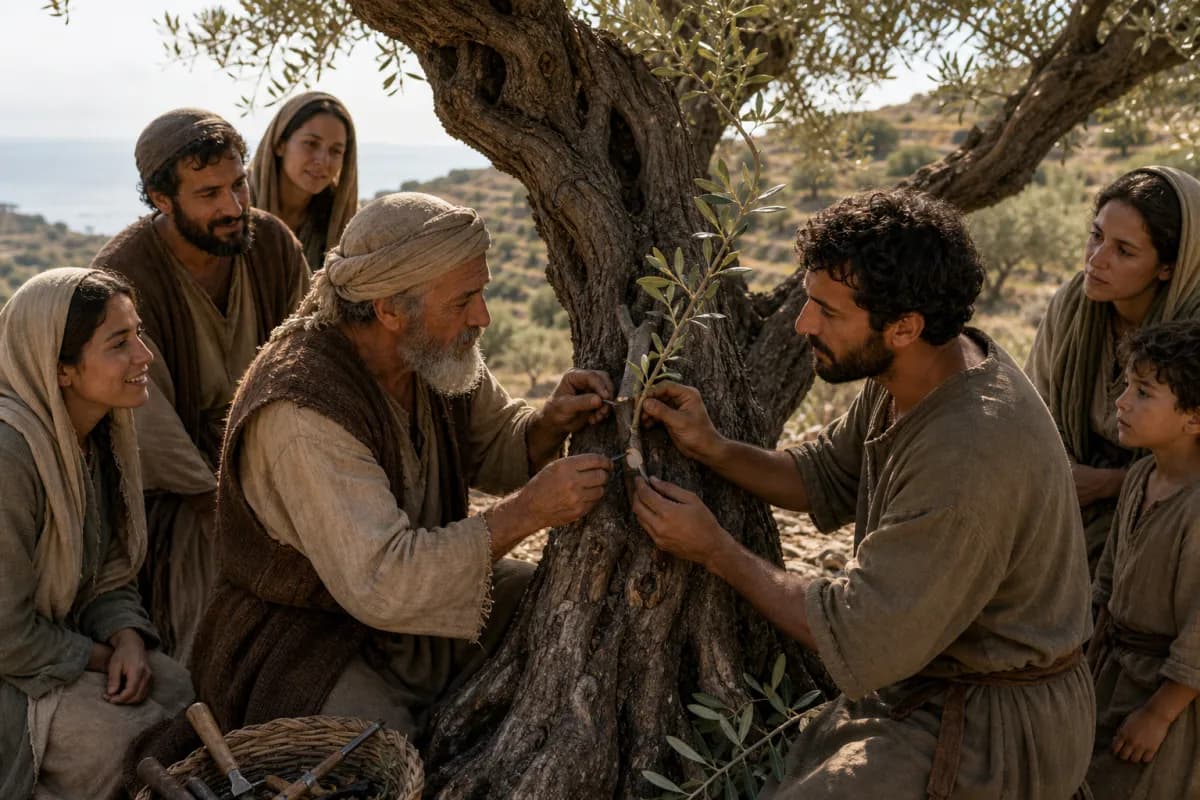
11:17But if some of the branches were broken off, and you, being a wild olive, were grafted in among them and became partaker with them of the root and of the richness of the olive tree,
11:18don’t boast over the branches. But if you boast, remember that it is not you who support the root, but the root supports you.
11:19You will say then, “Branches were broken off, that I might be grafted in.”
11:20True; by their unbelief they were broken off, and you stand by your faith. Don’t be conceited, but fear;
11:21for if God didn’t spare the natural branches, neither will he spare you.
11:22See then the goodness and severity of God. Toward those who fell, severity; but toward you, goodness, if you continue in his goodness; otherwise you also will be cut off.
11:23They also, if they don’t continue in their unbelief, will be grafted in, for God is able to graft them in again.
11:24For if you were cut out of that which is by nature a wild olive tree, and were grafted contrary to nature into a good olive tree, how much more will these, which are the natural branches, be grafted into their own olive tree?
11:25For I don’t desire you to be ignorant, brothers, of this mystery, so that you won’t be wise in your own conceits, that a partial hardening has happened to Israel, until the fullness of the Gentiles has come in,
11:26and so all Israel will be saved. Even as it is written, “There will come out of Zion the Deliverer, and he will turn away ungodliness from Jacob.
11:27This is my covenant with them, when I will take away their sins.”
11:28Concerning the Good News, they are enemies for your sake. But concerning the election, they are beloved for the fathers’ sake.
11:29For the gifts and the calling of God are irrevocable.
11:30For as you in time past were disobedient to God, but now have obtained mercy by their disobedience,
11:31even so these also have now been disobedient, that by the mercy shown to you they may also obtain mercy.
11:32For God has bound all to disobedience, that he might have mercy on all.
11:33Oh the depth of the riches both of the wisdom and the knowledge of God! How unsearchable are his judgments, and his ways past tracing out!
11:34“For who has known the mind of the Lord? Or who has been his counselor?”
11:35“Or who has first given to him, and it will be repaid to him again?”
11:36For of him and through him and to him are all things. To him be the glory for ever! Amen.
CONTEXTUAL OVERVIEW
Romans 9 begins with Paul’s unusually personal sorrow. He speaks of great anguish for his own people, Israelites who possess adoption, glory, covenants, law, worship, promises, patriarchs, and the human ancestry of the Messiah. The question is not whether Israel mattered in God’s plan. It is how the Messiah can have come from Israel while so many Israelites reject Him and so many Gentiles receive the gospel.
The argument runs through three connected movements. Romans 9 insists that God’s promise has not failed; Romans 10 identifies the tragic refusal to submit to God’s righteousness in Christ; Romans 11 warns Gentile believers not to become proud and holds out hope because God’s gifts and calling are irrevocable. Paul refuses both despair over Israel and contempt for Israel.
HISTORICAL AND LITERARY CONTEXT
Paul writes to congregations in Rome composed of Jewish and Gentile believers, after arguing in Romans 1–8 that all stand under sin and that God justifies the ungodly through faith in Christ. Chapters 9–11 therefore are not a detour. They protect the reliability of the gospel’s God: if His promises to Israel simply collapsed, readers would have reason to question every promise Paul has just celebrated.
Paul reads Israel’s Scriptures as a unified witness to God’s free mercy and to the inclusion of the nations. He cites Isaac rather than Ishmael, Jacob rather than Esau, Moses, Pharaoh, Hosea, Isaiah, Joel, and Elijah. These citations are not isolated proof texts. They explain why ethnic descent never guaranteed saving faith, why a remnant is not evidence of failure, and why Gentile faith was anticipated within Israel’s own story.
SECTION-BY-SECTION ANALYSIS
- Romans 9:1–33 · Romans 9:5God’s promise stands because His mercy creates the people of promise, while Israel’s pursuit of self-established righteousness leads many to stumble over Christ.
- Romans 10:1–21 · Romans 10:12The crucified and risen Jesus is publicly confessed as Lord, and the same saving call goes out to Jew and Gentile through gospel proclamation.
- Romans 11:1–36 · Romans 9:6Gentile inclusion must produce humility, since all depend on mercy and God has not abandoned His covenant purposes for Israel.
CHRIST IN THIS PASSAGE
Christ is the decisive issue in Israel’s stumbling and the only righteousness Paul offers. Romans 9 identifies Him as the stone laid in Zion; Romans 10 calls Him the goal of the law for righteousness to everyone who believes and requires the confession that Jesus is Lord; Romans 11 calls Gentile believers into an olive tree sustained by God’s covenant mercy. The passage therefore speaks directly of Christ’s saving mission rather than merely of an abstract doctrine of election.
Paul’s mission logic follows from Christ’s death and resurrection. The Messiah descended from Israel according to the flesh, yet His resurrection establishes the Lord whom every people must hear and call upon. The strong canonical connection is that God’s promise to bless the nations through Abraham’s family reaches its saving center in Jesus. Mercy excludes boasting: neither Jewish heritage nor Gentile inclusion gives anyone grounds to stand over another at the foot of Christ’s cross.
REFLECTION
Paul models grief without bitterness. He does not turn Israel’s unbelief into an excuse for detachment, nor does he dilute the confession that Jesus is Lord. Pray specifically for people close to you who know the language of faith but resist Christ Himself. Let Paul’s question about hearing also press you to consider whether your words and support make the gospel audible to those who have not heard it.
The olive tree gives the church a needed posture. If you stand by faith, you stand by mercy. Reject superiority toward another ethnic group, church tradition, or believer with a different history. Receive the kindness of God with awe, confess Jesus openly, and join the praise that ends the section: from Him, through Him, and to Him are all things.
Original Greek Word Study
Romans 9:16
ἔλεος
eleos · G1656
Usually translated: mercy or compassionate help
Eleos means mercy. Paul grounds God’s saving purpose in mercy rather than human willing or running, preserving both God’s freedom and the humble posture of those who receive grace.
Follow the Scripture trail
God’s Mercy Keeps His Promise and Gathers the Nations in the larger story
The connection: The God who chose Abraham’s family has not abandoned His word. In Jesus, Israel’s Messiah and the risen Lord, God reveals the righteousness received by faith, gathers Gentiles by mercy, and keeps His covenant purposes moving toward the worship of all peoples.
Respond to the passage
Bring your grief for unbelieving friends or family to God without resentment. Confess any pride that treats your background or spiritual knowledge as a claim on grace, openly trust the risen Jesus as Lord, and ask God to make you a faithful part of the chain by which another person hears the gospel.
- Why does Paul’s sorrow for Israel matter for the way he explains God’s faithfulness?
- How does Romans 10 connect the confession of Jesus as Lord with the need for preaching?
- What does the olive tree image forbid Gentile believers from doing?
Prayer
Merciful God, thank You that Your promises do not fail and that salvation rests in Your grace. Keep me humble before Jesus, Israel’s Messiah and Lord of all, and make me faithful in prayer and witness so that others may call on His name. Amen.