Passage Study
Song of Songs 3:6–5:1: A Wedding Procession and Mutual Delight
Song of Songs 3:6–5:1
Song of Songs 3:6–5:1 moves from a royal wedding procession to lavish mutual praise. Solomon’s litter and crown give public splendor to the scene; gardens, spices, and sealed springs speak of beauty, exclusivity, and welcome between the lovers. The poem celebrates embodied delight without treating either person as merchandise, and it ends by inviting joy rather than secrecy or shame.
- In this study
- 23 verses · 5 movements
Song of Solomon 3
3:6Who is this who comes up from the wilderness like pillars of smoke, perfumed with myrrh and frankincense, with all spices of the merchant?
3:7Behold, it is Solomon’s carriage! Sixty mighty men are around it, of the mighty men of Israel.
3:8They all handle the sword, and are expert in war. Every man has his sword on his thigh, because of fear in the night.
3:9King Solomon made himself a carriage of the wood of Lebanon.
3:10He made its pillars of silver, its bottom of gold, its seat of purple, the middle of it being paved with love, from the daughters of Jerusalem.
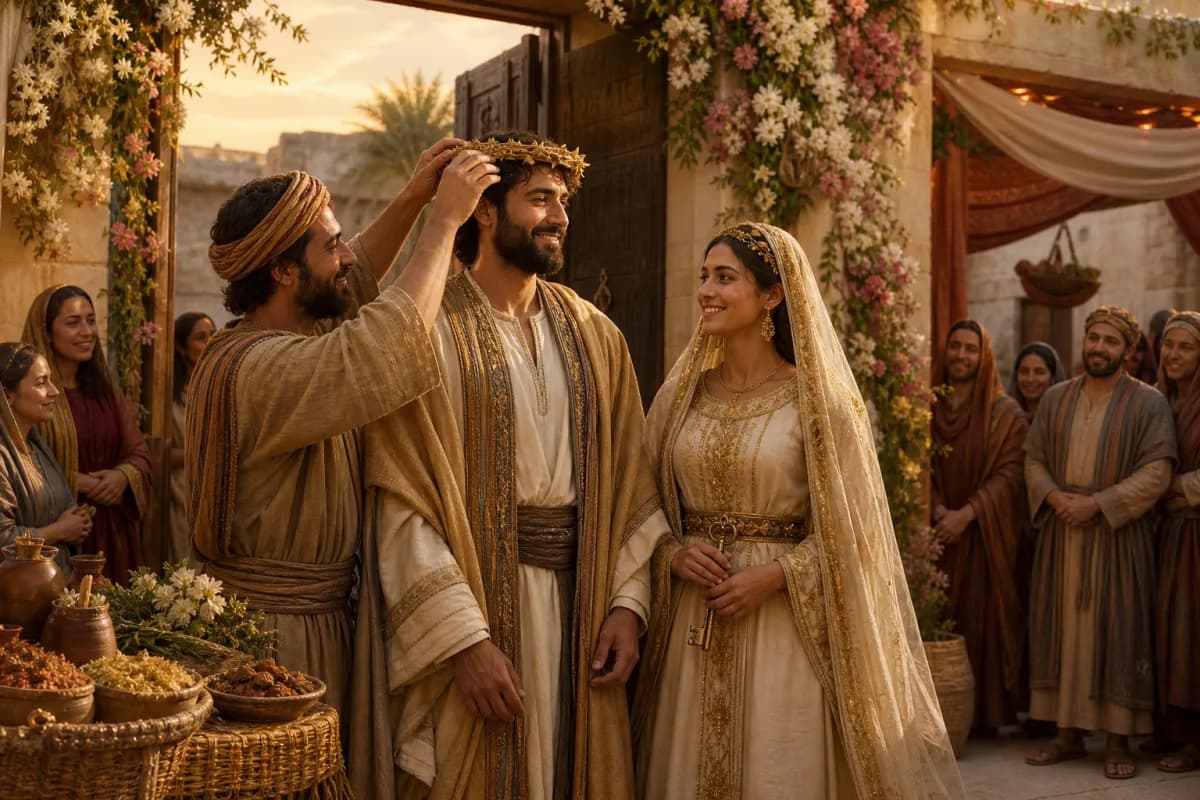
3:11Go out, you daughters of Zion, and see King Solomon, with the crown with which his mother has crowned him, in the day of his weddings, in the day of the gladness of his heart.
Song of Solomon 4
4:1Behold, you are beautiful, my love. Behold, you are beautiful. Your eyes are like doves behind your veil. Your hair is as a flock of goats, that descend from Mount Gilead.
4:2Your teeth are like a newly shorn flock, which have come up from the washing, where every one of them has twins. None is bereaved among them.
4:3Your lips are like scarlet thread. Your mouth is lovely. Your temples are like a piece of a pomegranate behind your veil.
4:4Your neck is like David’s tower built for an armory, on which a thousand shields hang, all the shields of the mighty men.
4:5Your two breasts are like two fawns that are twins of a roe, which feed among the lilies.
4:6Until the day is cool, and the shadows flee away, I will go to the mountain of myrrh, to the hill of frankincense.
4:7You are all beautiful, my love. There is no spot in you.
4:8Come with me from Lebanon, my bride, with me from Lebanon. Look from the top of Amana, from the top of Senir and Hermon, from the lions’ dens, from the mountains of the leopards.
4:9You have ravished my heart, my sister, my bride. You have ravished my heart with one of your eyes, with one chain of your neck.
4:10How beautiful is your love, my sister, my bride! How much better is your love than wine, the fragrance of your perfumes than all kinds of spices!
4:11Your lips, my bride, drip like the honeycomb. Honey and milk are under your tongue. The smell of your garments is like the smell of Lebanon.
4:12My sister, my bride, is a locked up garden; a locked up spring, a sealed fountain.
4:13Your shoots are an orchard of pomegranates, with precious fruits, henna with spikenard plants,
4:14spikenard and saffron, calamus and cinnamon, with every kind of incense tree; myrrh and aloes, with all the best spices,
4:15a fountain of gardens, a well of living waters, flowing streams from Lebanon. Beloved
4:16Awake, north wind, and come, you south! Blow on my garden, that its spices may flow out. Let my beloved come into his garden, and taste his precious fruits.
Song of Solomon 5
5:1I have come into my garden, my sister, my bride. I have gathered my myrrh with my spice; I have eaten my honeycomb with my honey; I have drunk my wine with my milk. Friends Eat, friends! Drink, yes, drink abundantly, beloved. Beloved
CONTEXTUAL OVERVIEW
The third section opens with public movement: a column of smoke rises from the wilderness, fragrant with myrrh and frankincense, and Solomon’s litter is surrounded by armed men. The image changes from private nighttime longing to a guarded royal procession. The next lines make the occasion explicit by naming the day of Solomon’s wedding and the day of his heart’s gladness.
From 4:1 onward, the lovers exchange extended praise. The man speaks of the woman’s eyes, hair, teeth, lips, temples, neck, breasts, and whole beauty; she is not silent, for in 4:16 she calls the north and south winds to awaken her garden and invites her beloved to enter. The poem’s mutual speech matters. Its metaphors can sound unfamiliar to modern ears, but they function as praise within a relationship marked by delight and welcome.
HISTORICAL AND LITERARY CONTEXT
The wedding language in 3:11 provides a clear literary setting for this central movement, though the Song does not supply enough details to settle every question about its speakers or historical occasion. Royal images—Solomon, cedar, silver, gold, purple, and warriors—raise the scene’s grandeur. Pastoral and garden imagery then gives that grandeur a personal focus: the beloved is praised not as an object of political display but as a person whose beauty evokes affection.
The garden and spring imagery of 4:12–15 conveys enclosure, freshness, and preciousness. It has often been read as a statement about sexual exclusivity and marital intimacy; that reading fits the wedding setting and the woman’s invitation in 4:16. The text does not license possessiveness or reduce the woman to a man’s property. Her own invitation and her description of the beloved in the following section keep mutuality in view.
SECTION-BY-SECTION ANALYSIS
- 3:6–3:11 · Song of Solomon 3:11Fragrance, warriors, royal craft, and the crown frame a wedding day as public gladness.
- 4:1–4:11 · Song of Solomon 3:8The man’s many metaphors form an extended act of personal praise, culminating in the woman’s whole beauty.
- 4:12–5:1 · Song of Solomon 4:12Locked garden and flowing fragrance lead to the woman’s invitation and the lovers’ shared, welcomed delight.
CHRIST IN THIS PASSAGE
This wedding-poem section should first be read as a celebration of human love under God’s good creation. It does not say that Solomon is Christ or that every garden image represents the church. The canonical connection to Jesus is therefore thematic: Scripture uses faithful marriage to testify to the covenant faithfulness that Christ displays when He gives Himself for His people, and this passage treats marital delight as honorable rather than as a rival to holiness.
Jesus gives Himself for the church to make her holy, not to possess or exploit her. His cross exposes every counterfeit of love that turns beauty into consumption, power, or pride. In the new creation the Lamb’s marriage supper will complete the Bible’s marriage imagery, but that final hope deepens rather than erases the Song’s witness that faithful human love is a gift to receive with gratitude.
REFLECTION
This passage asks whether the way you speak about another person protects their dignity. Praise that is truthful and attentive differs from flattery, comparison, and the casual objectification common in public and private speech. Married couples can learn from the lovers’ specificity: notice a spouse’s character, labor, speech, and presence. Other readers can honor the same good by refusing speech that turns bodies into commodities.
Bring your own history of shame, coercion, betrayal, or disappointment to Christ without using the Song to minimize those wounds. The poem celebrates welcome and mutuality; it does not baptize abuse. Jesus is gentle with the wounded and truthful about sin, and His saving love gives courage to pursue repentance, wise protection, and restored faithfulness where possible.
Original Hebrew Word Study
Song of Solomon 4:1
יָפָה
yaphah · H3302
Usually translated: beautiful or lovely
Yaphah expresses beauty and delight. The lovers’ praise honors embodied covenant love without reducing either person to a possession.
Follow the Scripture trail
Song of Songs 3:6–5:1: A Wedding Procession and Mutual Delight in the larger story
The connection: This wedding poem honors joy, mutual praise, exclusivity, and welcomed intimacy as gifts of the Creator. The passage is not an allegory of Christ, yet its marriage setting belongs to the larger biblical pattern in which Jesus’ self-giving love becomes the true measure and final hope of faithful covenant love.
Respond to the passage
Examine one way your speech, imagination, or habits have treated another person as an image to consume rather than a neighbor to honor. Receive Christ’s forgiveness and choose one concrete practice of faithful, dignifying love or protection.
- How does the wedding procession change the way the following garden imagery should be read?
- What makes the lovers’ praise different from speech that objectifies another person?
- Why does Christ’s self-giving love correct both shame about the body and misuse of the body?
Prayer
Lord Jesus, Your love is holy, self-giving, and true. Forgive every way I have used another person for my own desire, heal what shame and sin have wounded, and teach me to honor Your good gifts with faithfulness. Amen.