Passage Study
Song of Songs 5:2–8:14: Love’s Pursuit, Jealousy, and Unquenchable Strength
Song of Songs 5:2–8:14
Song of Songs 5:2–8:14 follows a painful missed meeting, a search through the city, renewed praise of the beloved, and a final meditation on love that is strong as death. Watchmen wound the woman, friends ask what makes her beloved distinctive, and the lovers affirm mutual belonging. The closing seal, flame, waters, and vineyard teach that faithful love cannot be purchased or casually extinguished.
- In this study
- 55 verses · 5 movements
Song of Solomon 5
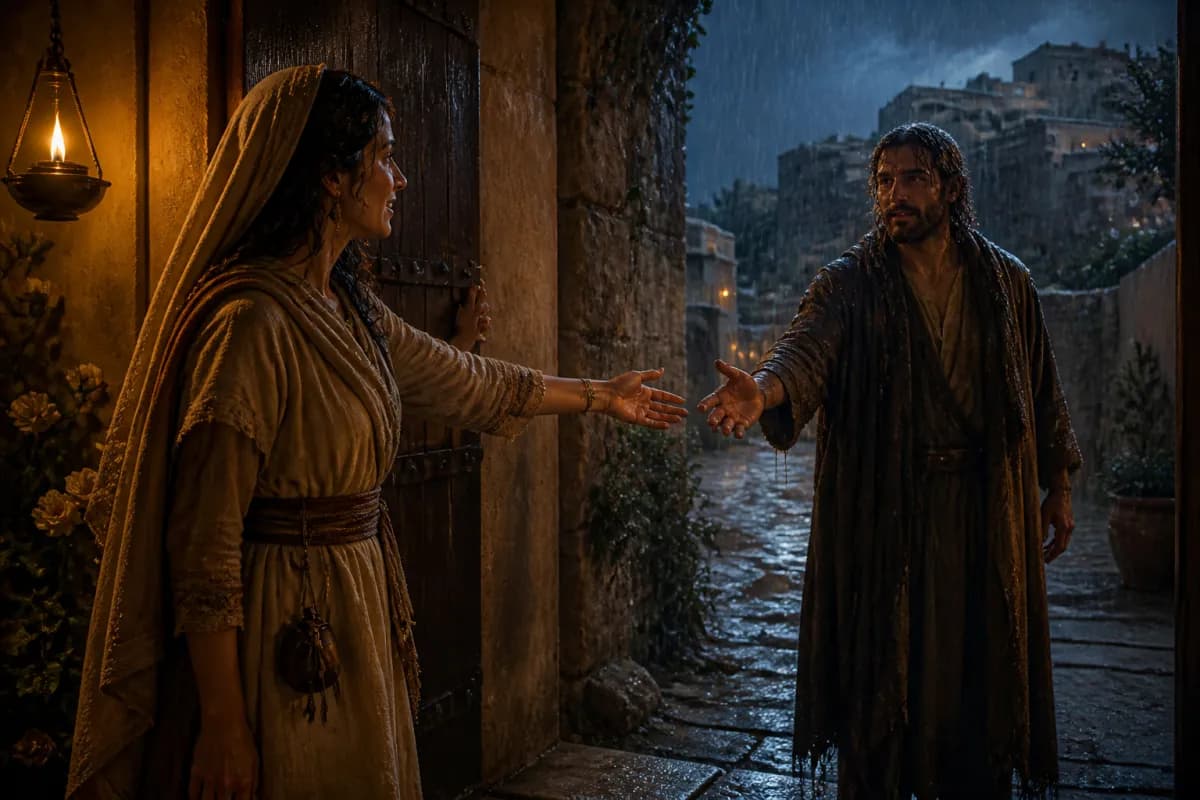
5:2I was asleep, but my heart was awake. It is the voice of my beloved who knocks: “Open to me, my sister, my love, my dove, my undefiled; for my head is filled with dew, and my hair with the dampness of the night.”
5:3I have taken off my robe. Indeed, must I put it on? I have washed my feet. Indeed, must I soil them?
5:4My beloved thrust his hand in through the latch opening. My heart pounded for him.
5:5I rose up to open for my beloved. My hands dripped with myrrh, my fingers with liquid myrrh, on the handles of the lock.
5:6I opened to my beloved; but my beloved left, and had gone away. My heart went out when he spoke. I looked for him, but I didn’t find him. I called him, but he didn’t answer.
5:7The watchmen who go about the city found me. They beat me. They bruised me. The keepers of the walls took my cloak away from me.
5:8I adjure you, daughters of Jerusalem, If you find my beloved, that you tell him that I am faint with love. Friends
5:9How is your beloved better than another beloved, you fairest among women? How is your beloved better than another beloved, that you do so adjure us? Beloved
5:10My beloved is white and ruddy. The best among ten thousand.
5:11His head is like the purest gold. His hair is bushy, black as a raven.
5:12His eyes are like doves beside the water brooks, washed with milk, mounted like jewels.
5:13His cheeks are like a bed of spices with towers of perfumes. His lips are like lilies, dropping liquid myrrh.
5:14His hands are like rings of gold set with beryl. His body is like ivory work overlaid with sapphires.
5:15His legs are like pillars of marble set on sockets of fine gold. His appearance is like Lebanon, excellent as the cedars.
5:16His mouth is sweetness; yes, he is altogether lovely. This is my beloved, and this is my friend, daughters of Jerusalem.
Song of Solomon 6
6:1Where has your beloved gone, you fairest among women? Where has your beloved turned, that we may seek him with you? Beloved
6:2My beloved has gone down to his garden, to the beds of spices, to pasture his flock in the gardens, and to gather lilies.
6:3I am my beloved’s, and my beloved is mine. He browses among the lilies. Lover
6:4You are beautiful, my love, as Tirzah, lovely as Jerusalem, awesome as an army with banners.
6:5Turn away your eyes from me, for they have overcome me. Your hair is like a flock of goats, that lie along the side of Gilead.
6:6Your teeth are like a flock of ewes, which have come up from the washing, of which every one has twins; not one is bereaved among them.
6:7Your temples are like a piece of a pomegranate behind your veil.
6:8There are sixty queens, eighty concubines, and virgins without number.
6:9My dove, my perfect one, is unique. She is her mother’s only daughter. She is the favorite one of her who bore her. The daughters saw her, and called her blessed. The queens and the concubines saw her, and they praised her.
6:10Who is she who looks out as the morning, beautiful as the moon, clear as the sun, and awesome as an army with banners?
6:11I went down into the nut tree grove, to see the green plants of the valley, to see whether the vine budded, and the pomegranates were in flower.
6:12Without realizing it, my desire set me with my royal people’s chariots. Friends
6:13Return, return, Shulammite! Return, return, that we may gaze at you. Lover Why do you desire to gaze at the Shulammite, as at the dance of Mahanaim?
Song of Solomon 7
7:1How beautiful are your feet in sandals, prince’s daughter! Your rounded thighs are like jewels, the work of the hands of a skillful workman.
7:2Your body is like a round goblet, no mixed wine is wanting. Your waist is like a heap of wheat, set about with lilies.
7:3Your two breasts are like two fawns, that are twins of a roe.
7:4Your neck is like an ivory tower. Your eyes are like the pools in Heshbon by the gate of Bathrabbim. Your nose is like the tower of Lebanon which looks toward Damascus.
7:5Your head on you is like Carmel. The hair of your head like purple. The king is held captive in its tresses.
7:6How beautiful and how pleasant you are, love, for delights!
7:7This, your stature, is like a palm tree, your breasts like its fruit.
7:8I said, “I will climb up into the palm tree. I will take hold of its fruit.” Let your breasts be like clusters of the vine, the smell of your breath like apples.
7:9Your mouth is like the best wine, that goes down smoothly for my beloved, gliding through the lips of those who are asleep. Beloved
7:10I am my beloved’s. His desire is toward me.
7:11Come, my beloved! Let’s go out into the field. Let’s lodge in the villages.
7:12Let’s go early up to the vineyards. Let’s see whether the vine has budded, its blossom is open, and the pomegranates are in flower. There I will give you my love.
7:13The mandrakes produce fragrance. At our doors are all kinds of precious fruits, new and old, which I have stored up for you, my beloved.
Song of Solomon 8
8:1Oh that you were like my brother, who nursed from the breasts of my mother! If I found you outside, I would kiss you; yes, and no one would despise me.
8:2I would lead you, bringing you into the house of my mother, who would instruct me. I would have you drink spiced wine, of the juice of my pomegranate.
8:3His left hand would be under my head. His right hand would embrace me.
8:4I adjure you, daughters of Jerusalem, that you not stir up, nor awaken love, until it so desires. Friends
8:5Who is this who comes up from the wilderness, leaning on her beloved? Beloved Under the apple tree I awakened you. There your mother conceived you. There she was in labor and bore you.
8:6Set me as a seal on your heart, as a seal on your arm; for love is strong as death. Jealousy is as cruel as Sheol. Its flashes are flashes of fire, a very flame of the LORD.
8:7Many waters can’t quench love, neither can floods drown it. If a man would give all the wealth of his house for love, he would be utterly scorned. Brothers
8:8We have a little sister. She has no breasts. What shall we do for our sister in the day when she is to be spoken for?
8:9If she is a wall, we will build on her a turret of silver. If she is a door, we will enclose her with boards of cedar. Beloved
8:10I am a wall, and my breasts like towers, then I was in his eyes like one who found peace.
8:11Solomon had a vineyard at Baal Hamon. He leased out the vineyard to keepers. Each was to bring a thousand shekels of silver for its fruit.
8:12My own vineyard is before me. The thousand are for you, Solomon, two hundred for those who tend its fruit. Lover
8:13You who dwell in the gardens, with friends in attendance, let me hear your voice! Beloved
8:14Come away, my beloved! Be like a gazelle or a young stag on the mountains of spices!
CONTEXTUAL OVERVIEW
The final large movement begins with a disturbance rather than a celebration. The woman is asleep but her heart is awake when the beloved knocks, wet with night dew. She hesitates after removing her garment and washing her feet; by the time she opens the door, he has turned away. Her hands drip with myrrh on the bolt, making the missed meeting feel tactile and costly.
The later scenes do not pretend that love is effortless. The city watchmen find the woman, strike and wound her, and take her mantle. Whether this is a dreamlike sequence or poetic dramatization, the text presents real vulnerability and loss. Yet the woman continues to seek, asks the daughters of Jerusalem to tell the beloved she is faint with love, and answers their question with a sustained account of why he is distinguished among thousands.
HISTORICAL AND LITERARY CONTEXT
Like the earlier city search in 3:1–5, this section uses shifting scenes, repeated language, and responsive voices. The watchmen’s violence sharply distinguishes this episode from the earlier search, so readers should not flatten the two into the same moment. The Song does not explain why the woman delayed or why the watchmen attacked; it lets the pain of failed meeting and public exposure stand without offering a simple moral formula.
The closing lines in 8:6–7 are the Song’s clearest reflection on love itself. A seal on heart and arm suggests enduring public and personal attachment. Love is called strong as death and jealousy fierce as the grave; its flashes are described as a blazing flame. The comparison does not make death good or jealousy automatically virtuous. It insists that exclusive love has a force money and floodwaters cannot simply command or erase.
SECTION-BY-SECTION ANALYSIS
- 5:2–5:8 · Song of Solomon 5:4A delayed opening leads to withdrawal, a dangerous city search, and the woman’s appeal for help finding the beloved.
- 5:9–6:13 · Song of Solomon 5:2The woman’s detailed praise explains the beloved’s singular worth and leads to a renewed confession of mutual belonging.
- 7:1–8:14 · Song of Solomon 8:6Praise, family concern, vineyards, seal, flame, and waters culminate in love that cannot be purchased or quenched.
CHRIST IN THIS PASSAGE
This closing poem is not a predictive account of Jesus’ suffering, and the woman’s wounded search should not be forced into an allegory of the church. Its sure Christ connection is thematic: the passage acknowledges that love in a fallen world knows delay, vulnerability, misunderstanding, and threats that wealth cannot solve. Jesus enters that fallen world and bears rejection, violence, and death to reconcile sinners to God.
The Song’s picture of love that cannot be bought or drowned finds a final canonical echo in Christ’s costly, unpurchasable love. He gives Himself for His people and nothing in all creation can separate them from His love. This does not turn every line into a symbol; it lets the poem’s strongest claim about enduring love point readers toward the greater faithfulness displayed at the cross and completed in the Lamb’s wedding feast.
REFLECTION
Do not use the woman’s delay or the watchmen’s violence to blame a wounded person or excuse violence in a relationship. The passage gives language for the ache of missed connection, vulnerability, and longing that has not been neatly resolved. Bring those realities to Jesus, who knows betrayal and suffering, and seek wise help where harm, coercion, or danger is present.
The seal and waters also ask what you believe can secure love. Money, appearance, access, surveillance, emotional intensity, and promises made under pressure cannot purchase it. Receive Christ’s steadfast love as the source of your security, then practice faithful love by keeping truth, protecting the vulnerable, repenting quickly, and refusing to make another person carry the weight only the Savior can bear.
Original Hebrew Word Study
Song of Solomon 8:6
עַז
az · H5794
Usually translated: strong, fierce, or mighty
Az means strong and fierce. Love is described as strong as death, a covenant bond that cannot be bought or extinguished by overwhelming waters.
Follow the Scripture trail
Song of Songs 5:2–8:14: Love’s Pursuit, Jealousy, and Unquenchable Strength in the larger story
The connection: This closing poem names the fragility and tenacity of faithful love in a world where people are wounded and death remains powerful. Christ’s death and resurrection reveal a love that sin cannot purchase, suffering cannot extinguish, and death cannot finally defeat; the Lamb’s final union with His people is the Bible’s ultimate marriage hope.
Respond to the passage
Tell Jesus where relational pain, fear, or a desire to control is shaping your choices. If you have wounded someone, begin a truthful act of repentance; if you are being harmed, seek wise protection and help. Let Christ’s steadfast love free you from asking a human relationship to save you.
- What makes the missed meeting in 5:2–8 painful without making the passage a simple lesson about blame?
- Why does the woman’s praise of the beloved matter after her experience with the watchmen?
- How do the seal, fire, waters, and money in 8:6–7 sharpen the Song’s vision of faithful love?
Prayer
Lord Jesus, You have loved Your people at the cost of Your own life. Meet me in the wounds and fears I carry, protect those in danger, forgive the harm I have done, and teach me a faithful love that rests first in Your unquenchable grace. Amen.